
AERO-350 · Lesson 5 of 12 · 25 min
Environmental control and pressurization
At the Swift 900 study's cruise altitude of 12 500 m the outside air pressure is about 18 kPa, less than a fifth of sea-level pressure, and the temperature is around −56 °C. A person exposed to that air would lose useful consciousness within seconds. The environmental control system, or ECS, keeps the cabin habitable: it supplies fresh air, keeps the cabin pressure at a comfortable equivalent altitude, controls temperature and humidity, and cools the avionics. It is one of the largest consumers of engine power on a jet aircraft. This lesson works through the Swift 900 study's pressurization and air supply, and then the much simpler unpressurized cabin of the Tern Block 2.
Why pressurize
The body depends on the partial pressure of oxygen in the lungs. Healthy people tolerate cabin altitudes up to about 2400 m with only a modest drop in blood oxygen saturation, which is why airworthiness rules for transport aircraft set a maximum cabin pressure altitude of 8000 ft under normal operating conditions. Above about 3000 m judgement and night vision begin to suffer, and above 4500 m many people become impaired. The time of useful consciousness, the time a person can act sensibly after losing pressurization, falls from minutes at 7500 m to well under a minute at 12 000 m, which is why the crew of a high-flying jet must don quick-donning oxygen masks within seconds after a rapid decompression.
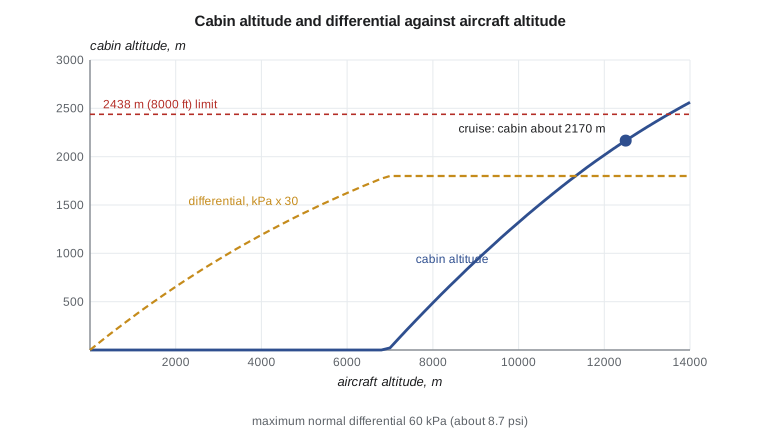
Pressurization is not free. The fuselage becomes a pressure vessel that must carry the pressure differential, the difference between cabin and outside pressure, on every flight. Structures courses covered the hoop and longitudinal stresses this creates and the fatigue design it demands; the Swift 900 study's fuselage analysis in AERO-310 was based on a maximum normal differential of about 60 kPa . The higher the differential, the lower the cabin altitude can be kept at a given flight altitude, and the heavier the structure.
Pressure control
A pressurized cabin is not sealed. Air is pumped in continuously and allowed to leak out through one or more outflow valves, motorised valves in the aft fuselage whose opening sets the cabin pressure. A cabin pressure controller schedules the cabin altitude as a function of the aircraft's altitude, rate of climb and the landing field elevation entered by the crew, and moves the outflow valve to follow the schedule. Positive pressure relief valves open if the differential exceeds its structural limit; negative pressure relief valves open if the outside pressure ever exceeds cabin pressure, for example in a fast descent with the outflow valve shut, since a fuselage is much weaker in reverse.
# Swift 900 study pressurization: cabin altitude schedule, pressure differential, cabin climb rate,
# and the power an electric cabin air compressor would need compared with engine bleed air.
import math
def isa_p(h):                                 # pressure in Pa at geopotential altitude h (m), up to 20 km
    if h <= 11000: return 101325 * (1 - 2.25577e-5 * h) ** 5.25588
    return 22632 * math.exp(-(h - 11000) / 6341.6)
def isa_alt(p):                               # inverse, troposphere only
    return (1 - (p / 101325) ** (1 / 5.25588)) / 2.25577e-5
dp_max = 60.0e3                               # maximum normal differential, Pa (about 8.7 psi)
print(" aircraft alt m   outside kPa   cabin kPa   cabin alt m   differential kPa")
for h in (0, 3000, 6000, 9000, 11000, 12500, 13700):
    po = isa_p(h)
    pc = max(po, min(101325.0, po + dp_max))
    pc = max(pc, isa_p(2438.0)) if h >= 12500 else pc       # never above 2438 m (8000 ft) cabin
    print(f"{h:15d} {po/1000:12.1f} {pc/1000:11.1f} {isa_alt(pc):12.0f} {(pc-po)/1000:16.1f}")
# Cabin climb rate on a 20 minute climb to 12 500 m
hc_top = isa_alt(isa_p(12500) + dp_max)
print(f"\ncabin altitude at 12 500 m with 60 kPa differential: {hc_top:.0f} m")
print(f"cabin climb rate over a 20 min climb: {hc_top/20/60:.2f} m/s ({hc_top/20*3.281:.0f} ft/min)")
# Air supply: at least 0.25 kg/min of outside air per occupant (about 0.55 lb/min)
occ = 12
m_air = occ * 0.25 / 60 * 1.6                 # kg/s; 60 percent margin for leakage and recirculation balance
T1, p1, p2, eta = 216.65, isa_p(12500), isa_p(hc_top) * 1.15, 0.75
T2s = T1 * (p2 / p1) ** (0.4 / 1.4)
P = m_air * 1005 * (T2s - T1) / eta
print(f"\nfresh air {m_air:.3f} kg/s for {occ} occupants")
print(f"electric compressor: pressure ratio {p2/p1:.2f}, about {P/1000:.1f} kW of shaft power")
# Bleed air from the engine compressor, taken at about 450 kPa and throttled: equivalent shaft power
T_bl = 480.0
P_bleed = m_air * 1005 * (T_bl - T1)          # enthalpy the engine put into that air
print(f"engine bleed air of the same flow carries about {P_bleed/1000:.1f} kW of compressor work, "
f"most of it thrown away in the pre-cooler") aircraft alt m outside kPa cabin kPa cabin alt m differential kPa
0 101.3 101.3 0 0.0
3000 70.1 101.3 0 31.2
6000 47.2 101.3 0 54.1
9000 30.7 90.7 921 60.0
11000 22.6 82.6 1687 60.0
12500 17.9 77.9 2167 60.0
13700 14.8 75.3 2438 60.5
cabin altitude at 12 500 m with 60 kPa differential: 2167 m
cabin climb rate over a 20 min climb: 1.81 m/s (355 ft/min)
fresh air 0.080 kg/s for 12 occupants
electric compressor: pressure ratio 5.01, about 13.6 kW of shaft power
engine bleed air of the same flow carries about 21.2 kW of compressor work, most of it thrown away in the pre-coolerThe schedule keeps the cabin at sea-level pressure while the differential is below its limit, up to about 6000 m. From there the differential is held at 60 kPa and the cabin altitude rises with the aircraft's: about 920 m at 9000 m, about 2170 m at the 12 500 m cruise and the 2438 m limit at about 13 700 m, which sets the study's maximum certified altitude for normal operation. On a 20 minute climb the cabin altitude rises at about 1.8 m/s , comfortably below the usual comfort limit of about 2.5 m/s on the way up and the more demanding limit of about 1.5 m/s on the way down, where ears are more sensitive.
Air supply
The cabin needs fresh outside air to dilute carbon dioxide and odours and to replace the air that leaks out. Transport category rules require at least about 0.25 kg of outside air per occupant per minute in normal operation, and most aircraft supply considerably more, recirculating part of the cabin air through high-efficiency filters to cut the engine power needed. The Swift 900 study's air supply for twelve occupants, with margin for leakage, is about 0.08 kg/s.
That air has to be compressed from the outside pressure of 18 kPa to slightly above the cabin's 78 kPa, a pressure ratio of about 5. Traditionally it is bled from the engines' compressors: high-pressure air is tapped from one or two stages, cooled in a pre-cooler with fan air, and then conditioned. Bleed air is simple and reliable but wasteful. The engine compressed the air to a higher pressure and temperature than the cabin needs, and the excess is thrown away in the pre-cooler and pressure-regulating valves. The program estimates that the same 0.08 kg/s of bleed air carries about 21 kW of compressor work, while an electric cabin compressor doing only the job needed would take about 14 kW of shaft power.
Several recent airliners use bleedless architectures, with electrically driven cabin compressors; the engines then deliver all their power as shaft power to generators. The trade is a much larger electrical system and heavier compressors and motors, against fuel savings and simpler engines. For a business jet the choice is closer, and Élise Fournier's team carried both options in the Swift 900 study. Dr. Teresa Nakamura's propulsion group prefers bleedless for engine efficiency; the electrical team points out that 14 kW of compressors on a 28 V system needs 500 A, which pushes the design toward a higher-voltage bus. The study recommends conventional bleed for the first version and a review when a higher-voltage electrical system is considered.
Conditioning the air
Air from the bleed or compressor is far too hot, often 200 °C or more, and in hot weather the cabin also needs cooling. The heart of a conventional ECS is the air cycle machine, also called the pack. Hot air passes through a heat exchanger cooled by ram air, then through a compressor, a second heat exchanger and a turbine. Expansion through the turbine cools the air well below the outside temperature, and the turbine's work drives the compressor and a fan. A water separator removes condensed moisture before the air enters the cabin, and a mix manifold blends conditioned air with recirculated cabin air. Hot trim air is added to each zone to set its temperature.
Cabin air is very dry at cruise, often below 10 percent relative humidity, because cold outside air holds little water. Some long-range aircraft add humidifiers, but humidity in the cabin can condense on the cold fuselage skin and corrode it or soak insulation, so most aircraft accept dry air. Ozone at high altitude is another concern on polar and high-latitude routes; catalytic ozone converters in the supply air break it down.
| Function | Swift 900 study | Tern Block 2 |
|---|---|---|
| Pressurization | Yes, 60 kPa maximum differential, cabin 2170 m at cruise | No, unpressurized, cruise 3000 m |
| Air source | Engine bleed with pre-cooler; bleedless studied | Ram air and electric fans |
| Cooling | Air cycle machine and ram air heat exchangers | Electric vapour cycle unit for avionics and cabin |
| Heating | Hot trim air | Electric heaters and waste heat from the propulsion cooling loop |
| Oxygen | Crew quick-donning masks and passenger drop-down masks | Portable oxygen for flights above 3000 m |
The Tern's cabin
The Tern cruises at about 3000 m and is not pressurized. Its cabin needs ventilation, heating and cooling, and its avionics and propulsion electronics need cooling. Here the hybrid system helps: the propulsion cooling loop of Lesson 2 removes about 81 kW of waste heat at cruise, far more than the cabin needs, and a heat exchanger in that loop warms the cabin in winter. In summer, an electric vapour cycle unit, essentially an aircraft air conditioner, cools the cabin and the avionics bay. Operating rules require supplemental oxygen for the crew on longer flights above about 3000 m and for occupants above higher altitudes, so the Tern's flight planning normally keeps it at or below that level.
Failures and emergencies
Loss of pressurization at altitude is a hazardous failure condition. The design prevents it with dual pressure controllers, two independent air sources and outflow valves that fail safe, and it protects against it with oxygen systems and the crew's procedures. In a rapid decompression, the cabin altitude warning alerts the crew, oxygen masks deploy automatically for passengers above about 4300 m cabin altitude, and the crew begins an emergency descent to below 3000 m. Passenger oxygen is usually supplied by chemical generators, which produce oxygen for about 12 to 15 minutes; the descent profile is designed around that time.
Smoke in the cabin is another ECS-related emergency. The system can be reconfigured to ventilate the cabin with maximum fresh air, and the crew has smoke procedures that start with identifying and isolating the source. Avionics bays are ventilated with dedicated fans, and smoke detectors in cargo and avionics compartments alert the crew. These procedures, like the decompression procedures, are tested in flight test.
Worked problem
Differential pressure
An aircraft flies at 11 000 m, where the outside pressure is 22.6 kPa, with a cabin altitude of 1800 m, where pressure is 81.5 kPa. Find the differential in kPa and psi.
Show solution
- \(\Delta p = 81.5 - 22.6 = 58.9\) kPa.
- In psi: \(58.9/6.895 = 8.5\) psi.
Answer: About 59 kPa or 8.5 psi.
Worked problem
Fresh air supply
A cabin carries 9 occupants. What is the minimum outside air supply at 0.25 kg per occupant per minute, in kg/s?
Show solution
- \(9 \times 0.25 = 2.25\) kg/min \(= 0.0375\) kg/s.
Answer: About 0.038 kg/s before margins for leakage.
Worked problem
Compressor temperature rise
Air at 217 K is compressed isentropically through a pressure ratio of 4.5. Find its temperature and the real temperature with a compressor efficiency of 0.75.
Show solution
- \(T_{2s} = 217 \times 4.5^{0.2857} = 217 \times 1.537 = 334\) K.
- Real: \(T_2 = 217 + (334 - 217)/0.75 = 373\) K.
Answer: Isentropic 334 K, real 373 K, which is why compressed cabin air must be cooled.
Common mistakes
MistakeAssuming a pressurized cabin is sealed.
InsteadAir flows in continuously and out through outflow valves that set the pressure.
MistakeTreating a fuselage as equally strong against reverse pressure.
InsteadNegative pressure relief valves protect it because it is much weaker that way.
MistakeAssuming bleed air is free.
InsteadThe engine did more compression work than the cabin needs, and the excess is thrown away.
MistakeUsing the same climb and descent rate limits for cabin comfort.
InsteadEars are more sensitive to rising pressure, so descent limits are tighter.
Summary and key terms
- The environmental control system supplies fresh air, holds cabin pressure, controls temperature and cools equipment.
- Pressurization schedules the cabin altitude below 2438 m (8000 ft) with an outflow valve, limited by the maximum differential the fuselage carries; the Swift 900 study's 60 kPa differential gives a cabin of about 2170 m at 12 500 m.
- Bleed air is simple but wasteful; electric cabin compressors save fuel at the cost of a larger electrical system.
- Air cycle machines cool the air, and oxygen systems and emergency descents protect against decompression.
- The Tern is unpressurized and uses waste heat from its propulsion cooling loop.
- Cabin altitude
- The altitude in the standard atmosphere whose pressure equals the cabin pressure.
- Pressure differential
- The difference between cabin and outside pressure.
- Outflow valve
- A motorised valve whose opening sets cabin pressure by controlling air leaving the cabin.
- Bleed air
- Compressed air taken from an engine compressor for aircraft systems.
- Air cycle machine
- A turbine-compressor unit that cools cabin supply air by expansion.
- Time of useful consciousness
- The time a person can act sensibly after losing oxygen supply at altitude.
Practice problems
Work each problem on paper first, then reveal the answer to check.
In the program, raise the maximum differential to 64 kPa. What is the cabin altitude at 12 500 m?
Show answer
About 1700 m.
Why do aircraft have negative pressure relief valves?
Show answer
A fuselage is much weaker against outside pressure higher than cabin pressure.
What is the usual normal maximum cabin altitude for transport aircraft?
Show answer
2438 m, or 8000 ft.
Name one disadvantage of bleedless air systems.
Show answer
A much larger electrical system and heavier compressors and motors.
Why is cabin air so dry at cruise?
Show answer
Cold outside air holds very little water.
How does the Tern heat its cabin in winter?
Show answer
With waste heat from the propulsion cooling loop.
Lesson quiz · 5 questions
Score 60% or more to complete this lesson.
Create a free account to save your progress, take quizzes and earn a certificate.