
AERO-350 · Lesson 4 of 12 · 26 min
Fuel systems
An aircraft's fuel system has to store several tonnes of flammable liquid inside the structure, deliver it to the engines at the right pressure and temperature in every attitude and at every altitude, tell the crew exactly how much is left, and manage where the weight sits as it is burned. It must also never become the source of a fire or explosion. These requirements pull in different directions: the best place to store fuel for weight and space is inside the wing, but the wing is also where lightning strikes, where heat from the sun soaks in, and where bending deflects the tanks in flight. This lesson follows the Swift 900 study's fuel system and the much smaller system of the Tern Block 2's turboshaft.
Tanks and their layout
Most aircraft carry fuel in integral tanks: sealed bays of the wing box itself, bounded by spars, ribs and skins, with sealant on every fastener and joint. They use the structure's volume efficiently and add almost no weight of their own. Bladder tanks, flexible cells inside a cavity, are used where the structure cannot easily be sealed, and some business jets add fuselage tanks to extend range. The Swift 900 study has an integral tank in each wing of about 1950 kg each and a centre tank in the wing-to-fuselage box of about 900 kg, for a total of about 4800 kg of usable fuel.
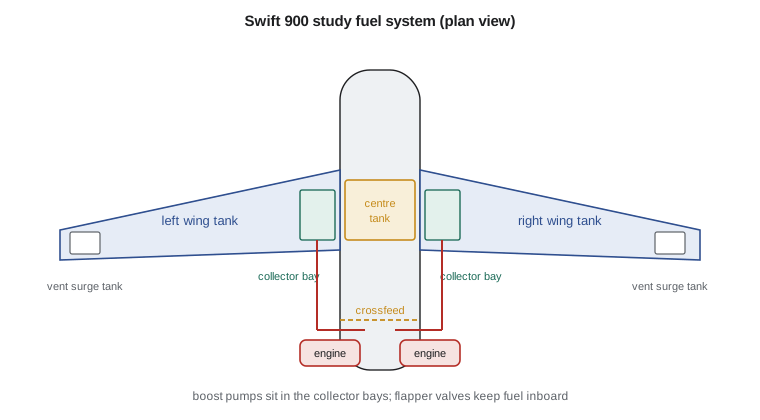
Inside each wing tank, ribs with flapper check valves let fuel flow inboard but not outboard, so that when the aircraft banks or accelerates the fuel near the pumps does not slosh away. The innermost bay, the collector or feed tank, holds enough fuel to keep the pumps covered in any normal attitude and is kept full by ejector pumps that use a small flow of high-pressure fuel to draw fuel in from the rest of the tank. Vent lines connect the tank's air space to the outside through a surge tank near the tip, so that the tank does not burst or collapse as the aircraft climbs and descends; the vent outlet is shaped so that ram air slightly pressurises the tank in flight.
Feeding the engines
Electric boost pumps in each collector bay deliver fuel to the engine's own engine-driven pump at positive pressure. The engine-driven pump, usually a gear pump, raises it to the high pressure the fuel control and nozzles need. The rules require that an engine keeps running if the boost pumps fail, at least up to a specified altitude, so the engine pump must be able to suction-feed from the tank, which becomes harder at altitude as dissolved air comes out of the fuel and vapour forms at the pump inlet. Engineers check this case with the hottest fuel the aircraft might carry and the lowest tank pressure, since hot fuel at low pressure is most prone to vapour.
A crossfeed valve lets either tank feed either engine, so that a pump failure or an engine shutdown does not strand fuel on one side. Crossfeed is also used to correct an imbalance between the wings when one engine has burned more. Fuel imbalance limits appear in the flight manual because a heavy wing needs constant aileron to hold level and reduces the roll control available, especially at low speed.
Fuel also does work as a coolant. Engine lubricating oil, generator oil and sometimes hydraulic fluid are cooled through heat exchangers in the fuel feed line, warming the fuel on its way to the engine. This is free cooling, but it limits how hot the fuel may become, which matters on long ground waits on a hot day. Fuel temperature is therefore monitored and, on some aircraft, warm fuel is returned to the tanks to mix.
Cold fuel and water
At cruise altitudes the air is around −55 °C, and fuel in thin wing tanks cools steadily during long flights. Jet A has a maximum freezing point of −40 °C and Jet A-1 of −47 °C; in practice the fuel's actual freezing point is measured and the crew monitors fuel temperature, keeping a margin above it by descending or speeding up if needed. Long flights over the northern Manitoba and Nunavut on cold winter days are where these limits most often matter for Canadian and northern US operators.
Water is the other enemy. Fuel always contains some dissolved water, which comes out as tiny droplets as the fuel cools and can freeze into ice crystals that block filters. Aircraft fuel systems have heated fuel filters or fuel-oil heat exchangers upstream of the filters, and drain valves at the tank low points that are sampled before flight. Some operators also use fuel system icing inhibitor additives. A widely studied accident in 2008, in which ice that had accumulated in a long-haul airliner's fuel feed system was released during the approach and restricted fuel flow to both engines, led to design changes in fuel-oil heat exchangers and new certification tests.
Centre of gravity and the burn sequence
As fuel burns the aircraft's mass and centre of gravity change, and the sequence in which tanks are used decides how. Fuel in the wings near the aircraft's centre of gravity has little effect; fuel in tanks well forward or aft has a large one. Some long-range aircraft carry fuel in the horizontal tail and move it in flight to keep the centre of gravity near the aft limit, which reduces trim drag. The Swift 900 study's tanks are all near the wing, so its centre of gravity moves only slightly, but the sequence still matters, for a structural reason.
Marcus Webb's structures group wants the wing tanks kept full as long as possible. Fuel in the wing hangs where the lift is, and its weight relieves the bending at the wing root; burning the wing fuel first leaves the lift acting on an empty wing and raises the root bending moment. The system therefore uses the centre tank first. Arjun's program checks that this sequence keeps the centre of gravity within the approved range at every stage.
# Swift 900 study: centre of gravity as fuel is burned in two sequences, and the fuel quantity
# error budget of the capacitance gauging. Masses and arms are illustrative.
MAC, LEMAC = 2.60, 11.10                     # mean aerodynamic chord and its leading edge station, m
zfw, x_zfw = 9500.0, 11.80                   # zero-fuel mass kg and its CG station m
tanks = {'centre': [900.0, 11.20], 'left wing': [1950.0, 11.98], 'right wing': [1950.0, 11.98]}
def cg(fuel):
    m = zfw + sum(fuel.values())
    mx = zfw * x_zfw + sum(fuel[k] * tanks[k][1] for k in fuel)
    return m, 100 * (mx / m - LEMAC) / MAC
def run(order, label):
    fuel = {k: v[0] for k, v in tanks.items()}
    full = sum(fuel.values()); print(label); step = 0
    while sum(fuel.values()) > 300.0:          # keep 300 kg final reserve
        need = min(250.0, sum(fuel.values()) - 300.0)
        for group in order:                     # burn from the first group that still has fuel
            have = sum(fuel[k] for k in group)
            if have > 0:
                take = min(need, have)
                for k in group: fuel[k] -= take * fuel[k] / have
                need -= take
            if need <= 1e-9: break
        step += 1
        if step % 4 == 0 or sum(fuel.values()) <= 300.0:
            m, c = cg(fuel); print(f"   burned {full - sum(fuel.values()):5.0f} kg  mass {m:6.0f} kg  CG {c:5.1f} % MAC")
m, c = cg({k: v[0] for k, v in tanks.items()}); print(f"full fuel: mass {m:.0f} kg, CG {c:.1f} % MAC")
run([['centre'], ['left wing', 'right wing']], 'centre tank first, then wings together:')
run([['left wing', 'right wing'], ['centre']], 'wings first, then centre tank:')
print(f"zero fuel: CG {100*(x_zfw-LEMAC)/MAC:.1f} % MAC   (approved range assumed 15 to 33 % MAC)")
# Fuel quantity indication: capacitance probe error budget (illustrative, root-sum-square)
errs = {'probe and wiring': 0.8, 'density compensation': 0.6, 'attitude and wing bending': 1.0, 'unusable fuel model': 0.4}
rss = sum(e * e for e in errs.values()) ** 0.5
print(f"\ngauging error, root-sum-square of {len(errs)} terms: about {rss:.1f} % of indicated quantity")
print(f"on 4800 kg that is about {rss/100*4800:.0f} kg")full fuel: mass 14300 kg, CG 27.4 % MAC centre tank first, then wings together: burned 1000 kg mass 13300 kg CG 28.9 % MAC burned 2000 kg mass 12300 kg CG 28.5 % MAC burned 3000 kg mass 11300 kg CG 28.0 % MAC burned 4000 kg mass 10300 kg CG 27.5 % MAC burned 4500 kg mass 9800 kg CG 27.1 % MAC wings first, then centre tank: burned 1000 kg mass 13300 kg CG 26.9 % MAC burned 2000 kg mass 12300 kg CG 26.3 % MAC burned 3000 kg mass 11300 kg CG 25.6 % MAC burned 4000 kg mass 10300 kg CG 25.1 % MAC burned 4500 kg mass 9800 kg CG 26.2 % MAC zero fuel: CG 26.9 % MAC (approved range assumed 15 to 33 % MAC) gauging error, root-sum-square of 4 terms: about 1.5 % of indicated quantity on 4800 kg that is about 71 kg
With full fuel the centre of gravity is at 27.4 percent of the mean aerodynamic chord. Burning the centre tank first moves it aft to about 28.9 percent, because the centre tank sits slightly forward of the aircraft's centre of gravity, then it drifts forward as the wing fuel goes. Burning the wings first moves it forward to about 25 percent. Both sequences stay inside the assumed range of 15 to 33 percent, so the choice can be made on structural grounds, and the centre-tank-first sequence wins. The fuel management computer enforces it automatically, and the crew sees the tank quantities and the centre of gravity on the systems display.
Measuring the fuel
Most aircraft gauge fuel with capacitance probes: vertical tubes in each tank whose electrical capacitance changes with the fraction immersed in fuel, since fuel and air have different permittivities. A computer combines the readings of many probes with the tank geometry, the aircraft's attitude and the wing's bending, and the fuel's measured density, to compute the mass of fuel, which is what matters for range and centre of gravity. Ultrasonic gauging is used on some newer aircraft and avoids electrical circuits inside the tank.
No gauge is perfect, and the flight crew's fuel planning has to allow for its error. Arjun's error budget combines four contributions by root-sum-square, the usual method when the errors are independent: probe and wiring errors, density compensation, attitude and wing bending, and the model of unusable fuel. The total is about 1.5 percent of indicated quantity, about 71 kg on full tanks. This is one reason fuel planning includes reserves well above the gauging error.
| Fuel | Typical use | Maximum freezing point | Notes |
|---|---|---|---|
| Jet A | Domestic flights in the United States | −40 °C | Kerosene-type turbine fuel |
| Jet A-1 | Most of the world including Canada | −47 °C | Kerosene-type turbine fuel |
| Sustainable aviation fuel blends | Increasing worldwide | Must meet the same specification as conventional fuel when blended | See AERO-340 Lesson 12 |
| Aviation gasoline | Piston engines | Much lower | Different system, not used in turbines |
Fuel tank safety
An empty-looking fuel tank is not empty: above the liquid is a mixture of air and fuel vapour that can be flammable over a wide range of conditions. A spark, a hot surface or a lightning arc inside a flammable tank can cause an explosion. The 1996 loss of an airliner off New York, attributed to an explosion in a heated centre tank, led to far-reaching rules on both preventing ignition sources and reducing flammability. Fuel pumps and probes are now designed so that no single failure can create a spark inside a tank, wiring in tanks is limited and protected, and bonding straps and fasteners are designed so that lightning current cannot arc inside the tank. For transport aircraft with high-flammability tanks, such as heated centre tanks, the rules also require flammability reduction, usually by filling the vapour space with nitrogen-enriched air from a small onboard inert gas generating system.
The Tern's turboshaft fuel system is simple by comparison: two wing tanks of about 300 kg each, a collector tank in the fuselage between them, two electric boost pumps and a filter. Its fuel is only for the range extender, which burns about 170 kg per hour at cruise. But the Tern adds a particular risk the Swift 900 does not have: the high-voltage battery and cables. The zonal safety analysis checks that no high-voltage cable runs through a fuel tank or vent, that battery venting cannot reach fuel vents, and that a battery fire could not heat a tank wall. These are the kinds of interactions that the common cause analysis of Lesson 1 exists to find.
Worked problem
Fuel mass from volume
A tank holds 2400 L of fuel at a density of 0.800 kg/L. What mass is that, and how much would the indication change if the density were wrongly taken as 0.780?
Show solution
- Mass \(= 2400 \times 0.800 = 1920\) kg.
- With 0.780: \(1872\) kg, an error of 48 kg or 2.5 percent.
Answer: 1920 kg; a density error of 0.02 kg/L gives a 2.5 percent mass error, which is why gauging systems measure density.
Worked problem
Centre of gravity shift
An aircraft of 12 000 kg has its centre of gravity at station 11.80 m. It burns 600 kg from a tank at station 11.20 m. Find the new centre of gravity.
Show solution
- Moment before: \(12\,000 \times 11.80 = 141\,600\) kg m; removed \(600 \times 11.20 = 6720\).
- New: \((141\,600 - 6720)/11\,400 = 11.83\) m.
Answer: The centre of gravity moves 0.03 m aft, because the fuel was forward of it.
Worked problem
Root-sum-square error
Three independent errors of 0.5, 0.8 and 1.2 percent combine how?
Show solution
- \(\sqrt{0.5^2 + 0.8^2 + 1.2^2} = \sqrt{0.25 + 0.64 + 1.44} = 1.53\) percent.
Answer: About 1.5 percent, less than the 2.5 percent their simple sum would give.
Common mistakes
MistakeBurning wing fuel first because the gauge reads it first.
InsteadThe burn sequence is chosen for structural relief and centre of gravity, and enforced by the fuel management system.
MistakeReading fuel quantity as volume.
InsteadRange and centre of gravity depend on mass; density must be measured or known.
MistakeAssuming a tank is safe because it is nearly empty.
InsteadThe vapour space above a small amount of fuel can be flammable.
MistakeIgnoring fuel temperature on long cold flights.
InsteadFuel must stay above its freezing point with margin.
Summary and key terms
- Aircraft store fuel in integral wing tanks with collector bays, check valves and vents, and feed engines through boost pumps, engine-driven pumps and crossfeed valves.
- Cold fuel and water ice are managed by temperature monitoring, heated filters and drains.
- The tank burn sequence controls centre of gravity and wing bending; the Swift 900 study burns its centre tank first and stays within its centre of gravity range.
- Capacitance gauging measures fuel mass to about 1.5 percent.
- Ignition prevention, lightning protection and, on some aircraft, inerting keep tanks from exploding.
- Integral tank
- A fuel tank formed by sealing part of the aircraft structure.
- Collector bay
- The tank compartment around the boost pumps, kept full by check valves and ejector pumps.
- Crossfeed
- A valve arrangement letting either tank feed either engine.
- Capacitance probe
- A fuel gauging sensor whose capacitance changes with the fuel level around it.
- Inerting
- Filling a tank's vapour space with nitrogen-enriched air to keep it non-flammable.
- Bending relief
- The reduction of wing root bending by weight carried in the wing.
Practice problems
Work each problem on paper first, then reveal the answer to check.
In the program, move the centre tank to station 11.60 m. How does the centre-tank-first sequence move the centre of gravity?
Show answer
It moves aft less, because the centre tank is now close to the aircraft's centre of gravity.
Why are flapper check valves fitted in wing tank ribs?
Show answer
To keep fuel near the pumps during banks and accelerations.
What is the maximum freezing point of Jet A-1?
Show answer
−47 °C.
Why must engines be able to suction-feed?
Show answer
So they keep running if the boost pumps fail.
Give one interaction the Tern's zonal safety analysis checks for its battery.
Show answer
That battery vents and high-voltage cables are kept away from fuel tanks and vents.
What does an onboard inert gas generating system produce?
Show answer
Nitrogen-enriched air for the tank vapour space.
Lesson quiz · 5 questions
Score 60% or more to complete this lesson.
Create a free account to save your progress, take quizzes and earn a certificate.