
AERO-320 · Lesson 9 of 12 · 23 min
Linearized subsonic flow
The Swift 900's wing will spend its life between Mach 0.2 on approach and Mach 0.82 in a fast cruise. All the incompressible tools of AERO-300, thin airfoil theory, panel methods, lifting-line theory, give answers that are good at the low end of that range and increasingly wrong at the high end. Tomasz Wierzbicki does not want to throw those tools away. He wants Arjun to correct them for compressibility, and to find the Mach number at which the corrections stop working. The theory that does this is linearized compressible flow, built on the small-perturbation potential equation. Its best-known result, the Prandtl-Glauert rule, is one of the most useful formulas in aerodynamics, and its failure near Mach 1 marks the start of the transonic problem treated in Lesson 10.
The full potential equation
For steady, irrotational flow of a perfect gas, the velocity can be written as the gradient of a potential, \(\mathbf{V} = \nabla\Phi\), as in AERO-300. In incompressible flow the potential satisfies Laplace's equation. In compressible flow, combining continuity, the momentum equation and the isentropic relations gives the full potential equation, which contains the local speed of sound and is nonlinear.
The full potential equation was the basis of the first transonic computer programs in the 1970s and is still used for quick transonic wing analysis. Its nonlinearity makes analytical solutions impossible except in special cases, so for analysis by hand we make one more assumption.
Small perturbations
For a thin wing at small angle of attack, the flow differs only slightly from the free stream. Write the velocity as the free stream plus small perturbations: \(u = V_\infty + u'\) and \(v = v'\), with \(u'\) and \(v'\) much smaller than \(V_\infty\). Expanding the full potential equation and keeping only first-order terms gives the linearized small-perturbation equation for the perturbation potential \(\phi\).
This simple equation has a striking feature: the free-stream Mach number appears only as the coefficient \(1 - M_\infty^2\). For subsonic flow the coefficient is positive and the equation is elliptic, like Laplace's equation, so disturbances spread in all directions. For supersonic flow the coefficient is negative and the equation is hyperbolic, like the wave equation, so disturbances travel only along Mach lines. The same linear theory therefore describes both subsonic and supersonic thin-wing flows, and Lesson 11 uses its supersonic form. Near Mach 1 the coefficient approaches zero, the neglected nonlinear terms become as large as the kept ones, and the linear theory fails.
Linearizing the pressure coefficient in the same way gives \(C_p = -2u'/V_\infty\). The boundary condition at the surface is also linearized: the flow must be tangent to the body, so \(v'/V_\infty\) equals the slope of the surface, applied at the chord line rather than at the actual surface.
The Prandtl-Glauert rule
Define \(\beta = \sqrt{1 - M_\infty^2}\) and stretch the coordinate normal to the flow by setting \(\eta = \beta y\). In the stretched coordinates the small-perturbation equation becomes Laplace's equation, and the compressible problem becomes an incompressible problem for a body whose thickness, camber and incidence are related to the real ones. Working through the transformation gives the Prandtl-Glauert rule: the pressure coefficient at any point on a thin body in compressible flow equals the incompressible value divided by \(\beta\).
Ludwig Prandtl stated the rule in lectures in the early 1920s and Hermann Glauert published a derivation in 1928. The lift coefficient and moment coefficient scale in the same way, so the lift slope of a thin section rises from \(2\pi\) per radian in incompressible flow to \(2\pi/\beta\): 7.26 per radian at Mach 0.5 and 8.80 at Mach 0.7. At the Swift 900's approach speed the correction is under 3 percent; at its cruise Mach number it is two-thirds. The rule also shows that compressibility amplifies everything: pressure peaks become sharper, adverse pressure gradients steeper, and the lift produced by a given angle of attack larger.
Better corrections: Karman-Tsien and Laitone
The Prandtl-Glauert rule underestimates the effect of compressibility on large suction peaks, because it is linear in the pressure coefficient. Theodore von Kármán and Hsue-Shen Tsien derived an improved rule in 1939 by using a tangent-gas approximation to the pressure-density relation, which keeps part of the nonlinearity. Edmund Laitone later proposed a rule that applies the Prandtl-Glauert factor using the local, rather than the free-stream, Mach number. Both reduce to Prandtl-Glauert for small pressure coefficients and predict stronger compressibility effects for large ones.
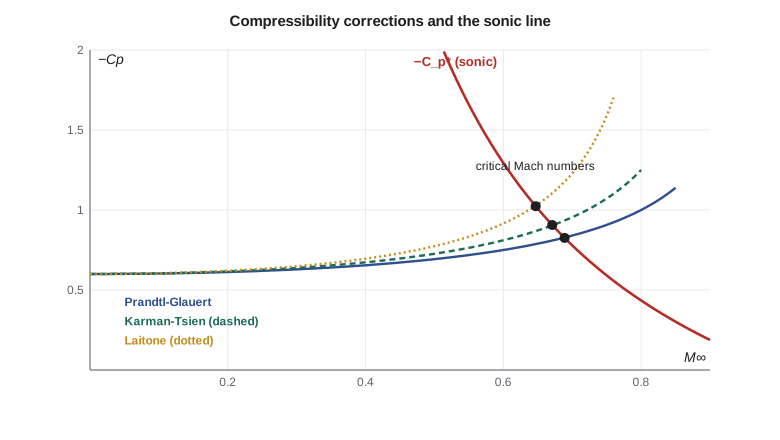
For the Swift 900's candidate section, with a low-speed minimum pressure coefficient of −0.60, the three rules agree closely up to about Mach 0.5. At Mach 0.7 they predict −0.84, −0.96 and −1.23 respectively. Experiments on airfoils generally fall between the Karman-Tsien and Laitone predictions, and the Karman-Tsien rule is the one most often used in practice. All three fail as the flow approaches the transonic range, because the shocks that then appear are outside the theory altogether.
The critical Mach number
As the free-stream Mach number rises, the peak velocity on the wing rises faster. At some free-stream Mach number the local flow at the suction peak just reaches Mach 1. This is the critical Mach number, \(M_{cr}\). It can be found by combining a compressibility correction with the pressure coefficient that corresponds to sonic flow, \(C_p^*\), which depends only on the free-stream Mach number and follows from the isentropic relations.
Plotting the corrected minimum pressure coefficient and \(C_p^*\) against Mach number, the critical Mach number is where they cross. The program finds the crossing by bisection: 0.689 with the Prandtl-Glauert rule, 0.671 with Karman-Tsien and 0.647 with Laitone. A thinner section, or one with a flatter pressure distribution and a smaller suction peak, has a higher critical Mach number. Above the critical Mach number the flow is transonic: a supersonic pocket forms over the wing, and a shock appears. The drag does not rise immediately, though. It begins to climb sharply only at a somewhat higher Mach number, the drag-divergence Mach number of Lesson 10.
# Linearized subsonic flow: compressibility corrections and the critical Mach number
import math
G = 1.4
def pg(cp0, M): return cp0 / math.sqrt(1 - M * M)
def kt(cp0, M):
    b = math.sqrt(1 - M * M)
    return cp0 / (b + M * M / (1 + b) * cp0 / 2)
def laitone(cp0, M):
    b = math.sqrt(1 - M * M)
    return cp0 / (b + M * M * (1 + (G - 1) / 2 * M * M) / (2 * b) * cp0)
def cp_star(M):                          # pressure coefficient where the local flow is sonic
    return 2 / (G * M * M) * (((2 + (G - 1) * M * M) / (G + 1)) ** (G / (G - 1)) - 1)
cp0 = -0.60                              # low-speed minimum pressure coefficient of the section
print(" M    Prandtl-Glauert  Karman-Tsien  Laitone   Cp*")
for M in (0.3, 0.5, 0.6, 0.7, 0.75):
    print(f"{M:4.2f} {pg(cp0, M):12.3f} {kt(cp0, M):12.3f} {laitone(cp0, M):9.3f} {cp_star(M):8.3f}")
def mcrit(rule):
    lo, hi = 0.3, 0.99
    for _ in range(80):
        mid = (lo + hi) / 2
        if rule(cp0, mid) > cp_star(mid): lo = mid       # local flow still subsonic
        else: hi = mid
    return (lo + hi) / 2
for name, rule in (("Prandtl-Glauert", pg), ("Karman-Tsien", kt), ("Laitone", laitone)):
    print(f"critical Mach by {name}: {mcrit(rule):.3f}")
# lift slope correction for a thin section: 2 pi / beta (two-dimensional)
for M in (0.0, 0.5, 0.7):
    print(f"M {M:.1f}: section lift slope {2 * math.pi / math.sqrt(1 - M * M):.3f} per radian")
# finite wing: Helmbold form with compressibility, aspect ratio 8.5, sweep 0
AR = 8.5
for M in (0.2, 0.6, 0.75):
    b2 = 1 - M * M
    a = 2 * math.pi * AR / (2 + math.sqrt(4 + AR * AR * b2))
print(f"M {M:.2f}: wing lift slope {a:.3f} per radian")M Prandtl-Glauert Karman-Tsien Laitone Cp* 0.30 -0.629 -0.638 -0.649 -6.947 0.50 -0.693 -0.727 -0.774 -2.133 0.60 -0.750 -0.811 -0.916 -1.294 0.70 -0.840 -0.955 -1.229 -0.779 0.75 -0.907 -1.072 -1.589 -0.591 critical Mach by Prandtl-Glauert: 0.689 critical Mach by Karman-Tsien: 0.671 critical Mach by Laitone: 0.647 M 0.0: section lift slope 6.283 per radian M 0.5: section lift slope 7.255 per radian M 0.7: section lift slope 8.798 per radian M 0.20: wing lift slope 5.055 per radian M 0.60: wing lift slope 5.877 per radian M 0.75: wing lift slope 6.703 per radian
Finite wings and sweep
The Prandtl-Glauert transformation applies in three dimensions as well. It stretches the spanwise and normal coordinates by \(\beta\), so a compressible flow about a wing of aspect ratio \(AR\) corresponds to an incompressible flow about a wing of aspect ratio \(\beta AR\). For a high-aspect-ratio wing, combining this with lifting-line theory gives a compressible version of the Helmbold equation for the lift slope. For the Swift 900's wing, with aspect ratio 8.5, the lift slope rises from 5.06 per radian at Mach 0.2 to 5.88 at Mach 0.6 and 6.70 at Mach 0.75. Finite-wing effects reduce the rise compared with a section, because the induced angle grows along with the section lift.
The effect of the lift slope rise is real and important for an aircraft. At high Mach number, a gust produces a larger change in lift, so gust loads on the wing and fuselage are larger. The structures group led by Marcus Webb uses the compressible lift slope in its gust load calculations. Sweep reduces the rise: a swept wing sees, approximately, only the component of the free stream normal to its leading edge, so its effective Mach number is \(M_\infty\cos\Lambda\). Lesson 10 uses that idea to raise the critical Mach number of the Swift 900's wing.
Göthert's rule and three-dimensional bodies
For fuselages, nacelles and other three-dimensional bodies, the Prandtl-Glauert rule is not simply the incompressible pressure divided by \(\beta\). Göthert's rule, published in 1940, shows that the compressible flow about a body equals the incompressible flow about an affinely stretched body, thinned in the lateral directions by \(\beta\), with the pressure coefficient divided by \(\beta^2\). For slender bodies of revolution the compressibility effect is weaker than for wings, which is one reason slender fuselages tolerate higher Mach numbers than thick wings do.
Worked problem
Compressible pressure on the Swift 900 section
A wind tunnel test at Mach 0.2 gives a pressure coefficient of −0.45 at a point on the upper surface of a section. Estimate it at Mach 0.65 with the Prandtl-Glauert and Karman-Tsien rules.
Show solution
- First remove the small compressibility effect at Mach 0.2: \(C_{p,0} = -0.45\times\sqrt{1 - 0.04} = -0.441\).
- At Mach 0.65, \(\beta = 0.760\). Prandtl-Glauert: \(-0.441/0.760 = -0.580\).
- Karman-Tsien: \(-0.441/(0.760 + (0.4225/1.760)(-0.2205)) = -0.441/0.707 = -0.624\).
Answer: About −0.58 to −0.62, a third larger in magnitude than at low speed.
Worked problem
Critical pressure coefficient at cruise
What is the critical pressure coefficient at Mach 0.80?
Show solution
- \(C_p^* = (2/(1.4\times 0.64))\big[((2 + 0.4\times 0.64)/2.4)^{3.5} - 1\big]\).
- \(= 2.232\times[0.9400^{3.5} - 1] = 2.232\times(0.8053 - 1) = -0.435\).
Answer: At Mach 0.80, any point where the pressure coefficient falls below −0.43 is supersonic. That is a very modest suction peak, which is why transonic wings must be designed to keep the upper-surface pressure as flat as possible.
Common mistakes
MistakeApplying the Prandtl-Glauert rule near Mach 1.
InsteadThe linear theory fails as M approaches 1 and gives infinite pressure coefficients there.
MistakeUsing the free-stream Mach number as the effective Mach number for a swept wing.
InsteadFor a swept wing use, approximately, M cos Λ normal to the leading edge.
MistakeAssuming drag rises as soon as the critical Mach number is passed.
InsteadDrag rises sharply only at the somewhat higher drag-divergence Mach number.
MistakeApplying the wing rule to a body of revolution.
InsteadUse Göthert's rule; slender bodies are less sensitive to compressibility.
Summary and key terms
- For thin bodies at small incidence, the compressible potential equation linearizes to (1 − M²)φxx + φyy = 0, elliptic in subsonic flow and hyperbolic in supersonic flow.
- A coordinate stretch reduces subsonic flow to an incompressible problem, giving the Prandtl-Glauert rule that pressure and lift coefficients scale as 1/√(1 − M²).
- The Karman-Tsien and Laitone rules handle larger suction peaks better.
- The critical Mach number is where the corrected minimum pressure coefficient meets the sonic value C_p*.
- Compressibility raises the lift slope of wings, less so for finite and swept wings and for slender bodies.
- Small-perturbation equation
- The linearized compressible potential equation for thin bodies.
- Prandtl-Glauert rule
- The rule that C_p and c_l in compressible subsonic flow equal their incompressible values divided by √(1 − M²).
- Karman-Tsien rule
- An improved compressibility correction that is more accurate for large suction peaks.
- Critical Mach number
- The free-stream Mach number at which the flow first reaches Mach 1 somewhere on the body.
- Critical pressure coefficient
- The pressure coefficient C_p* that corresponds to locally sonic flow.
- Göthert's rule
- The compressibility rule for three-dimensional bodies using an affinely stretched shape.
- Elliptic and hyperbolic
- The mathematical types of the subsonic and supersonic potential equations.
Practice problems
Work each problem on paper first, then reveal the answer to check.
Find the Prandtl-Glauert factor at Mach 0.6.
Show answer
1/√0.64 = 1.25.
Using the program, what does Karman-Tsien give for C_p,0 = −0.60 at Mach 0.6?
Show answer
−0.811.
Change the program to C_p,0 = −0.43 and find the critical Mach number by Karman-Tsien.
Show answer
About 0.72.
What is C_p* at Mach 0.7?
Show answer
About −0.78.
Why does a finite wing's lift slope rise less with Mach number than a section's?
Show answer
The induced angle of attack increases along with the section lift, partly cancelling the rise.
Why does the linear theory fail at Mach 1?
Show answer
The coefficient 1 − M² goes to zero and the neglected nonlinear terms become dominant.
Lesson quiz · 5 questions
Score 60% or more to complete this lesson.
Create a free account to save your progress, take quizzes and earn a certificate.