
AERO-320 · Lesson 4 of 12 · 23 min
Oblique shocks
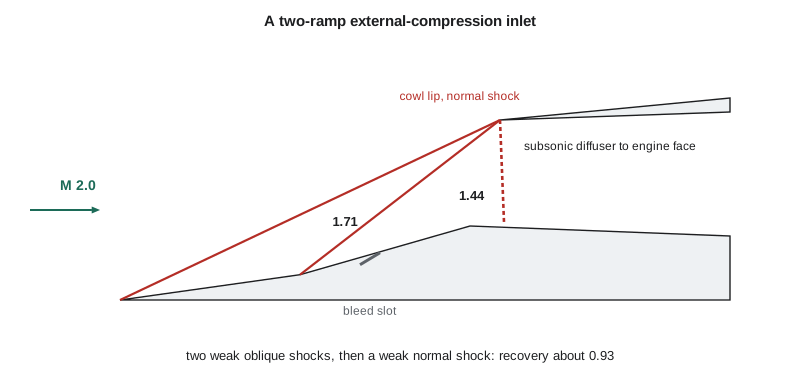
The second model scheduled for the trisonic tunnel is a generic external-compression inlet, part of a the National Research Council study of engines for future quiet supersonic airliners and business jets. Its front is a pair of ramps that turn the incoming Mach 2 air through two small angles before a final normal shock at the cowl lip. Kenji Watanabe wants to know why the designers bothered with ramps at all, and how much better they are than the simple pitot inlet whose loss Lesson 3 calculated. The answer lies in oblique shocks: shocks inclined to the flow, which compress and turn it at the same time, with far less loss than a normal shock of the same total compression.
Turning a supersonic flow
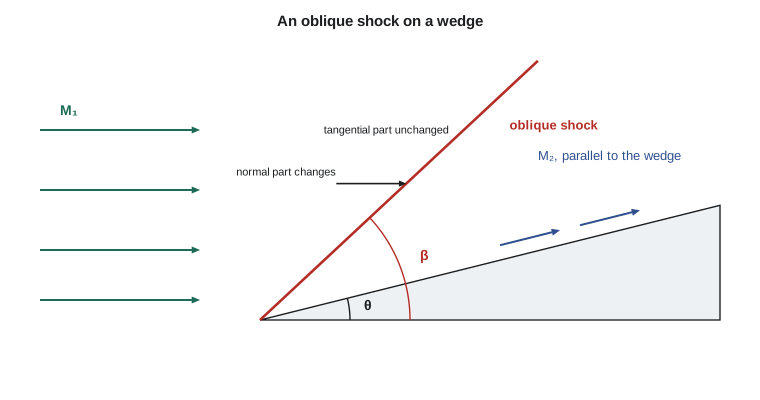
When a supersonic flow meets a wall that turns into it, a concave corner or the leading edge of a wedge, the flow cannot curve gradually as a subsonic flow would. Instead an oblique shock forms at the corner, inclined at a wave angle \(\beta\) to the upstream flow. Across it the flow turns through the deflection angle \(\theta\), so that it runs parallel to the new wall, and its pressure, density and temperature rise. If the wall turns away from the flow, the opposite happens: the flow expands smoothly through a fan of Mach waves, the subject of Lesson 5.
The key idea: only the normal component changes
An oblique shock can be analysed with no new physics. Resolve the upstream velocity into a component normal to the shock, \(u_1 = V_1\sin\beta\), and a component tangential to it, \(w_1 = V_1\cos\beta\). The momentum equation in the tangential direction has no pressure gradient, because the pressure does not change along the shock, so \(w_2 = w_1\). The normal component, on the other hand, obeys exactly the same conservation equations as a normal shock. An oblique shock is therefore a normal shock with a uniform sideways velocity added, and the normal-shock relations of Lesson 3 apply if the upstream Mach number is replaced by its normal component.
The pressure, density and temperature ratios are those of a normal shock at \(M_{n1}\). Because \(M_{n1}\) can be much smaller than \(M_1\), an oblique shock can be very weak even in a very fast flow. The downstream normal component is subsonic, but the total downstream velocity, with its unchanged tangential part, is usually still supersonic. The flow behind a weak oblique shock remains supersonic.
The theta-beta-M relation
Geometry links the deflection angle to the wave angle. The tangential velocities are equal and the normal velocities are in the ratio of the densities, so \(\tan\beta/\tan(\beta - \theta) = \rho_2/\rho_1\). Substituting the normal-shock density ratio gives the theta-beta-M relation, the single most used equation in supersonic aerodynamics.
Given \(M_1\) and \(\beta\), the deflection follows directly. The usual problem is the reverse: the wall angle \(\theta\) is known, and \(\beta\) is wanted. Plotting \(\theta\) against \(\beta\) for a fixed Mach number shows that \(\theta\) is zero when \(\beta\) equals the Mach angle, where the shock degenerates into a Mach wave, rises to a maximum, then falls to zero again at \(\beta = 90°\), the normal shock. Every deflection below the maximum therefore has two solutions: a weak shock with the smaller wave angle and a strong shock with the larger one.
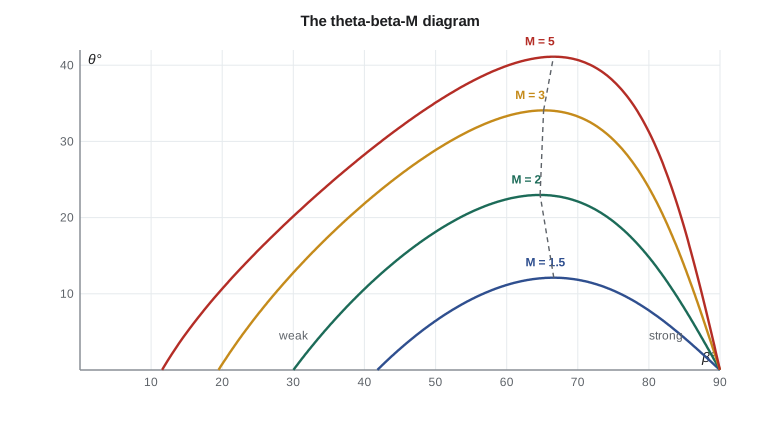
In external flows the weak solution almost always occurs: a wedge in a free stream carries a weak oblique shock. The strong solution appears when the downstream pressure is forced to be high, for example inside a duct where a back pressure is imposed. If the wall angle exceeds the maximum deflection, no attached shock is possible. The shock then stands detached ahead of the body as a curved bow shock, normal on the stagnation streamline and weakening into a Mach wave far away. For Mach 2 in air the maximum deflection is about 23 degrees, so a 25-degree wedge has a detached bow shock.
# Oblique shocks: solve the theta-beta-M relation for the weak and strong waves
import math
G = 1.4
def theta_of(beta, M):                       # flow deflection for a wave angle beta (radians)
    t = 2 / math.tan(beta) * (M**2 * math.sin(beta)**2 - 1) / (M**2 * (G + math.cos(2 * beta)) + 2)
    return math.atan(t)
def max_deflection(M):
    mu = math.asin(1 / M); best = (0, mu)
    for i in range(1, 4000):
        b = mu + (math.pi / 2 - mu) * i / 4000
        th = theta_of(b, M)
        if th > best[0]: best = (th, b)
    return best
def beta_of(theta, M, strong=False):
    th_max, b_max = max_deflection(M)
    if theta > th_max: return None            # detached shock
    lo, hi = (b_max, math.pi / 2) if strong else (math.asin(1 / M), b_max)
    for _ in range(80):                       # bisection on the chosen branch
        mid = (lo + hi) / 2
        f = theta_of(mid, M) - theta
        if (f > 0) != strong: hi = mid
        else: lo = mid
    return (lo + hi) / 2
def after(M1, beta, theta):
    Mn1 = M1 * math.sin(beta)
    Mn2 = math.sqrt((1 + (G - 1) / 2 * Mn1**2) / (G * Mn1**2 - (G - 1) / 2))
    p21 = 1 + 2 * G / (G + 1) * (Mn1**2 - 1)
    return Mn2 / math.sin(beta - theta), p21
M1 = 2.0
for th_deg in (5, 10, 15, 20):
    th = math.radians(th_deg)
    bw, bs = beta_of(th, M1), beta_of(th, M1, True)
    M2w, pw = after(M1, bw, th); M2s, ps = after(M1, bs, th)
    print(f"theta {th_deg:2d} deg: weak beta {math.degrees(bw):5.2f} M2 {M2w:.3f} p2/p1 {pw:.3f} | strong beta {math.degrees(bs):5.2f} M2 {M2s:.3f} p2/p1 {ps:.3f}")
th_max, b_max = max_deflection(M1)
print(f"M {M1}: maximum deflection {math.degrees(th_max):.2f} deg at beta {math.degrees(b_max):.2f} deg")
print("25 deg wedge at M 2:", "detached bow shock" if beta_of(math.radians(25), M1) is None else "attached")
# two-ramp external compression inlet versus one normal shock at M 2.0
def p0_normal(M):
    p21 = 1 + 2 * G / (G + 1) * (M**2 - 1); r21 = (G + 1) * M**2 / ((G - 1) * M**2 + 2)
    return r21 ** (G / (G - 1)) * (1 / p21) ** (1 / (G - 1))
M, rec = M1, 1.0
for th_deg in (8, 8):
    th = math.radians(th_deg); b = beta_of(th, M)
    rec *= p0_normal(M * math.sin(b)); M, _ = after(M, b, th)
rec *= p0_normal(M)
print(f"two 8 deg ramps then a normal shock: total pressure recovery {rec:.3f} (normal shock alone {p0_normal(M1):.3f})")theta 5 deg: weak beta 34.30 M2 1.821 p2/p1 1.315 | strong beta 86.97 M2 0.584 p2/p1 4.487 theta 10 deg: weak beta 39.31 M2 1.641 p2/p1 1.707 | strong beta 83.70 M2 0.604 p2/p1 4.444 theta 15 deg: weak beta 45.34 M2 1.446 p2/p1 2.195 | strong beta 79.83 M2 0.644 p2/p1 4.355 theta 20 deg: weak beta 53.42 M2 1.210 p2/p1 2.843 | strong beta 74.27 M2 0.728 p2/p1 4.157 M 2.0: maximum deflection 22.97 deg at beta 64.66 deg 25 deg wedge at M 2: detached bow shock two 8 deg ramps then a normal shock: total pressure recovery 0.935 (normal shock alone 0.721)
What the program shows
At Mach 2, a 10-degree deflection produces a weak shock at 39.3 degrees with a downstream Mach number of 1.64 and a pressure ratio of 1.71, or a strong shock at 83.7 degrees with a downstream Mach number of 0.60 and a pressure ratio of 4.44. The strong shock is almost a normal shock: its pressure rise is close to the 4.50 of the Mach 2 normal shock. As the deflection rises to 20 degrees, the weak shock steepens to 53.4 degrees and the downstream flow slows to Mach 1.21, close to sonic. Beyond 23 degrees the solution disappears.
The weak shock compresses much less than a normal shock at the same Mach number. That seems like a disadvantage until the entropy is considered. A weak shock's normal Mach number is only 1.27 for the 10-degree case, and its stagnation pressure loss is about 1.5 percent, compared with 28 percent for the normal shock. The inlet designer can therefore compress the air in several weak steps, each nearly isentropic, and finish with a weak normal shock at a much lower Mach number.
Shock-system inlets
That is exactly what the ramps of the the National Research Council inlet do. Two 8-degree ramps each produce a weak oblique shock, slowing the air from Mach 2.0 to about 1.71 and then to about 1.44. A final normal shock at the cowl lip takes it subsonic. The program multiplies the three stagnation pressure ratios and finds a total recovery of 0.935, compared with 0.721 for a normal shock alone. The difference, over 20 percent of stagnation pressure, is roughly 20 percent of engine thrust at the same fuel flow.
Klaus Oswatitsch showed in the 1940s that for a given number of shocks the recovery is best when all the oblique shocks have the same strength, and that the recovery improves steadily as more shocks are added, approaching isentropic compression in the limit of a smoothly curved ramp. Real inlets balance this against length, weight and the need to swallow the shock system smoothly when the engine demand changes. Supersonic airliners and fighters of the 1960s and 1970s used variable ramps that moved with flight Mach number to keep the shocks focused on the cowl lip, and modern low-boom concepts use carefully shaped axisymmetric or two-dimensional inlets with bleed systems that remove the boundary layer where the shocks meet the ramp surface.
Shock reflection and interaction
An oblique shock that strikes a solid wall cannot simply end, because the flow behind it is turned toward the wall. A reflected shock forms that turns the flow back parallel to the wall. The reflected shock is weaker than a normal shock but stronger than the incident one in pressure ratio, because the flow behind the incident shock is slower. If the required turning exceeds the maximum deflection for the flow behind the incident shock, a regular reflection is impossible and a Mach reflection forms, with a short normal-shock stem at the wall. Shocks striking boundary layers cause a further complication: the pressure rise can separate the layer, and the separation bubble changes the shock pattern. Shock-boundary-layer interaction is one of the main reasons inlets need bleed, and it reappears on transonic wings in Lesson 10.
Worked problem
Pressure on a wedge at Mach 3
A wedge of half-angle 12 degrees is placed at zero incidence in a Mach 3 stream at 15 kPa. Find the wave angle and the pressure on the wedge face.
Show solution
- From the theta-beta-M relation, the weak solution is \(\beta \approx 29.3°\).
- \(M_{n1} = 3\sin 29.3° = 1.466\), so \(p_2/p_1 = 1 + (2.8/2.4)(1.466^2 - 1) = 2.340\).
- \(p_2 = 35.1\ \text{kPa}\).
Answer: The face pressure is about 35 kPa, more than twice the free-stream value, even though the shock is weak in the sense of its normal Mach number.
Worked problem
Will the shock attach?
A test probe has a conical tip treated, for a first estimate, as a two-dimensional wedge of half-angle 20 degrees. Will an attached shock form at Mach 1.8?
Show solution
- The maximum deflection at Mach 1.8 is about 19.2 degrees.
- The required 20 degrees exceeds it.
Answer: No. The shock detaches and stands ahead of the tip. (A real cone allows a little more deflection than a wedge, so the three-dimensional shock may just attach, which is why conical probes are used.)
Common mistakes
MistakeApplying the normal-shock relations with the full upstream Mach number.
InsteadUse the normal component \(M_1\sin\beta\).
MistakePicking the strong solution for a wedge in a free stream.
InsteadExternal flows almost always take the weak solution.
MistakeAssuming the flow behind any oblique shock is subsonic.
InsteadBehind a weak oblique shock the flow usually remains supersonic.
MistakeAssuming any wedge angle gives an attached shock.
InsteadAbove the maximum deflection the shock detaches into a bow shock.
Summary and key terms
- An oblique shock turns and compresses a supersonic flow.
- Only the velocity component normal to the shock changes, so the normal-shock relations apply with M₁ sin β.
- The theta-beta-M relation links the deflection, wave angle and Mach number; below the maximum deflection there are weak and strong solutions, and above it the shock detaches.
- Weak oblique shocks lose very little stagnation pressure, so supersonic inlets compress in several weak steps before a final weak normal shock.
- Shocks reflect from walls and interact strongly with boundary layers.
- Oblique shock
- A shock inclined to the upstream flow that both compresses and turns it.
- Wave angle
- The angle β between the shock and the upstream flow direction.
- Deflection angle
- The angle θ through which the flow is turned by the shock.
- Weak solution
- The oblique shock with the smaller wave angle for a given deflection.
- Detached shock
- A curved bow shock standing ahead of a body whose deflection exceeds the maximum.
- External-compression inlet
- An inlet that slows supersonic air with oblique shocks ahead of the cowl lip.
- Mach reflection
- A shock reflection with a normal-shock stem, used when regular reflection is impossible.
Practice problems
Work each problem on paper first, then reveal the answer to check.
Using the program, find the weak wave angle for θ = 15° at Mach 2.
Show answer
About 45.3°.
What is the normal Mach number of that shock?
Show answer
2 sin 45.3° = 1.42.
Find the maximum deflection at Mach 2.
Show answer
About 23.0°, at β ≈ 64.7°.
Why does the strong solution at Mach 2 and θ = 5° have almost the same pressure rise as a normal shock?
Show answer
Its wave angle is about 87°, nearly normal to the flow.
Change the program to use three 6° ramps. Is the recovery better or worse than two 8° ramps?
Show answer
Better, about 0.956, because each shock is weaker and the final normal shock is at a lower Mach number.
Explain why a supersonic inlet needs boundary-layer bleed.
Show answer
Shocks striking the ramp boundary layer can separate it; bleed removes the low-energy air.
Lesson quiz · 5 questions
Score 60% or more to complete this lesson.
Create a free account to save your progress, take quizzes and earn a certificate.