
AERO-320 · Lesson 5 of 12 · 23 min
Prandtl-Meyer expansions
When the first schlieren photographs of the inlet model came back from the trisonic tunnel, Arjun noticed that the shocks were not the only features. Wherever the model surface turned away from the flow, at the shoulder of the second ramp and at the trailing edge of the cowl, there was a fan of faint lines spreading out from the corner. Those are expansion waves. A supersonic flow turning away from itself does not form a shock; it expands smoothly, accelerating and losing pressure through a continuous fan of Mach waves. The theory of that expansion was worked out by Ludwig Prandtl and his student Theodor Meyer in 1908, and it completes the set of tools needed to calculate two-dimensional supersonic flows.
Mach waves
Lesson 1 described the Mach cone of a small disturbance in supersonic flow. In two dimensions the cone becomes a pair of straight lines, Mach waves, inclined at the Mach angle \(\mu = \sin^{-1}(1/M)\) to the flow. A Mach wave is the limit of an oblique shock as the deflection goes to zero: an infinitely weak shock, across which the flow properties change by infinitesimal amounts and the entropy change is zero. Any smooth supersonic flow can be thought of as built from Mach waves. A wall turning slightly into the flow sends out compression Mach waves; a wall turning slightly away sends out expansion Mach waves.
Compression waves converge, because each one travels in flow that has already been slowed and has a larger Mach angle. They coalesce into an oblique shock. Expansion waves diverge, because each one travels in flow that has been accelerated and has a smaller Mach angle, so they spread into a fan. This is why compression in supersonic flow is sudden and irreversible, while expansion is gradual and isentropic.
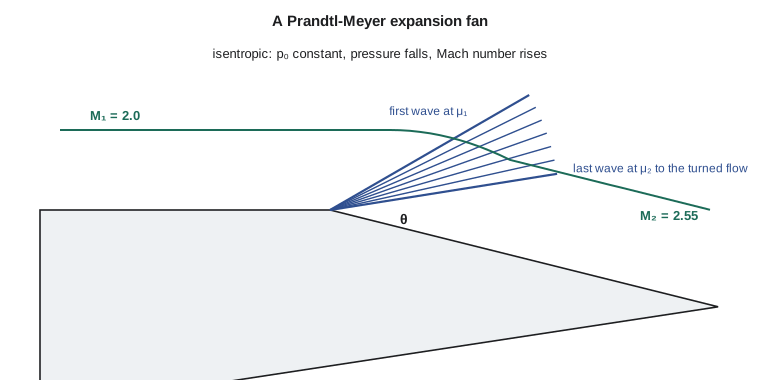
The Prandtl-Meyer function
Consider a supersonic flow turning through a very small angle \(d\theta\) across a single Mach wave. Geometry and the momentum equation tangential to the wave give \(d\theta = \sqrt{M^2 - 1}\,dV/V\). Writing the velocity in terms of Mach number and the speed of sound, and using the energy equation to relate the speed of sound to the Mach number, allows this to be integrated from Mach 1. The result is the Prandtl-Meyer function \(\nu(M)\), the angle through which a sonic flow would have to turn to reach Mach number \(M\).
For a flow at Mach \(M_1\) turning away through an angle \(\theta\), the downstream Mach number follows from a single equation: \(\nu(M_2) = \nu(M_1) + \theta\). Because the expansion is isentropic, the stagnation pressure and temperature are unchanged, and the static pressure and temperature then follow from the isentropic relations of Lesson 2 at the two Mach numbers. The inverse problem, finding \(M_2\) from \(\nu(M_2)\), has no closed form, so the program uses bisection.
The function rises from zero at Mach 1 to 11.9 degrees at Mach 1.5, 26.4 degrees at Mach 2, 49.8 degrees at Mach 3 and 76.9 degrees at Mach 5. It approaches a limit of 130.45 degrees for air as the Mach number goes to infinity. That limit means a sonic flow can turn through at most 130 degrees, expanding to zero pressure and temperature, before it separates from the wall and leaves a vacuum behind it. In practice the gas condenses or the continuum assumption fails long before that point.
# Prandtl-Meyer expansions: nu(M), its inverse, and flow round a convex corner
import math
G = 1.4
def nu(M):                                   # Prandtl-Meyer function in degrees
    k = math.sqrt((G + 1) / (G - 1))
    return math.degrees(k * math.atan(math.sqrt((M**2 - 1) / k**2)) - math.atan(math.sqrt(M**2 - 1)))
def mach_from_nu(target):
    lo, hi = 1.0, 30.0
    for _ in range(80):
        mid = (lo + hi) / 2
        if nu(mid) < target: lo = mid
        else: hi = mid
    return (lo + hi) / 2
def p0_p(M): return (1 + (G - 1) / 2 * M * M) ** (G / (G - 1))
print(" M     nu deg   Mach angle deg")
for M in (1.0, 1.5, 2.0, 2.5, 3.0, 5.0):
    print(f"{M:4.1f}  {nu(M):7.3f}   {math.degrees(math.asin(1 / M)):7.3f}")
k = math.sqrt((G + 1) / (G - 1))
print(f"largest possible turn (expansion to M = infinity): {90 * (k - 1):.2f} deg")
# a M 2.0 stream turns 10 deg round a convex corner
M1, turn = 2.0, 10.0
M2 = mach_from_nu(nu(M1) + turn)
p21 = p0_p(M1) / p0_p(M2)
mu1, mu2 = math.degrees(math.asin(1 / M1)), math.degrees(math.asin(1 / M2))
print(f"\nM1 {M1} round a {turn:.0f} deg corner: M2 = {M2:.3f}, p2/p1 = {p21:.4f}")
print(f"fan from {mu1:.2f} deg (leading Mach line) to {mu2 - turn:.2f} deg (trailing line) from the upstream flow direction")
# underexpanded jet: a nozzle exit at M 2.0 and p = 2.0 pb expands at the lip to the ambient pressure
Me, pe_pb = 2.0, 2.0
M_after = math.sqrt(2 / (G - 1) * ((p0_p(Me) * pe_pb) ** ((G - 1) / G) - 1))
print(f"\nunderexpanded jet: M rises from {Me} to {M_after:.3f}; the flow turns outward by {nu(M_after) - nu(Me):.2f} deg at the lip")M nu deg Mach angle deg 1.0 0.000 90.000 1.5 11.905 41.810 2.0 26.380 30.000 2.5 39.124 23.578 3.0 49.757 19.471 5.0 76.920 11.537 largest possible turn (expansion to M = infinity): 130.45 deg M1 2.0 round a 10 deg corner: M2 = 2.385, p2/p1 = 0.5480 fan from 30.00 deg (leading Mach line) to 14.79 deg (trailing line) from the upstream flow direction underexpanded jet: M rises from 2.0 to 2.444; the flow turns outward by 11.41 deg at the lip
Expansion at a corner and on a wing
A Mach 2 stream turning through 10 degrees round a convex corner has \(\nu_1 = 26.38°\), so \(\nu_2 = 36.38°\) and \(M_2 = 2.385\). The pressure falls to 0.548 of its upstream value. The fan begins with a wave at 30.0 degrees to the incoming flow and ends with a wave at 24.8 degrees to the turned flow, which is 14.8 degrees to the original direction. Across the fan the flow accelerates, the Mach angle shrinks, and each streamline bends smoothly.
Expansions are as important as shocks on supersonic bodies. On a diamond-shaped airfoil at Mach 2, the flow is compressed by oblique shocks at the leading edge, expanded at the shoulder at mid-chord, and recompressed at the trailing edge. The low pressure on the rear faces, produced by the expansions, is what gives the airfoil its wave drag in Lesson 11. On the upper surface of a wing at incidence, the leading-edge expansion produces the suction that carries much of the lift. In both cases, combining oblique shocks with Prandtl-Meyer expansions, called shock-expansion theory, gives exact results for two-dimensional bodies with straight faces, as long as the shocks remain attached.
Supersonic jets and nozzle plumes
A nozzle whose exit pressure differs from the surrounding pressure produces a jet with a characteristic diamond pattern. If the exit pressure is higher than ambient, the jet is underexpanded: the flow turns outward at the lip through an expansion fan until its pressure matches ambient. The program shows a Mach 2.0 jet at twice the ambient pressure accelerating to Mach 2.44 and turning outward by 11.4 degrees. The expansion waves reflect from the free jet boundary as compression waves, which coalesce into shocks, which reflect again as expansions, producing the bright repeating cells seen in the exhaust of rocket engines and afterburning engines. If the exit pressure is lower than ambient, the jet is overexpanded and the pattern starts with oblique shocks at the lip. Lesson 6 shows how the nozzle pressure ratio decides which happens.
Reflection and cancellation
An expansion fan striking a solid wall reflects as another expansion fan, because the wall must turn the flow back parallel to itself. An expansion striking a free boundary, where the pressure is fixed, reflects as a compression. These rules are the basis of the method of characteristics, a graphical and later numerical technique that builds a complete two-dimensional supersonic flow out of a network of Mach waves. It was the standard way of designing supersonic wind tunnel nozzles for decades. A nozzle designed by characteristics turns the flow outward to accelerate it, then turns the wall back so that each expansion wave arriving at the wall is cancelled, rather than reflected, leaving a uniform parallel stream at the exit. Lesson 7 uses that idea when it discusses the nozzle of the trisonic tunnel.
Expansions on the inlet model
The inlet model gives a concrete example of how expansions and shocks work together. Behind the second ramp the air is at about Mach 1.44, and the ramp surface then turns away from the flow toward the throat region, a few degrees at a time, so that the air can enter the subsonic diffuser. Each turn sends out a small expansion fan that accelerates the flow and lowers its pressure. Those fans travel outward and meet the oblique shocks coming down from the ramps, weakening them where they cross. If the shoulder is placed too far forward, its expansion reaches the cowl lip, accelerates the air just ahead of the terminal normal shock and makes that shock stronger, costing pressure recovery. If it is too far aft, the boundary layer arriving at the throat is thicker. The designers placed the shoulder so that its expansion fan passes just inside the cowl lip, and the schlieren photographs from the tunnel let the team check that the fan sits where the calculations put it.
The same reasoning applies at the trailing edge of the cowl, where the outer surface turns inward and the external flow expands round it. The low pressure there acts on the rear-facing parts of the cowl and adds to the external drag of the nacelle, a component that inlet designers try hard to keep small. A thin, gently boat-tailed cowl turns the flow through smaller angles and therefore produces weaker expansions and less drag than a blunt one, which is one reason supersonic nacelles are long and slender. The calculation is a direct use of the Prandtl-Meyer function: the turning angle of each surface gives the change in \(\nu\), and the pressure on that surface follows from the isentropic relations.
Where expansions cause trouble
Expansions are isentropic, but the flow behind them has a lower pressure, and the recompression that inevitably follows is not. On a transonic wing the flow expands round the leading edge into a supersonic pocket, then must recompress, usually through a shock, before reaching the trailing edge. Strong expansion followed by strong recompression is the pattern the supercritical wing designs of Lesson 10 work to avoid. On the inlet model, the expansion at the ramp shoulder accelerates the flow just before the cowl shock, which increases the strength of that shock if the shoulder is placed badly. The design of every supersonic shape is a balance between the compressions and expansions its surfaces create.
Worked problem
Pressure on the rear face of a ramp
Behind the first ramp of the inlet model the flow is at Mach 1.71 and 45 kPa. The ramp surface then turns away by 4 degrees. Find the Mach number and pressure after the turn.
Show solution
- \(\nu(1.71) = 18.1°\), so \(\nu_2 = 22.1°\) and \(M_2 \approx 1.85\).
- \(p_0/p\) at 1.71 is 5.01 and at 1.85 is 6.18.
- \(p_2 = 45\times 5.01/6.18 = 36.5\ \text{kPa}\).
Answer: The pressure falls by about 19 percent through the 4-degree expansion, and the flow speeds up to Mach 1.85.
Worked problem
Maximum expansion of a sonic flow
Air leaves a choked slot at Mach 1 and is allowed to expand round a sharp edge. Through what angle can it turn before reaching Mach 3?
Show solution
- \(\nu(1) = 0\) and \(\nu(3) = 49.76°\).
Answer: About 50 degrees. Turning through the full 130 degrees would take the flow to an infinite Mach number and zero pressure, which no real gas reaches.
Common mistakes
MistakeExpecting a shock at a convex corner.
InsteadSupersonic flow turning away from itself expands smoothly through a fan of Mach waves.
MistakeAssuming the stagnation pressure falls through an expansion.
InsteadPrandtl-Meyer expansions are isentropic; stagnation pressure is constant.
MistakeAdding the turning angle to the Mach number.
InsteadAdd it to the Prandtl-Meyer function, then invert to find the new Mach number.
MistakeMeasuring the fan's trailing edge from the upstream direction without subtracting the turn.
InsteadThe trailing wave lies at the downstream Mach angle to the turned flow.
Summary and key terms
- A supersonic flow turning away from itself expands isentropically through a fan of Mach waves.
- The Prandtl-Meyer function gives the turning angle needed to accelerate a sonic flow to a given Mach number, and the downstream state follows from ν(M₂) = ν(M₁) + θ and the isentropic relations.
- The function approaches about 130 degrees for air.
- Expansions combine with oblique shocks in shock-expansion theory, shape supersonic jet plumes and reflect from walls and free boundaries in ways that underlie the method of characteristics.
- Mach wave
- An infinitely weak disturbance line inclined at the Mach angle.
- Expansion fan
- A centred set of Mach waves through which a supersonic flow turns away and accelerates.
- Prandtl-Meyer function
- The turning angle ν(M) needed to accelerate a sonic flow isentropically to Mach M.
- Shock-expansion theory
- The exact method for supersonic flow over bodies with straight faces, using oblique shocks and expansion fans.
- Underexpanded jet
- A jet whose exit pressure exceeds ambient, so it expands at the lip.
- Overexpanded jet
- A jet whose exit pressure is below ambient, so oblique shocks form at the lip.
- Method of characteristics
- A technique that builds a supersonic flow from a network of Mach waves.
Practice problems
Work each problem on paper first, then reveal the answer to check.
Find ν at Mach 2.5 from the program.
Show answer
39.12°.
A Mach 1.5 stream turns away through 15°. What is the new Mach number?
Show answer
ν₂ = 26.9°, so M₂ ≈ 2.02.
What is the pressure ratio across that expansion?
Show answer
p₂/p₁ = 3.671/8.06 ≈ 0.46.
Why do compression waves coalesce into a shock while expansion waves spread out?
Show answer
Each compression wave travels in slower flow with a larger Mach angle, so they converge; expansion waves travel in faster flow with smaller angles, so they diverge.
Change the program's underexpanded jet to three times ambient pressure. How far does the flow turn?
Show answer
The flow accelerates to about Mach 2.71 and turns outward by about 17.4°.
Is an expansion fan reflected from a free jet boundary as an expansion or a compression?
Show answer
As a compression, because the boundary pressure is fixed.
Lesson quiz · 5 questions
Score 60% or more to complete this lesson.
Create a free account to save your progress, take quizzes and earn a certificate.