
AERO-320 · Lesson 10 of 12 · 23 min
Transonic flow and supercritical airfoils
This is the lesson the Swift 900 project has been building toward. The aircraft must cruise at Mach 0.80, with a fast-cruise option at Mach 0.82 for short business trips, and its wing must do so without a large drag penalty. Lesson 9 showed that the candidate section reaches sonic flow on its upper surface at about Mach 0.67. Above that, the wing is transonic: part of the flow over it is supersonic, the supersonic region ends in a shock, and the drag eventually rises steeply. Tomasz Wierzbicki's group must choose the sweep, thickness and section type that keep the drag rise beyond the cruise Mach number while leaving room for fuel in the wing and keeping the structure light. The tools are partly theory, partly correlation and partly the hard-won experience of the last seventy years of transonic aircraft design.
Flow over a wing above the critical Mach number
Just above the critical Mach number, a small pocket of supersonic flow appears near the suction peak on the upper surface. It is bounded by a sonic line and ends in a weak, nearly normal shock where the flow returns to subsonic speed. As the free-stream Mach number rises, the pocket grows and moves aft, and the shock at its end strengthens and moves toward the trailing edge. A similar pocket may form on the lower surface. Near Mach 1 the shocks reach the trailing edges, and above it a bow shock forms ahead of the wing and the flow behind it becomes almost entirely supersonic.
Two kinds of drag appear. The first is wave drag: the entropy produced in the shock represents a loss of momentum in the wake, just like the losses of Lesson 3. Because the local Mach number ahead of the shock is only about 1.2 to 1.3, the shock is weak and the wave drag is small at first. The second, often more important, is the effect of the shock on the boundary layer. The sudden pressure rise thickens the boundary layer and, if the shock is strong enough, separates it. Shock-induced separation raises the drag sharply, causes buffet, a heavy shaking of the wing as the shock and separation oscillate, and can reduce the lift and shift the centre of pressure.
Drag divergence
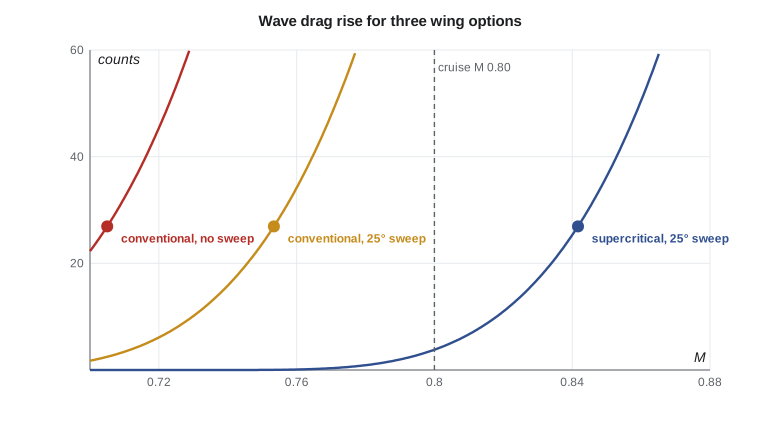
Plotting the drag coefficient against Mach number at constant lift shows the classic drag rise. Below the critical Mach number the drag is nearly constant. Above it the drag creeps up slowly at first, then rises steeply. The drag-divergence Mach number, \(M_{dd}\), marks the start of the steep rise. Two definitions are common: the Mach number at which \(dC_D/dM = 0.1\), used by most airframe companies, or the Mach number at which the drag has risen 20 counts (0.0020) above its low-speed value. For a well-designed wing the two are close. Aircraft cruise just below \(M_{dd}\), where the drag rise is still small but the speed is as high as possible.
Estimating drag divergence: the Korn equation
Detailed transonic analysis needs computational fluid dynamics, but early design needs a quick estimate. A widely used correlation is the Korn equation, proposed by David Korn in the 1970s and extended to swept wings by simple sweep theory. It relates the drag-divergence Mach number to the thickness ratio, the section lift coefficient and the sweep of the wing, with a technology factor \(\kappa\) that is about 0.87 for conventional sections of the 1950s and about 0.95 for modern supercritical sections.
The equation captures the three levers a designer has. Thinner sections delay the drag rise because they accelerate the flow less. Lower lift coefficients delay it because the suction peak is smaller. Sweep delays it because, to a first approximation, only the velocity component normal to the leading edge drives compressibility effects. Pairing the Korn estimate with Lock's empirical drag rise, in which wave drag grows as \(20(M - M_{cr})^4\) above a critical Mach number placed just below \(M_{dd}\), gives a simple model of the whole drag rise that is accurate to a few hundredths in Mach number for conventional aircraft.
# Transonic flow: the Korn equation for drag divergence and Lock's wave-drag rise
import math
def m_dd(tc, cl, sweep_deg, kappa):        # Korn equation with simple sweep theory
    c = math.cos(math.radians(sweep_deg))
    return kappa / c - tc / c**2 - cl / (10 * c**3)
def m_cr(mdd): return mdd - (0.1 / 80) ** (1 / 3)
def cd_wave(M, mcr): return 0.0 if M <= mcr else 20 * (M - mcr) ** 4
cl = 0.45                                  # cruise section lift coefficient of the business jet
print("section          sweep  t/c    Mdd    Mcr    wave drag counts at M 0.80")
for name, kappa in (("conventional", 0.87), ("supercritical", 0.95)):
    for sweep in (20, 25, 30):
        for tc in (0.10, 0.12):
            mdd = m_dd(tc, cl, sweep, kappa); mcr = m_cr(mdd)
            print(f"{name:15s} {sweep:5d} {tc:5.2f} {mdd:6.3f} {mcr:6.3f} {1e4 * cd_wave(0.80, mcr):8.1f}")
# what thickness can a supercritical wing at 25 deg sweep carry for Mdd = 0.82?
lo, hi = 0.05, 0.20
for _ in range(60):
    mid = (lo + hi) / 2
    if m_dd(mid, cl, 25, 0.95) > 0.82: lo = mid
    else: hi = mid
print(f"\nsupercritical, 25 deg sweep, Mdd 0.82: t/c up to {mid:.3f}")
# drag rise curve for the chosen wing
mcr = m_cr(m_dd(0.12, cl, 25, 0.95))
print("M      wave drag counts")
for M in (0.70, 0.74, 0.78, 0.80, 0.82, 0.84, 0.86):
print(f"{M:.2f} {1e4 * cd_wave(M, mcr):7.1f}")section sweep t/c Mdd Mcr wave drag counts at M 0.80 conventional 20 0.10 0.758 0.651 99.6 conventional 20 0.12 0.736 0.628 175.1 conventional 25 0.10 0.778 0.670 57.1 conventional 25 0.12 0.753 0.646 113.4 conventional 30 0.10 0.802 0.694 25.0 conventional 30 0.12 0.775 0.668 61.5 supercritical 20 0.10 0.843 0.736 3.4 supercritical 20 0.12 0.821 0.713 11.4 supercritical 25 0.10 0.866 0.758 0.6 supercritical 25 0.12 0.842 0.734 3.8 supercritical 30 0.10 0.894 0.787 0.0 supercritical 30 0.12 0.868 0.760 0.5 supercritical, 25 deg sweep, Mdd 0.82: t/c up to 0.138 M wave drag counts 0.70 0.0 0.74 0.0 0.78 0.9 0.80 3.8 0.82 11.0 0.84 25.3 0.86 50.5
Choosing the Swift 900's wing
The program compares twelve combinations at the cruise section lift coefficient of 0.45. A conventional section, even at 30 degrees of sweep and 10 percent thickness, diverges at Mach 0.80 and has 25 counts of wave drag at cruise, a penalty of perhaps 8 percent of total drag. Every conventional option is ruled out. A supercritical section at 20 degrees of sweep reaches \(M_{dd} = 0.82\) at 12 percent thickness. At 25 degrees, the same thickness gives \(M_{dd} = 0.842\), with under 4 counts of wave drag at Mach 0.80 and 11 counts at Mach 0.82, while the section could be as thick as 13.8 percent for drag divergence at the fast-cruise speed.
Tomasz's group chooses 25 degrees of sweep at the quarter chord and a supercritical section with a mean thickness of 12 percent, thicker at the root and thinner at the tip. The extra sweep beyond 20 degrees costs some structural weight and some low-speed lift, which the flap system must recover, but it buys margin: the drag rise lies comfortably above Mach 0.82, and the thick root carries fuel and keeps the wing box light. A wing of 30 degrees would give little extra benefit and would make the low-speed handling and the high-lift system harder.
The supercritical airfoil
A conventional airfoil accelerates the flow to a sharp suction peak near the leading edge, then decelerates it steadily. Above the critical Mach number the supersonic region it produces ends in a strong shock. The supercritical airfoil, developed by Richard Whitcomb at NASA Langley in the 1960s, reshapes the section to manage the supersonic pocket. Its upper surface is relatively flat, so the flow accelerates to a moderate, almost uniform supersonic Mach number over much of the chord, and the shock at the end of the pocket is weak. Its lower surface is cambered strongly near the trailing edge, an effect called aft loading, so that the section still carries plenty of lift despite the flat top. Its leading edge is relatively large and round, which helps at low speed and spreads the expansion.
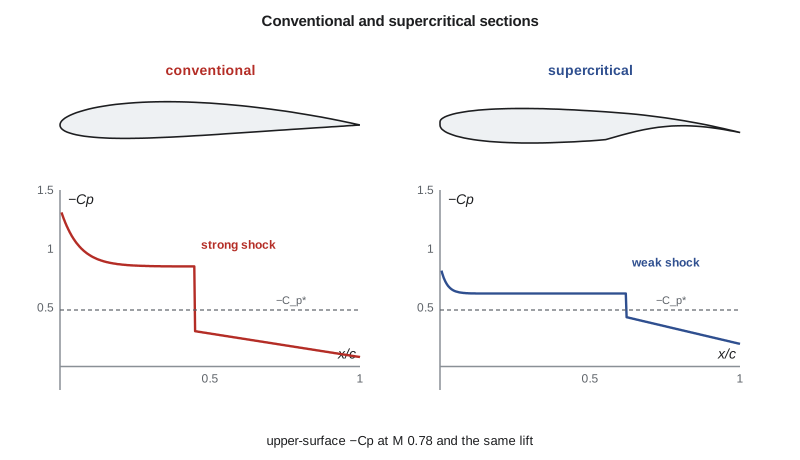
At the design condition, the expansion waves leaving the upper surface reflect from the sonic line as compression waves, and a well-designed supercritical section arranges for those compressions to slow the flow gradually, so that the terminating shock is weak or nearly absent. Supercritical sections allow either a higher cruise Mach number for the same thickness, or a thicker, lighter, more spacious wing at the same Mach number, or less sweep. Most transport and business jets since the 1980s use them, usually trading the gain mainly for thickness and lower weight rather than speed.
The area rule
Near Mach 1 the whole aircraft, not just the wing, produces wave drag. Whitcomb's earlier discovery, in the early 1950s, was that the transonic wave drag of a complete aircraft depends mainly on the way its cross-sectional area varies along its length, not on its detailed shape. An aircraft whose area distribution is smooth, close to that of a slender body of revolution, has low wave drag. Where the wing joins the fuselage, the area jumps; reducing the fuselage cross section there, the waisted or Coke-bottle shape, smooths the distribution. The area rule transformed fighter design in the 1950s. For a business jet cruising at Mach 0.80 the effect is smaller, but the engine nacelles, wing-fuselage fairing and tail are still shaped with the area distribution in mind, and the Swift 900's rear-mounted nacelles are placed where they add least to the area peak.
Handling problems near Mach 1
Transonic flow brings handling problems as well as drag. As the shock on the upper surface moves aft with increasing Mach number, the centre of pressure moves aft, and the aircraft tends to pitch nose-down, an effect called Mach tuck. Early jets lost control in dives this way; modern aircraft use a Mach trim system that automatically adjusts the trim as the Mach number rises, and they observe a maximum operating Mach number with a margin below the buffet boundary. The certification rules of Transport Canada require demonstrated margins between the cruise lift coefficient and the onset of buffet, which in practice means the wing must be able to pull about 1.3 g at cruise Mach number before buffet starts. Those margins, as much as drag, set how fast and how high the Swift 900 can fly.
Transonic flows are also the hardest to test. Wind tunnel walls choke near Mach 1 unless they are slotted or porous, and the Reynolds number of most tunnels is far below that of flight, which matters because the shock position depends on the boundary layer. Cryogenic tunnels, which cool the nitrogen test gas to around 100 K to raise its density and lower its viscosity, reach flight Reynolds numbers for transport aircraft models. The Swift 900 programme will rely mostly on computational fluid dynamics calibrated against transonic tunnel data, with a tunnel entry to confirm buffet onset.
Worked problem
Drag divergence of a straight wing
An early straight-wing design uses a 12 percent conventional section at a section lift coefficient of 0.45. Estimate its drag-divergence Mach number.
Show solution
- \(M_{dd} = 0.87 - 0.12 - 0.045 = 0.705\).
Answer: About Mach 0.70. That is close to the cruise speed of a turboprop-era airliner and far short of the Swift 900's target, which is why jets need sweep.
Worked problem
Effect of sweep on the effective Mach number
The Swift 900 cruises at Mach 0.80 with 25 degrees of sweep. What Mach number does the flow normal to the leading edge see, by simple sweep theory?
Show solution
- \(M_n = 0.80\cos 25° = 0.725\).
Answer: About 0.73, comparable with a straight wing at the speed of a turboprop. In practice the benefit is somewhat less than simple sweep theory suggests, especially near the root and tip, which is why the Korn equation uses partial cosine factors rather than a full transformation.
Common mistakes
MistakeAssuming wave drag starts at the critical Mach number.
InsteadIt starts there but stays small until the drag-divergence Mach number, typically about 0.05 to 0.1 higher.
MistakeTreating a supercritical section as shock-free at all conditions.
InsteadIt is designed for a weak shock at one condition; off-design it can still form strong shocks.
MistakeApplying full simple sweep theory near the wing root and tip.
InsteadThe flow there is not that of an infinite swept wing, and the benefit of sweep is reduced.
MistakeIgnoring buffet margins when choosing cruise altitude.
InsteadThe wing must reach about 1.3 g before buffet at cruise Mach number.
Summary and key terms
- Above the critical Mach number a supersonic pocket forms on the wing and ends in a shock, which produces wave drag and can separate the boundary layer, causing buffet.
- The drag-divergence Mach number marks the steep rise in drag.
- The Korn equation estimates it from thickness, lift and sweep, with a factor that is higher for supercritical sections.
- Supercritical airfoils have flat upper surfaces, aft loading and weak terminal shocks, and allow thicker or less swept wings.
- The area rule smooths the cross-sectional area distribution to reduce transonic wave drag.
- Mach tuck and buffet margins limit transonic operation.
- Transonic flow
- Flow with both subsonic and supersonic regions, typical of jets near Mach 0.8.
- Drag-divergence Mach number
- The Mach number at which drag begins to rise steeply, often defined by dC_D/dM = 0.1.
- Wave drag
- Drag caused by the entropy produced in shock waves.
- Shock-induced separation
- Boundary-layer separation caused by the pressure rise across a shock.
- Supercritical airfoil
- A section designed to hold a flat supersonic region ending in a weak shock.
- Area rule
- The principle that transonic wave drag depends mainly on the distribution of cross-sectional area.
- Mach tuck
- The nose-down pitching tendency caused by the aft shift of the shock near Mach 1.
Practice problems
Work each problem on paper first, then reveal the answer to check.
From the program, what is M_dd for a conventional 10 percent section at 25° of sweep?
Show answer
About 0.778.
What thickness ratio would a supercritical section at 25° need for M_dd = 0.85?
Show answer
About 0.11, found by changing the target in the program.
Using Lock's rule with M_cr = 0.734, what is the wave drag at Mach 0.83 in counts?
Show answer
20 × 0.096⁴ × 10⁴ ≈ 17 counts.
Why does aft loading help a supercritical airfoil?
Show answer
It carries lift on the lower rear surface, so the flat upper surface does not need a high suction peak.
State two definitions of the drag-divergence Mach number.
Show answer
dC_D/dM = 0.1, or a 20-count rise above the low-speed drag.
Why do transonic wind tunnels use slotted or porous walls?
Show answer
To prevent the test section choking near Mach 1 and to absorb waves that would otherwise reflect onto the model.
Lesson quiz · 5 questions
Score 60% or more to complete this lesson.
Create a free account to save your progress, take quizzes and earn a certificate.