
AERO-320 · Lesson 1 of 12 · 24 min
Compressibility and the speed of sound
The Tern turboprop that Borealis Aerospace builds in Winnipeg cruises at about a third of the speed of sound. At that speed the air flowing over its wing changes density by only a few percent, and the incompressible methods of AERO-300 work very well. The company's next project is different. Élise Fournier, the chief engineer, has asked Tomasz Wierzbicki's aerodynamics group to study the Swift 900, a twin-engine light business jet that would cruise at Mach 0.80 at 12,500 m . At that speed the air over the upper surface of the wing goes supersonic, shock waves appear, and drag rises steeply if the wing is not designed for it. The same study includes engine inlets and exhaust nozzles, and a research collaboration with the National Research Council that will put supersonic models in the National Research Council 1.5 m trisonic wind tunnel in Ottawa. Arjun Mehta, now in his final co-op term, joins the new high-speed group under Dr. Kenji Watanabe. This course follows that work, from the speed of sound to the edge of hypersonic flight.
What compressibility means
Every fluid is compressible to some degree: squeeze it and its density rises. What matters in aerodynamics is not whether a fluid can be compressed but whether the flow actually compresses it. For a gas the answer depends on how fast the flow moves compared with the speed at which pressure disturbances travel through it. That speed is the speed of sound, and the ratio of the flow speed to the local speed of sound is the Mach number.
A useful way to see why the Mach number controls compressibility is to ask how much the density changes when moving air is brought to rest. Bernoulli's equation says the pressure rise is about one dynamic pressure, \(\tfrac{1}{2}\rho V^2\). For a gas the pressure change and density change are linked by the speed of sound, \(dp = a^2\,d\rho\). Dividing gives a fractional density change of about \(\tfrac{1}{2}M^2\). At Mach 0.3 that is about 4.5 percent, which is why aerodynamicists traditionally treat flows below Mach 0.3 as incompressible. At Mach 0.8 the change is over a third, and no incompressible method can be trusted.
Mass flow, momentum and energy are all affected. In incompressible flow, continuity says that a stream tube which narrows must speed up in proportion. In compressible flow the density also changes, and above Mach 1 it changes so strongly that a narrowing tube actually slows the flow down. This reversal, which we shall meet in Lesson 2, explains why a rocket or wind tunnel nozzle must first converge and then diverge, and why a supersonic inlet must do the opposite.
The speed of sound
A sound wave is a very weak pressure pulse moving through the air. Consider a wave travelling into still air and look at it from a frame moving with the wave, so the wave stands still and the air flows through it. Mass conservation across the wave gives \(\rho a = (\rho + d\rho)(a + du)\), and momentum gives \(dp = -\rho a\,du\). Eliminating \(du\) shows that the wave speed satisfies \(a^2 = dp/d\rho\). Because the changes in a sound wave are tiny and happen too quickly for heat to flow, the process is isentropic, so the derivative is taken at constant entropy.
For a calorically perfect gas, \(p/\rho^\gamma\) is constant along an isentrope, which gives the second form. The speed of sound depends only on temperature, not on pressure or density. Air has \(\gamma = 1.4\) and \(R = 287\ \text{J/(kg K)}\), so at the standard sea-level temperature of 288.15 K the speed of sound is 340.3 m/s. In the cold air of the stratosphere, at 216.65 K, it falls to 295.1 m/s. A jet flying at a fixed Mach number therefore flies more slowly through the air at altitude. The Swift 900 at Mach 0.80 would move at 272 m/s near sea level but only 236 m/s at its cruise altitude.
Newton was the first to calculate the speed of sound, in the late seventeenth century, but he assumed the process was isothermal and got a value about 15 percent too low. Laplace corrected the result early in the nineteenth century by recognizing that sound waves are adiabatic, which introduces the factor \(\gamma\). The correction is a good reminder that the thermodynamics of the process matters as much as its mechanics.
The Mach cone and the zone of silence
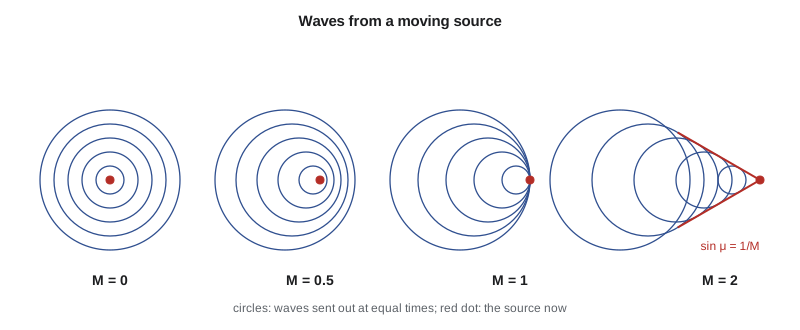
Picture a small source moving through still air and sending out a pressure pulse at regular intervals. Each pulse spreads as a sphere at the speed of sound. If the source moves slowly, the spheres crowd together in front of it and spread apart behind it, but every sphere still surrounds the source, so the air ahead receives a warning that something is coming. Streamlines bend smoothly around a subsonic wing long before the air reaches it, because the pressure field of the wing reaches far upstream.
At Mach 1 the source keeps pace with its own waves, and they pile up into a single front. Above Mach 1 the source outruns them. All the spheres lie inside a cone whose apex is at the source, and the air outside the cone, including all the air ahead, knows nothing of the source until the cone arrives. This is the zone of silence. The half-angle of the cone is the Mach angle, given by \(\sin\mu = 1/M\): 90 degrees at Mach 1, 30 degrees at Mach 2 and under 12 degrees at Mach 5. In a supersonic flow the air cannot adjust gradually to an obstacle, so it adjusts suddenly, through shock waves, or by turning through expansion fans. These are the subjects of Lessons 3 to 5.
Flow regimes
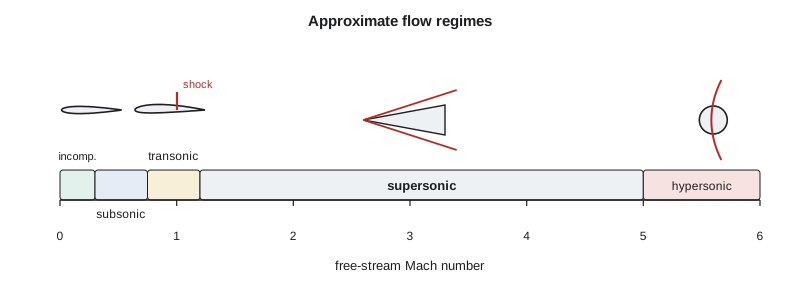
Aerodynamicists divide flows into regimes by Mach number, although the boundaries are not sharp. Below about Mach 0.3 the flow is effectively incompressible. Up to the critical Mach number, typically 0.6 to 0.75 for an aircraft, the flow is compressible but subsonic everywhere, and the corrections of Lesson 9 apply. Above the critical Mach number, local pockets of supersonic flow appear on the body, usually ending in a shock. This transonic regime, roughly Mach 0.8 to 1.2, is the hardest to analyse and the most important commercially, because almost every jet airliner and business jet cruises in it. Above about Mach 1.2 the whole flow is supersonic, apart from small regions near blunt noses. Above about Mach 5 the flow is called hypersonic: shocks lie close to the body, temperatures become high enough to change the chemistry of the air, and new methods are needed. Lesson 12 introduces that regime.
Compressibility and the airspeed indicator
The first practical effect a pilot meets is in the airspeed indicator. A pitot tube measures the total pressure of the air brought to rest in its mouth, and a static port measures the ambient pressure. For incompressible flow the difference is exactly the dynamic pressure. In compressible flow, bringing the air to rest compresses it, and the pitot reads more than the dynamic pressure. The ratio of the pitot-static difference to the true dynamic pressure is 1.023 at Mach 0.3, 1.064 at Mach 0.5 and 1.170 at Mach 0.8. An instrument that used the incompressible formula would read 17 percent too much dynamic pressure at the Swift 900's cruise speed. Aircraft instruments and air data computers therefore use the compressible relation, derived in Lesson 2, and pilots distinguish calibrated, equivalent and true airspeed partly because of it.
# Speed of sound, Mach number and when compressibility matters
import math
G, R = 1.4, 287.05                       # ratio of specific heats and gas constant for air
def isa(h):                              # standard atmosphere up to 20 km: temperature, pressure, density
    if h <= 11000:
        T = 288.15 - 0.0065 * h
        p = 101325 * (T / 288.15) ** 5.2559
    else:
        T = 216.65
        p = 22632 * math.exp(-(h - 11000) / (R * T / 9.80665))
    return T, p, p / (R * T)
print("altitude m   T K   a m/s   speed at M 0.80 (m/s, km/h)")
for h in (0, 3000, 6000, 9000, 11000, 12500):
    T, p, rho = isa(h)
    a = math.sqrt(G * R * T)
    print(f"{h:9d} {T:7.1f} {a:7.1f}   {0.8 * a:6.1f} {0.8 * a * 3.6:7.0f}")
# how much does density change when the air is brought to rest?
print("\nMach   rho0/rho - 1 (percent)")
for M in (0.1, 0.2, 0.3, 0.5, 0.8):
    r = (1 + (G - 1) / 2 * M * M) ** (1 / (G - 1))
    print(f"{M:4.1f}   {100 * (r - 1):6.2f}")
# error in dynamic pressure if Bernoulli is used for the pitot reading
print("\nMach   (p0 - p)/q  compressible   error of incompressible pitot (percent)")
for M in (0.3, 0.5, 0.8):
    ratio = ((1 + (G - 1) / 2 * M * M) ** (G / (G - 1)) - 1) / (G / 2 * M * M)
print(f"{M:4.1f} {ratio:8.4f} {100 * (ratio - 1):5.2f}")altitude m T K a m/s speed at M 0.80 (m/s, km/h)
0 288.1 340.3 272.2 980
3000 268.6 328.6 262.9 946
6000 249.1 316.4 253.1 911
9000 229.6 303.8 243.0 875
11000 216.6 295.1 236.1 850
12500 216.7 295.1 236.1 850
Mach rho0/rho - 1 (percent)
0.1 0.50
0.2 2.01
0.3 4.56
0.5 12.97
0.8 35.14
Mach (p0 - p)/q compressible error of incompressible pitot (percent)
0.3 1.0227 2.27
0.5 1.0641 6.41
0.8 1.1704 17.04The program shows three things the Swift 900 team must design around. First, the speed of sound falls by about 13 percent between sea level and 11 km, then stays constant in the lower stratosphere because the temperature does. Second, the density change rises as roughly the square of the Mach number: 0.5 percent at Mach 0.1, 4.6 percent at Mach 0.3 and 35 percent at Mach 0.8. Third, the incompressible pitot error grows in the same way. A designer who carries incompressible habits into high-speed work makes errors that grow with the square of the speed.
Thermodynamics needed for this course
Compressible flow combines fluid mechanics with thermodynamics, and the course uses a small set of results from MEC-230 and MEC-330. Air at the temperatures met in this course behaves as a calorically perfect gas: it obeys \(p = \rho R T\), and its specific heats \(c_p\) and \(c_v\) are constant, with \(c_p - c_v = R\) and \(\gamma = c_p/c_v\). For air \(c_p = 1005\ \text{J/(kg K)}\). Enthalpy is \(h = c_p T\). Entropy changes follow from the Gibbs equation: \(s_2 - s_1 = c_p\ln(T_2/T_1) - R\ln(p_2/p_1)\). A flow that is adiabatic and has no friction or shocks is isentropic, and along an isentrope \(p\), \(\rho\) and \(T\) are linked by simple power laws with exponents built from \(\gamma\).
Above about 800 K the specific heats of air begin to rise as molecular vibrations are excited, and above about 2,500 K oxygen begins to dissociate. Those effects matter in combustors, rocket nozzles and re-entry, and are noted where they appear. For flight up to about Mach 4 and for wind tunnels, the perfect-gas model is accurate to a few percent, and it is the basis of the standard compressible-flow tables that every aerospace engineer uses. In this course those tables are generated by short programs instead of printed pages.
Revisiting the governing equations
AERO-300 derived the continuity, momentum and energy equations and then simplified them by assuming constant density. In compressible flow that simplification is not allowed, and the energy equation becomes coupled to the others: temperature changes alter the speed of sound and the density, which alter the velocity field. For steady adiabatic flow with no shaft work, the energy equation integrates to a very useful result: the total enthalpy \(h + \tfrac{1}{2}V^2\) is constant along a streamline. With \(h = c_pT\) this defines the stagnation temperature \(T_0\), the temperature the air would reach if brought to rest adiabatically.
Unlike Bernoulli's equation, this energy equation remains true through shock waves and in the presence of friction, provided no heat is added. That makes the stagnation temperature one of the most robust quantities in high-speed flow. At the Swift 900's cruise condition it is about 28 K above the ambient temperature, which is why the leading edges, windshield and engine inlets of fast aircraft are noticeably warmer than the surrounding air. At Mach 2 the rise is 80 percent of the ambient absolute temperature, which is why supersonic airliners were built of heat-resistant aluminium alloys and why their fuselages grew measurably longer in flight.
Worked problem
Mach number of the Swift 900 in a climb
During a climb the Swift 900 passes 6,000 m at a true airspeed of 220 m/s. The outside air temperature is 249 K. Find the Mach number.
Show solution
- \(a = \sqrt{1.4\times 287\times 249} = 316.3\ \text{m/s}\).
- \(M = 220/316.3 = 0.696\).
Answer: About Mach 0.70. The same true airspeed at sea level would be only Mach 0.65 because the warmer air has a higher speed of sound.
Worked problem
Is the incompressible assumption acceptable?
A wind tunnel test of a Tern model runs at 80 m/s in air at 290 K. Estimate the fractional density change at the stagnation point.
Show solution
- \(a = \sqrt{1.4\times 287\times 290} = 341.4\ \text{m/s}\), so \(M = 0.234\).
- \(\Delta\rho/\rho \approx \tfrac{1}{2}M^2 = 0.027\).
Answer: About 2.7 percent at the stagnation point and less elsewhere. The incompressible assumption is acceptable for the pressure distribution, although careful work still applies a small compressibility correction to the measured dynamic pressure.
Common mistakes
MistakeUsing the sea-level speed of sound at altitude.
InsteadThe speed of sound depends on the local temperature. Use \(a = \sqrt{\gamma R T}\) with the actual temperature.
MistakeTreating the Mach number as a fixed property of the aircraft.
InsteadMach number depends on the local air. The same true airspeed gives a higher Mach number in colder air.
MistakeApplying Bernoulli's equation to a pitot reading at Mach 0.8.
InsteadThe pitot reads more than the dynamic pressure in compressible flow. Use the compressible relation.
MistakeAssuming the speed of sound depends on pressure.
InsteadFor a perfect gas it depends only on temperature.
Summary and key terms
- Compressibility matters when the flow speed is a significant fraction of the speed of sound.
- The speed of sound in a perfect gas is the square root of gamma R T and depends only on temperature.
- The fractional density change of a flow brought to rest is about half the Mach number squared, so flows below Mach 0.3 are usually treated as incompressible.
- Above Mach 1 disturbances are confined to a Mach cone of half-angle sin to the minus one of one over M.
- Flow regimes run from incompressible through subsonic, transonic and supersonic to hypersonic.
- The stagnation temperature is constant in adiabatic flow even through shocks.
- Mach number
- The ratio of the flow speed to the local speed of sound.
- Speed of sound
- The speed of a weak pressure wave, the square root of gamma R T for a perfect gas.
- Compressible flow
- Flow in which density changes significantly, usually above about Mach 0.3.
- Mach angle
- The half-angle of the Mach cone, sin mu = 1/M.
- Zone of silence
- The region outside the Mach cone that has not yet received any disturbance from a supersonic source.
- Transonic flow
- Flow containing both subsonic and supersonic regions, roughly Mach 0.8 to 1.2.
- Stagnation temperature
- The temperature reached if the flow is brought to rest adiabatically.
Practice problems
Work each problem on paper first, then reveal the answer to check.
Find the speed of sound at 223 K.
Show answer
a = √(1.4 × 287 × 223) = 299.3 m/s.
A jet flies at 250 m/s at 11,000 m where T = 216.65 K. What is its Mach number?
Show answer
a = 295.1 m/s, so M = 0.847.
What is the Mach angle at Mach 1.5?
Show answer
μ = sin⁻¹(1/1.5) = 41.8°.
Estimate the fractional density change at the nose of a car at 40 m/s.
Show answer
M = 0.118, so about 0.7 percent.
Using the program, how large is the incompressible pitot error at Mach 0.5?
Show answer
About 6.4 percent too high in dynamic pressure.
Find the stagnation temperature for flight at Mach 0.80 in air at 216.65 K.
Show answer
T₀ = 216.65(1 + 0.2 × 0.64) = 244.4 K.
Lesson quiz · 5 questions
Score 60% or more to complete this lesson.
Create a free account to save your progress, take quizzes and earn a certificate.