
AERO-320 · Lesson 7 of 12 · 24 min
Supersonic wind tunnels
The test campaign in the National Research Council 1.5 m trisonic wind tunnel in Ottawa gives Arjun his first look inside a supersonic wind tunnel. A low-speed tunnel such as the one used for the Tern Block 2 wing in AERO-300 is little more than a fan, a contraction and a test section. A supersonic tunnel is a much more demanding machine. It must accelerate air through a carefully shaped converging-diverging nozzle, hold a uniform flow at the test Mach number, start through a shock that briefly travels the length of the test section, and then slow the air again with as little loss as possible. Every element follows from the theory of Lessons 2 to 6, and this lesson puts it together.
The layout of a supersonic tunnel
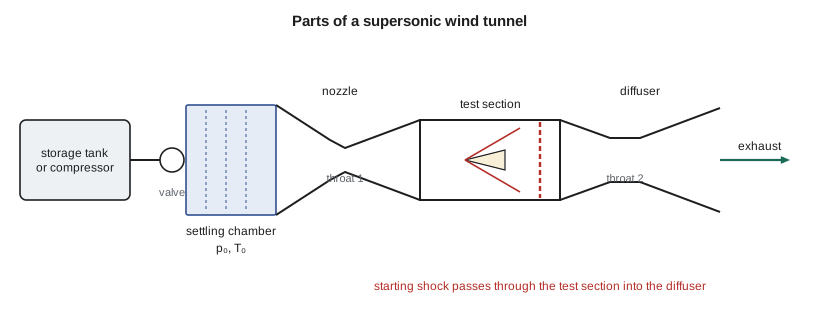
A supersonic tunnel has five main parts. A settling chamber holds the air almost at rest, at the stagnation pressure and temperature that set the test conditions, with screens and honeycomb to smooth the flow. A converging-diverging nozzle accelerates the air to the test Mach number. Its area ratio fixes that Mach number: from the area-Mach relation, Mach 2 needs an exit area 1.69 times the throat, Mach 3 needs 4.2 times and Mach 4 almost 11 times. The test section holds the model, usually with windows for optical measurements. A diffuser slows the air again, ideally through a second throat. Finally the air is either returned to the compressor in a closed circuit or discharged to the atmosphere or to a vacuum tank.
Designing the nozzle
The area ratio alone is not enough. A nozzle that simply widens from the throat to the test section along a straight line would produce a flow full of expansion and compression waves, non-uniform in both Mach number and direction. A good supersonic nozzle has a carefully contoured wall that first turns the flow outward, generating expansion waves that accelerate it, and then turns the wall back so that every wave arriving at the wall is cancelled rather than reflected. The method of characteristics introduced in Lesson 5 was developed largely for this purpose. The result is a test section where the Mach number varies by less than about half a percent across the core of the flow.
Changing the test Mach number means changing the nozzle. Some tunnels have a set of fixed nozzle blocks, each giving one Mach number, swapped between test series. Others have flexible steel plates whose contour is set by jacks, so the Mach number can be changed without stopping for long. Still others use a sliding block that changes the throat area while the upper and lower walls remain fixed. The choice is a trade between flow quality, the cost of the mechanism and how quickly a test programme can move from one Mach number to the next.
Starting a supersonic tunnel
When a supersonic tunnel is started, the pressure ratio across it rises from zero. At first the throat chokes and a normal shock forms just downstream of it, as in the nozzle of Lesson 6. As the pressure ratio rises, the shock moves downstream through the nozzle and into the test section. To reach the diffuser, the shock must pass through the test section at the full test Mach number, where it is at its strongest. Behind it the stagnation pressure has fallen by the normal-shock ratio, so the diffuser must be able to pass the same mass flow at that reduced stagnation pressure.
If the diffuser has a second throat of area \(A_{t2}\), the mass flow through it, choked at the lower stagnation pressure, must at least equal the flow through the first throat \(A_{t1}\). Since \(p_0A^*\) is constant, the second throat must be larger than the first by the normal-shock stagnation pressure ratio.
For a Mach 2 test section the second throat must be at least 1.39 times the first; for Mach 3 it must be 3.05 times, and for Mach 4 over 7 times. Once the shock has been swallowed, it passes through the second throat and the flow in the diffuser can be supersonic again, with a weak shock near the second throat. A variable second throat can then be closed down to improve the pressure recovery while the tunnel runs. If the second throat is too small, the shock cannot pass, the tunnel will not start, and the test section remains filled with subsonic flow behind a shock: the tunnel is said to be blocked or unstarted. Models that are too large for the test section cause the same problem, because they reduce the effective area available to the flow.
# Supersonic wind tunnels: nozzle and diffuser throats, starting, and blowdown run time
import math
G, R = 1.4, 287.05
def A_Astar(M): return (1 / M) * ((2 / (G + 1)) * (1 + (G - 1) / 2 * M * M)) ** ((G + 1) / (2 * (G - 1)))
def p0_normal(M):
    p21 = 1 + 2 * G / (G + 1) * (M**2 - 1); r21 = (G + 1) * M**2 / ((G - 1) * M**2 + 2)
    return r21 ** (G / (G - 1)) * (1 / p21) ** (1 / (G - 1))
def p_p0(M): return (1 + (G - 1) / 2 * M * M) ** (-G / (G - 1))
print(" test M  nozzle A/A*  second-throat ratio At2/At1")
for M in (1.5, 2.0, 2.5, 3.0, 4.0):
    ratio = 1 / p0_normal(M)          # diffuser throat must pass the flow after the starting shock
    print(f"{M:6.1f} {A_Astar(M):11.3f} {ratio:20.3f}")
# blowdown tunnel: a storage tank feeds a regulated settling chamber
V_tank = 1500.0                       # tank volume, m3 (study value)
p_start, T_tank = 2.07e6, 290.0       # tank pressure (about 300 psi) and temperature
M, A_test = 2.0, 1.5 * 1.5            # test Mach number and section area, m2
A_throat = A_test / A_Astar(M)
p0 = 300e3                            # regulated stagnation pressure for the run, Pa
p_min = p0 * 1.10                     # the regulator needs some margin above p0
def mdot(p0, T0): return A_throat * p0 / math.sqrt(T0) * math.sqrt(G / R) * (2 / (G + 1)) ** ((G + 1) / (2 * (G - 1)))
# emptying of the tank in small time steps (n = 1.4 adiabatic, n = 1.0 isothermal limit);
# the regulator holds p0, so the mass flow stays at its starting value
for n in (1.4, 1.0):
    m = p_start * V_tank / (R * T_tank); t = 0.0; p = p_start; T = T_tank; dt = 0.1
    m0, p00 = m, p_start
    while p > p_min:
        m -= mdot(p0, T_tank) * dt; t += dt
        p = p00 * (m / m0) ** n
    print(f"n = {n}: run time about {t:.0f} s with the {p0 / 1e3:.0f} kPa run, tank falls to {p / 1e6:.2f} MPa")
q = 0.5 * G * p0 * p_p0(M) * M * M
print(f"throat {A_throat:.3f} m2, mass flow {mdot(p0, T_tank):.1f} kg/s, test dynamic pressure {q / 1e3:.1f} kPa")
# a continuous tunnel needs a compressor pressure ratio at least the starting value
print(f"continuous tunnel at M 2.0: compressor pressure ratio at least about {1 / p0_normal(2.0):.2f} plus losses")test M nozzle A/A* second-throat ratio At2/At1 1.5 1.176 1.076 2.0 1.688 1.387 2.5 2.637 2.004 3.0 4.235 3.046 4.0 10.719 7.207 n = 1.4: run time about 29 s with the 300 kPa run, tank falls to 0.33 MPa n = 1.0: run time about 33 s with the 300 kPa run, tank falls to 0.33 MPa throat 1.333 m2, mass flow 949.3 kg/s, test dynamic pressure 107.4 kPa continuous tunnel at M 2.0: compressor pressure ratio at least about 1.39 plus losses
Blowdown and continuous tunnels
There are two ways to supply the large mass flow a supersonic tunnel needs. A blowdown tunnel stores high-pressure air in tanks, filled slowly by a modest compressor over minutes or hours, and releases it through a control valve for a run of seconds to a minute. A pressure regulator holds the settling-chamber pressure constant while the tank pressure falls. The run ends when the tank pressure is too low for the regulator to maintain the required stagnation pressure. A continuous tunnel uses large compressors to circulate the air for as long as needed, at the cost of far higher installed power.
the National Research Council 1.5 m trisonic wind tunnel in Ottawa is a blowdown tunnel. Its supersonic runs last 30 to 40 seconds at Mach numbers below 4, the tanks are recharged in under 30 minutes, and the supersonic nozzle provides 16 fixed Mach numbers between 1 and 4.25. Because the stagnation pressure can be set independently of the Mach number, the Reynolds number of a test can be varied while the Mach number is held, a valuable feature when results must be extrapolated to flight. The same tunnel can also run subsonic and transonic tests at continuously variable Mach numbers up to about 1.2.
The program estimates the run time of a blowdown tunnel with a 1.5 m square test section at Mach 2, fed from a 1,500 m³ tank at about 2 MPa and regulated to a stagnation pressure of 300 kPa. The throat must pass about 950 kg of air per second. If the air in the tank expands adiabatically as it empties, the tank cools and its pressure falls quickly, giving about 29 seconds; if heat from the tank walls kept the air at constant temperature, the run would last about 33 seconds. Real tanks fall between the two limits, and many blowdown tunnels pack their tanks with metal to hold the temperature nearer to the isothermal case. The test section dynamic pressure is 107 kPa, which sets the loads the model and its sting must carry.
Flow quality and measurements
Supersonic tunnels share several problems that low-speed tunnels do not have. The static temperature in the test section is very low, 161 K at Mach 2 with a 290 K supply, so any water vapour condenses into a fog that alters the flow; the air is dried to a dew point well below minus 40 degrees. The walls carry thick boundary layers that grow along the nozzle and test section and must be allowed for in the nozzle contour. Shocks from the model reflect from the walls and can strike the model again if the test section is too small; the model must be small enough that its reflected bow shock passes behind it. At transonic speeds the walls are made porous or slotted to absorb waves, because a solid wall would choke the test section at Mach 1.
Supersonic flows are well suited to optical measurement because the density changes strongly across shocks and expansions. Schlieren systems, which show density gradients, and shadowgraphs, which show their second derivative, have been used since the nineteenth century and remain the first tool for checking a shock pattern. Pressure-sensitive paint, which glows with a brightness that depends on the local oxygen pressure, gives the full surface pressure field of a model in a single image. Balances measure the forces and moments, and pitot rakes measure the stagnation pressure recovery at the exit of an inlet model, as in the campaign the high-speed group is supporting.
Model scaling and what tunnels cannot do
Like a low-speed tunnel, a supersonic tunnel matches the Mach number exactly but usually falls short of the flight Reynolds number. The effect is smaller than at low speed for features dominated by shocks and expansions, which depend mainly on Mach number, but large for boundary-layer transition, separation and shock-boundary-layer interaction. Tunnels also cannot match the temperatures of real high-speed flight: a Mach 3 tunnel with room-temperature supply air has a stagnation temperature near 290 K, while a vehicle flying at Mach 3 at altitude has a stagnation temperature of about 600 K. For hypersonic tests the air must be heated, often electrically or with combustion, and run times become very short. Lesson 12 returns to this limitation.
Worked problem
Second throat for a Mach 2.5 nozzle block
A tunnel's Mach 2.5 nozzle block has a first throat of 0.20 m². What is the minimum area of the second throat needed to start the tunnel?
Show solution
- Normal shock at Mach 2.5: \(p_{02}/p_{01} = 0.499\).
- \(A_{t2} \ge 0.20/0.499 = 0.40\ \text{m}^2\).
Answer: At least 0.40 m², twice the first throat. After starting, the second throat could be closed somewhat to reduce the strength of the diffuser shock.
Worked problem
Test section temperature and condensation
A Mach 3 test is run with dry air supplied at 290 K. What is the static temperature in the test section?
Show solution
- \(T = 290/(1 + 0.2\times 9) = 290/2.8 = 103.6\ \text{K}\).
Answer: About 104 K, or minus 170 degrees Celsius. Even the nitrogen and oxygen in the air come close to condensing at higher Mach numbers, which is why hypersonic tunnels heat their supply air.
Common mistakes
MistakeSizing the diffuser second throat equal to the first throat.
InsteadIt must pass the flow at the reduced stagnation pressure behind the starting shock, so it must be larger by p₀₁/p₀₂.
MistakeAssuming a straight-walled diverging nozzle gives uniform flow.
InsteadA contoured wall designed by characteristics is needed to cancel the expansion waves.
MistakeTesting too large a model.
InsteadA large model blocks the test section and can prevent the tunnel from starting; its reflected shocks may also strike it.
MistakeForgetting to dry the air.
InsteadThe low static temperature makes water vapour condense into fog in the test section.
Summary and key terms
- A supersonic wind tunnel has a settling chamber, a contoured converging-diverging nozzle, a test section, a diffuser with a second throat, and a supply that is either stored air for a blowdown run or continuous compressors.
- The nozzle area ratio fixes the test Mach number, and its contour is designed to cancel waves.
- To start, the normal shock must pass through the test section, so the second throat must exceed the first by the normal-shock stagnation pressure ratio.
- Blowdown run time depends on the tank volume, pressure and thermal behaviour.
- Low static temperatures, wall boundary layers, reflected shocks and Reynolds number mismatch limit what tunnels can simulate.
- Settling chamber
- The low-speed section upstream of the nozzle where the stagnation conditions are set.
- Second throat
- A minimum area in the diffuser that lets the starting shock pass and improves pressure recovery.
- Tunnel start
- The process in which the normal shock moves through the test section into the diffuser.
- Unstart
- A condition in which the shock stays upstream and the test section flow is subsonic.
- Blowdown tunnel
- A tunnel supplied by air stored at high pressure, giving short runs.
- Continuous tunnel
- A tunnel driven by compressors that can run for long periods.
- Schlieren
- An optical method that shows density gradients in a flow.
Practice problems
Work each problem on paper first, then reveal the answer to check.
From the program, what is the minimum second-throat ratio for a Mach 3 nozzle?
Show answer
About 3.05.
What nozzle area ratio is needed for Mach 1.5?
Show answer
A/A* = 1.176.
Change the program's tank volume to 1,000 m³. Roughly how long is the adiabatic run?
Show answer
About two thirds as long, near 20 seconds.
Why does a blowdown tank's pressure fall faster when the air expands adiabatically?
Show answer
The air also cools as it expands, which lowers the pressure further for the same mass remaining.
What is the test section static temperature at Mach 2 with a 290 K supply?
Show answer
290/1.8 = 161 K.
Give one reason slotted walls are used at transonic speeds.
Show answer
Solid walls would choke the test section near Mach 1 and reflect waves onto the model.
Lesson quiz · 5 questions
Score 60% or more to complete this lesson.
Create a free account to save your progress, take quizzes and earn a certificate.