
AERO-320 · Lesson 3 of 12 · 22 min
Normal shock waves
The first supersonic test in the collaboration with the National Research Council is a calibration run: before any model goes into the trisonic tunnel, the high-speed group must know exactly what Mach number the test section delivers. Kenji Watanabe hands Arjun a pitot probe reading and a static pressure and asks for the Mach number. Arjun's first attempt uses the isentropic formula from Lesson 2 and gets Mach 1.83. Kenji shakes his head: in supersonic flow there is a shock in front of the probe, and the air does not reach the probe isentropically. The correct answer is Mach 2.07. Understanding why requires the theory of the normal shock wave, the simplest and most important discontinuity in gas dynamics.
What a shock wave is
Lesson 1 showed that a supersonic flow receives no warning of an obstacle ahead. It must still slow down and turn to get around the obstacle, and it does so abruptly, in a shock wave. A shock is an extremely thin region, only a few molecular mean free paths thick, in which the pressure, temperature and density jump upward and the velocity drops. At sea level a shock is less than a micrometre thick. On the scale of an aircraft it is a true discontinuity, and the theory treats it as a surface across which the flow properties change instantly.
Inside the shock, viscosity and heat conduction are intense, so the process is irreversible and entropy rises. Outside it, the flow is isentropic. The theory does not need to describe the inside of the shock at all. It applies the conservation laws to a thin control volume enclosing the shock and finds the downstream state directly from the upstream state. The simplest case is the normal shock, which stands perpendicular to the flow. It forms in front of a blunt body on the stagnation streamline, inside supersonic inlets and diffusers, and in a nozzle running below its design pressure ratio.
The conservation equations across a normal shock
Take a control volume of unit area enclosing a stationary normal shock. Upstream conditions carry the subscript 1 and downstream conditions the subscript 2. With no area change, no heat added and no work done, the three conservation laws are very simple.
With the perfect-gas relations \(p = \rho R T\) and \(h = c_p T\), these three equations can be solved for the downstream state. The algebra is a classic exercise. A convenient intermediate result is the Prandtl relation, \(u_1 u_2 = a^{*2}\), which shows immediately that if the upstream flow is supersonic, the downstream flow must be subsonic. The full results depend only on the upstream Mach number and \(\gamma\).
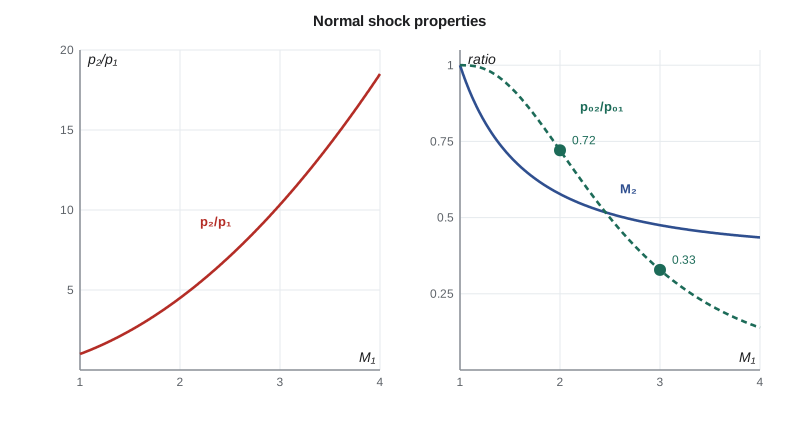
What the relations show
The program evaluates these relations and the entropy rise for a range of upstream Mach numbers. Several features stand out. The downstream Mach number is always below 1 and falls toward a limit of about 0.378 for air as the upstream Mach number grows. The pressure ratio rises with the square of the Mach number: 2.46 at Mach 1.5, 4.50 at Mach 2 and over 10 at Mach 3. The density ratio rises more slowly and approaches a limit of \((\gamma + 1)/(\gamma - 1) = 6\) for air, however strong the shock. The temperature ratio has no limit. In very strong shocks the gas is compressed only sixfold but heated enormously, which is the origin of the re-entry heating problem in Lesson 12.
Why can a shock only compress? The equations admit a mathematical solution with \(M_1 < 1\), an expansion shock in which pressure falls suddenly. The second law rules it out, because the entropy would decrease. Shocks in air are always compression waves, and they occur only when the upstream flow is supersonic relative to the shock.
Loss of stagnation pressure and entropy
The stagnation temperature is the same on both sides of the shock, because the energy equation holds. The stagnation pressure is not. Its ratio across the shock is directly related to the entropy rise: \(s_2 - s_1 = -R\ln(p_{02}/p_{01})\). For a weak shock at Mach 1.1 the loss is only 0.1 percent. At Mach 1.5 it is 7 percent, at Mach 2 it is 28 percent, and at Mach 3 the downstream stagnation pressure is only a third of the upstream value. That loss is wasted energy: the downstream gas could be expanded back to the upstream static pressure, but only to a lower speed.
For weak shocks the entropy rise grows as the cube of the shock strength, \((M_1^2 - 1)^3\), which is why weak shocks are almost isentropic. This fact underlies supersonic inlet design: it is far better to slow the air through several weak shocks than through one strong normal shock, as Lesson 4 shows. It also underlies the wave drag of transonic wings: the drag created by a weak shock on the upper surface is small at first and rises steeply once the shock becomes stronger.
# Normal shock relations, the supersonic pitot tube and the loss of total pressure
import math
G = 1.4
def shock(M1):
    M2 = math.sqrt((1 + (G - 1) / 2 * M1**2) / (G * M1**2 - (G - 1) / 2))
    p21 = 1 + 2 * G / (G + 1) * (M1**2 - 1)
    r21 = (G + 1) * M1**2 / ((G - 1) * M1**2 + 2)
    T21 = p21 / r21
    p0_ratio = (r21 ** (G / (G - 1))) * ((1 / p21) ** (1 / (G - 1)))
    ds = -287.05 * math.log(p0_ratio)            # entropy rise, J/(kg K)
    return M2, p21, r21, T21, p0_ratio, ds
print(" M1     M2     p2/p1   rho2/rho1  T2/T1  p02/p01  ds J/(kg K)")
for M1 in (1.1, 1.3, 1.5, 2.0, 2.5, 3.0):
    M2, p21, r21, T21, p0r, ds = shock(M1)
    print(f"{M1:4.1f} {M2:7.4f} {p21:7.3f} {r21:8.3f} {T21:7.3f} {p0r:8.4f} {ds:8.1f}")
# Rayleigh pitot formula: a pitot probe in supersonic flow reads the total pressure behind a normal shock
def pitot_ratio(M1):                             # p02 / p1
    return ((G + 1)**2 * M1**2 / (4 * G * M1**2 - 2 * (G - 1))) ** (G / (G - 1)) * (1 - G + 2 * G * M1**2) / (G + 1)
def mach_from_pitot(r):
    lo, hi = 1.0, 6.0
    for _ in range(60):
        mid = (lo + hi) / 2
        if pitot_ratio(mid) < r: lo = mid
        else: hi = mid
    return (lo + hi) / 2
# tunnel probe: static 14.2 kPa, pitot 85.0 kPa
print(f"\npitot/static = {85.0 / 14.2:.3f}  ->  M1 = {mach_from_pitot(85.0 / 14.2):.3f}")
# if someone wrongly used the isentropic (subsonic) formula
Mwrong = math.sqrt(2 / (G - 1) * ((85.0 / 14.2) ** ((G - 1) / G) - 1))
print(f"isentropic formula would give M = {Mwrong:.3f} (wrong in supersonic flow)")M1 M2 p2/p1 rho2/rho1 T2/T1 p02/p01 ds J/(kg K) 1.1 0.9118 1.245 1.169 1.065 0.9989 0.3 1.3 0.7860 1.805 1.516 1.191 0.9794 6.0 1.5 0.7011 2.458 1.862 1.320 0.9298 20.9 2.0 0.5774 4.500 2.667 1.687 0.7209 93.9 2.5 0.5130 7.125 3.333 2.137 0.4990 199.5 3.0 0.4752 10.333 3.857 2.679 0.3283 319.7 pitot/static = 5.986 -> M1 = 2.066 isentropic formula would give M = 1.827 (wrong in supersonic flow)
The pitot tube in supersonic flow
Now Arjun's calibration problem can be solved. A pitot probe in a supersonic stream has a detached normal shock just ahead of its mouth. The air passes through the shock, becomes subsonic, and is then brought to rest isentropically inside the probe. The probe therefore reads \(p_{02}\), the stagnation pressure behind a normal shock, not the free-stream \(p_{01}\). Combining the normal shock relations with the isentropic stagnation ratio gives Rayleigh's pitot formula, which relates the probe reading to the free-stream static pressure.
The formula cannot be solved for \(M_1\) in closed form, so the program uses bisection between Mach 1 and Mach 6. With the tunnel readings of 85.0 kPa from the pitot and 14.2 kPa from the wall static taps, the ratio is 5.99 and the free-stream Mach number is 2.066. The isentropic formula would have given 1.827, an error of over 11 percent. The air data computers of supersonic aircraft apply Rayleigh's formula automatically once the measured ratio exceeds the sonic value of 1.893.
Moving shocks
So far the shock has been stationary with the air flowing through it. A shock moving into still air, such as the wave from a sudden release of compressed gas, obeys the same relations in a frame moving with the shock. The upstream Mach number is then the shock speed divided by the speed of sound in the still air, and the gas behind the shock is set in motion in the direction of the shock. The same idea explains the sonic boom from a supersonic aircraft: the shock pattern attached to the aircraft sweeps over the ground as the aircraft passes, and a listener hears the sudden pressure jump. Sonic booms are the main reason supersonic flight over land has been restricted since the 1970s, and they are the subject of continuing research into low-boom aircraft shapes that spread the pressure change over a longer time.
Shocks in the Swift 900's world
The Swift 900 itself will never fly supersonic, but it will meet shocks every day. At its cruise Mach number the air accelerates to about Mach 1.2 over part of the upper wing surface, and the supersonic pocket ends in a nearly normal shock. Lesson 10 examines that shock in detail. Because the local Mach number ahead of it is low, the stagnation pressure loss is under 1 percent, but the sudden pressure rise acts on the boundary layer and can make it separate. Strong shocks also occur briefly in the engine inlet if the engine surges, and in the fan where the blade tips run supersonic relative to the air. Understanding normal shocks is therefore essential even for an aircraft that stays below Mach 1.
Worked problem
Conditions behind a Mach 2 normal shock
Air at 20 kPa and 220 K flows at Mach 2.0 into a normal shock. Find the downstream static pressure, temperature, Mach number and speed.
Show solution
- From the relations, \(p_2/p_1 = 4.500\), \(T_2/T_1 = 1.687\) and \(M_2 = 0.577\).
- \(p_2 = 90.0\ \text{kPa}\) and \(T_2 = 371.2\ \text{K}\).
- \(a_2 = \sqrt{1.4\times 287\times 371.2} = 386.2\ \text{m/s}\), so \(u_2 = 0.577\times 386.2 = 222.9\ \text{m/s}\).
Answer: The flow arrives at 594 m/s and leaves at 223 m/s, more than four times the pressure and 151 K hotter. The density ratio, 2.67, matches the speed ratio as continuity requires.
Worked problem
How much stagnation pressure does a normal shock waste?
An inlet with a single normal shock at its lip operates at Mach 1.6 with a free-stream stagnation pressure of 120 kPa. What stagnation pressure reaches the engine if the subsonic diffuser is perfect?
Show solution
- \(M_1 = 1.6\): \(\rho_2/\rho_1 = 2.032\), \(p_2/p_1 = 2.820\).
- \(p_{02}/p_{01} = 2.032^{3.5}\times(1/2.820)^{2.5} = 11.95\times 0.0750 = 0.895\).
Answer: About 107 kPa, a loss of 10.5 percent. At Mach 1.6 a simple pitot-type inlet is acceptable, but at higher Mach numbers the loss becomes too large and oblique-shock inlets are needed.
Common mistakes
MistakeUsing the isentropic pitot formula above Mach 1.
InsteadThe probe reads the stagnation pressure behind a normal shock. Use Rayleigh's pitot formula.
MistakeAssuming stagnation pressure is conserved across a shock.
InsteadOnly stagnation temperature is conserved. The stagnation pressure ratio measures the entropy produced.
MistakeExpecting a normal shock to leave the flow supersonic.
InsteadThe downstream flow behind a normal shock is always subsonic.
MistakeThinking an expansion shock is possible in air.
InsteadIt would decrease entropy and is forbidden by the second law.
Summary and key terms
- A normal shock is a thin, irreversible compression across which supersonic flow becomes subsonic.
- Conservation of mass, momentum and energy gives the downstream state as a function of the upstream Mach number alone.
- Pressure and temperature rise without limit as the shock strengthens, while density approaches six times the upstream value in air.
- Stagnation temperature is conserved but stagnation pressure falls, and the loss grows rapidly above Mach 1.5.
- A pitot probe in supersonic flow reads the stagnation pressure behind a normal shock, so Rayleigh's pitot formula must be used.
- Shock wave
- A thin irreversible region in which supersonic flow is suddenly compressed and slowed.
- Normal shock
- A shock perpendicular to the upstream flow.
- Prandtl relation
- For a normal shock, u₁u₂ = a*².
- Stagnation pressure loss
- The fall in p₀ across a shock, a measure of the entropy produced.
- Rayleigh pitot formula
- The relation between the pitot pressure behind a normal shock and the free-stream static pressure.
- Sonic boom
- The pressure jump heard on the ground when the shock system of a supersonic aircraft passes.
- Moving shock
- A shock travelling into still gas, analysed in a frame moving with it.
Practice problems
Work each problem on paper first, then reveal the answer to check.
Find M₂ and p₂/p₁ for a normal shock at M₁ = 2.5.
Show answer
M₂ = 0.513, p₂/p₁ = 7.125.
What is the limiting density ratio across a very strong normal shock in air?
Show answer
(γ + 1)/(γ − 1) = 6.
Using the program, what fraction of stagnation pressure is lost across a Mach 3 normal shock?
Show answer
About 67 percent; p₀₂/p₀₁ = 0.328.
A pitot-static ratio of 1.5 is measured. Is the flow subsonic or supersonic?
Show answer
Subsonic, because 1.5 is below the sonic value of 1.893.
Show that the downstream flow is subsonic using the Prandtl relation.
Show answer
u₁u₂ = a*². If u₁ > a* then u₂ < a*, so M₂ < 1.
Why are weak shocks almost isentropic?
Show answer
The entropy rise grows as the cube of (M₁² − 1), so it is tiny when M₁ is close to 1.
Lesson quiz · 5 questions
Score 60% or more to complete this lesson.
Create a free account to save your progress, take quizzes and earn a certificate.