
ACCT-311 · Lesson 8 of 12 · 31 min
Changes in ownership interest
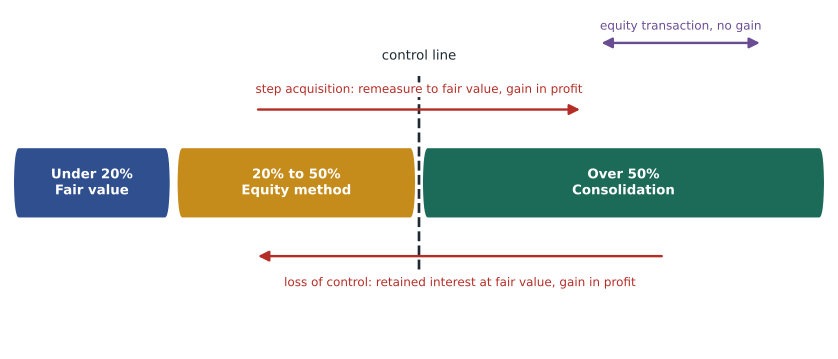
Ownership of subsidiaries changes over time. A parent may build up a stake in steps, buy out minority shareholders, sell part of its holding while keeping control, or sell enough to lose control. Groups also own subsidiaries indirectly, through other subsidiaries. This lesson explains how each change is accounted for. The guiding principle is that control is the significant economic event: crossing the control threshold, in either direction, remeasures interests to fair value through profit or loss; changes in ownership that leave control unchanged are transactions among the owners of the group and go through equity.
Step acquisitions: achieving control in stages
An acquirer sometimes holds an equity interest in an entity before it obtains control, for example an associate accounted for by the equity method. When it buys more shares and obtains control, a business combination occurs on that date. The acquirer remeasures its previously held equity interest to fair value at the acquisition date and recognizes any gain or loss in profit or loss. The fair value of the previously held interest is then included in the goodwill calculation along with the consideration for the new shares and the NCI.
Amounts the investor recognized in OCI for the previously held interest, such as its share of the associate's translation differences, are treated as if the interest had been disposed of: recycled to profit or loss if they would be recycled on disposal, or transferred within equity if not. If the previous holding was an equity investment designated at FVOCI under IFRS 9, its cumulative gains stay in equity and are not recycled.
Worked problem
Larkspur gains control of Cedar Point
At 1 January 2028 Larkspur's 30 per cent equity-method investment in Cedar Point has a carrying amount of $1,102,500 (lesson 2). Larkspur pays $1,800,000 for a further 40 per cent and obtains control. The fair value of the original 30 per cent is $1,350,000, the fair value of the 30 per cent NCI is $1,250,000, and Cedar Point's identifiable net assets have a fair value of $3,600,000.
Show solution
- Remeasure the previously held 30 per cent: $1,350,000 − $1,102,500 = gain of $247,500 in profit or loss.
- Goodwill: consideration $1,800,000 + fair value of previously held interest $1,350,000 + NCI $1,250,000 − identifiable net assets $3,600,000 = $800,000.
- Cedar Point becomes a subsidiary and is consolidated from 1 January 2028.
- The equity method ends; the investment account is replaced by Cedar Point's net assets, goodwill and NCI.
Answer: Gain of $247,500; goodwill of $800,000.
The logic is that the investor has exchanged one asset, a significant-influence investment, for another, a controlling interest, and the exchange is measured at fair value. Critics note that the remeasurement gain arises from buying more shares, not from selling anything, and that it can be large when the earlier stake was bought years ago.
Changes in a parent's interest that do not affect control
Once a parent controls a subsidiary, buying more shares from the NCI or selling some shares to outsiders while keeping control does not change the group's assets and liabilities. No goodwill is recognized on further purchases, and no gain or loss is recognized on partial disposals. Instead, the transaction is accounted for within equity: the carrying amount of NCI is adjusted to reflect the change in relative interests, and any difference between that adjustment and the fair value of the consideration paid or received is recognized directly in equity attributable to the owners of the parent.
Worked problem
Buying out half of Blue Heron's NCI
On 1 January 2028 Larkspur buys 10 per cent of Blue Heron from minority shareholders for $560,000, increasing its holding to 90 per cent. The carrying amount of NCI at that date, after the adjustments in lessons 5 to 7, is $1,032,872.
Show solution
- NCI transferred to the parent: 10/20 × $1,032,872 = $516,436.
- Entry: debit NCI $516,436 and equity attributable to owners of the parent $43,564; credit cash $560,000.
- No change to Blue Heron's assets, liabilities or goodwill in the consolidated statements.
- From 2028, NCI's share of Blue Heron's adjusted profit is 10 per cent.
Answer: A $43,564 charge to the parent's equity; no gain, loss or goodwill.
# Changes in Larkspur's ownership of Blue Heron and Cedar Point, 1 January 2028 (illustrative)
# 1. Step acquisition: from 30% (equity method) to 70% of Cedar Point
held_carrying, held_fv = 1_102_500, 1_350_000
paid, nci_fv, fv_net_assets = 1_800_000, 1_250_000, 3_600_000
remeasure_gain = held_fv - held_carrying
goodwill = paid + held_fv + nci_fv - fv_net_assets
print(f"Step acquisition: gain on remeasuring 30% stake {remeasure_gain:,.0f}; goodwill {goodwill:,.0f}")
# 2. Buying half of the NCI in Blue Heron (20% -> 10% NCI): an equity transaction
nci_carrying = 990_000 - 12_000 + 114_000 - 50_000 - 12_000 + 2_872   # lessons 5-7 roll-forward
price = 560_000
nci_transferred = nci_carrying * 10 / 20
print(f"NCI before {nci_carrying:,.0f}; transferred {nci_transferred:,.0f}; "
      f"charge to parent's equity {price - nci_transferred:,.0f}")
# 3. Indirect holding: effective interest through a chain
p_in_s, s_in_t = 0.80, 0.60
eff = p_in_s * s_in_t
print(f"Effective interest in a sub-subsidiary: {eff:.0%}; total NCI in it {1 - eff:.0%}")Step acquisition: gain on remeasuring 30% stake 247,500; goodwill 800,000 NCI before 1,032,872; transferred 516,436; charge to parent's equity 43,564 Effective interest in a sub-subsidiary: 48%; total NCI in it 52%
The program also shows how ownership works through a chain. If a subsidiary owns 60 per cent of another company, and the parent owns 80 per cent of that subsidiary, the parent's effective interest in the sub-subsidiary is 48 per cent. The sub-subsidiary is still consolidated, because the parent controls it through its controlled subsidiary, but total NCI in its profit is 52 per cent: 40 per cent held directly by outsiders and 12 per cent indirectly through the outsiders who own 20 per cent of the intermediate subsidiary. Consolidating chains bottom-up, starting with the lowest-level subsidiary, keeps the attribution straight.
Worked problem
Selling part of a subsidiary while keeping control
As an alternative, suppose that on 1 January 2028 Larkspur instead sells 10 per cent of Blue Heron to an outside investor for $600,000, reducing its interest to 70 per cent. Blue Heron's net assets in the consolidated statements, including all goodwill, are $5,400,000.
Show solution
- Increase in NCI: 10% × $5,400,000 = $540,000. (With full goodwill, NCI is based on net assets including goodwill.)
- Entry: debit cash $600,000; credit NCI $540,000 and equity attributable to owners of the parent $60,000.
- No gain is recognized in profit or loss; the $60,000 is an increase in the parent's equity.
- Control is unchanged, so Blue Heron's assets and liabilities stay at their consolidated carrying amounts.
Answer: A $60,000 credit to the parent's equity, not a gain in profit.
Loss of control
When a parent loses control of a subsidiary, whether by selling shares, by the subsidiary issuing shares to others, by contract or by the subsidiary coming under the control of a government or court, it derecognizes the subsidiary's assets (including goodwill) and liabilities at their carrying amounts and derecognizes the carrying amount of NCI. It recognizes the fair value of any consideration received and the fair value of any investment it retains. The difference is a gain or loss in profit or loss attributable to the parent, and amounts in OCI relating to the subsidiary are recycled or transferred as if the assets had been disposed of directly. The retained interest becomes an associate, a joint venture or a financial asset, measured initially at fair value.
Worked problem
Selling 60 per cent of Blue Heron
Instead of the earlier transactions, suppose Larkspur sells 60 per cent of Blue Heron for $3,400,000 on 1 January 2028, keeping 20 per cent and two board seats. Blue Heron's net assets in the consolidated statements, including goodwill, are $5,400,000, and NCI is $1,032,872. The fair value of the 20 per cent retained is $1,100,000.
Show solution
- Derecognize net assets including goodwill: $5,400,000. Derecognize NCI: $1,032,872.
- Recognize cash received $3,400,000 and the retained 20 per cent at fair value $1,100,000.
- Gain: $3,400,000 + $1,100,000 + $1,032,872 − $5,400,000 = $132,872 in profit or loss.
- The retained 20 per cent is an associate; the equity method starts with a carrying amount of $1,100,000.
Answer: A gain of $132,872, including the remeasurement of the retained interest.
# Loss of control: Larkspur sells 60% of Blue Heron, keeping 20% (alternative scenario)
proceeds = 3_400_000
fv_retained = 1_100_000          # fair value of the 20% kept, now an associate
net_assets_incl_gw = 5_400_000   # Blue Heron's net assets in the consolidated statements, with goodwill
nci = 1_032_872                  # NCI derecognized
oci_recycled = 0                 # no recyclable OCI in this example
gain = proceeds + fv_retained + nci - net_assets_incl_gw + oci_recycled
print(f"Derecognize net assets {net_assets_incl_gw:,.0f} and NCI {nci:,.0f}")
print(f"Gain on loss of control: {gain:,.0f}")
part_retained = fv_retained - 0.20 / 0.80 * (net_assets_incl_gw - nci)
print(f" of which from remeasuring the retained 20% to fair value: about {part_retained:,.0f}")Derecognize net assets 5,400,000 and NCI 1,032,872 Gain on loss of control: 132,872 of which from remeasuring the retained 20% to fair value: about 8,218
Part of the gain comes from remeasuring the retained interest to fair value, which the standards treat as a deemed sale and repurchase. The second program estimates that portion at about $8,218: the parent's share of Blue Heron's net assets was $4,367,128, so the retained 20 per cent (a quarter of the parent's 80 per cent) carried about $1,091,782, which is remeasured to $1,100,000.
IFRS 10 requires this treatment. When a subsidiary that does not contain a business is transferred to an associate or joint venture, the accounting of gains and losses has been a long-standing point of conflict between IFRS 10 and IAS 28; the IASB's 2014 amendments to resolve it were deferred indefinitely, and its equity method project (lesson 2) is expected to settle the issue. Under ASPE, Section 1602 treats changes in a parent's ownership that do not result in loss of control as equity transactions, similar to IFRS.
| Change | Accounting | Effect on profit |
|---|---|---|
| Investor obtains control of a former associate | Remeasure previously held interest to fair value; acquisition method | Gain or loss on remeasurement |
| Parent buys more shares from NCI | Equity transaction; adjust NCI | None |
| Parent sells shares but keeps control | Equity transaction; adjust NCI | None |
| Parent loses control, keeps an interest | Derecognize subsidiary and NCI; retained interest at fair value | Gain or loss, including remeasurement |
| Subsidiary issues shares to outsiders, parent keeps control | Equity transaction (dilution) | None |
Dilution through subsidiary share issues
A parent's percentage can also change when the subsidiary itself issues new shares. If outsiders buy them and the parent keeps control, the parent's interest is diluted. The transaction is an equity transaction: NCI increases by its new share of the subsidiary's net assets after the issue, and the difference between the proceeds and that increase adjusts the parent's equity. If the parent buys all the new shares, its percentage rises, and the same equity accounting applies in reverse.
Common mistakes
MistakeRecognizing goodwill when a parent buys more shares from NCI.
InsteadOnce control exists, further purchases are equity transactions with no new goodwill.
MistakeRecording a gain in profit when selling shares of a subsidiary without losing control.
InsteadRecognize the difference in equity attributable to the parent.
MistakeLeaving the previously held interest at its carrying amount when control is obtained.
InsteadRemeasure it to fair value and recognize a gain or loss in profit or loss.
MistakeMeasuring a retained interest at its old carrying amount after losing control.
InsteadMeasure it at fair value; the remeasurement is part of the gain or loss.
MistakeUsing direct ownership percentages to attribute a sub-subsidiary's profit.
InsteadUse effective interests through the chain; NCI includes indirect outside holdings.
Summary and key terms
- Obtaining or losing control is a significant economic event that triggers fair value remeasurement through profit or loss.
- In a step acquisition, the previously held interest is remeasured to fair value and included in the goodwill calculation.
- Purchases and sales of subsidiary shares that do not change control are equity transactions with no gain, loss or new goodwill.
- On loss of control, the subsidiary and NCI are derecognized and any retained interest is measured at fair value.
- OCI relating to a former investee or subsidiary is recycled or transferred as if the underlying items were sold.
- Dilution through subsidiary share issues is accounted for in equity when control is kept.
- Indirect holdings are consolidated through the chain, with NCI based on effective outside interests.
- Step acquisition
- A business combination achieved in stages, where the acquirer held an equity interest before obtaining control.
- Previously held interest
- An acquirer's equity interest in the acquiree before the acquisition date, remeasured to fair value.
- Equity transaction
- A transaction among owners of the group, such as a change in ownership that does not affect control, recognized in equity.
- Loss of control
- The event in which a parent ceases to control a subsidiary, triggering deconsolidation.
- Retained interest
- An investment a former parent keeps in a former subsidiary, measured at fair value on loss of control.
- Dilution
- A decrease in a parent's percentage interest when a subsidiary issues shares to others.
- Effective interest
- A parent's ownership of a sub-subsidiary computed by multiplying percentages through the chain.
- Deconsolidation
- Removing a former subsidiary's assets, liabilities and NCI from the consolidated statements.
Practice problems
Work each problem on paper first, then reveal the answer to check.
An investor's 25 per cent equity-method stake with a carrying amount of $400,000 is worth $520,000 when it buys control. Gain?
Show answer
$120,000 in profit or loss.
It pays $1,200,000 for another 35 per cent; NCI fair value is $780,000; identifiable net assets are $2,100,000. Goodwill?
Show answer
$400,000.
A parent with 70 per cent buys a further 15 per cent for $450,000 when NCI is $750,000. Charge to the parent's equity?
Show answer
$75,000 ($450,000 − 15/30 × $750,000).
Rerun the changes program with a price of $500,000 for the 10 per cent. Effect on the parent's equity?
Show answer
A credit of $16,436; the price is below the NCI transferred.
A parent sells 15 per cent of a subsidiary for $900,000, keeping control; subsidiary net assets with goodwill are $5,000,000. Equity adjustment?
Show answer
A $150,000 credit to the parent's equity; NCI increases $750,000.
Rerun the loss-of-control program with proceeds of $3,200,000. Gain?
Show answer
−$67,128, a loss.
A parent owns 90 per cent of S, which owns 70 per cent of T. Parent's effective interest in T and total NCI in T?
Show answer
63 per cent; 37 per cent.
Why does a step acquisition produce a gain without a sale?
Show answer
The standards treat the previously held interest as exchanged for a controlling interest at fair value.
A subsidiary issues shares to outsiders and the parent keeps control. Where is the difference recognized?
Show answer
In equity attributable to the parent.
On loss of control, what happens to OCI relating to the subsidiary?
Show answer
It is recycled to profit or loss or transferred within equity as if the assets had been sold directly.
Lesson quiz · 5 questions
Score 60% or more to complete this lesson.
Create a free account to save your progress, take quizzes and earn a certificate.