
ACCT-311 · Lesson 3 of 12 · 31 min
Business combinations: the acquisition method
On 1 January 2026 Larkspur acquires 80 per cent of the common shares of Blue Heron Controls, a profitable maker of industrial control panels, for $4,000,000 in cash. It also agrees to pay the former owners a further $500,000 in early 2028 if Blue Heron's 2027 revenue exceeds an agreed target. Larkspur now controls Blue Heron. This lesson applies the acquisition method to that transaction: deciding whether it is a business combination at all, identifying the acquirer and the acquisition date, measuring what was given and what was received, and recognizing goodwill and non-controlling interest. Lessons 4 and 5 then show how the result flows into consolidated financial statements.
Is it a business combination?
IFRS 3 applies when an acquirer obtains control of a business. A business is an integrated set of activities and assets capable of being conducted and managed to provide goods or services to customers, generate investment income or generate other income. To be a business, the set must include, at a minimum, an input and a substantive process that together significantly contribute to the ability to create outputs. IFRS 3 offers an optional concentration test: if substantially all the fair value of the gross assets acquired is concentrated in a single identifiable asset or group of similar assets, the set is not a business and the transaction is an asset acquisition. Blue Heron has a workforce, manufacturing processes, customer contracts and revenue; it is clearly a business.
The distinction matters. In an asset acquisition, the cost is allocated to the assets acquired in proportion to their relative fair values, no goodwill is recognized, transaction costs are capitalized and no deferred tax is usually recognized on initial differences. In a business combination, assets and liabilities are measured at fair value, goodwill or a bargain purchase gain arises, and transaction costs are expensed.
The four steps of the acquisition method
The acquisition method has four steps: identify the acquirer; determine the acquisition date; recognize and measure the identifiable assets acquired, the liabilities assumed and any non-controlling interest in the acquiree; and recognize and measure goodwill or a gain from a bargain purchase.
The acquirer is the entity that obtains control. In a cash purchase it is usually obvious: the entity paying cash. When shares are exchanged, the acquirer is often, but not always, the entity that issues the shares. Indicators include which group of former owners holds the largest portion of voting rights in the combined entity, which group can elect a majority of the board, which entity's management dominates, and which entity is larger. In a reverse acquisition, a private operating company becomes public by having a listed shell issue shares to its owners; the legal acquirer (the shell) is the accounting acquiree, and the private company's owners end up controlling the combined entity.
The acquisition date is the date control passes, usually the closing date when consideration is transferred and the acquirer takes over the acquiree's assets and liabilities. It can be earlier or later if a written agreement transfers control on a different date. All fair values are measured at the acquisition date.
Measuring the consideration transferred
Consideration transferred is measured at fair value at the acquisition date. It includes cash, other assets transferred, liabilities incurred to former owners, equity interests issued and contingent consideration. Contingent consideration, an obligation to transfer more assets or shares if specified future events occur, is recognized at its acquisition-date fair value, which reflects the probability of payment and the time value of money.
After the acquisition date, contingent consideration classified as a liability is remeasured to fair value at each reporting date, with changes recognized in profit or loss, until it is settled. Contingent consideration classified as equity is not remeasured. Changes resulting from facts and circumstances that existed at the acquisition date and are identified during the measurement period adjust goodwill instead.
Acquisition-related costs, such as legal, accounting, valuation and advisory fees, are expensed as incurred. They are not part of the consideration, because they are fees for services rather than amounts exchanged with the former owners. Costs of issuing debt or shares are accounted for under the standards on financial instruments: debt issue costs reduce the carrying amount of the debt, and share issue costs reduce equity.
Worked problem
Larkspur's consideration
Larkspur pays $4,000,000 cash for 80 per cent of Blue Heron. A valuation specialist estimates a 45 per cent probability that the $500,000 revenue payment will be made in two years and, using a discount rate that reflects the risk, values the obligation at $200,000. Larkspur also paid $120,000 in legal and due-diligence fees. Measure the consideration transferred.
Show solution
- Cash: $4,000,000.
- Contingent consideration: a liability measured at fair value, $200,000.
- Consideration transferred: $4,200,000.
- Acquisition-related costs of $120,000 are expensed in 2026, not added to consideration.
Answer: Consideration transferred $4,200,000; $120,000 expensed.
Recognizing identifiable assets and liabilities
The acquirer recognizes the acquiree's identifiable assets acquired and liabilities assumed, separately from goodwill, if they meet the definitions of assets and liabilities at the acquisition date and are part of what was exchanged. They are measured at fair value, with limited exceptions such as income taxes, employee benefits, leases in which the acquiree is a lessee and assets held for sale, which follow their own standards.
This often recognizes assets the acquiree never recorded. An intangible asset is identifiable if it is separable, meaning it could be sold, licensed or exchanged, or if it arises from contractual or legal rights. Customer lists, order backlogs, customer contracts and relationships, patents, trademarks, internet domain names and non-compete agreements are common examples. An assembled workforce is not identifiable and is subsumed in goodwill. Contingent liabilities that are present obligations arising from past events are recognized if their fair value can be measured reliably, even though the acquiree did not recognize them because an outflow was not probable.
Worked problem
Blue Heron's identifiable net assets
At 1 January 2026 Blue Heron's carrying amounts total $3,000,000 (share capital $1,000,000 and retained earnings $2,000,000). The valuation shows that its inventory is worth $100,000 more than its carrying amount and will be sold during 2026; its equipment is worth $400,000 more, with a remaining life of 10 years; and it holds an unrecorded patent on a control algorithm worth $300,000, with a remaining life of 5 years. Other items are carried at fair value. Ignoring deferred taxes, compute the fair value of the identifiable net assets.
Show solution
- Carrying amount of net assets: $3,000,000.
- Add fair value increments: inventory $100,000 + equipment $400,000 + patent $300,000 = $800,000.
- Fair value of identifiable net assets: $3,800,000.
Answer: Identifiable net assets at fair value: $3,800,000.
In practice, fair value increments create temporary differences, because the tax bases of the acquiree's assets usually do not change in a share purchase. A deferred tax liability is recognized on those differences, which increases goodwill. To keep the numbers clear, this course ignores deferred taxes on acquisition differentials unless stated; ACCT-212, lesson 7, covers the mechanics.
Non-controlling interest
When the acquirer buys less than 100 per cent, it must also measure the non-controlling interest. IFRS 3 allows a choice, made transaction by transaction, for present ownership interests that entitle holders to a proportionate share of net assets on liquidation. NCI can be measured at fair value, which includes the NCI's share of goodwill (often called the full goodwill method), or at the NCI's proportionate share of the acquiree's identifiable net assets, which excludes the NCI's share of goodwill (the partial goodwill method). Other components of NCI, such as preferred shares, are measured at fair value.
The fair value of the NCI is usually estimated from the market price of the shares the acquirer did not buy, if they are traded, or from valuation techniques. It is often lower per share than the price the acquirer paid, because the acquirer pays a control premium for the ability to direct the business.
Goodwill and bargain purchases
Goodwill is measured as the excess of the sum of the consideration transferred, the amount of any NCI and the fair value of any previously held equity interest in the acquiree, over the net of the acquisition-date fair values of the identifiable assets acquired and liabilities assumed. It represents future economic benefits from assets that cannot be individually identified and separately recognized, such as synergies, an assembled workforce and the going-concern value of the acquiree's business.
Worked problem
Goodwill under both measurement bases
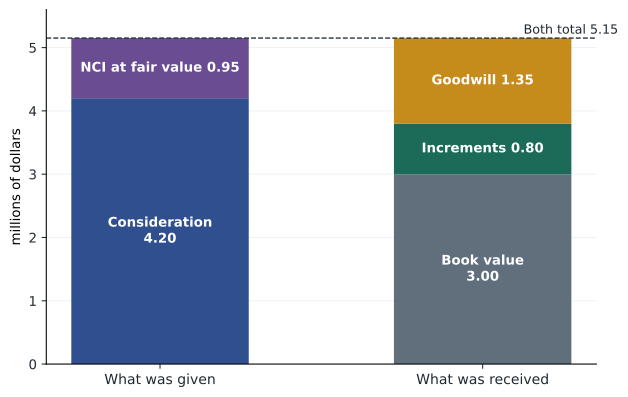
Use the figures above. The fair value of the 20 per cent NCI, based on a valuation that excludes a control premium, is $950,000. Compute goodwill and NCI at the acquisition date under the fair value basis and under the proportionate share basis.
Show solution
- Fair value basis: goodwill = $4,200,000 + $950,000 − $3,800,000 = $1,350,000; NCI = $950,000.
- Of that goodwill, the parent's share is $4,200,000 − 80% × $3,800,000 = $1,160,000, and the NCI's share is $950,000 − 20% × $3,800,000 = $190,000.
- Proportionate share basis: NCI = 20% × $3,800,000 = $760,000; goodwill = $4,200,000 + $760,000 − $3,800,000 = $1,160,000.
- Larkspur chooses the fair value basis for Blue Heron, as many acquirers do when the NCI is significant.
Answer: Fair value basis: goodwill $1,350,000, NCI $950,000. Proportionate basis: goodwill $1,160,000, NCI $760,000.
# Acquisition analysis for Blue Heron (illustrative, deferred tax ignored)
cash, contingent = 4_000_000, 200_000
consideration = cash + contingent
carrying = 3_000_000
fv_increments = {"Inventory": 100_000, "Equipment (10 yr)": 400_000, "Patent (5 yr)": 300_000}
fv_net_assets = carrying + sum(fv_increments.values())
nci_fair_value, owned = 950_000, 0.80

def goodwill(nci):
    return consideration + nci - fv_net_assets

nci_prop = (1 - owned) * fv_net_assets
print(f"Consideration transferred:   {consideration:>12,.0f}")
print(f"FV of identifiable net assets:{fv_net_assets:>11,.0f}")
for label, nci in (("Fair value NCI", nci_fair_value), ("Proportionate NCI", nci_prop)):
    print(f"{label:<20} NCI {nci:>10,.0f}   goodwill {goodwill(nci):>11,.0f}")
# A bargain purchase: what if Larkspur had paid only $2,700,000 cash and NCI were proportionate?
low = 2_700_000 + contingent + nci_prop - fv_net_assets
print(f"Low price case: {'goodwill' if low > 0 else 'bargain purchase gain'} {abs(low):,.0f}")Consideration transferred: 4,200,000 FV of identifiable net assets: 3,800,000 Fair value NCI NCI 950,000 goodwill 1,350,000 Proportionate NCI NCI 760,000 goodwill 1,160,000 Low price case: bargain purchase gain 140,000
The last line shows a bargain purchase. If the consideration plus NCI is less than the fair value of the identifiable net assets, the acquirer first reassesses whether it has correctly identified and measured all assets, liabilities, NCI and consideration. If a shortfall remains after that review, it is recognized immediately as a gain in profit or loss on the acquisition date. Bargain purchases are rare; they usually arise from forced sales, such as a seller in financial distress or one required by a regulator to divest quickly.
The measurement period
Valuations take time. If the initial accounting is incomplete at the end of the reporting period in which the combination occurs, the acquirer reports provisional amounts. During the measurement period, which ends when the acquirer has the information it was seeking and cannot exceed one year from the acquisition date, it adjusts the provisional amounts to reflect new information about facts and circumstances that existed at the acquisition date. The adjustments are made against goodwill.
Under IFRS 3, measurement-period adjustments are recognized retrospectively, as if the accounting had been completed at the acquisition date, so comparative information is revised, including any related depreciation or amortization.
After the acquisition: goodwill and push-down accounting
Goodwill is not amortized under IFRS. It is allocated to cash-generating units and tested for impairment at least annually under IAS 36 (ACCT-211, lesson 11). In 2024 the IASB published an exposure draft on business combination disclosures and goodwill impairment testing, proposing more information about the subsequent performance of acquisitions while retaining the impairment-only model. Canadian private enterprises under ASPE Section 1582 apply a similar acquisition method, but test goodwill for impairment only when events or changes in circumstances indicate impairment, rather than annually.
Under US GAAP, an acquired company may elect push-down accounting in its own separate financial statements when another entity obtains control of it, adopting the acquirer's new fair value basis, including goodwill, in its own books. IFRS does not address push-down accounting, so it is not used by IFRS reporters. Business combinations under common control, such as transferring a subsidiary from one part of a group to another, are outside the scope of IFRS 3; in practice entities use either the acquisition method or carryover book values as a policy.
| Issue | IFRS 3 | US GAAP (ASC 805) |
|---|---|---|
| Definition of a business | Optional concentration test, then input and substantive process | Mandatory screen, then input and substantive process |
| NCI measurement | Fair value or proportionate share of identifiable net assets | Fair value |
| Contingent consideration (liability) | Fair value through profit or loss | Fair value through net income |
| Acquisition-related costs | Expensed | Expensed |
| Measurement-period adjustments | Retrospective, comparatives revised | Current period, with disclosure |
| Push-down accounting | Not addressed | Optional election for the acquiree |
| Goodwill after acquisition | Impairment testing only | Impairment testing; private companies may amortize |
Common mistakes
MistakeCapitalizing legal and advisory fees into goodwill.
InsteadAcquisition-related costs are expensed as incurred.
MistakeRecording contingent consideration only when it is paid.
InsteadRecognize it at acquisition-date fair value and remeasure liability-classified amounts through profit or loss.
MistakeIgnoring intangible assets the acquiree never recorded.
InsteadRecognize identifiable intangibles such as patents, customer relationships and backlog at fair value.
MistakeRecognizing an assembled workforce as an intangible asset.
InsteadIt is not identifiable; it is part of goodwill.
MistakeAssuming NCI must always be measured at fair value.
InsteadIFRS 3 allows fair value or proportionate share, transaction by transaction.
Summary and key terms
- A business combination occurs when an acquirer obtains control of a business; otherwise the transaction is an asset acquisition.
- The acquisition method identifies the acquirer and acquisition date, measures net assets at fair value, and recognizes goodwill or a bargain purchase gain.
- Consideration includes contingent consideration at fair value; acquisition-related costs are expensed.
- Identifiable intangibles are recognized even if the acquiree never recorded them; an assembled workforce is part of goodwill.
- NCI may be measured at fair value or at its proportionate share of identifiable net assets.
- Goodwill equals consideration plus NCI plus any previously held interest, less the fair value of identifiable net assets.
- Measurement-period adjustments within one year are retrospective under IFRS 3.
- Full goodwill method
- Measuring NCI at fair value so that goodwill includes the NCI's share.
- Partial goodwill method
- Measuring NCI at its proportionate share of identifiable net assets, excluding the NCI's share of goodwill.
- Acquisition method
- The method required for business combinations: identify the acquirer, set the acquisition date, measure net assets at fair value and recognize goodwill.
- Acquirer
- The entity that obtains control of the acquiree.
- Acquisition date
- The date on which the acquirer obtains control of the acquiree.
- Consideration transferred
- The fair value of assets given, liabilities incurred and equity issued by the acquirer.
- Contingent consideration
- An obligation to transfer more consideration to former owners if specified future events occur.
- Goodwill
- An asset representing future economic benefits from assets that are not individually identified and separately recognized.
- Bargain purchase
- A combination in which the fair value of net assets exceeds consideration plus NCI, producing a gain.
- Measurement period
- The period, not exceeding one year, during which provisional acquisition amounts may be adjusted.
Practice problems
Work each problem on paper first, then reveal the answer to check.
Cash $6,000,000 for 75 per cent; NCI fair value $1,800,000; identifiable net assets at fair value $6,400,000. Goodwill (fair value NCI)?
Show answer
$1,400,000.
Same facts with proportionate NCI. NCI and goodwill?
Show answer
NCI $1,600,000; goodwill $1,200,000.
Consideration $2,000,000 for 100 per cent; identifiable net assets $2,300,000 after reassessment. Result?
Show answer
A bargain purchase gain of $300,000 in profit or loss.
Legal fees of $90,000 on an acquisition. Treatment?
Show answer
Expense as incurred.
Contingent consideration liability of $200,000 is remeasured to $260,000 a year later because revenue beat expectations. Entry?
Show answer
Increase the liability by $60,000 and recognize a $60,000 loss in profit or loss.
Rerun the acquisition program with NCI fair value of $1,000,000. Goodwill on the fair value basis?
Show answer
$1,400,000.
Is an assembled workforce recognized separately?
Show answer
No; it is part of goodwill.
A listed shell issues shares that give a private company's owners 85 per cent of the combined entity. Who is the accounting acquirer?
Show answer
The private company; it is a reverse acquisition.
Provisional equipment fair value is revised upward by $50,000 eight months after acquisition, based on facts at the acquisition date. Treatment under IFRS 3?
Show answer
Adjust goodwill retrospectively and revise comparatives, including depreciation.
Why is the fair value of NCI often lower per share than the price the acquirer paid?
Show answer
The acquirer pays a control premium that the minority shares do not carry.
Lesson quiz · 5 questions
Score 60% or more to complete this lesson.
Create a free account to save your progress, take quizzes and earn a certificate.