
ACCT-311 · Lesson 11 of 12 · 25 min
Translating foreign operations
On 1 January 2027 Larkspur acquires all the shares of Osprey Instruments Inc., a Seattle maker of optical sensors, for USD 1,800,000. Osprey keeps its books in US dollars, sells mainly in the United States and pays its staff and suppliers in US dollars, so its functional currency is the US dollar. To consolidate Osprey, Larkspur must express Osprey's statements in Canadian dollars. Unlike the transactions in the previous lesson, the exchange differences that arise here do not affect Osprey's cash flows or Larkspur's profit: they are the result of restating an investment whose value is measured in another currency. IAS 21 therefore reports them in other comprehensive income.
Two processes, chosen by functional currency
The method depends on the foreign operation's functional currency. If Osprey's functional currency is the US dollar, its statements are translated into the presentation currency: assets and liabilities at the closing rate, income and expenses at the rates on the transaction dates (an average rate is a practical approximation) and equity items at historical rates, with the resulting difference in OCI. If an entity keeps its books in a currency that is not its functional currency, it first remeasures them into the functional currency (IAS 21 paragraph 34): monetary items at the closing rate, non-monetary items at historical rates, with differences in profit or loss. IAS 21 does not offer a choice of method; the functional currency, determined from the facts, decides.
| Item | Translation (functional currency USD) | Remeasurement (functional currency CAD) |
|---|---|---|
| Monetary assets and liabilities | Closing rate | Closing rate |
| Inventory and equipment at cost | Closing rate | Historical rates |
| Revenue and most expenses | Transaction-date or average rate | Transaction-date or average rate |
| Cost of sales and depreciation | Average rate | Historical rates of the related assets |
| Share capital | Historical rate | Historical rate |
| Exchange difference | OCI (translation reserve) | Profit or loss |
Translating Osprey
Worked problem
Osprey's first year
Osprey's net assets at acquisition were USD 1,600,000 at fair value, so Larkspur recognized goodwill of USD 200,000. In 2027 Osprey earned profit of USD 300,000 and paid a dividend of USD 100,000 on 31 December, leaving net assets of USD 1,800,000. Rates (CAD per USD, illustrative): 1 January 1.35; average 1.37; 31 December 1.40. Translate Osprey's results and find the translation difference.
Show solution
- Cost of the investment: USD 1,800,000 × 1.35 = CAD 2,430,000, of which goodwill CAD 270,000.
- Goodwill is an asset of the foreign operation (IAS 21 paragraph 47), so at year end it is translated at the closing rate: USD 200,000 × 1.40 = CAD 280,000.
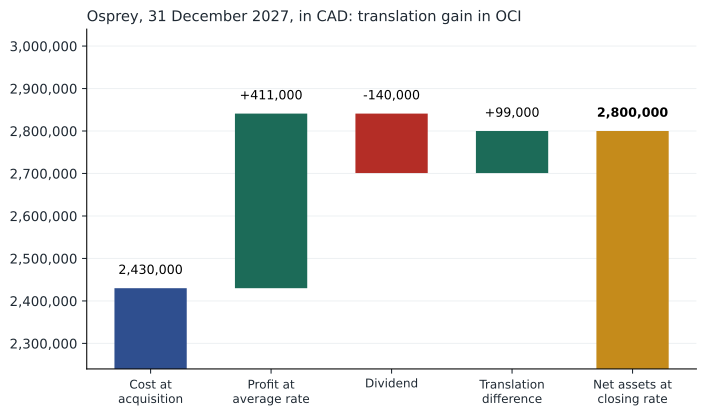
- Closing net assets including goodwill: USD 2,000,000 × 1.40 = CAD 2,800,000. Profit: 300,000 × 1.37 = 411,000. Dividend: 100,000 × 1.40 = 140,000.
- Translation difference: 2,800,000 − 2,430,000 − 411,000 + 140,000 = CAD 99,000, a gain in OCI because the US dollar strengthened while Larkspur held net assets in US dollars.
Answer: Translation gain in OCI of CAD 99,000.
# Translating Osprey's 2027 statements (all figures and rates illustrative)
fc, home = "USD", "CAD"
opening, average, closing = 1.35, 1.37, 1.40         # CAD per USD; acquisition on 1 Jan 2027 at the opening rate
bs = {"cash": 300_000, "receivables": 500_000, "inventory": 600_000, "equipment": 1_600_000,
      "payables": -400_000, "loan": -800_000}      # 31 Dec 2027, in USD
goodwill = 200_000                                # arose on acquisition; an asset of the foreign operation
profit, dividends = 300_000, 100_000              # dividends paid on 31 Dec
net_assets = sum(bs.values())                     # 1,800,000
cost = round((net_assets - profit + dividends + goodwill) * opening)
closing_home = round((net_assets + goodwill) * closing)
profit_home = round(profit * average)
div_home = round(dividends * closing)
reserve = closing_home - cost - profit_home + div_home
print(f"Cost of the investment at acquisition: {cost:,} {home}")
print(f"Net assets incl. goodwill at closing rate: {closing_home:,}")
print(f"Profit at average rate {profit_home:,}; dividends at closing rate {div_home:,}")
print(f"Translation difference for 2027 (OCI): {reserve:,}")
check = round((net_assets - profit + dividends + goodwill) * (closing - opening) + profit * (closing - average))
print(f"Check: opening net assets x rate change + profit x (closing - average) = {check:,}")Cost of the investment at acquisition: 2,430,000 CAD Net assets incl. goodwill at closing rate: 2,800,000 Profit at average rate 411,000; dividends at closing rate 140,000 Translation difference for 2027 (OCI): 99,000 Check: opening net assets x rate change + profit x (closing - average) = 99,000
The program confirms the 99,000 and checks it a second way. Opening net assets of USD 1,800,000 including goodwill gained 0.05 per US dollar during the year (90,000), and profit, translated at the average rate of 1.37 but added to net assets now translated at 1.40, gained another 9,000. The dividend, translated at the closing rate on the day it was paid, adds nothing. This decomposition is how analysts explain movements in the translation reserve.
Remeasurement and the temporal method
Suppose instead that Osprey were a sales office set up by Larkspur years earlier (at a rate of 1.30) that resells Larkspur products, remits cash to Calgary and depends on Larkspur for financing. Its functional currency would then be the Canadian dollar even though its books are kept in US dollars. Remeasurement keeps non-monetary items at the rates when they were acquired, so only the net monetary position is exposed to rate changes, and the exchange difference goes to profit or loss, as it would for transactions Larkspur entered into directly.
# The same balances remeasured by the temporal method (hypothetical sales office; illustrative)
historical, average, closing, inv_rate, cogs_rate = 1.30, 1.37, 1.40, 1.39, 1.36
monetary = {"cash": 300_000, "receivables": 500_000, "payables": -400_000, "loan": -800_000}
inventory, equipment, share_capital = 600_000, 1_600_000, 1_000_000
opening_re = 760_000                                # remeasured retained earnings at 1 Jan 2027, given
revenue, cogs, depreciation, other, tax, dividends = 3_000_000, 1_800_000, 200_000, 600_000, 100_000, 100_000
assets_less_liab = round(sum(monetary.values()) * closing + inventory * inv_rate + equipment * historical)
closing_re = assets_less_liab - round(share_capital * historical)
before = round(revenue * average - cogs * cogs_rate - depreciation * historical - (other + tax) * average)
plug = closing_re - (opening_re + before - round(dividends * closing))
print(f"Net monetary position: {sum(monetary.values()):,}")
print(f"Profit before remeasurement {before:,}; remeasurement gain (loss) in profit {plug:,}")
print(f"Profit after remeasurement {before + plug:,}; no translation difference in OCI")Net monetary position: -400,000 Profit before remeasurement 443,000; remeasurement gain (loss) in profit -9,000 Profit after remeasurement 434,000; no translation difference in OCI
With a net monetary liability of USD 400,000 and a strengthening US dollar, remeasurement produces a loss of CAD 9,000 in profit. Inventory is carried at the rate when it was bought (1.39), equipment and depreciation at 1.30 and cost of sales at the historical rates of the inventory sold (1.36 on average). The same balances translated by the current rate method would have produced a gain in OCI, so the choice of functional currency changes both the sign and the location of the result.
Consolidating a foreign subsidiary
Once translated, Osprey's statements are consolidated with the usual eliminations. Fair value adjustments and goodwill from the acquisition are treated as assets and liabilities of the foreign operation and translated at the closing rate, so the translation reserve includes their exchange differences. If the subsidiary is not wholly owned, the NCI's share of the translation difference is attributed to NCI. Intercompany balances do not eliminate cleanly when they are denominated in one party's currency, because exchange differences on them are real exposures for the other party; those differences stay in consolidated profit or loss unless the balance is a long-term loan whose settlement is neither planned nor likely, in which case it forms part of the net investment and its exchange differences go to OCI in the consolidated statements.
When Larkspur disposes of Osprey, or loses control of it, the cumulative translation reserve attributable to Osprey is reclassified from equity to profit or loss as part of the gain or loss on disposal. A partial disposal that keeps control reattributes a proportionate share of the reserve to NCI instead; a partial disposal of an associate or joint arrangement reclassifies a proportionate share to profit or loss.
Hedging a net investment
A company that does not want translation differences to swing its equity can hedge its net investment, typically by borrowing in the foreign currency or entering into forward contracts. If Larkspur borrows USD 1,000,000 and designates the loan as a hedge of its net investment in Osprey, the exchange loss on the loan (USD 1,000,000 × 0.05 = CAD 50,000 in 2027) goes to OCI rather than profit, offsetting part of the 99,000 translation gain. Like the reserve itself, the hedge's accumulated gain or loss is reclassified to profit or loss when Osprey is disposed of.
Hyperinflationary economies
When a foreign operation's functional currency is that of a hyperinflationary economy, IAS 29 requires its statements to be restated for changes in the general purchasing power of the currency before translation, and all amounts, including comparatives in most cases, are then translated at the closing rate. Indicators include a cumulative inflation rate over three years approaching or exceeding 100 per cent. Economies that have been treated as hyperinflationary in recent years include Argentina, Venezuela and Türkiye; entities check current assessments each reporting period.
Private enterprises
ASPE Section 1651 uses older terminology: a foreign operation is either integrated, translated by the temporal method with exchange gains and losses in net income, or self-sustaining, translated by the current rate method with exchange gains and losses in a separate component of equity. The classification turns on whether the operation is financially and operationally interdependent with the reporting enterprise, which leads to much the same answers as the functional currency analysis in most cases. Because ASPE has no OCI, the separate component is presented directly in equity.
Exchange rates and the cash flow statement
Translation also affects the consolidated statement of cash flows. IAS 7 requires cash flows of a foreign subsidiary to be translated at the rates on the dates of the cash flows (an average rate is acceptable), and the effect of exchange rate changes on cash held in foreign currencies is reported separately as a reconciling item between opening and closing cash, outside operating, investing and financing activities. Because this effect is not a cash flow, it would distort the three main sections if it were buried in them. Analysts examining a multinational's cash generation look at this line to see how much of the change in cash came from currency movements rather than from the business.
Reading results in constant currency
Because translation changes reported revenue and profit even when the foreign business performs exactly as before, many companies report growth in constant currency, restating the current period at the prior period's rates, in their management commentary. If Osprey's revenue of 3,000,000 in its own currency were unchanged next year but the average rate moved, the parent would report a different translated amount; constant-currency growth of zero tells users that the change came from rates, not from customers. Such measures are not defined by the standards, so securities regulators expect them to be labelled clearly, reconciled to the reported figures and not given more prominence than them.
Common mistakes
MistakeTranslating all items of a foreign subsidiary at the closing rate, including equity.
InsteadShare capital and pre-acquisition equity stay at historical rates; the reserve balances.
MistakePutting translation differences in profit or loss.
InsteadTranslation differences go to OCI; only remeasurement differences go to profit or loss.
MistakeKeeping goodwill on a foreign acquisition at the acquisition-date rate.
InsteadGoodwill and fair value adjustments are assets of the foreign operation, translated at the closing rate.
MistakeChoosing the method that gives the smoothest result.
InsteadThe functional currency, a question of fact, determines the method.
MistakeLeaving the translation reserve in equity when the subsidiary is sold.
InsteadThe cumulative reserve is reclassified to profit or loss on disposal or loss of control.
Summary and key terms
- The functional currency determines whether statements are translated or remeasured.
- Translation: assets and liabilities at closing rates, income at average rates, differences in OCI.
- Remeasurement (temporal method): monetary items at closing rates, non-monetary items at historical rates, differences in profit.
- Goodwill and fair value adjustments on a foreign acquisition are translated at the closing rate.
- Long-term intercompany loans that form part of the net investment send exchange differences to OCI on consolidation.
- The cumulative reserve is reclassified to profit on disposal; net investment hedges offset it in OCI.
- IAS 29 restates hyperinflationary statements before translation; ASPE uses integrated and self-sustaining classifications.
- Translation reserve
- The component of equity that accumulates translation differences on foreign operations.
- Presentation currency
- The currency in which financial statements are presented.
- Self-sustaining foreign operation
- An ASPE term for an operation largely independent of the reporting enterprise.
- Translation
- Expressing an entity's functional currency statements in a different presentation or reporting currency.
- Remeasurement
- Restating books kept in another currency into the functional currency, using the temporal method.
- Temporal method
- Monetary items at the current rate and non-monetary items at historical rates.
- Current rate method
- Assets and liabilities at the current rate, income at average rates and equity at historical rates.
- Net investment hedge
- A hedge of the currency exposure of the net assets of a foreign operation.
- Hyperinflationary economy
- An economy with very high cumulative inflation, around 100 per cent over three years.
Practice problems
Work each problem on paper first, then reveal the answer to check.
ca
Show answer
us
Which rate translates share capital?
Show answer
The historical rate when the shares were issued or acquired.
Under remeasurement, which rate applies to equipment?
Show answer
The historical rate when it was acquired.
Rerun the temporal program with a closing rate of 1.33. Remeasurement result?
Show answer
A gain of 12,000.
Where do exchange differences on a long-term intercompany loan forming part of the net investment go in the consolidated statements?
Show answer
OCI.
Larkspur sells Osprey. What happens to the cumulative reserve?
Show answer
It is reclassified to profit or loss as part of the gain or loss on disposal.
Larkspur designates a USD 500,000 loan as a net investment hedge. Effect in 2027?
Show answer
Loss of CAD 25,000 in OCI.
Why is a translation difference not in profit?
Show answer
It does not affect cash flows from operations; it reflects restating a net investment.
What does IAS 29 require before translating hyperinflationary statements?
Show answer
Restatement for changes in general purchasing power.
Name two indicators of functional currency.
Show answer
Currency influencing sales prices; currency of costs; currency of financing (any two).
Lesson quiz · 5 questions
Score 60% or more to complete this lesson.
Create a free account to save your progress, take quizzes and earn a certificate.