
ACCT-311 · Lesson 2 of 12 · 29 min
The equity method and joint arrangements
On 1 January 2026 Larkspur pays $900,000 for 30 per cent of the voting shares of Cedar Point Analytics, a private company that builds software for interpreting sensor data. Larkspur appoints two of Cedar Point's seven directors and licenses its sensor protocols to Cedar Point. Larkspur clearly has significant influence but not control. This lesson shows how Larkspur accounts for Cedar Point using the equity method, and then turns to joint arrangements, where two or more parties share control.
The logic of the equity method
Under the cost method, an investor recognizes income only when the investee declares dividends. If the investor can influence the dividend policy, it could time its income by deciding when the investee pays out. Fair value measurement, the alternative for passive holdings, ignores the investor's involvement in the investee's operations and can be hard to apply to private investees. The equity method answers both problems. It treats the investor's share of the investee's profit as the investor's own income as soon as the investee earns it, and treats dividends as a return of part of the investment rather than as income.
The basic entries are simple. The investment is recorded at cost. Each period, the investor increases the investment and recognizes income for its share of the investee's profit (or decreases both for a loss). It recognizes its share of the investee's other comprehensive income in its own OCI. When the investee pays a dividend, the investor debits cash and credits the investment, because the dividend converts part of the investment into cash.
IAS 28 requires the equity method for associates and joint ventures, with limited exemptions: an investor that is itself a subsidiary meeting certain conditions, and venture capital organizations, mutual funds and similar entities, which may elect to measure such investments at fair value through profit or loss under IFRS 9. Under ASPE Section 3051, a private enterprise may choose, as a policy for all significantly influenced investees, the equity method or the cost method; if it chooses cost and the shares are quoted in an active market, it must use fair value instead.
The acquisition differential
An investor rarely pays exactly its share of the investee's carrying amounts. The difference between the cost of the investment and the investor's share of the carrying amount of the investee's net assets is called the acquisition differential (Canadian textbooks) or basis difference (US practice). It is allocated, in memorandum records only, to the investor's share of the differences between fair values and carrying amounts of the investee's identifiable assets and liabilities, with any remainder treated as goodwill. Amounts allocated to depreciable or amortizable assets are amortized over those assets' remaining lives, reducing the investor's share of profit; amounts allocated to inventory are expensed as the inventory is sold; goodwill is not amortized but is part of the carrying amount tested for impairment.
Worked problem
Allocating Larkspur's acquisition differential
At 1 January 2026 Cedar Point's net assets have a carrying amount of $2,400,000. Its office building has a fair value $300,000 above its carrying amount and a remaining life of 20 years. Other assets and liabilities are carried at about fair value. Larkspur paid $900,000 for 30 per cent. Allocate the acquisition differential.
Show solution
- Cost of investment: $900,000.
- Larkspur's share of carrying amounts: 30% × $2,400,000 = $720,000.
- Acquisition differential: $900,000 − $720,000 = $180,000.
- Allocated to building: 30% × $300,000 = $90,000, amortized over 20 years at $4,500 a year.
- Remainder, goodwill: $180,000 − $90,000 = $90,000, not amortized.
Answer: Building $90,000 (amortized $4,500 a year) and goodwill $90,000.
Unrealized profits on transactions with the investee
When an investor and an associate trade with each other, part of the profit on goods still held by the buyer has not been earned from the group's point of view. Under both IFRS and US GAAP, the investor eliminates its share of unrealized profits and losses on such transactions, whether the sale is downstream (investor to investee) or upstream (investee to investor). Only the investor's percentage is eliminated, because the other owners of the associate are outside parties. The elimination is reversed in the period the buyer sells the goods to an outside party, when the profit is realized.
The IASB's equity method project, which published an exposure draft in September 2024, proposed recognizing the full gain or loss on all transactions with associates and joint ventures, both downstream and upstream, instead of eliminating the investor's share. As of September 2026 the IASB had completed its redeliberations and begun balloting a revised IAS 28, which it expects to issue in the first half of 2027 with an effective date of 1 January 2029. Until then, the current partial elimination applies.
Worked problem
Larkspur's 2026 equity income
In 2026 Cedar Point reports profit of $500,000 and pays dividends of $150,000. During the year Larkspur sold Cedar Point sensors at a profit of $90,000; at 31 December, goods carrying $40,000 of that profit remain in Cedar Point's inventory. Compute Larkspur's equity income and the year-end carrying amount of the investment.
Show solution
- Share of reported profit: 30% × $500,000 = $150,000.
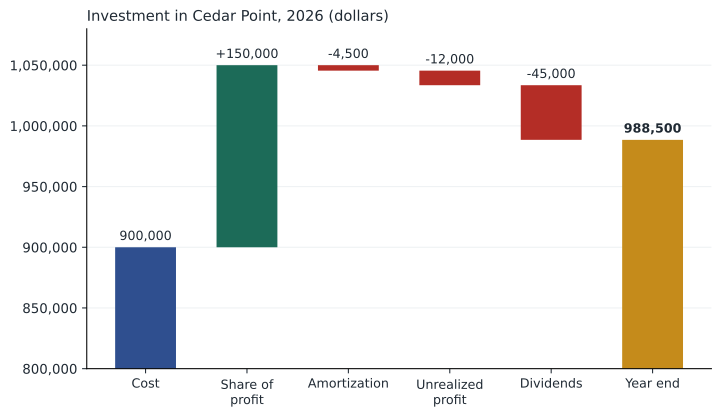
- Less amortization of the building differential: $4,500.
- Less unrealized downstream profit: 30% × $40,000 = $12,000.
- Equity income: $150,000 − $4,500 − $12,000 = $133,500.
- Investment at year end: $900,000 + $133,500 − 30% × $150,000 dividends = $988,500.
Answer: Equity income $133,500; investment $988,500.
# Equity method schedule for Larkspur's 30% investment in Cedar Point (illustrative)
cost, share = 900_000, 0.30
building_diff, life = 0.30 * 300_000, 20
years = [  # (year, investee profit, dividends, unrealized downstream profit at year end)
    (2026, 500_000, 150_000, 40_000),
    (2027, 560_000, 180_000, 25_000),
]
inv, prior_unreal = cost, 0
print(f"{'Year':>4} {'Share':>9} {'Amort':>7} {'Unreal adj':>11} {'Income':>9} {'Dividends':>10} {'Investment':>11}")
for yr, profit, div, unreal in years:
    s = share * profit
    amort = building_diff / life
    unreal_adj = share * (prior_unreal - unreal)   # realize last year's, defer this year's
    income = s - amort + unreal_adj
    inv += income - share * div
    print(f"{yr:>4} {s:>9,.0f} {amort:>7,.0f} {unreal_adj:>11,.0f} {income:>9,.0f} {share*div:>10,.0f} {inv:>11,.0f}")
prior_unreal = unrealYear Share Amort Unreal adj Income Dividends Investment 2026 150,000 4,500 -12,000 133,500 45,000 988,500 2027 168,000 4,500 4,500 168,000 54,000 1,102,500
In 2027 the profit deferred at the end of 2026 is realized when Cedar Point sells the goods, so Larkspur adds back $12,000 and defers 30 per cent of the new $25,000, a net adjustment of $4,500. Equity income for 2027 is $168,000 ($168,000 share, less $4,500 amortization, plus $4,500 net realization) and the investment rises to $1,102,500. The schedule shows how the equity method tracks the investee's growth year by year.
Losses, impairment and presentation
If an associate makes losses, the investor's share reduces the investment. When the investment reaches zero, the investor stops recognizing further losses unless it has guaranteed the investee's obligations or otherwise committed to provide further support. Under IFRS, the interest that absorbs losses includes long-term interests, such as loans to the associate that are in substance part of the net investment. If the associate later returns to profit, the investor resumes recognizing its share only after its share of profits equals the share of losses not recognized.
Under IAS 28, the investment as a whole is tested for impairment under IAS 36 when there is objective evidence that it may be impaired, such as significant financial difficulty of the associate or a significant or prolonged decline in fair value below cost. The recoverable amount is the higher of value in use and fair value less costs of disposal. Because goodwill is not separately recognized, an impairment loss is not allocated to it, and the loss can be reversed if the recoverable amount later increases.
The investor presents its share of profit of equity-accounted investees as a separate line in profit or loss. Under IFRS 18, which applies from 1 January 2027, income and expenses from associates and joint ventures accounted for using the equity method are classified in the investing category, below operating profit, so they no longer affect the new subtotal of operating profit. The investment is a non-current asset, and the cash flow statement shows dividends received and the acquisition cost as investing flows unless the entity's policy for dividends differs.
Joint arrangements
A joint arrangement is an arrangement of which two or more parties have joint control. IFRS 11 classifies joint arrangements as joint operations or joint ventures according to the parties' rights and obligations. In a joint operation, the parties have rights to the assets and obligations for the liabilities relating to the arrangement. In a joint venture, the parties have rights to the net assets of the arrangement. An arrangement not structured through a separate vehicle is always a joint operation. One structured through a separate vehicle, such as a corporation, is usually a joint venture unless its legal form, the contractual terms or other facts give the parties rights to the assets and obligations for the liabilities, for example when the parties are obliged to buy substantially all its output.
Worked problem
Classifying and accounting for Northgate
In 2026 Larkspur and an unrelated partner each contribute $2,000,000 to Northgate Sensors Ltd., a new corporation that manufactures sensor housings. Decisions on budgets, capital spending and key personnel require both partners' approval. Northgate sells most of its output to outside customers, and the partners have no obligation to buy it or to fund its liabilities. Northgate earns profit of $400,000 in 2026.
Show solution
- Joint control: unanimous consent is required for the relevant activities.
- Separate vehicle: a corporation, whose legal form separates the parties from the assets and liabilities.
- No contractual terms or other facts give the parties rights to assets or obligations for liabilities; most output goes to third parties.
- Classification: joint venture. Larkspur applies the equity method: investment $2,000,000 + 50% × $400,000 = $2,200,000.
Answer: A joint venture accounted for by the equity method; investment $2,200,000.
If instead Larkspur and its partner each owned an undivided half of a production line in Larkspur's plant and shared its output and costs directly, the arrangement would be a joint operation. Larkspur would recognize its share of the line's assets, any liabilities it incurred jointly, its revenue from selling its share of output and its share of expenses, in its own financial statements. Under ASPE Section 3056, a private enterprise may choose, as a policy, to account for interests in jointly controlled enterprises by the equity method, by the cost method (fair value if quoted) or by proportionate consolidation.
| Feature | Equity method | Joint operation accounting |
|---|---|---|
| What is recognized | One investment line and one income line | Own share of each asset, liability, revenue and expense |
| Group profit attributable to investor | Same | Same |
| Effect on reported revenue and assets | Not included | Included line by line |
| When used | Associates and joint ventures | Joint operations under IFRS 11 |
Common mistakes
MistakeRecording dividends from an associate as income.
InsteadUnder the equity method, dividends reduce the investment; income is the share of profit.
MistakeEliminating 100 per cent of unrealized profit on sales to an associate.
InsteadEliminate only the investor's percentage, under current standards.
MistakeContinuing to record losses below zero without any obligation.
InsteadStop at zero unless the investor has guaranteed obligations or committed to fund the investee.
MistakeForgetting to amortize the part of the acquisition differential allocated to depreciable assets.
InsteadAmortize it over the asset's remaining life; it reduces equity income each year.
MistakeClassifying every arrangement in a separate company as a joint venture.
InsteadCheck the contractual terms and other facts; obligations to buy substantially all output can make it a joint operation.
Summary and key terms
- The equity method recognizes the investor's share of investee profit as earned and treats dividends as a return of investment.
- The acquisition differential is allocated to fair value differences and goodwill; depreciable portions are amortized against equity income.
- The investor's share of unrealized profits on upstream and downstream transactions is eliminated until realized.
- Losses are recognized until the investment reaches zero, unless the investor has further obligations.
- IAS 28 investments are tested under IAS 36, and impairment can reverse; IFRS 18 moves equity-method results into the investing category.
- IFRS 11 classifies joint arrangements as joint operations or joint ventures by rights and obligations.
- ASPE allows a policy choice of equity method, cost method or, for joint ventures, proportionate consolidation.
- Joint operation
- Under IFRS 11, a joint arrangement giving the parties rights to the assets and obligations for the liabilities.
- Joint venture
- Under IFRS 11, a joint arrangement giving the parties rights to the net assets.
- Equity method
- Accounting that records the investment at cost and adjusts it for the investor's share of the investee's profit, OCI and dividends.
- Acquisition differential
- The excess of an investment's cost over the investor's share of the investee's carrying amounts, allocated to fair value differences and goodwill.
- Downstream transaction
- A sale from the investor or parent to the investee or subsidiary.
- Upstream transaction
- A sale from the investee or subsidiary to the investor or parent.
- Unrealized profit
- Profit on intercompany sales of goods still held within the group or by the investee.
- Joint arrangement
- An arrangement of which two or more parties have joint control.
Practice problems
Work each problem on paper first, then reveal the answer to check.
Cost $500,000 for 40 per cent of net assets with a carrying amount of $1,000,000. Acquisition differential?
Show answer
$100,000.
$60,000 of that relates to equipment with a 6-year life. Annual amortization?
Show answer
$10,000.
The investee earns $200,000 and pays $50,000. Equity income and change in investment, ignoring amortization?
Show answer
Income $80,000; investment up $60,000.
An upstream sale leaves $30,000 of profit in the investor's inventory; investor owns 25 per cent. Elimination?
Show answer
$7,500.
The investment is $40,000 and the investor's share of the loss is $70,000, with no guarantees. Loss recognized?
Show answer
$40,000; the remaining $30,000 is tracked and not recognized.
Rerun the equity schedule with 2027 dividends of $300,000. Investment at the end of 2027?
Show answer
$1,066,500 (2027 income is unchanged at $168,000; dividends received rise by $36,000).
Two parties each own half of a company that sells all output to them and relies on them to settle its liabilities. Classification under IFRS 11?
Show answer
Joint operation; the parties have, in substance, rights to the assets and obligations for the liabilities.
Can an IFRS reporter reverse an impairment of an associate?
Show answer
Yes, if the recoverable amount increases.
Why are dividends from an associate not income under the equity method?
Show answer
The income was already recognized as the investee earned it; dividends convert part of the investment to cash.
Name one effect of the IASB's proposed IAS 28 change on transactions with associates.
Show answer
Full gains and losses on transactions with associates and joint ventures would be recognized instead of eliminating the investor's share.
Lesson quiz · 5 questions
Score 60% or more to complete this lesson.
Create a free account to save your progress, take quizzes and earn a certificate.