
WRIT-101 · Lesson 7 of 12 · 20 min
Using sources: quoting, paraphrasing and summarizing
▶ Video coming soon A video version of this lesson is on the way.
Dr. Varga projects a paragraph from a source the class will use all term. Like every source in this course's examples, it is invented for practice: an article by R. Delgado and P. Wen, 'Open Textbooks and First-Year Course Completion,' in a fictional journal, the Journal of College Teaching Practice. The passage reads:
'Across the five introductory courses we examined, students assigned open textbooks completed their courses at rates similar to or slightly higher than students in sections using commercial texts. The difference was largest in the two courses with the most expensive commercial textbooks, which suggests that the benefit of open materials may depend less on their content than on whether cost would otherwise have kept students from using any textbook at all. We caution, however, that our sample was drawn from three colleges in one region, and that instructors who volunteer to adopt open materials may differ from those who do not.' (Delgado & Wen, 2023, p. 53)
She asks the class how they might use this passage. Kofi wants to quote the whole thing. Luis wants to say 'open textbooks improve completion.' Hana notices the caution at the end and says either approach would misrepresent it. This lesson is about the three ways to bring a source into your writing, quoting, paraphrasing and summarizing, and about doing each accurately.
Three ways to use a source
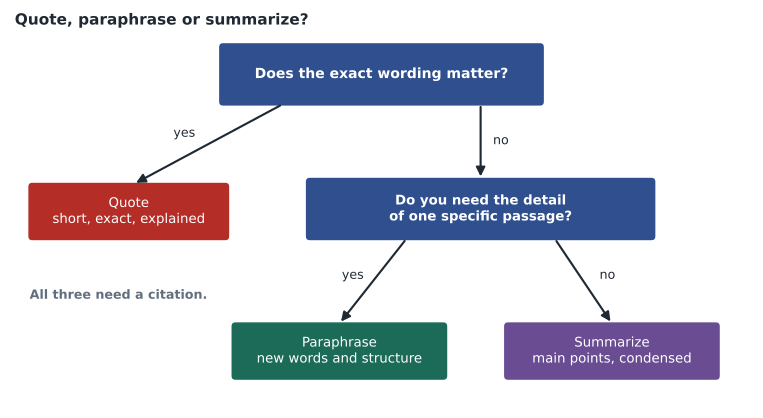
A quotation reproduces the source's exact words, in quotation marks, with a citation. A paraphrase restates a specific passage in your own words and sentence structure, at roughly the same level of detail, with a citation. A summary condenses a longer passage or an entire source into its main points, in your own words, with a citation. All three require citation. The difference is how much of the source's language you use and how much you condense.
When to quote
Quote when the exact words matter: when the wording is memorable or distinctive, when you are analyzing the language itself, when an authority's precise phrasing carries weight, or when paraphrasing would distort a carefully worded claim. In most academic writing outside literature and some humanities fields, quotations should be short and used sparingly. A paper that is mostly quotations has handed its argument to its sources. Varga's guideline for this course: quotations should make up no more than about one tenth of your words, and every quotation must be followed by your own explanation.
Quote exactly. Spelling, punctuation and capitalization must match the source. If you must change something to fit your sentence, show it. Use square brackets for words you add or change, and an ellipsis (three spaced or unspaced periods, depending on the style) for words you remove. Never remove words in a way that changes the meaning. Writing that Delgado and Wen found students 'completed their courses at rates ... slightly higher' would be an accurate use of an ellipsis only if it did not hide the words 'similar to or', which change the claim. As it stands, it does hide them, so it would be a misrepresentation.
Integrating quotations
Quotations must fit grammatically into your sentences and be introduced with a signal phrase that tells the reader who is speaking. Compare three versions.
- Dropped in: 'Open textbooks help. "The difference was largest in the two courses with the most expensive commercial textbooks" (Delgado & Wen, 2023, p. 53).'
- Introduced: 'Delgado and Wen (2023) report that "the difference was largest in the two courses with the most expensive commercial textbooks" (p. 53).'
- Introduced and explained: 'Delgado and Wen (2023) report that "the difference was largest in the two courses with the most expensive commercial textbooks" (p. 53), a pattern suggesting that open materials help most where cost is the greatest barrier.'
The third version is the model. Quotations longer than about forty words in APA, or four lines in MLA, are set as block quotations: indented, without quotation marks, with the citation after the final punctuation. Use them rarely in short essays.
Signal verbs
The verb you use to introduce a source tells the reader how to understand it. Neutral verbs report: states, writes, reports, notes, observes, describes. Verbs of argument signal a position: argues, claims, contends, maintains, suggests. Evaluative verbs carry your judgment: demonstrates, shows and establishes imply the source is right; asserts and alleges may imply doubt. Choose deliberately. Writing that Delgado and Wen 'prove' open textbooks work claims far more than they do; 'suggest' or 'report' is accurate.
| Purpose | Signal verbs | Caution |
|---|---|---|
| Report neutrally | states, reports, notes, describes, observes | Safe for most uses |
| Present an argument | argues, claims, contends, maintains | Signals a debatable position |
| Indicate tentative findings | suggests, proposes, speculates | Use when the source hedges |
| Show agreement | agrees, concurs, confirms | Use only when the sources really align |
| Imply the source is right | demonstrates, shows, establishes | Implies your endorsement |
| Imply doubt | asserts, alleges, insists | May sound dismissive |
Paraphrasing
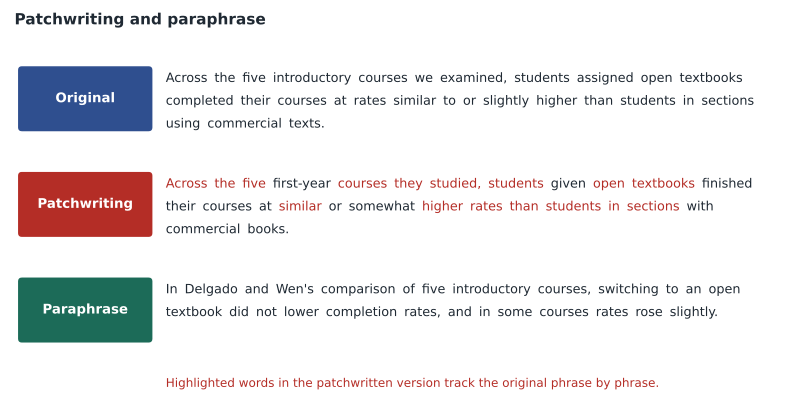
A paraphrase restates a passage in your own words and your own sentence structure. It is useful when the detail of a passage matters but its wording doesn't, and it shows the reader you understand the source. A paraphrase is not a quotation with a few words swapped for synonyms. That practice, sometimes called patchwriting, keeps the source's structure and much of its language, and it is treated as plagiarism even with a citation.
Varga shows a patchwritten version of the first sentence of the passage: 'Across the five first-year courses they studied, students given open textbooks finished their courses at similar or somewhat higher rates than students in sections with commercial books (Delgado & Wen, 2023).' Nearly every phrase tracks the original. A genuine paraphrase changes the structure and expresses the idea freshly: 'In Delgado and Wen's (2023) comparison of five introductory courses, switching to an open textbook did not lower completion rates, and in some courses rates rose slightly.'
A reliable method for paraphrasing has four steps. Read the passage until you understand it. Put the source away and write the idea from memory, as if explaining it to a friend. Compare your version with the original to check accuracy and make sure you haven't reproduced its wording or structure. Add a citation, including a page number where your style requires one. If a technical term has no good substitute, such as course completion, you may keep it; you don't need to invent synonyms for specialized vocabulary.
Summarizing
A summary condenses a source to its main points. It is shorter than the original, often much shorter, and leaves out examples and details. A one-sentence summary of the whole Delgado and Wen passage might read: 'Delgado and Wen (2023) found that open textbooks did not reduce course completion and may improve it where commercial texts are most expensive, though they note that their sample was limited.' That sentence includes the caution, which is essential to representing the source fairly.
A good summary is accurate, proportionate and neutral. It gives the source's main claims the emphasis the source gives them, including qualifications, and keeps your own opinions out; your evaluation comes after the summary, clearly marked as yours. Lesson 10 covers writing longer standalone summaries.
Representing sources fairly
Every use of a source is an interpretation, and interpretations can mislead even when every word is accurate. The most common distortions are cherry-picking, quoting the part of a source that supports you while ignoring its qualifications; overstating, turning 'may' into 'does'; and context-stripping, presenting a view the author describes as an example of what they disagree with as if it were their own position. Luis's sentence, 'open textbooks improve completion,' overstates a finding the authors called similar or slightly higher, and drops their caution. A fair writer represents a source in a way its authors would recognize.
Synthesis: sources in conversation
Using sources well is not only a matter of representing each one accurately. It means putting them in conversation with each other and with your own argument. A paper that summarizes one source per paragraph, in sequence, reads like an annotated reading list. Synthesis organizes by idea: it shows where sources agree, where they disagree, how one extends another and what none of them address.
A synthesis matrix helps. Make a table with your sources as rows and the main questions or themes of your paper as columns. Fill in what each source says about each theme. Reading down a column shows you the conversation on that theme, which becomes a paragraph: 'Delgado and Wen (2023) and the Northgate survey both suggest that cost is the main barrier, while Ferris (2021) argues that format and access matter as much as price.'
Keeping your own voice
Sources support your argument; they don't replace it. Your own voice should open and close most paragraphs, with sources in the middle. A useful check is to highlight every sentence in a draft that comes from a source. If whole paragraphs are highlighted, your argument has gone missing. Add the explanation and analysis that only you can provide: why the evidence matters, how the sources relate and what they mean for your thesis.
Quoting across disciplines
How much you quote depends on your field. In literature, history and film studies, the language of a primary source is often the evidence, so close analysis of short quotations is central: a historian may quote a phrase from a letter to show how a writer saw events, and a film scholar may quote a line of dialogue to analyze a character. In the sciences, engineering and most social sciences, writers rarely quote at all. They paraphrase or summarize findings and cite them, because what matters is the result, not the words used to report it. Hana's physics instructors expect almost no quotations in lab reports; Brigid's film instructors expect several in an analysis.
Business and technical writing usually follow the sciences: summarize and cite. Legal writing quotes statutes and decisions precisely, because exact wording determines meaning. When you are unsure, look at a few strong examples of writing in your field and count the quotations.
Four common problems, and their fixes
Sam Achebe at the writing center sees the same source problems every term. The first is the quotation that ends a paragraph, leaving the source with the last word; move your explanation after it. The second is the string of quotations joined by 'also' and 'in addition,' with no analysis between them; keep the best one and paraphrase or cut the rest. The third is the vague citation, such as 'studies show,' with no study named; name the source or drop the claim. The fourth is the source that never appears in the argument at all, listed in the references but never used in a way that matters; either use it or remove it.
Achebe suggests a final check before submitting: for each source in your reference list, find every place you used it and ask what it contributed. If the answer is nothing important, the source is padding, and readers notice.
Achebe's last piece of advice is about proportion. Count, roughly, how many of your paragraphs begin with a source rather than with your own point. If most do, the sources are leading and you are following. Rewrite the openings so that each paragraph begins with your claim, brings in the sources as support, and ends with your explanation. The sources will still be there, but the argument will be yours.
Worked problem
Choosing quotation, paraphrase or summary
Kofi wants to use three things from Delgado and Wen in his essay: their general finding, their point about expensive textbooks, and their caution about volunteer instructors. Which method suits each?
Show solution
- General finding: a summary in one clause is enough, because his reader needs the conclusion, not the wording: 'Delgado and Wen (2023) found that open textbooks did not reduce completion.'
- Expensive textbooks: a paraphrase, because the detail matters to his argument about cost but the wording doesn't: they found the largest gains in the courses where commercial texts cost most.
- Volunteer instructors: a short quotation, because the precise wording of a limitation matters and paraphrasing could soften or sharpen it: the authors note that instructors who volunteer 'may differ from those who do not' (p. 53).
- Follow each with his own explanation of how it supports or qualifies his thesis.
Answer: Summarize the finding, paraphrase the cost pattern, and quote the limitation briefly, each with a citation and his own analysis.
Common mistakes
MistakeChanging a few words in a passage makes it a paraphrase.
InsteadSwapping synonyms while keeping the structure is patchwriting; a paraphrase changes words and structure.
MistakeParaphrases don't need citations.
InsteadEvery quotation, paraphrase and summary needs a citation.
MistakeMore quotations make a paper more scholarly.
InsteadHeavy quoting hands your argument to your sources; quote sparingly and explain every quotation.
MistakeA summary can leave out the source's qualifications.
InsteadA fair summary keeps the qualifications that shape the source's claims.
Summary and key terms
- Quotations reproduce exact words, paraphrases restate a passage in new words and structure, and summaries condense main points; all need citations.
- Quote when wording matters, sparingly, exactly, with brackets and ellipses used honestly.
- Introduce sources with signal phrases and choose signal verbs deliberately.
- Avoid patchwriting by writing paraphrases from memory and checking them against the source.
- Represent sources fairly and synthesize them by idea, keeping your own voice in control.
- Quotation
- A source's exact words, in quotation marks, with a citation.
- Paraphrase
- A restatement of a specific passage in your own words and structure.
- Summary
- A condensed account of a source's main points in your own words.
- Patchwriting
- Copying a source's structure and much of its wording while swapping some words.
- Signal phrase
- A phrase that introduces a source, such as "Delgado and Wen report that".
- Synthesis
- Combining sources by idea to show how they agree, differ and relate.
Practice problems
Work each problem on paper first, then reveal the answer to check.
When should you use a block quotation in APA style?
Show answer
For quotations of about forty words or more, and rarely in short essays.
What is wrong with changing 'may differ' to 'differ' in a quotation?
Show answer
It changes the meaning, turning a possibility into a claim, which misrepresents the source.
Name the four steps of a reliable paraphrase.
Show answer
Understand the passage, write from memory, compare for accuracy and wording, add a citation.
How does a synthesis matrix help?
Show answer
It shows what each source says about each theme, so you can write paragraphs organized by idea.
Lesson quiz · 5 questions
Score 60% or more to complete this lesson.
Create a free account to save your progress, take quizzes and earn a certificate.