
WRIT-101 · Lesson 6 of 12 · 20 min
Finding and evaluating sources
▶ Video coming soon A video version of this lesson is on the way.
Priya Nair, in the artificial intelligence program, types her research question into a search engine: 'do open textbooks work.' She gets millions of results in under a second. The first page includes a publisher's marketing page, a blog post by a student, a news article, a college library guide, a page from an advocacy group and a forum thread. She brings the list to class and asks Dr. Varga which ones she can use. 'Maybe all of them, maybe none,' Varga says. 'It depends on what you need them for, and on whether they hold up when you check them.' This lesson is about finding sources efficiently and judging whether they deserve your reader's trust.
Why sources matter
Academic writing joins a conversation that started before you arrived. Sources let you show what is already known, support your claims with evidence your reader can check, and engage with people who see the question differently. Your argument can be no stronger than the sources it rests on. A brilliant essay built on a misread blog post collapses the moment a reader checks the citation.
Primary, secondary and tertiary sources
Sources are often classified by how close they are to the original evidence. Primary sources are the original material: data, experiments, interviews, laws, historical documents, financial statements, a film itself. Secondary sources analyze or interpret primary sources: research articles that discuss studies, books that interpret history, reviews of a film. Tertiary sources summarize and organize secondary sources: encyclopedias, textbooks, handbooks and literature guides. The categories depend on use. A newspaper article from 1965 is a secondary source on the events it describes, but a primary source for a study of how newspapers covered those events.
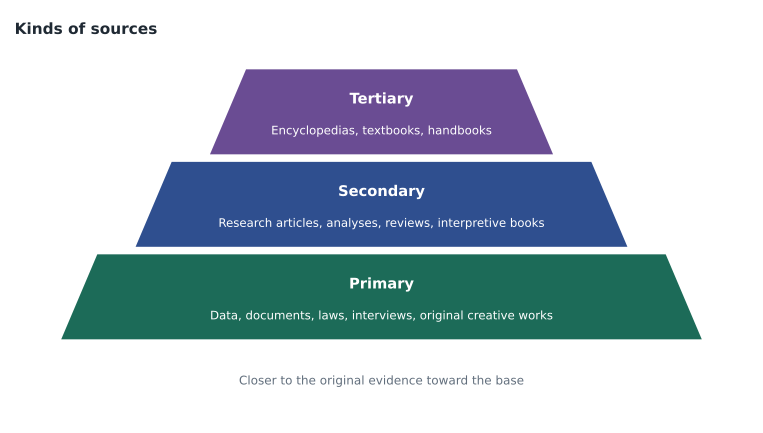
Tertiary sources are excellent places to start, because they give an overview and point you to more detailed sources. They are rarely what you should cite for key claims in an academic paper. Varga's rule: use the encyclopedia to find your way, then follow its references to the sources it relied on.
Scholarly and popular sources
Scholarly sources are written by researchers for other researchers, usually published in academic journals or by university presses, and typically reviewed by other experts before publication. Popular sources are written for general readers: newspapers, magazines, websites, blogs. Professional and trade sources fall between: industry magazines, professional association reports and government publications written for practitioners.
| Feature | Scholarly | Popular | Professional or government |
|---|---|---|---|
| Author | Researchers with stated credentials | Journalists or general writers | Practitioners, analysts or agencies |
| Audience | Other researchers | General public | Practitioners and decision makers |
| Review | Usually peer reviewed | Editorial review only | Varies; often internal review |
| Citations | Full references | Few or none | Often some references |
| Strength | Rigor and detail | Timeliness and accessibility | Practical data and context |
| Limitation | Slow to publish, technical | Simplifies, may sensationalize | May reflect an agency's mandate |
Popular sources are not forbidden. A news article can show that an issue is current, report an event that research has not yet studied or offer an example. But for claims about what is true in general, such as whether open textbooks affect learning, readers will expect scholarly or authoritative sources.
Peer review
Peer review is the process by which a journal sends a submitted article to other experts who evaluate its methods, reasoning and contribution before it is accepted. It is the main quality control in academic publishing. It is not a guarantee: reviewers miss errors, and some peer-reviewed findings later fail to replicate. But it means that at least two qualified people other than the authors have checked the work. Most library databases let you limit a search to peer-reviewed articles.
Be aware of predatory journals, which charge authors fees to publish and claim peer review without performing it. Typical signs include aggressive email solicitations, very fast acceptance, a vague editorial board and a title that closely imitates a respected journal. If you are unsure about a journal, ask a librarian.
Where to search
Search engines are good for finding organizations, government reports, news and general information. For scholarly sources, start with your college library's search tool and its subject databases, which index journals and often provide full text your library pays for. Academic search engines such as Google Scholar are useful too, especially for following citations, but they include material of uneven quality and often link to articles behind paywalls that your library may already give you access to.
For American data, federal agencies such as the U.S. Census Bureau and the National Center for Education Statistics publish extensive datasets, and state agencies publish their own. For international comparisons, organizations such as the OECD publish data across many countries. Your own college may also publish institutional research, as Northgate does. Government and institutional reports are often called gray literature: authoritative material published outside commercial and academic channels. It is valuable, especially for local questions, and should be evaluated like any other source.
Search strategies
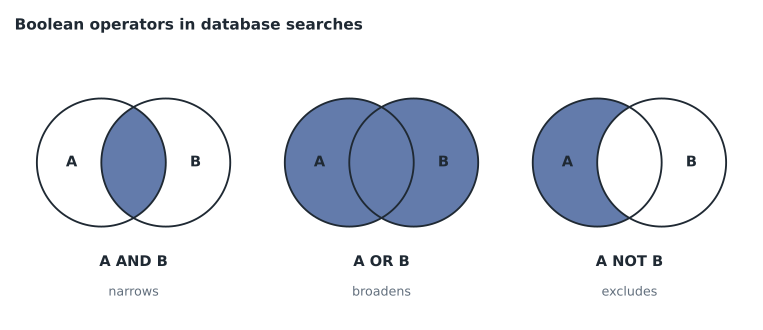
Effective searching starts with keywords, not full questions. Break your question into its main concepts and list synonyms for each. For Priya's question about whether open textbooks affect learning, the concepts are open textbooks (synonyms: open educational resources, OER, free textbooks), learning (synonyms: achievement, grades, outcomes, course completion) and college (synonyms: postsecondary, higher education, university). Databases let you combine these with Boolean operators.
- AND narrows: open textbooks AND outcomes finds only items containing both.
- OR broadens: open textbooks OR OER finds items containing either, which is useful for synonyms.
- NOT excludes: textbooks NOT elementary removes items about elementary schools, though it can remove relevant items too.
- Quotation marks search for an exact phrase: "open educational resources".
- Truncation, usually an asterisk, finds word endings: textbook* finds textbook and textbooks.
Priya's database search, ("open textbooks" OR "open educational resources" OR OER) AND (outcomes OR achievement OR completion) AND (college OR postsecondary), limited to peer-reviewed articles from the last ten years, returns a manageable list. She sorts it by relevance and reads titles and abstracts to choose a dozen worth reading in full.
Once you find a good source, use it to find more. Its reference list points backward to earlier work. A citation search in Google Scholar or a database points forward to later work that cited it. Librarians call this citation chaining, and it is often the fastest way to find the central studies on a topic.
Evaluating sources
Finding a source is half the work. Before you rely on it, evaluate it. Librarians have developed several checklists. One widely used set of questions asks about currency, relevance, authority, accuracy and purpose.
- Currency: when was it published or updated, and does that matter for your topic? A ten-year-old article on artificial intelligence is out of date; a ten-year-old article on the history of textbooks may be fine.
- Relevance: does it address your question, at the right level, for your context?
- Authority: who is the author or publisher, and what are their qualifications?
- Accuracy: is the information supported by evidence, cited and consistent with other reliable sources?
- Purpose: why was it written: to inform, persuade, sell or entertain? Is there a stake or bias?
Checklists are useful, but researchers who study how experts evaluate websites found that professional fact-checkers work differently from students. Instead of reading a page closely to judge it, they leave it quickly and read laterally: they open new tabs to see what other reliable sources say about the site, the author and the claim. A page can look professional and still be published by a group with an undisclosed agenda. Lateral reading finds that out in minutes.
Priya practices lateral reading on a site called Textbook Truth that appears in her results. It looks like an independent research organization. Two searches show that it is funded by a commercial publishers' association. That doesn't mean its data are false, but it changes how she uses them: as evidence of the industry's position, checked against independent research.
AI search tools
Many students now use AI chatbots to find sources. These tools can be useful for brainstorming keywords or getting a quick overview, but they have a serious weakness: they can produce plausible citations to articles that do not exist, or attribute real findings to the wrong authors. Never cite a source you have not located and read yourself. If a chatbot suggests a source, search for it in the library database. Lesson 9 covers the integrity questions AI tools raise.
Keeping a research log
Keep a record of every search you run and every source you use: the database, the search terms, the date, and for each source, the full citation details and a note on what it contributes. A research log saves you from repeating searches, makes building the reference list easy and protects you if you need to show how you found something. A spreadsheet or a reference manager such as Zotero works well.
How many sources, and which ones?
Students often ask how many sources an essay needs. The assignment usually sets a minimum, but the real answer is: enough to support each claim that needs support, from sources strong enough to persuade a skeptical reader. A 2,000-word argumentative essay typically draws on six to twelve sources, but the number matters less than the mix. Kofi's final essay uses a systematic review and two individual studies for his claim that open textbooks work, Northgate's institutional survey for the local problem, a faculty association report for the cost of adoption, and one student newspaper article to show that the debate is current on campus. Each source does a specific job.
A good test is to look at your outline and ask, for each section, which source a doubtful reader would most want to see. If the answer is a source you don't have, you need to search again. If a section rests entirely on one source, you may be summarizing that source rather than building an argument. And if all your sources agree, you have probably missed part of the conversation; look for the strongest work on the other side.
Working with a librarian
College librarians are experts in exactly the problems this lesson describes, and most students never ask them for help. A librarian can suggest the best database for your topic, help you find the right search terms, show you how to get articles your library doesn't hold through interlibrary loan, and help you judge whether a journal or publisher is reputable. Many libraries offer drop-in help, online chat and booked research consultations.
Priya books a twenty-minute consultation and comes away with two subject databases she hadn't known about, a list of search terms the field actually uses, and a recent systematic review that cites most of the studies she needs. She tells the class it saved her a weekend. Varga adds that librarians prefer to be asked early, when there is still time to change direction, not the night before the paper is due.
Finally, remember that evaluation continues while you write. If a source's claim turns out to be contradicted by stronger evidence, or a figure you planned to use can't be traced to its origin, drop it or say plainly what its limits are. A paper with six well-chosen sources that the writer understands is far stronger than one with fifteen that the writer has skimmed. Readers judge your argument partly by the company it keeps, and a single unreliable source can make them doubt the rest.
Worked problem
Evaluating a source
Hana finds a website article titled 'Open Textbooks Fail Physics Students.' It is undated, written by 'Staff,' and cites one study without a link. What should she do?
Show solution
- Currency: undated, so she can't tell whether it reflects current research.
- Authority: no named author; she checks who runs the site by reading laterally.
- Accuracy: one study cited without a link; she searches the library database for the study itself.
- Purpose: the title is sensational, suggesting the article aims to persuade.
- Decision: she finds the original study, which shows a small difference in one course and no difference in two others, and cites the study rather than the website.
Answer: Don't cite the website; locate and read the original study, and cite it accurately.
Common mistakes
MistakePeer-reviewed means proven true.
InsteadPeer review is a quality check, not a guarantee; findings still need evaluation.
MistakePopular sources can never be used in academic writing.
InsteadThey can show currency, examples or public debate, but general claims need scholarly or authoritative support.
MistakeType your full question into the database.
InsteadSearch with key concepts and synonyms combined with AND and OR.
MistakeA professional-looking website is reliable.
InsteadRead laterally to find out who is behind it and what others say about it.
Summary and key terms
- Sources can be primary, secondary or tertiary; start with tertiary sources but rest arguments on primary and secondary ones.
- Scholarly sources are written for researchers and usually peer reviewed; popular and professional sources have other uses.
- Search library databases with keywords, synonyms and Boolean operators, and use citation chaining.
- Evaluate sources for currency, relevance, authority, accuracy and purpose, and read laterally.
- Verify every source an AI tool suggests and keep a research log.
- Primary source
- Original material such as data, documents or a creative work.
- Secondary source
- A source that analyzes or interprets primary sources.
- Tertiary source
- A source that summarizes secondary sources, such as an encyclopedia.
- Peer review
- Evaluation of a submitted article by independent experts before publication.
- Boolean operators
- AND, OR and NOT, used to combine search terms.
- Lateral reading
- Checking a source by seeing what other reliable sources say about it.
- Gray literature
- Authoritative material published outside commercial and academic channels, such as government reports.
Practice problems
Work each problem on paper first, then reveal the answer to check.
Is a film a primary or secondary source in a paper analyzing that film?
Show answer
Primary; reviews and scholarly analyses of the film are secondary.
Write a search string for articles on remote work and productivity in construction.
Show answer
For example: ("remote work" OR telework) AND (productivity OR performance) AND construction.
What does lateral reading mean?
Show answer
Leaving a source to check what other reliable sources say about its author, publisher and claims.
A chatbot gives you a citation. What must you do before using it?
Show answer
Find the source in a database, confirm it exists and read it.
Lesson quiz · 5 questions
Score 60% or more to complete this lesson.
Create a free account to save your progress, take quizzes and earn a certificate.