
WRIT-101 · Lesson 3 of 12 · 21 min
Building an argument: thesis, claims and evidence
▶ Video coming soon A video version of this lesson is on the way.
Dr. Varga writes a sentence on the board: 'Textbooks are expensive.' She asks whether it is a good thesis for an essay. Kofi says it is true. Varga agrees, and says that is the problem. 'If no reasonable person would disagree with your thesis,' she says, 'you don't have an argument. You have a fact, and an essay about a fact has nowhere to go.' She rewrites it: 'Northgate should require first-year courses to use open textbooks wherever an adequate one exists, because the savings for students outweigh the costs to faculty and the college.' Now, she says, there is something to argue about.
In academic writing, an argument is not a quarrel. It is a reasoned case for a position on a question where reasonable people could disagree, supported by evidence and presented to a reader who has not yet been persuaded. This lesson covers the parts of an argument: the thesis, the claims and reasons that support it, the evidence that supports the reasons, and the counterarguments a fair writer must address.
What makes a thesis
A thesis is the main point of an essay, usually stated in one or two sentences near the end of the introduction. A strong academic thesis has four qualities. It is arguable: a reasonable reader could disagree. It is specific: it names exactly what is being claimed, about what, and often why. It is supportable: evidence exists or could be found to support it. And it is limited to what the paper can cover: a 2,000-word essay cannot settle the future of higher education.
| Weak thesis | Problem | Stronger version |
|---|---|---|
| Textbooks are expensive. | A fact, not an argument | Northgate should adopt open textbooks in first-year courses where adequate ones exist, because student savings outweigh faculty and college costs. |
| Social media has good and bad effects. | Too vague to argue | For first-year students, limiting phone use during lectures improves note quality more than it harms access to course tools. |
| This essay will discuss remote work. | Announces a topic, makes no claim | Small construction firms gain more than they lose by allowing project coordinators to work remotely two days a week. |
| Climate change is the biggest problem humanity has ever faced and must be solved now. | Too broad for a short essay | A municipal rebate for heat pumps would reduce household emissions in Columbus more cheaply than the current furnace-replacement grant. |
Look at what the stronger versions have in common. Each names a specific subject, takes a position someone could reasonably dispute and hints at the reasons the essay will develop. A precise claim can be supported; a vague one can't, because there is no way to tell what evidence would count.
Kinds of claims
Arguments make different kinds of claims, and each needs different support. Recognizing which kind you are making helps you find the right evidence.
- Claims of fact argue that something is or was the case: online evaluations reduced response rates at Northgate. They need data and reliable sources.
- Claims of definition argue about what something is or how it should be classified: an open textbook must be free to read and free to adapt, not only free to read. They need criteria and examples.
- Claims of cause argue that one thing produces another: rising textbook prices cause students to skip required readings. They need evidence that rules out other explanations.
- Claims of value argue that something is good, bad, better or worse: open textbooks are as good as commercial ones for introductory courses. They need stated criteria and evidence for each.
- Claims of policy argue that something should be done: Northgate should adopt open textbooks. They usually rest on claims of fact, cause and value, and they must address feasibility and cost.
Most essays combine several. Kofi's policy thesis depends on a claim of fact (students are paying a lot), a claim of cause (cost leads students to go without required texts) and a claim of value (open textbooks are good enough). Each needs its own evidence.
Reasons and evidence
A thesis is supported by reasons, and reasons are supported by evidence. A reason answers the question 'why should I believe that?' Evidence answers 'how do you know?' In an essay, each major reason usually becomes a section, and the evidence fills the paragraphs.
Evidence comes in several forms: statistics and data, results of studies, examples and cases, expert testimony, and reasoning from principles. In most academic fields, the strongest evidence is systematic: data from a well-designed study is stronger than a single anecdote, and a review of many studies is stronger than one study. But examples and cases have their place. They make abstract points concrete and show what statistics mean for real people. A strong argument usually combines them: a statistic to show scale, a case to show what it means.
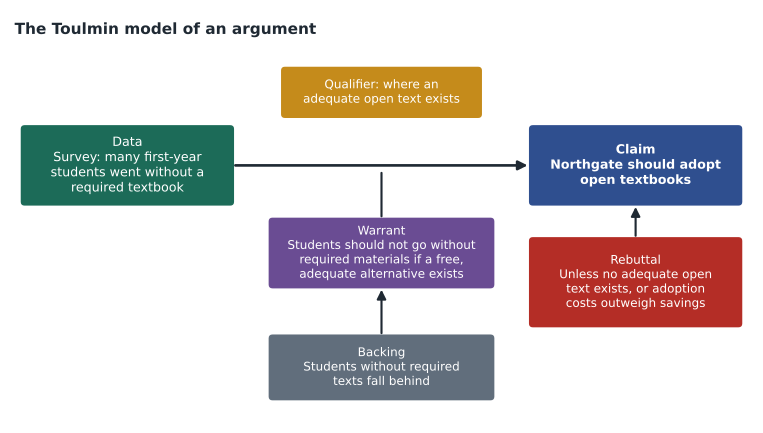
The warrant: why the evidence supports the claim
Philosopher Stephen Toulmin pointed out that evidence never supports a claim on its own. There is always a link, which he called the warrant: a general principle that explains why this evidence supports this claim. Suppose Kofi's evidence is that a Northgate survey found many first-year students did not buy at least one required textbook because of cost, and his claim is that the college should adopt open textbooks. The warrant is something like: if students go without required materials because of cost, and a free alternative of adequate quality exists, the college should provide it. Most readers will accept that warrant. But if a reader doesn't, no amount of survey data will persuade them; Kofi would need to support the warrant itself, perhaps with evidence that students without textbooks do worse.
The Toulmin model adds three more parts. A qualifier limits the claim: 'in most first-year courses' or 'where an adequate open text exists.' Backing supports the warrant. And a rebuttal states conditions under which the claim would not hold, such as courses where no adequate open textbook exists. Qualifiers and rebuttals are not signs of weakness. They make an argument more credible, because they show the writer has thought about its limits.
Counterarguments
A fair argument addresses the strongest objections to it. Doing so is not only polite; it is persuasive, because a reader who holds the objection will dismiss an essay that ignores it. There are three ways to respond to a counterargument. You can concede it: accept that it is true and show that your thesis still holds. You can refute it: show with evidence or reasoning that it is wrong. Or you can qualify your thesis: narrow it so that the objection no longer applies.
Kofi identifies the strongest objection to his thesis: adapting a course to a new textbook takes faculty time, and some open textbooks are less polished or lack the problem sets and online tools commercial publishers provide. He concedes that adoption takes time, refutes the idea that open textbooks are generally inferior by citing a review of studies that found similar learning outcomes, and qualifies his thesis to apply only where an adequate open text exists, with support for faculty who make the switch.
Appeals: logos, ethos and pathos
The ancient Greek philosopher Aristotle described three ways arguments persuade. Logos is the appeal to reason: evidence and logic. Ethos is the appeal to the writer's credibility: expertise, fairness and care with sources. Pathos is the appeal to emotion and values: what the reader cares about. Academic writing relies mainly on logos, but it is not purely logical. Ethos matters enormously: a writer who cites carefully, represents opponents fairly and qualifies claims earns trust. And pathos has a place when it is honest: a brief example of a student choosing between a textbook and rent can show why the numbers matter. Pathos becomes manipulation when it replaces evidence instead of illustrating it.
Fallacies to avoid
A fallacy is a flaw in reasoning that makes an argument seem stronger than it is. Recognizing fallacies helps you read critically and keeps them out of your own writing. These are the ones Varga sees most often in student essays.
| Fallacy | What it does | Example |
|---|---|---|
| Hasty generalization | Draws a broad conclusion from too little evidence | My two classes using open textbooks went well, so they work everywhere. |
| False cause | Assumes that because B followed A, A caused B | Grades rose the year we switched textbooks, so the switch raised grades. |
| Straw man | Misrepresents an opposing view to make it easier to attack | Opponents of open textbooks just want publishers to keep making money. |
| Ad hominem | Attacks the person instead of the argument | The dean opposes the plan, but she used to work for a publisher. |
| False dilemma | Presents two options as the only ones | Either we adopt open textbooks everywhere or we abandon students who can't pay. |
| Slippery slope | Claims one step will lead to extreme consequences without showing how | If we allow open textbooks, soon no one will publish serious scholarship. |
| Appeal to popularity | Treats wide belief as proof | Most students support the switch, so it must be the right policy. |
Some of these patterns are not always fallacies. A person's financial interest is relevant to how carefully you check their claims, even if it doesn't make them wrong. A sequence of events can be evidence of cause if other explanations are ruled out. The fallacy lies in treating the pattern as proof.
Arguments across disciplines
Argument looks different in different fields, but it is everywhere. A physics lab report argues that the data support a conclusion within a stated uncertainty. An audit finding argues that a control failed and recommends a fix. A design document argues that one architecture is better than another for stated requirements. A film proposal argues that a story deserves funding. Hana notices that her lab reports have a thesis, a claim about what the experiment showed, even though no one calls it that. Varga says that recognizing the argument in every genre is one of the main things this course is meant to teach.
Testing your thesis
Before drafting, Varga asks the class to put their working theses through four quick tests. The disagreement test: can you name a reasonable person who would disagree, and say why? If not, the thesis is probably a fact. The so-what test: if a reader accepted your thesis, would anything change in what they believe or do? If not, the thesis may be too trivial. The evidence test: can you name the kinds of evidence that would support each part, and do you know where to find them? If not, the thesis may be unsupportable in the time you have. The scope test: could you support the thesis well in the length you have? If you would need a book, narrow it.
Brigid's working thesis is that films should be shot on film rather than digitally. It fails the scope test badly. After the four tests she narrows it to a claim she can support in 2,000 words: that for a first-year cinematography course, a short assignment shot on sixteen-millimeter film teaches exposure more effectively than the same assignment shot digitally, because the cost of each frame forces students to plan. The narrower thesis is arguable, matters to her program and can be supported with course outcomes, interviews and published teaching research.
How strong is your evidence?
Not all evidence is equal. Varga gives the class a rough ladder for judging evidence about cause and effect, from weakest to strongest. At the bottom are personal anecdotes and opinions. Above them are single examples or case studies, then surveys and correlational studies that show two things occur together, then controlled studies that compare groups, and at the top, systematic reviews that combine the results of many studies. The ladder is not a rule that weaker evidence is useless. A case study can reveal how something works in practice, and expert opinion can matter where research is thin. But when you make a claim about cause, readers will expect evidence from higher on the ladder, and you should say honestly when the best evidence available is limited.
A useful habit is to match the strength of your language to the strength of your evidence. A systematic review may support 'reduces.' A single survey may support only 'is associated with' or 'suggests.' Matching language to evidence is one of the clearest signs of a careful academic writer.
Worked problem
Building an argument outline
Amir wants to argue that small construction firms should let project coordinators work remotely two days a week. Build the core of his argument.
Show solution
- Thesis (policy claim): small construction firms gain more than they lose by allowing project coordinators to work remotely two days a week.
- Reason 1 (fact and cause): much coordination work, such as scheduling, procurement and documentation, can be done online, so remote days do not delay it. Evidence: a task breakdown from two firms and published productivity research.
- Reason 2 (value): flexible work helps firms recruit and keep coordinators in a tight labor market. Evidence: industry survey data on retention.
- Warrant: a policy that keeps work on schedule while improving retention benefits the firm.
- Counterargument: coordinators need to be on site to catch problems. Response: concede that site presence matters and qualify the policy so that remote days are scheduled around key site milestones.
Answer: A qualified policy claim supported by two reasons with evidence, a stated warrant and a fair response to the main objection.
Common mistakes
MistakeA thesis should be something everyone agrees with.
InsteadA thesis should be arguable; a fact no one disputes leaves nothing to argue.
MistakeMentioning counterarguments weakens an essay.
InsteadAddressing the strongest objection fairly makes an essay more persuasive.
MistakeEmotional appeals have no place in academic writing.
InsteadHonest emotional appeals can illustrate evidence; they become manipulative only when they replace it.
MistakeOne vivid example proves a general claim.
InsteadA single example illustrates; general claims need systematic evidence.
Summary and key terms
- An academic argument is a reasoned, evidence-based case on a debatable question, written for a reader not yet persuaded.
- A strong thesis is arguable, specific, supportable and limited to what the paper can cover.
- Claims of fact, definition, cause, value and policy each need different evidence.
- The warrant connects evidence to claim; qualifiers and rebuttals make an argument more credible.
- Address the strongest counterargument by conceding, refuting or qualifying, and avoid common fallacies.
- Thesis
- The main, arguable point of an essay.
- Claim
- A statement the writer asks the reader to accept.
- Evidence
- Information, data, examples or testimony that supports a reason.
- Warrant
- The principle that explains why evidence supports a claim.
- Qualifier
- A word or phrase that limits the scope of a claim.
- Counterargument
- An objection to the writer's thesis.
- Fallacy
- A flaw in reasoning that makes an argument seem stronger than it is.
Practice problems
Work each problem on paper first, then reveal the answer to check.
Is 'Many students work part time' a good thesis? Why or why not?
Show answer
No; it is a fact few would dispute. A thesis must be arguable, for example about what colleges should do about it.
Identify the kind of claim: 'Group work in first-year courses is a better use of class time than lectures.'
Show answer
A claim of value; it needs criteria for 'better' and evidence for each.
What is the warrant in: 'The bridge inspection found corrosion, so the bridge should be closed'?
Show answer
Something like: a bridge with corrosion that threatens its safety should be closed; it needs backing about the severity of the corrosion.
Name the fallacy: 'Either we ban phones in class or students will never learn to concentrate.'
Show answer
False dilemma; there are other options, such as limited use.
Lesson quiz · 5 questions
Score 60% or more to complete this lesson.
Create a free account to save your progress, take quizzes and earn a certificate.