
WRIT-101 · Lesson 5 of 12 · 20 min
Paragraphs that work: topic sentences, evidence and analysis
▶ Video coming soon A video version of this lesson is on the way.
Hana Sato reads a paragraph from her draft aloud. It contains a statistic about textbook prices, a quotation from a professor, a sentence about her own experience buying a physics textbook, and a final sentence that begins 'In conclusion.' Every sentence is accurate. Dr. Varga asks the class what the paragraph argues. Nobody can say. 'It has evidence,' Varga says, 'but no point, and no explanation of how the evidence supports the point. That is a pile of bricks. A paragraph is a wall.'
If the essay is a building, paragraphs are its load-bearing walls. Each one should make a single point that advances the argument, support that point with evidence, and explain how the evidence supports it. This lesson covers how to build paragraphs that do all three, and how to connect them so the reader moves smoothly from one to the next.
One paragraph, one point
A paragraph in an academic essay is a unit of argument. It should develop one main idea, usually a claim that supports the thesis or one of its reasons. When a paragraph tries to make two or three points, readers lose track of which point the evidence supports. When a single point is spread across several paragraphs without clear divisions, readers can't tell where one step of the argument ends and the next begins.
A simple test is to state the point of each paragraph in one sentence. If you can't, the paragraph probably lacks a clear point. If you need two sentences joined by 'and also,' it probably makes two points and should be split.
Topic sentences
The topic sentence states the paragraph's main point, usually at or near the beginning. It tells the reader what the paragraph will argue and, ideally, how it connects to the thesis. Topic sentences are the skeleton of the essay: read them in order and you should get a summary of the argument.
Weak topic sentences announce a subject without making a claim: 'This paragraph is about cost' or 'Textbooks are an important issue.' Strong topic sentences make a claim that the rest of the paragraph supports: 'Cost does not only make textbooks inconvenient; for many first-year students, it puts them out of reach entirely.' The strong version tells the reader exactly what evidence to expect.
| Weak topic sentence | Problem | Stronger version |
|---|---|---|
| There are many studies on open textbooks. | Describes the literature without a claim | Studies comparing open and commercial textbooks in introductory courses consistently find similar learning outcomes. |
| Faculty time is another issue. | Names a topic only | The largest hidden cost of adopting open textbooks is faculty time, but it is a one-time cost that support can reduce. |
| Some students prefer printed books. | A fact with no link to the argument | Students' preference for print does not undermine the case for open textbooks, because most open texts can be printed at low cost. |
Point, evidence, explanation, link
Varga teaches a pattern for body paragraphs that many writing courses use in some form. Point: state the paragraph's claim in the topic sentence. Evidence: provide the data, example, quotation or reasoning that supports it. Explanation: show how the evidence supports the point and why it matters. Link: connect the point back to the thesis or forward to the next paragraph. The pattern is not a formula to follow mechanically; strong writers vary it. But it names the parts that most weak paragraphs are missing, especially the explanation.
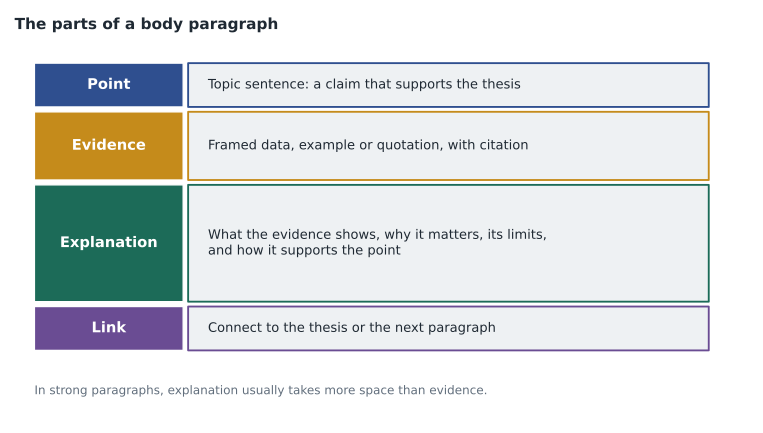
Here is a body paragraph from Kofi's essay revised to follow the pattern. Point: 'Cost does not only make textbooks inconvenient; for many first-year students, it puts them out of reach entirely.' Evidence: 'In a 2025 survey by Northgate's Office of Institutional Research, a large share of first-year respondents reported not buying at least one required textbook because of cost, and many of those said they had fallen behind in the course as a result.' Explanation: 'These students are not choosing convenience over learning; they are choosing between course materials and other necessities. The fact that many report falling behind suggests the problem affects learning, not just budgets.' Link: 'If cost is a real barrier to learning, the next question is whether free alternatives can remove it without lowering quality.'
Analysis: the part most paragraphs are missing
The most common weakness in student paragraphs is too little analysis. Analysis is the writer's explanation of what the evidence means: why it matters, what it shows, what its limits are and how it supports the point. Without it, the reader has to do the thinking, and they may draw a different conclusion than you intended. A paragraph that presents a quotation and moves on has handed the argument to the source.
Varga gives the class four questions to generate analysis after any piece of evidence. What does this show? Why does it matter for my point? What are its limits? How does it connect to my thesis? Answering even two of these usually produces two or three sentences of analysis, which is often enough. A rough guide she offers: in a body paragraph, the writer's own sentences of explanation should at least equal the sentences of evidence.
Analysis is also where the writer's voice appears. Hana revises her paragraph so that its point is that the price of required physics textbooks has risen faster than other course costs. She keeps the statistic, cuts the unrelated quotation and her anecdote, and adds three sentences explaining that the rise matters because physics students typically need two expensive texts in first year, and that the anecdote she cut was, on reflection, not evidence of a trend.
Unity, coherence and development
Three qualities make paragraphs work. Unity means every sentence relates to the paragraph's main point; a sentence that drifts to another topic belongs elsewhere or nowhere. Coherence means the sentences connect logically, so the reader can follow the reasoning from one to the next. Development means the point is supported fully enough to be convincing: enough evidence and enough explanation.
Coherence comes from several techniques. Transitions show relationships between sentences. Repeating key terms keeps the reader focused; academic writing repeats important words rather than varying them, because a new word can suggest a new idea. Pronouns such as this and these link back, but only when the reference is clear; 'This shows' is vague if the reader can't tell what this refers to, so write 'This decline shows.' And the known-new principle helps most of all: begin sentences with information the reader already has and end them with new information. Each sentence's new information then becomes the next sentence's known starting point, creating a chain.
Varga demonstrates. Without the known-new chain: 'Faculty must revise their courses. Open textbooks are often adopted by faculty. Time is required for revision.' With it: 'Adopting an open textbook requires faculty to revise their courses. That revision takes time, often several weeks before the first term. The time is a real cost, but it is paid once rather than every term.' The second version reads as a line of reasoning because each sentence picks up where the last one ended.
Paragraph length
There is no fixed length for an academic paragraph, but most body paragraphs in essays run from about 120 to 250 words. Very short paragraphs, one or two sentences, usually lack development. Very long paragraphs, more than a page, usually contain more than one point. In reports and online writing, paragraphs are often shorter because readers scan; in essays, readers expect developed paragraphs. If a paragraph is getting long, look for the place where the point shifts and split it there.
Special paragraphs
Not every paragraph follows the body-paragraph pattern. Introductions and conclusions have their own jobs, covered in Lesson 4. Transitional paragraphs, usually short, summarize one section and set up the next in a long paper. Counterargument paragraphs often begin with the objection stated fairly, then the response; their topic sentence may be the objection itself, followed by a sentence that signals the response. And in some disciplines, a paragraph may be built around a figure or table, explaining what it shows.
Framing evidence inside a paragraph
Evidence should never arrive in a paragraph unannounced. Varga calls a quotation or statistic dropped in without introduction a 'parachute': it lands in the middle of the paragraph, and the reader has to work out where it came from and why it is there. The fix is to frame each piece of evidence in three moves. Introduce it, so the reader knows who is speaking or where the data come from. Present it, accurately and with a citation. Then explain it, in your own words, connecting it to the paragraph's point. Writing tutors often call this the evidence sandwich, with the evidence as the filling between your introduction and your explanation.
Compare two versions. Parachute: 'Open textbooks are effective. "Students using open materials achieved similar final grades" (Delgado & Wen, 2023, p. 52).' Framed: 'In a study of five introductory courses at three colleges, Delgado and Wen (2023) found that "students using open materials achieved similar final grades" to those using commercial texts (p. 52). Because the courses, instructors and assessments were held constant, the finding suggests that the type of textbook, not other differences between sections, explains the result.' The framed version tells the reader where the evidence came from, how strong it is and what it means. Lesson 7 covers quoting and paraphrasing in more detail; Lesson 8 covers the citation formats.
Paragraphs in your discipline
The body-paragraph pattern adapts to different fields. In a lab report's discussion section, the point is an interpretation of a result, the evidence is the data, and the explanation compares the data to theory and discusses uncertainty. In an accounting memo, paragraphs are often shorter and lead with the conclusion, because managers read for decisions. In a design document, a paragraph may state a requirement, present a design choice and explain how the choice meets the requirement. In a film analysis, the evidence is a shot or a scene, described precisely, and the explanation shows how its framing, light or editing creates meaning.
Brigid tries the pattern on a paragraph about a scene from a short film. Her point is that the director uses natural light to make a kitchen feel like a refuge. Her evidence is a description of the scene: the window light falling across the table, the darker hallway visible through the door. Her explanation connects the contrast in light to the character's relief at being home. The pattern is the same as Kofi's; only the kind of evidence has changed.
From notes to paragraphs
If you have kept double-entry notes, as Lesson 2 suggested, building paragraphs becomes easier. Group your notes by the point they support. Each group is a likely paragraph. The left column of your notes supplies the evidence; the right column, where you recorded your own responses, often supplies the beginnings of your analysis. When a group of notes supports no point in your outline, either your outline is missing a point or the notes don't belong in this essay. Both are worth knowing before you draft.
Worked problem
Revising a paragraph
Luis's draft paragraph reads: 'Online course evaluations are used at Northgate. According to the Office of Institutional Research, response rates fell from about two thirds to under half after the switch. One professor said students forget. Response rates matter. Also, some students say the questions are too long.' Revise it.
Show solution
- Identify the point. The evidence suggests the paragraph is about falling response rates, so the topic sentence should state a claim about that: the switch to online evaluations sharply reduced response rates.
- Keep the strongest evidence, the institutional data, and present it precisely.
- Add analysis: why lower response rates matter, for example because students who respond may not represent the class, so the feedback may be less useful for improving teaching.
- Move the point about question length to a separate paragraph on causes, or cut it.
- Add a link to the next paragraph, which examines why response rates fell.
Answer: 'The switch to online course evaluations sharply reduced the share of students who complete them. According to Northgate's Office of Institutional Research, response rates fell from about two thirds of enrolled students to under half in the first year after the change. The decline matters because students who choose to respond may not represent their classes; if the most satisfied and least satisfied students respond most often, instructors receive a distorted picture of their teaching. To improve the evaluations, then, the college first needs to understand why so many students stopped responding.'
Common mistakes
MistakeA topic sentence names the topic of the paragraph.
InsteadA topic sentence states a claim the paragraph will support.
MistakeMore evidence makes a stronger paragraph.
InsteadEvidence needs explanation; a paragraph with one piece of evidence well explained beats one with three unexplained.
MistakeVarying key terms makes writing more interesting.
InsteadIn academic writing, repeating key terms keeps the meaning clear; a new word suggests a new idea.
MistakeParagraphs should end with a summary sentence beginning 'In conclusion'.
InsteadParagraphs end with a link to the thesis or the next point; 'In conclusion' belongs, if anywhere, in the conclusion.
Summary and key terms
- Each body paragraph makes one point that advances the argument.
- The topic sentence states that point as a claim, not just a topic.
- Body paragraphs combine point, evidence, explanation and link; explanation is the part most often missing.
- Unity, coherence and development make paragraphs work; the known-new principle builds coherence.
- Most essay paragraphs run about 120 to 250 words; split long ones where the point shifts.
- Topic sentence
- The sentence that states a paragraph's main point.
- Analysis
- The writer's explanation of what evidence means and how it supports the point.
- Unity
- The quality of a paragraph in which every sentence relates to one point.
- Coherence
- The quality of writing in which sentences connect logically.
- Development
- The extent to which a point is supported with evidence and explanation.
- Known-new principle
- Beginning sentences with familiar information and ending them with new information.
Practice problems
Work each problem on paper first, then reveal the answer to check.
Rewrite as a claim: 'This paragraph discusses tuition.'
Show answer
For example: 'Tuition increases have made textbook costs harder for students to absorb.'
Name the four parts of the body-paragraph pattern.
Show answer
Point, evidence, explanation, link.
Why is 'This shows that' sometimes unclear?
Show answer
Because the reader may not know what this refers to; add a noun, such as 'This decline shows.'
A paragraph runs a page and a half. What should you check?
Show answer
Whether it contains more than one point, and split it where the point shifts.
Lesson quiz · 5 questions
Score 60% or more to complete this lesson.
Create a free account to save your progress, take quizzes and earn a certificate.