
WRIT-101 · Lesson 12 of 12 · 20 min
Capstone: an argumentative essay from proposal to final draft
▶ Video coming soon A video version of this lesson is on the way.
The final assignment in WRIT-101 is an argumentative essay of 1,800 to 2,200 words on a question of the student's choice, using at least six sources, in the citation style of the student's program. It is due in four stages: a proposal, an annotated bibliography, a full draft for peer review and the final essay with a short reflection. Dr. Varga tells the class that the stages exist for the reason Lesson 1 gave: good writing comes from a process, and the process needs time. This lesson follows Kofi Mensah's essay on open textbooks through every stage, drawing together the skills of the whole course. The sources in his essay, like all the sources in this course's examples, are invented for practice.
Stage one: the proposal
The proposal is a one-page plan that states the question, a working thesis, the main reasons, the kinds of sources needed and a schedule. Its purpose is to test the idea before you invest weeks in it. Kofi's first proposal asks 'Are textbooks too expensive?' Varga's feedback is brief: the question has a yes-or-no answer and doesn't ask anyone to do anything. Applying the thesis tests from Lesson 3, Kofi revises it to a policy question: 'Should Northgate require first-year courses to use open textbooks?' His working thesis is that Northgate should adopt open textbooks in first-year courses because they save students money without reducing learning.
Varga's second round of feedback pushes on scope and counterargument. Every first-year course? What about courses where no good open textbook exists? Who pays for the faculty time? Kofi adds a qualification and a reason: the policy should apply where an adequate open text exists, with support for faculty. The proposal has done its job. The question is arguable, the thesis is specific and limited, and Kofi knows which evidence he needs: data on local costs, research on learning outcomes, information on adoption costs, and the strongest objections.
Stage two: research and the annotated bibliography
Kofi searches the library databases using the keyword strategy from Lesson 6, books a librarian consultation, and follows citations from a systematic review. He evaluates each source for currency, relevance, authority, accuracy and purpose, and reads laterally about one advocacy website, which he decides to use only as evidence of a position. His annotated bibliography lists eight sources. Here is one annotation, in APA style.
Delgado, R., & Wen, P. (2023). Open textbooks and first-year course completion. Journal of College Teaching Practice, 14(2), 45–61. https://doi.org/10.0000/jctp.2023.0142. Delgado and Wen compare course completion in sections using open and commercial textbooks across five introductory courses at three colleges. They find similar or slightly higher completion with open textbooks, with the largest difference in the courses whose commercial texts were most expensive. The study holds instructors and assessments constant within each course, which strengthens its comparison, but its sample is regional and the instructors volunteered, as the authors acknowledge. I will use it as the main evidence that open textbooks do not reduce completion, and its cost pattern to support my argument that the policy helps most where prices are highest.
The annotation summarizes, evaluates and explains its use, following Lesson 10. Writing it forces Kofi to notice the limitation he will need to acknowledge in the essay.
Stage three: outline and draft
Kofi builds a synthesis matrix with his eight sources as rows and four themes as columns: cost to students, effect on learning, cost to faculty and the college, and objections. The columns become his sections. He writes a sentence outline, as Lesson 4 recommended, and checks it against his thesis. Then he drafts quickly over three evenings, leaving bracketed notes such as [find page number] and [weak, need better evidence?] instead of stopping.
His first-draft introduction reads: 'Textbooks have been used in education for hundreds of years. In today's world, textbooks have become very expensive, and this is a big problem for students. This essay will discuss open textbooks and whether Northgate should use them.' He knows it is weak, but he also knows, from Lesson 1, that first drafts are for getting material down.
Stage four: peer review
In class, students exchange drafts and respond using a guide Varga provides. Reviewers are asked to describe how the draft reads rather than to correct it: what they think the thesis is, where they got lost, which evidence convinced them and which didn't, and what objection they would raise. Jess reviews Kofi's draft. Her comments include: 'I didn't know your actual position until page two. Your thesis is in the conclusion, not the introduction.' 'The section on learning outcomes is convincing, but you only quote Delgado and Wen and never explain what the numbers mean.' 'You never answer the obvious question of whether faculty will actually do this.' And: 'Your conclusion repeats your introduction.'
Kofi also visits Sam Achebe at the writing center, bringing two specific questions as Lesson 1 recommended. Achebe suggests a reverse outline, which shows Kofi that two paragraphs in different sections make the same point about student debt and that the counterargument section has three sentences.
Stage five: revision
Kofi plans his revision from the top down, as Lesson 11 advised. He moves and sharpens the thesis. He merges the two paragraphs on student debt. He adds explanation after each piece of evidence, following the point, evidence, explanation and link pattern from Lesson 5. He expands the counterargument section, using a faculty association report on the time needed to adopt open materials and the college's own budget for teaching development. He rewrites the conclusion to propose a concrete next step. Only then does he edit sentences, cutting wordy phrases and turning nominalizations into verbs, and proofread, reading aloud and checking his reference list against APA style.
His revised introduction shows the difference:
'In the 2025 fall term, a survey by Northgate's Office of Institutional Research found that a large share of first-year respondents had gone without at least one required textbook because of cost, and many said they had fallen behind as a result (Northgate College Office of Institutional Research, 2025). Open textbooks, which are free to read and to adapt, offer a possible solution, but they also raise questions about quality and about the time instructors need to adopt them. This essay argues that Northgate should require first-year courses to use open textbooks wherever an adequate one exists, and should fund instructors to make the change, because the savings for students are large, the evidence on learning outcomes is reassuring, and the costs to faculty and the college can be managed.'
The revised introduction starts close to the problem, cites its evidence, names the tension and states an arguable, specific, qualified thesis with its three reasons, which become a roadmap for the body.
A body paragraph, revised
Here is the revised version of the paragraph Jess said lacked explanation:
'The strongest concern about open textbooks is that free materials may teach less well, but the available research does not support it. In a comparison of five introductory courses at three colleges, Delgado and Wen (2023) found that students using open textbooks completed their courses at rates "similar to or slightly higher than" students using commercial texts (p. 53). Because the same instructors taught both kinds of sections and used the same assessments, the comparison isolates the effect of the textbook more effectively than studies comparing different instructors. The authors caution that their instructors volunteered, so enthusiasm for open materials may have played a part; even so, the absence of any decline in completion answers the most common objection. If open textbooks do not harm learning, the question becomes one of cost and implementation.'
The paragraph has a claim as its topic sentence, framed evidence with an accurate signal phrase and a short quotation where the wording matters, two sentences of analysis including the source's own limitation, and a link to the next section.
The counterargument and the conclusion
Kofi's counterargument section now opens by stating the objection fairly: adopting a new textbook takes instructors weeks of work, and some open textbooks lack the problem sets and online tools that commercial publishers supply. He concedes the first point, citing a faculty association estimate of the time required. He refutes part of the second, noting that open homework platforms exist for several of the largest courses, and qualifies his thesis for courses where they don't. And he proposes using the college's teaching development fund to pay instructors for adoption time, citing the budget figure. The section is now five paragraphs, proportionate to the work it has to do.
His revised conclusion begins: 'The evidence suggests that cost keeps many Northgate students from using required materials, that open textbooks do not reduce learning, and that the main barrier to adopting them is the time instructors need, a barrier that modest funding can address.' It then proposes beginning with the five largest first-year courses, evaluating completion and student spending after one year, and expanding the policy if the results hold. It ends with the implication that matters most to his reader: the college can test the policy at low cost before committing to it.
The reference list
Kofi's final reference list includes eight sources, alphabetized by first author, with hanging indents and DOIs where they exist. Three of the entries, in APA style, show how different source types appear. Delgado, R., & Wen, P. (2023). Open textbooks and first-year course completion. Journal of College Teaching Practice, 14(2), 45–61. https://doi.org/10.0000/jctp.2023.0142. Ferris, M. (2021). The price of reading: Textbooks, access, and learning. Lakemont Press. Northgate College Office of Institutional Research. (2025). First-year textbook cost survey: Fall 2025 results. Northgate College. Before submitting, he checks each in-text citation against the list and each list entry against the text.
Stage six: the reflection
The final essay is accompanied by a short reflection of about 300 words. Varga asks students to explain the most important change between their draft and final versions and why they made it, what they learned about their own writing process, and how they used, or chose not to use, any tools, including the disclosure required by the course policy from Lesson 9. Kofi writes that the most important change was moving the thesis and expanding the counterargument, because peer review showed him that a reader who didn't already agree with him had nothing to hold on to until page two. He notes that he used a grammar checker, as permitted, and no AI drafting tools, and that he kept his notes and drafts.
How the essay is assessed
Varga's rubric weights the elements of the course in proportion to their importance. Each criterion is scored on a five-level scale from beginning to excellent.
| Criterion | Weight out of 100 | What excellent work shows |
|---|---|---|
| Thesis and argument | 25 | An arguable, specific, qualified thesis developed by well-reasoned claims |
| Evidence and use of sources | 25 | Credible, relevant sources, framed, explained, synthesized and represented fairly |
| Counterargument | 10 | The strongest objection stated fairly and answered convincingly |
| Structure and paragraphs | 15 | A logical order, clear topic sentences, strong transitions and a purposeful conclusion |
| Style and correctness | 15 | Clear, concise, precise sentences with few errors and consistent spelling |
| Citation and format | 10 | Accurate in-text citations and reference list in the required style |
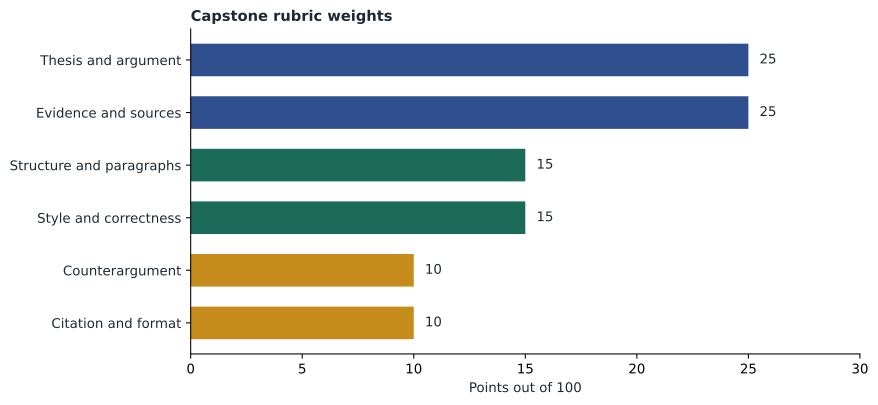
Luis notices that the weights add up to 100 and that half of the grade rests on thinking and evidence. Varga says that is deliberate: in every program they will enter, readers will forgive a misplaced comma long before they forgive a weak argument or a misrepresented source.
A final checklist
Before submitting any academic paper, Varga suggests working through a short list of questions, each tied to a lesson in this course. Does the paper do what the assignment's task word asks? Is the thesis arguable, specific and stated early? Does each section support it, in a logical order? Does each paragraph make one point, with framed evidence and real explanation? Are the sources credible, accurately represented and synthesized? Is the strongest objection answered? Are quotations exact and paraphrases genuinely your own? Is every source cited correctly in the required style? Have you followed the course policy on tools and disclosed what you used? Have you edited for clarity and concision and proofread slowly?
Worked problem
Choosing what to revise
With two days left before the deadline, Brigid has a complete draft of her essay arguing that a first-year cinematography assignment should be shot on film. Peer review says her thesis is clear but her evidence is mostly her own experience, her counterargument about cost is missing, and she has several comma splices. What should she do first?
Show solution
- Rank the problems by the rubric weights and by how much they affect the argument: evidence and counterargument are worth far more than comma splices.
- Add evidence: replace or support her personal experience with course outcome data, interviews with instructors and published research on teaching exposure.
- Write the counterargument section on cost, conceding the expense and proposing a limited roll of film per student.
- Edit and proofread last, fixing the comma splices in the final hour.
- Write the reflection explaining the revisions.
Answer: Spend the first day on evidence and counterargument, and the second on editing, proofreading and the reflection.
Common mistakes
MistakeThe capstone is mainly a test of grammar.
InsteadHalf the grade rests on the argument and evidence; correctness matters, but less.
MistakePeer reviewers should correct your errors.
InsteadPeer reviewers are most useful when they describe how the draft reads.
MistakeRevision means making the draft sound better.
InsteadRevision means changing the argument, structure and evidence where the draft needs it.
MistakeThe reflection is a summary of the essay.
InsteadThe reflection explains your process and the most important changes you made.
Summary and key terms
- A staged process of proposal, annotated bibliography, draft, peer review, revision and reflection builds a stronger essay.
- Test the proposal's question and thesis early for arguability, specificity and scope.
- Use peer review and tutoring to see how the draft reads, then revise from the top down.
- The final essay brings together every skill in the course: argument, structure, paragraphs, sources, citation, integrity and style.
- Assessment weights thinking and evidence most heavily.
- Proposal
- A short plan stating the question, working thesis, reasons, sources and schedule.
- Peer review
- Feedback from classmates on how a draft reads.
- Rubric
- A set of weighted criteria used to assess work.
- Reflection
- A short account of the writer's process and the reasons for revisions.
- Working thesis
- A provisional thesis that guides research and is refined as the essay develops.
Practice problems
Work each problem on paper first, then reveal the answer to check.
Why did Varga ask Kofi to revise 'Are textbooks too expensive?'
Show answer
It had a yes-or-no answer and didn't pose a debatable policy question.
What three things did Kofi's annotation do?
Show answer
Summarized the study, evaluated its strengths and limits, and explained how he would use it.
According to the rubric, which two criteria carry the most weight?
Show answer
Thesis and argument, and evidence and use of sources.
With little time left, what should you fix first: comma splices or a missing counterargument?
Show answer
The missing counterargument, because it affects the argument and carries more weight.
Lesson quiz · 5 questions
Score 60% or more to complete this lesson.
Create a free account to save your progress, take quizzes and earn a certificate.