
WRIT-101 · Lesson 10 of 12 · 20 min
Summaries, reports and other academic genres
▶ Video coming soon A video version of this lesson is on the way.
Dr. Varga asks each student to bring in the last three pieces of writing assigned in their other courses. The pile on her desk includes a lab report, an audit memo, a film treatment, a site inspection report, an annotated bibliography, a reflective journal, a design proposal and a literature review. 'None of these is an essay,' she says, 'and all of them use what you have learned so far: a clear purpose, a reader, evidence, structure and honest use of sources. What changes is the genre.' This lesson introduces the genres students meet most often outside the essay, starting with the summary, the building block of many of them.
What a genre is
A genre is a type of writing with recognizable conventions that have developed to serve a recurring purpose. A lab report has a methods section because scientists need to know how results were obtained in order to judge and repeat them. An executive summary comes first in a business report because managers need the conclusion before the details. Learning a genre means learning what its readers expect and why. When you meet a new genre, find two or three good examples, notice their structure and conventions, and ask what reader need each convention serves.
Writing a summary
A standalone summary condenses a source into its main points, accurately and briefly, so that a reader who has not read the source understands what it says. Summaries appear on their own as assignments, inside essays, in literature reviews and annotated bibliographies, and in professional work, where you may be asked to summarize a report for a manager.
Writing a good summary takes four steps. First, read the whole source and identify its main claim and the main points that support it; previewing and annotating, from Lesson 2, help. Second, write a one-sentence version of the main claim in your own words. Third, add the main supporting points, in the order and proportion the source gives them, leaving out examples, details and repetition. Fourth, check your summary against the source for accuracy, neutrality and the source's own qualifications.
A summary usually opens with a sentence naming the author, the title and the main claim: 'In The Price of Reading, Mara Ferris argues that the cost of textbooks is only one of several barriers to student reading, alongside format, access and time.' It then reports the main points with signal phrases that keep the source in view: Ferris explains, she then argues, she concludes. It does not include your opinion. If an assignment asks for a summary and response, keep them in separate sections.
How long should a summary be? It depends on the purpose. A one-sentence summary inside an essay may be enough to introduce a source. A summary assignment for a 20-page article may be 250 to 400 words. A common guideline is that a summary is a small fraction of the source's length, often between a tenth and a quarter. Luis writes a short program to check how much his summary condenses the source and whether its sentences are, on average, shorter.
source = (
    "Across the five introductory courses we examined, students assigned open textbooks completed their courses "
    "at rates similar to or slightly higher than students in sections using commercial texts. The difference was "
    "largest in the two courses with the most expensive commercial textbooks. We caution, however, that our sample "
    "was drawn from three colleges in one region, and that instructors who volunteer may differ from those who do not.")
summary = ("Delgado and Wen found that open textbooks did not reduce completion and may raise it where commercial "
           "texts cost most, though their sample was limited.")
def stats(t):
    words = t.split()
    sentences = [s for s in t.replace("?", ".").split(".") if s.strip()]
    return len(words), round(len(words) / len(sentences), 1)
sw, ssl = stats(source)
mw, msl = stats(summary)
print("source words:", sw, "| average sentence:", ssl)
print("summary words:", mw, "| average sentence:", msl)
print("summary is about", round(mw / sw, 2), "of the source length")source words: 68 | average sentence: 22.7 summary words: 25 | average sentence: 25.0 summary is about 0.37 of the source length
The summary is roughly a quarter of the passage, which is long for a summary of a whole article but reasonable for a short passage. Numbers like these are only a check; accuracy and fairness matter more than length.
Abstracts
An abstract is a summary of your own paper, placed at the beginning of research papers, theses and some reports. Readers use abstracts to decide whether to read the paper, so an abstract must stand alone. Most follow a pattern that mirrors the paper's structure: the problem or purpose, the method, the main findings and the main conclusion or implication, usually in 150 to 250 words. Write the abstract last, when you know what the paper says, and include the actual findings, not just a promise that they will be discussed. 'This paper discusses response rates' is a weak abstract sentence; 'Response rates fell from about two thirds to under half after the switch' is a strong one.
Annotated bibliographies
An annotated bibliography is a list of sources, each followed by a short paragraph, the annotation, that summarizes the source and usually evaluates it and explains its relevance to your project. Instructors assign annotated bibliographies to make sure research is under way early and that students are reading critically. A typical annotation of 100 to 200 words has three parts: a summary of the source's main argument and evidence, an evaluation of its strengths, limits and credibility, and a statement of how you will use it. Entries follow the citation style of the course and are alphabetized like a reference list.
Kofi's annotation for the Northgate survey report begins with a summary of what the survey asked and found, notes that the response rate was modest and that students who responded may have been those most concerned about costs, and ends by saying he will use the report to establish the local scale of the problem while noting its limitation. The annotation is, in effect, a small piece of critical reading.
Reports
Reports present information and analysis to readers who need to understand a situation or make a decision. They are the main genre of professional writing in business, engineering, health, government and many other fields. Unlike essays, reports are designed to be scanned: they use headings, numbered sections, lists, tables and figures so that readers can find what they need, and they often put the conclusion first.
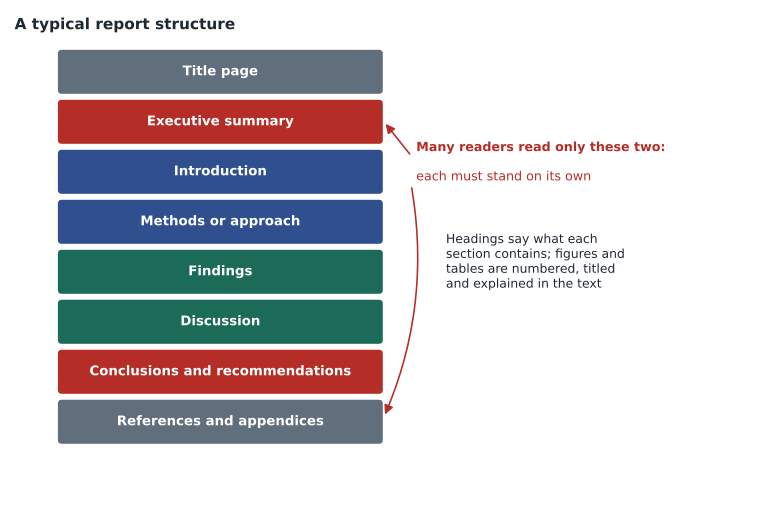
| Section | Purpose |
|---|---|
| Title page | Title, author, date and the reader or organization it is prepared for |
| Executive summary | The whole report in brief, including findings and recommendations, for readers who read nothing else |
| Introduction | Purpose, scope and background of the report |
| Methods or approach | How information was gathered and analyzed |
| Findings | What was found, often with tables and figures |
| Discussion | What the findings mean, including limitations |
| Conclusions and recommendations | The judgments the findings support and the actions proposed |
| References and appendices | Sources cited, and supporting material such as raw data or survey questions |
An executive summary is not an introduction. It gives the findings and recommendations, not a description of what the report will do. A manager should be able to read only the executive summary and make a decision. Amir's site inspection reports put a short summary at the top: what was inspected, what was found, what must happen and by when.
Report writing also has a style of its own: headings that say what a section contains ('Response rates fell after the switch' rather than 'Results'), numbered recommendations that each begin with a verb, and tables and figures that are numbered, titled, introduced in the text and explained. Every figure should be referred to in the text before it appears, with a sentence telling the reader what to notice.
Lab reports
Lab reports, common in the sciences and engineering, follow a structure close to the research article's IMRaD pattern: an introduction stating the purpose and relevant theory, a methods section describing materials and procedure in enough detail to repeat the experiment, a results section presenting data without interpretation, and a discussion interpreting the results, comparing them with theory, accounting for sources of error and stating a conclusion. Hana's physics instructors also want a short abstract and a clear statement of uncertainty for every measured value. The genre values precision and honesty: report what happened, including what went wrong.
Reflective writing
Some courses ask for reflective writing, especially in health, education and the professions: journals, learning logs or reflections on a placement. Reflective writing uses the first person and draws on your own experience, but it is still analytical. A common structure describes what happened, explains what you thought and felt, analyzes what it means using course concepts, and states what you would do differently or what you learned. Reflection that only narrates events, or only expresses feelings, misses the analytical step that instructors are assessing.
Literature reviews
A literature review surveys and synthesizes research on a question, showing what is known, where sources agree and disagree, and what gaps remain. It is organized by theme, not by source, using the synthesis approach from Lesson 7. Literature reviews appear as standalone assignments, as the opening section of research papers and theses, and in proposals. A literature review has an argument too: that the research shows certain things and leaves certain questions open, which often justifies a new study or a proposal.
Proposals, memos and emails
A proposal argues that a project should be approved or funded: it states the problem, the proposed solution, the method, the timeline, the budget and the expected outcomes. Brigid's film treatment is a kind of proposal. A memo is a short internal document that states its purpose in the first sentence, gives the necessary detail, and states what action is needed. Professional emails follow the same principle: a clear subject line, the purpose up front, short paragraphs and a specific request. Kofi rewrites his email to his landlord using the memo pattern and gets a reply the same day.
Learning an unfamiliar genre
Sooner or later, every student is asked to write in a genre no one has taught them. Jess's architecture studio asks for a design brief: a document, written before design begins, that states a client's needs, the site conditions, the budget and the performance goals a design must meet. She has never seen one. Varga suggests a method that works for any new genre.
First, find examples: ask the instructor for strong samples, look in the library or professional association websites, and collect two or three. Second, map them: list their sections, their order and roughly how long each is, and note features such as headings, lists, tables, tone and whether they use the first person. Third, ask what each convention is for. Jess notices that every brief puts the client's requirements in a numbered list, and realizes why: designers refer back to them by number when they explain how a design meets each one. Fourth, draft using the pattern, and fifth, get feedback from someone who knows the genre.
Genres also vary within fields and change over time. A design brief at one firm may look different from one at another, and the conventions of lab reports in a first-year course are simpler than those of a published paper. The method is the same: find what readers in that setting expect, and why.
Worked problem
Writing an executive summary
Luis's report on online course evaluations finds that response rates fell from about two thirds to under half after the switch, that responding students were more likely to have very high or very low course satisfaction, and that sending reminders during class time raised responses in a pilot. Write a four-sentence executive summary.
Show solution
- Sentence 1 states the purpose: what the report examined.
- Sentence 2 gives the main finding with its number.
- Sentence 3 gives the second finding and its significance.
- Sentence 4 gives the recommendation based on the pilot.
Answer: 'This report examines the effect of Northgate's 2024 switch to online course evaluations. Response rates fell from about two thirds of enrolled students to under half in the first year. Students who responded were more likely to report very high or very low satisfaction, so the results may not represent typical student experience. We recommend that instructors set aside ten minutes of class time for evaluations, which raised response rates in a pilot of twelve courses.'
Common mistakes
MistakeA summary should include your opinion of the source.
InsteadA summary reports the source neutrally; your evaluation belongs in a separate response.
MistakeAn executive summary describes what the report will cover.
InsteadAn executive summary states the findings and recommendations themselves.
MistakeReports should be written like essays, in continuous prose.
InsteadReports use headings, lists, tables and figures so readers can scan and find what they need.
MistakeReflective writing is just describing your feelings.
InsteadReflection connects experience to concepts and draws lessons from it.
Summary and key terms
- A genre is a type of writing with conventions that serve its readers' recurring needs.
- A summary states a source's main claim and points accurately, neutrally and in proportion.
- Abstracts and executive summaries must stand alone and report actual findings.
- Annotated bibliographies summarize, evaluate and explain the relevance of each source.
- Reports, lab reports, reflections, literature reviews, proposals and memos each adapt the same core skills to their readers.
- Genre
- A type of writing with recognizable conventions.
- Summary
- A condensed, neutral account of a source's main points.
- Abstract
- A short summary of a paper placed at its beginning.
- Annotated bibliography
- A list of sources, each with a paragraph summarizing and evaluating it.
- Executive summary
- A standalone summary of a report's findings and recommendations.
- Literature review
- A synthesis of research on a question, organized by theme.
Practice problems
Work each problem on paper first, then reveal the answer to check.
What are the four parts of a typical abstract?
Show answer
Purpose or problem, method, main findings and main conclusion or implication.
What three things does a typical annotation include?
Show answer
A summary of the source, an evaluation of it, and how you will use it.
Rewrite the report heading 'Results' to say what the section contains.
Show answer
For example: 'Response rates fell after the switch to online evaluations.'
What step do weak reflections usually skip?
Show answer
Analysis, connecting the experience to course concepts and drawing a lesson.
Lesson quiz · 5 questions
Score 60% or more to complete this lesson.
Create a free account to save your progress, take quizzes and earn a certificate.