
WRIT-101 · Lesson 11 of 12 · 20 min
Revising and editing: clarity, concision and style
▶ Video coming soon A video version of this lesson is on the way.
Dr. Varga puts a sentence from a real student draft on the screen, changed slightly to protect its author: 'It is important to note that there are a number of factors that have an impact on the decision-making process of students with regard to the purchase of textbooks.' She asks the class to count the words. Twenty-nine. Then she asks what the sentence says. Amir offers: 'Several factors affect whether students buy textbooks.' Seven words, and clearer. 'Nothing was lost,' Varga says, 'except the fog.' This lesson is about the final stages of the writing process: revising the draft as a whole, and editing its sentences for clarity, concision, correctness and style.
Revise before you edit
Lesson 1 described revision as re-seeing the draft: changing its argument, structure and evidence. That work comes first, because there is no point polishing a paragraph you are about to cut. Start revision by setting the draft aside for at least a day, so you can read it as a reader would. Then work from the top down. Does the thesis state what the paper actually argues? Lessons 3 and 4 noted that drafts often argue something slightly different from the thesis written at the start; revise the thesis or the paper. Does each section support the thesis? A reverse outline, from Lesson 4, will tell you. Does each paragraph have a clear point, evidence and explanation, as Lesson 5 described? Are the sources represented fairly and cited correctly?
Feedback helps most at this stage. Kofi takes his draft to Sam Achebe at the writing center with two questions: is the counterargument section convincing, and does the conclusion add anything? Achebe tells him the counterargument is fair but the response is thin, and that the conclusion repeats the introduction. Kofi spends his revision time there, not on commas.
Clarity: characters and actions
Once the structure is sound, turn to sentences. The most useful principle for clear sentences, developed by the writing scholar Joseph Williams, is to make the main characters of your story the subjects of your sentences, and to express their main actions as verbs. Unclear academic prose often hides both. In 'The implementation of the policy by the administration resulted in a reduction of costs,' the characters, the administration, are buried in a prepositional phrase, and the actions, implementing and reducing, are turned into nouns. Revised: 'When the administration implemented the policy, costs fell.' The sentence is shorter and easier to follow because the reader can see who did what.
Nouns made from verbs or adjectives, such as implementation, reduction, decision, analysis and importance, are called nominalizations. They are not wrong, and academic writing needs some, especially to name concepts that recur. But a sentence with several nominalizations and a weak verb such as is, has, makes or results in is usually a sentence that could be clearer.
Active and passive voice
In the active voice, the subject performs the action: 'The committee approved the budget.' In the passive voice, the subject receives it: 'The budget was approved by the committee,' or simply 'The budget was approved.' Passive sentences are not grammatically wrong, and they have real uses. They are standard in scientific methods sections, where the procedure matters more than who did it: 'The samples were heated to 80 degrees Celsius.' They are useful when the actor is unknown or unimportant, or when you want to keep a topic in the subject position for coherence. But passive voice can also hide responsibility: 'Mistakes were made.' By whom? In most writing, prefer the active voice unless you have a reason for the passive.
Concision
Concise writing uses no more words than it needs. It is not the same as short writing; a long paper can be concise if every sentence earns its place. Wordiness comes from a few predictable sources, and cutting them makes almost any draft better.
| Wordy | Concise | Pattern |
|---|---|---|
| It is important to note that costs rose. | Costs rose. | Empty opener |
| Due to the fact that | Because | Inflated phrase |
| In the event that | If | Inflated phrase |
| At this point in time | Now | Inflated phrase |
| Each and every student | Every student | Redundant pair |
| Past history | History | Redundancy |
| Make a decision about | Decide | Nominalization with weak verb |
| There are many students who skip textbooks. | Many students skip textbooks. | Empty there are construction |
Hedges and intensifiers need judgment. Academic writing qualifies claims honestly, as Lesson 3 explained, so words like may, suggests and in most cases are often necessary. But stacked hedges, 'it might perhaps be possible that,' sound evasive, and intensifiers such as very, really, extremely and clearly usually add nothing. If something is clear, the reader will see it; if it isn't, saying clearly won't help.
Precision
Precise writing chooses the exact word. Vague words such as thing, aspect, factor, impact and issue often stand in for an idea the writer hasn't pinned down. 'The cost issue has an impact on students' could mean almost anything; 'Textbook costs lead some students to skip required readings' says something definite. Precision also means using technical terms correctly and consistently. In accounting, revenue and income are different things; in physics, weight and mass are different things. Using them loosely tells an expert reader you don't understand the field.
Academic tone
Academic writing is usually formal but not stiff. It avoids slang, most contractions and casual phrasing, but it doesn't require long words where short ones work. Use the first person according to the conventions of your discipline and your instructor: many fields now accept 'I argue' or 'we measured', especially in the humanities and in reflective writing, while some sciences still prefer impersonal constructions. Avoid addressing the reader as you in formal essays, except in instructions. And avoid sweeping words such as always, never, everyone and proves unless the evidence really supports them.
Inclusive language is also part of academic tone. Use gender-neutral terms where gender is not relevant, such as chair, firefighter and humankind. Singular they is accepted by APA, MLA and Chicago for a person whose gender is unknown or who uses they. When describing groups, use the terms people use for themselves and be specific: 'first-year students who work more than twenty hours a week' is more precise than 'poor students.' Style guides differ on details such as person-first and identity-first language, so follow the guide your course uses and the preferences of the people you are writing about.
Common errors to check
Varga lists the sentence-level errors she sees most often in first-year writing. Comma splices join two complete sentences with only a comma: 'Costs rose, students bought fewer books.' Fix with a period, a semicolon or a conjunction. Fragments are incomplete sentences punctuated as complete: 'Because costs rose.' Subject-verb agreement errors occur when the verb doesn't match its subject, often when a phrase separates them: 'The cost of textbooks are rising' should be 'is rising.' Unclear pronoun reference leaves the reader unsure what this, it or they refers to. Misplaced modifiers attach a phrase to the wrong word: 'Using open textbooks, costs fell' suggests the costs used the textbooks. Apostrophe errors confuse its and it's, or plural and possessive forms.
American spelling
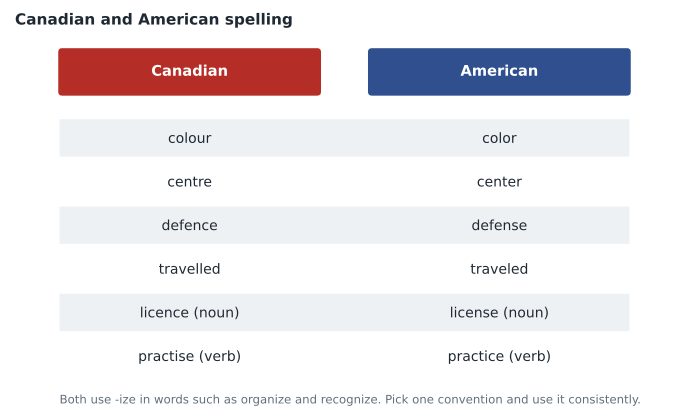
Spelling conventions differ between American, Canadian and British English, and consistency matters more than any single choice. American spelling, which this course uses on its American site, generally drops the u in words such as color, behavior and neighbor, ends words like center and theater in -er, uses -ize endings in words such as organize and recognize, writes defense and license, uses practice as both noun and verb, and does not double the final l in words like traveled and canceled. Canadian and British spelling differ in many of these words, as the figure shows. Merriam-Webster is the standard American reference, and AP style, the Chicago Manual of Style and APA all follow American spelling. If your instructor or publication requires Canadian or British spelling, follow it, and set your spell checker to match, since a checker set to the wrong variety will mark correct words as errors and miss real ones.
Editing with a tool
Grammar and style checkers can catch many errors, but they also flag correct sentences and miss real problems, and their suggestions sometimes change meaning. Use them as a second reader, not as an authority, and check your course policy, since some instructors limit tools that rewrite sentences. Luis writes a short program that flags his longest sentences and common wordy phrases, so he knows where to look.
import re
draft = ("It is important to note that there are a number of factors that have an impact on the decision-making "
         "process of students with regard to the purchase of textbooks. Costs rose. Due to the fact that open "
         "textbooks are free, many students prefer them, although some students like print and some instructors "
         "worry about the time that adapting a course to a new textbook would take during the term.")
wordy = ["it is important to note that", "due to the fact that", "a number of", "with regard to", "have an impact on"]
sentences = [s.strip() for s in re.split(r"(?<=[.!?])\s+", draft) if s.strip()]
for i, s in enumerate(sentences, 1):
    n = len(s.split())
    flags = [w for w in wordy if w in s.lower()]
    note = "long" if n > 25 else ""
print(i, n, "words", note, flags)1 29 words long ['it is important to note that', 'a number of', 'with regard to', 'have an impact on'] 2 2 words [] 3 38 words long ['due to the fact that']
The script finds the opening sentence's wordy phrases and flags the long final sentence, which Luis splits into two. The tool points to problems; the judgment about how to fix them is still his.
Proofreading
Proofreading is the last check before submission, and it requires a different kind of reading: slow, word by word, looking at what is on the page rather than what you meant. Techniques that help include reading aloud, which catches missing words and awkward rhythm; printing the paper or changing its font, which makes familiar text look new; reading the last sentence first and working backward, which breaks the flow of meaning so you see each sentence; and keeping a list of your own frequent errors and searching for them. Check the formatting and citations against the assignment and the style guide one final time.
Sentence variety and emphasis
Clear sentences are not all the same length. A paragraph of identical medium-length sentences reads like a list, and a paragraph of long sentences exhausts the reader. Vary length deliberately: use longer sentences to show how ideas relate and shorter ones to state key points. A short sentence after a long one lands with force. Costs fell.
Sentence endings also matter. English readers tend to give the most weight to the end of a sentence, so put the information you want to stress there. Compare 'Open textbooks raised completion rates in the two most expensive courses, according to the study' with 'According to the study, open textbooks raised completion rates in the two most expensive courses.' The second ends on the finding rather than the attribution. Combined with the known-new principle from Lesson 5, this gives a simple rule: begin with what the reader knows, end with what you want them to remember.
Hana revises a paragraph of her lab report using both ideas. She combines three short sentences describing the setup into one, keeps the key result as a short sentence on its own, and moves the uncertainty to the end of the sentence that reports the measured value, where her instructor will look for it. The paragraph is no shorter, but it is much easier to read.
Finally, read your revised paragraphs aloud. Your ear will catch rhythms that are monotonous or sentences that run out of breath long before your eye does. If you stumble reading a sentence, a reader will stumble too.
Worked problem
Editing a paragraph
Edit this sentence for clarity and concision: 'The utilization of open textbooks by instructors at Northgate has resulted in a situation in which there has been a significant reduction in the amount of money that students are required to spend.'
Show solution
- Find the characters: instructors and students. Find the actions: using open textbooks, reducing spending.
- Make the characters subjects and the actions verbs: instructors use open textbooks; students spend less.
- Cut the wordy phrases: has resulted in a situation in which, the amount of money that, are required to.
- Replace utilization with use, and check whether significant is supported by evidence; if not, cut it or give the figure.
- Combine: 'Because Northgate instructors use open textbooks, students spend less on course materials.'
Answer: Thirty-three words become twelve, with the same meaning and a clearer line of action.
Common mistakes
MistakeRevising means fixing grammar.
InsteadRevise argument and structure first; edit sentences afterward.
MistakePassive voice is always wrong.
InsteadPassive voice suits methods sections and cases where the actor is unknown; prefer active voice otherwise.
MistakeLong words and sentences sound more academic.
InsteadClear, concise sentences sound more authoritative to expert readers.
MistakeA spell checker catches all spelling errors.
InsteadIt misses correctly spelled wrong words and may be set to the wrong variety of English.
Summary and key terms
- Revise argument and structure before editing sentences.
- Make characters the subjects and actions the verbs; limit nominalizations.
- Prefer active voice unless the passive serves a purpose, and cut empty and inflated phrases.
- Choose precise words, use a discipline-appropriate tone and write inclusively.
- Check common errors, follow one spelling convention consistently and proofread slowly.
- Nominalization
- A noun formed from a verb or adjective, such as reduction from reduce.
- Active voice
- A construction in which the subject performs the action.
- Passive voice
- A construction in which the subject receives the action.
- Concision
- Using no more words than the meaning requires.
- Comma splice
- Two complete sentences joined only by a comma.
- Misplaced modifier
- A phrase attached to the wrong word in a sentence.
Practice problems
Work each problem on paper first, then reveal the answer to check.
Revise: 'A decision was made by the committee to postpone the vote.'
Show answer
'The committee decided to postpone the vote.'
When is the passive voice appropriate?
Show answer
When the actor is unknown or unimportant, as in many methods sections, or to keep a topic in subject position.
Fix the comma splice: 'The survey closed early, few students responded.'
Show answer
'The survey closed early, so few students responded.' or use a period or semicolon.
Name two proofreading techniques.
Show answer
Reading aloud and reading backward from the last sentence.
Lesson quiz · 5 questions
Score 60% or more to complete this lesson.
Create a free account to save your progress, take quizzes and earn a certificate.