
WLD-340 · Lesson 11 of 12 · 18 min
Test plate strategy and practical test day
The written side matters, but Devon's certifications will be decided by coupons. In week eight, alongside the codes review, Marta starts practice test plates for two people. Devon is booked at an AWS Accredited Test Facility in Houston for a 3G and 4G groove plate with stick electrodes and, a week later, a 6G pipe test, and he wants both done before his apprenticeship ends. Kofi is booked for an AWS flux-cored plate test, his first certification in the United States, and he wants his plates to be perfect. Marta's view is that a test plate is a performance like any other: it rewards preparation, routine and calm, and it punishes improvisation.
Know the test before you weld it
Every test is defined by a procedure and a set of instructions: the process and filler, the position, the plate thickness and joint, the backing, the cleaning allowed, preheat and interpass temperature, whether the coupon may be removed from its position between passes, and how it will be examined. AWS Certified Welder tests are welded to a WPS the facility provides under the AWS QC47 specification, with a Certified Welding Inspector watching, and the coupon is examined visually and then bent or radiographed. Read the WPS the week before if the facility will send it, not on the day. Ask about anything that is unclear: whether grinding is allowed on the root and cap, whether the backing strip can be tacked on both sides, whether a power wire brush may be used between passes.
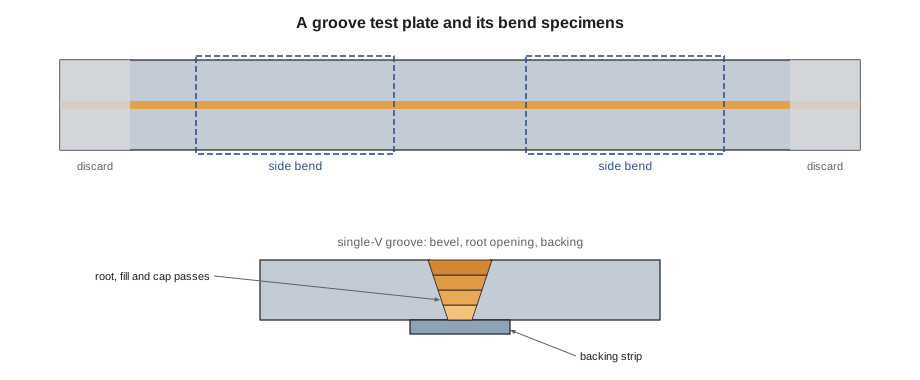
The typical groove plate test is two plates beveled to a single-V groove, fitted with a root opening onto a backing strip, welded in the stated position, and then cut into strips for bend testing. The face bend stretches the cap, the root bend stretches the root, and side bends, used on thicker plate, stretch the full thickness from the side. A bend fails if any opening on its convex surface exceeds the code's limit, commonly 1/8 in for a single opening, or if the total of smaller openings exceeds another limit. Openings at the corners of the specimen are treated differently. What makes a bend open is almost always a discontinuity in the weld: lack of fusion at the sidewall or root, slag between passes, porosity in a cluster or a crack at a tie-in.
Preparing the coupon
Preparation decides more test results than welding does. The bevel angle and root face must match the procedure, and both plates must be the same. The root face, if the procedure has one, is filed to an even width with no burrs. The backing strip must be flat, clean, tight to both plates along its whole length, and long enough to extend past the ends of the groove so the start and finish of each pass are made on run-off areas rather than on the part that will be tested. The joint and the area around it are cleaned to bright metal on both sides. The root opening is set with a gauge and checked at both ends and the middle after tacking, because tacks pull plates together as they shrink.
Marta's checklist for Devon and Kofi has ten items and they read it aloud before every practice plate, the way a pilot runs a checklist. It covers bevel angle, root face, root opening at three points, backing tight, plates level and in line, tacks on the backing or ends only, cleanliness, machine settings checked on scrap, electrodes or wire correct and dry, and the coupon set at the right height and position with the identification marks facing the right way. The code in this lesson turns the checklist into a record and works out where the bend specimens will come from, so the welder knows which part of the plate matters.
# Test plate preparation record and bend specimen layout
prep = {'bevel angle (deg)': (22.5, 20, 25), 'root face (in)': (0.0, 0, 0.125), 'root opening left (in)': (0.25, 0.25, 0.3125), 'root opening mid (in)': (0.25, 0.25, 0.3125), 'root opening right (in)': (0.1875, 0.25, 0.3125)}
spec = ['side bend', 'side bend']
ok = True
for item, (measured, lo, hi) in prep.items():
    good = lo <= measured <= hi
    ok &= good
    print(f"{item:<22} {measured:>6} (limits {lo}-{hi}) {'ok' if good else 'FIX BEFORE WELDING'}")
print('coupon ready' if ok else 'coupon not ready')

# where the specimens come from along the weld
length, discard, width, gap = 7, 1.25, 1.5, 0.375
x = discard
for name in spec:
    print(f"  {name:<10} from {x:>6.1f} to {x + width:>6.1f} in")
    x += width + gap
print(f" last specimen ends at {x - gap:.1f}; discard from {length - discard:.1f} to {length:.1f}")bevel angle (deg) 22.5 (limits 20-25) ok root face (in) 0.0 (limits 0-0.125) ok root opening left (in) 0.25 (limits 0.25-0.3125) ok root opening mid (in) 0.25 (limits 0.25-0.3125) ok root opening right (in) 0.1875 (limits 0.25-0.3125) FIX BEFORE WELDING coupon not ready side bend from 1.2 to 2.8 in side bend from 3.1 to 4.6 in last specimen ends at 4.6; discard from 5.8 to 7.0
The record catches the same fault Devon made on his second practice plate: the root opening at one end closed to 3/16 in after tacking, below the procedure's minimum. On a backing strip a tight root means the root pass cannot fuse into the backing and both sidewalls, which is the commonest cause of a bend opening at the root. He broke the tack, reset the gap with a 1/4 in rod as a spacer and tacked again. The specimen layout shows the welder that the start and finish of the plate are discarded, so restarts belong there if they must happen at all. The specimen sizes and positions in the program are typical, not taken from any one code.
Welding the plate
The root pass on backing must fuse into both bevel faces and into the backing plate. The arc is kept on the leading edge of the puddle so it melts into the sidewalls rather than rolling over them. The hot pass, the second pass, burns out any slag trapped at the edges of the root and adds metal. Fill passes are run as stringers or with a small weave, as the procedure allows, with each bead overlapping the last by about a third to a half, and each layer kept level so the next does not trap slag in a valley. The last fill layer should leave the groove about 1/16 in below the plate surface with the bevel edges still visible, so the cap can cover them by a small amount on each side.
Cleaning between passes is not optional. Every pass is cleaned to bright metal with a chipping hammer and wire brush, and any slag in the toes of a bead is removed with a grinder if the test allows grinding, or with a needle scaler or a thin wire wheel if it does not. A pass with a high crown or a deep valley at its edge is ground down before the next pass if grinding is allowed. The interpass temperature is checked if the procedure sets a maximum; welding on a very hot plate in the vertical position makes the puddle run and causes undercut and overlap. And the coupon stays in position: rotating a vertical plate to flat to make a pass easier voids the test.
Worked problem
Planning restarts on a vertical plate
Devon's vertical test plate needs about nine passes with 1/8 in E7018. Each electrode runs about 10 in of root in the vertical position. The test length between the discard strips is 10 in. How should he plan his restarts?
Show solution
- Each restart is a place where a defect can start, so fewer restarts in the test zone mean fewer risks.
- Start each root electrode on the run-off tab below the plate so the arc is stable before it reaches the groove.
- If one electrode will not finish a pass, change electrodes and restart a little behind the crater, grinding the crater to a taper first if allowed.
- Stagger the restarts of successive passes so they do not stack at the same point.
Answer: Start and finish on the run-off areas, plan one restart per pass at most, and stagger them. A tie-in done carelessly is the commonest failure in vertical and overhead tests.
Why plates fail
Hartwell has kept a record of every failed practice and test coupon for six years. The causes are few and they repeat. Root bends open at lack of fusion to one sidewall or the backing, from a tight root opening, too low a current or the arc riding on the puddle. Face bends open at slag between passes, from poor cleaning or valleys between beads. Both open at tie-ins, from restarting on a cold crater. Porosity clusters come from damp electrodes, a long arc or arc blow. Cracks at the start of a bend usually trace back to a crater crack that was welded over. And some failures are not welding at all: a coupon tested in the wrong position, a procedure ignored, or a coupon damaged in cutting.
# Practice plate log: pass rate and the commonest failure causes
from collections import Counter
log = [
    # (welder, position, result, cause if failed)
    ('Devon', '3G', 'fail', 'tight root, lack of fusion'), ('Devon', '3G', 'pass', ''),
    ('Devon', '4G', 'fail', 'slag at tie-in'), ('Devon', '4G', 'pass', ''), ('Devon', '3G', 'pass', ''),
    ('Devon', '4G', 'pass', ''), ('Kofi', '3G FCAW', 'fail', 'slag between passes'), ('Kofi', '3G FCAW', 'pass', ''),
    ('Kofi', '4G FCAW', 'fail', 'porosity cluster'), ('Kofi', '4G FCAW', 'pass', ''), ('Kofi', '3G FCAW', 'pass', ''),
]
for welder in ('Devon', 'Kofi'):
    runs = [r for r in log if r[0] == welder]
    passed = sum(r[2] == 'pass' for r in runs)
    last3 = sum(r[2] == 'pass' for r in runs[-3:])
    print(f"{welder}: {passed}/{len(runs)} passed overall, {last3}/3 of the last three")
causes = Counter(r[3] for r in log if r[2] == 'fail')
for c, n in causes.most_common():
print(f" failure cause: {c} ({n})")Devon: 4/6 passed overall, 3/3 of the last three Kofi: 3/5 passed overall, 2/3 of the last three failure cause: tight root, lack of fusion (1) failure cause: slag at tie-in (1) failure cause: slag between passes (1) failure cause: porosity cluster (1)
Marta uses a simple rule: a welder is ready for the real test after three practice plates in a row pass, in each position. The overall pass rate matters less than the last three, because practice is supposed to improve the result. Devon reached three in a row in both positions in the second week of practice; Kofi's porosity cluster on his overhead plate came from wire left on the feeder over a damp weekend, and Marta made him strip off the outer turns and check the drive rolls before every plate after that.
Test day
On the day, Devon arrives early at the test facility with his helmet, gloves, safety glasses, hearing protection, chipping hammer, wire brushes, files, a fillet and root gauge and a marker. He reads the WPS again, checks the machine on a piece of scrap, and asks the inspector about grinding. He runs his checklist out loud, quietly. He does not look at the clock except at the end of each pass. When the root on the overhead plate shows a short section of slag at a tie-in, he stops, grinds it out as the WPS allows, and rewelds it, rather than burying it under the hot pass. Both plates pass their bends and go into the AWS registry. Kofi's flux-cored plate, a week later, passes too, and he keeps the paper copy of his record in his tool box anyway.
Marta's last words before each of them goes in are the same: read everything, set your gap, clean every pass, and if something goes wrong, fix it then, not later. A test is the one weld where nobody minds if you take longer.
After the test
Whatever the result, the coupon teaches something. A passing coupon's bend specimens are worth keeping and looking at under good light: small openings that stayed within the limit show where the next test could fail. A failed coupon tells you exactly what to practice. Devon keeps a photo of every bend he has ever had tested, labeled with the date, position and what he changed afterwards, and he says the collection taught him more than any single lesson.
Common mistakes
MistakeReading the procedure for the first time on test day.
InsteadGet and read it the week before; ask about grinding and cleaning rules.
MistakeTrusting the root opening set before tacking.
InsteadCheck it at three points after tacking; tacks pull the plates in.
MistakeRestarting on a cold crater in the test zone.
InsteadStart and stop on run-off areas; feather craters and stagger restarts.
MistakeBurying a visible defect under the next pass.
InsteadRemove it as the instructions allow before continuing.
MistakeRotating the coupon to an easier position.
InsteadThe coupon must stay in the test position throughout.
Summary and key terms
- A test is defined by its procedure and instructions; read them before the day.
- Bend specimens show lack of fusion, slag, porosity and tie-in defects as openings.
- Preparation decides most results: bevel, root face, root opening, backing and cleanliness.
- Clean every pass to bright metal, keep layers level and stagger restarts.
- Most failures come from tight roots, poor cleaning and careless tie-ins.
- Three passing practice plates in a row in each position is a good sign of readiness.
- Face bend
- A bend test that stretches the cap side of the weld.
- Root bend
- A bend test that stretches the root side of the weld.
- Side bend
- A bend test on thicker plate that stretches the full weld thickness from the side.
- Backing strip
- A strip of metal behind the root of a groove weld that the root fuses into.
- Run-off tab
- Extra material at the ends of a joint for starting and stopping welds.
- Tie-in
- The point where a new bead joins the end of the previous one.
Practice problems
Work each problem on paper first, then reveal the answer to check.
A bend specimen shows one opening of 3/32 in and three of 1/32 in. Single openings are limited to 1/8 in and the total of openings over 1/32 in to 3/8 in in this example. Does it pass?
Show answer
Yes: the largest is 3/32 in, and only that one is over 1/32 in.
After tacking, the root opening reads 1/4, 1/4 and 3/16 in. The procedure allows 1/4 to 5/16 in. What do you do?
Show answer
Break the tack at the tight end, reset the gap and retack.
Why are the ends of a test plate discarded?
Show answer
Starts and stops are less sound and are not representative of the weld.
Lesson quiz · 5 questions
Score 60% or more to complete this lesson.
Create a free account to save your progress, take quizzes and earn a certificate.