
WLD-340 · Lesson 5 of 12 · 18 min
SMAW review
Devon teaches the shielded metal arc review himself in week three, because it is the process he has welded most and the one his first AWS plate test will be in. School finals and the shop's written checks give stick welding the largest share of any single process. Marta warns him that knowing the process well is a trap: questions on electrode classifications, polarity and storage rules are recall questions, and experienced welders lose marks on them because they choose electrodes by habit, not by reading the box. Devon's session runs through WLD-120 and WLD-230 lesson by lesson, with a practice question at each stop.
The process in one paragraph
In shielded metal arc welding an arc runs between a flux-covered electrode and the work. The heat melts the core wire, the flux and the base metal. The flux does several jobs at once: it gives off gas that shields the molten metal from the air, forms a slag that covers and protects the weld while it cools, adds deoxidizers and alloying elements, stabilizes the arc and, in some electrodes, adds iron powder to raise deposition. The welder controls the arc length, the travel speed, the electrode angle and the manipulation; the machine controls the current. SMAW is simple, portable, works outdoors in wind that would blow away a gas shield and welds in all positions, but it is slower than the wire processes because of electrode changes and slag removal.
The power source is a constant-current machine. Its volt-ampere curve is steep, so a change in arc length changes the voltage a lot but the current only a little, which is what a welder holding an electrode by hand needs. A constant-voltage machine, made for wire processes, would let the current swing wildly with every small change in arc length. That is a common exam question in two forms: which kind of machine for stick welding, and why. WLD-120 lesson 2 has the curves.
Polarity
Direct current electrode positive, DCEP, also called reverse polarity, puts more heat into the electrode and gives deeper penetration with most stick electrodes. Direct current electrode negative, DCEN or straight polarity, puts more heat into the work at the surface and melts the electrode faster, giving shallower penetration and higher deposition with electrodes made for it. Alternating current switches between the two many times a second; it reduces arc blow, the sideways wandering of the arc caused by magnetic fields around the work, and lets cheaper transformer machines be used. Each electrode classification states which currents it may be used on, and that is printed on the box.
Worked problem
Fixing arc blow
Devon is welding a long fillet near the end of a heavy beam with E7018 on DCEP. Near the end the arc wanders backward and leaves porosity and undercut at the last 4 in. What should he try, in what order?
Show solution
- Arc blow is magnetic deflection of a DC arc, worst near ends, corners and where the work lead is far from the weld.
- Weld toward a heavy tack or an existing weld, not away from it, and use backstep sequences.
- Move the work lead, or use two work leads, so the current path does not push the arc.
- Shorten the arc and angle the electrode against the direction of blow.
- If the procedure and electrode allow, switch to AC, which almost eliminates arc blow.
Answer: Change the welding direction and the work lead first, then shorten the arc and angle against the blow, and use AC if the procedure permits it.
Reading electrode classifications
Classifications are the most tested topic in this review. AWS A5.1 classifies carbon steel stick electrodes with designations such as E7018. The first two digits, 70, give the minimum tensile strength of the weld metal in thousands of psi. The next digit gives the positions: 1 for all positions, 2 for flat and horizontal fillets only, 4 for the vertical-down positions listed. The last digit, read with the one before it, gives the type of covering and the currents allowed: the 18 in E7018 means a low-hydrogen iron powder covering for AC or DCEP. Electrodes made to the matching Canadian standard carry metric designations such as E4918, which is the same electrode.
| Classification (AWS) | Covering | Current | Typical use |
|---|---|---|---|
| E6010 | High-cellulose sodium | DCEP | Deep-penetrating open roots on pipe, dirty steel |
| E6011 | High-cellulose potassium | AC or DCEP | Like 6010 where only AC is available |
| E6013 | High-titania potassium | AC, DCEP or DCEN | Light sheet and general work with an easy arc |
| E7014 | Iron powder titania | AC, DCEP or DCEN | Faster deposition on fillets and lap joints |
| E7018 | Low-hydrogen iron powder | AC or DCEP | Structural and pressure work needing low hydrogen |
| E7024 | Iron powder titania, high deposition | AC, DCEP or DCEN | Flat and horizontal fillets only, high deposition |
Suffixes add information. A -1 after E7018 means improved toughness at low temperature. An H4, H8 or H16 designator gives the maximum diffusible hydrogen in milliliters per hundred grams of deposited weld metal, so H4 is the lowest. An R means the covering has passed a moisture resistance test. Alloy electrodes classified under A5.5 add a suffix for the alloy: A1 for carbon-molybdenum, B2 for chromium-molybdenum, C1 to C3 for nickel, G for a general alloy. WLD-120 lesson 4 has the whole system. A favorite exam trap is the second-last digit: E7024 has a 2, so it is flat and horizontal fillets only, however tempting it looks for a vertical joint because of its high deposition.
# Decode carbon steel stick electrode classifications
POS = {'1': 'all positions', '2': 'flat and horizontal fillets', '4': 'flat, horizontal, overhead and vertical down'}
COVER = {'10': ('high-cellulose sodium', 'DCEP'), '11': ('high-cellulose potassium', 'AC or DCEP'),
         '13': ('high-titania potassium', 'AC, DCEP or DCEN'), '14': ('iron powder, titania', 'AC, DCEP or DCEN'),
         '18': ('low-hydrogen potassium, iron powder', 'AC or DCEP'), '24': ('iron powder, titania', 'AC, DCEP or DCEN'),
         '16': ('low-hydrogen potassium', 'AC or DCEP'), '15': ('low-hydrogen sodium', 'DCEP')}
STRENGTH = {'60': '60 ksi (about 430 MPa)', '70': '70 ksi (about 490 MPa)', '43': '430 MPa (about 60 ksi)', '49': '490 MPa (about 70 ksi)'}

def decode(c):
    base, _, suffix = c.partition('-')
    s, p, cov = base[1:3], base[3], base[3:5]
    out = f"{c}: tensile {STRENGTH[s]}, {POS[p]}, {COVER[cov][0]}, {COVER[cov][1]}"
    if suffix:
        out += f", suffix {suffix}"
    return out

for c in ['E7018', 'E6010', 'E7024', 'E7018-1', 'E6013']:
print(decode(c))E7018: tensile 70 ksi (about 490 MPa), all positions, low-hydrogen potassium, iron powder, AC or DCEP E6010: tensile 60 ksi (about 430 MPa), all positions, high-cellulose sodium, DCEP E7024: tensile 70 ksi (about 490 MPa), flat and horizontal fillets, iron powder, titania, AC, DCEP or DCEN E7018-1: tensile 70 ksi (about 490 MPa), all positions, low-hydrogen potassium, iron powder, AC or DCEP, suffix 1 E6013: tensile 60 ksi (about 430 MPa), all positions, high-titania potassium, AC, DCEP or DCEN
Storage of low-hydrogen electrodes
Low-hydrogen electrodes take up moisture from the air, and moisture in the covering becomes hydrogen in the weld, which can cause cracking in hardenable steels hours after welding. So the electrodes are stored in sealed containers or in a holding oven, are taken out only in the quantity a welder will use within the allowed exposure time, and are redried or discarded when that time is exceeded. Structural codes commonly allow E7018 about four hours out of a holding oven, with shorter times for higher-strength classes, and the holding oven runs at about 250 °F. Redrying is done at a higher temperature, set by the manufacturer, and is allowed only a limited number of times. Electrodes that have been wet are discarded.
Cellulosic electrodes such as E6010 are the opposite. Their covering needs some moisture to work, and drying them in a hot oven ruins them. They are stored at room temperature in their containers. Questions on this contrast catch people out every year: which electrode must not be put in a hot oven? WLD-120 lesson 5 covers the storage rules.
Setting up and running
Current is set by the electrode diameter, type and position. A rough starting rule is one ampere per thousandth of an inch of diameter: a 1/8 in electrode starts around 125 amperes, then the welder adjusts for position, thickness and how the puddle behaves. Vertical and overhead welding use less current than flat, perhaps ten to fifteen percent less, to keep the puddle from sagging. Arc length is kept about equal to the core wire diameter for most electrodes and shorter for low-hydrogen ones, because a long arc lets air into the shield and causes porosity. Travel speed controls bead size; the electrode angle, usually a drag of ten to twenty degrees in the flat position, controls where the arc force pushes the puddle.
Machines have a duty cycle, the percentage of a ten-minute period they can deliver a rated current without overheating. A machine rated at 60 percent at 300 amperes can weld six minutes in ten at that current. At lower current the duty cycle rises, roughly in proportion to the square of the current ratio. That is a standard calculation, and so is heat input, which links the electrical settings to the metallurgy in lesson 8. The code below works both, along with the number of electrodes for a weld.
# SMAW review calculations
# 1. Duty cycle at another current: DC2 = DC1 * (I1 / I2)**2, capped at 100 %
rated_dc, rated_i = 60, 300
for i in (300, 250, 200, 150):
    dc = min(100, rated_dc * (rated_i / i) ** 2)
    print(f"at {i} A the duty cycle is about {dc:.0f} %")

# 2. Heat input = 60 * E * I / (1000 * v)
E, I, v = 24, 140, 6          # volts, amps, travel speed per minute
hi = 60 * E * I / (1000 * v)
print(f"heat input {hi:.2f} kJ/in")

# 3. Electrodes needed for a fillet weld
leg = 0.3125                     # fillet leg size
length = 480                  # total weld length
density = 0.284                 # steel density, mass per volume
area = leg * leg / 2
mass = area * length * density
per_rod = 0.048                 # weld metal deposited by one electrode
print(f"fillet weld metal {mass:.2f} lb, about {mass / per_rod:.0f} electrodes")at 300 A the duty cycle is about 60 % at 250 A the duty cycle is about 86 % at 200 A the duty cycle is about 100 % at 150 A the duty cycle is about 100 % heat input 33.60 kJ/in fillet weld metal 6.66 lb, about 139 electrodes
Dropping from 300 A to 200 A raises the duty cycle from 60 percent to the full cycle in the program's rough model, which is why a machine that overheats on a heavy gouging job is fine for stick welding. The heat input of 33.6 kJ/in is typical of a stringer bead with E7018. The fillet calculation ignores reinforcement and stub losses beyond the deposition figure per electrode, so in practice Devon adds about ten percent.
Defects and their causes
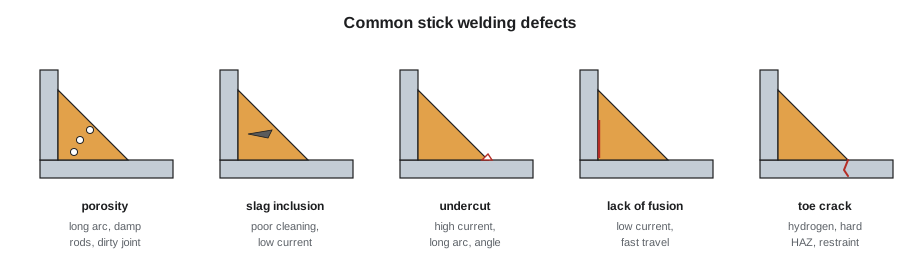
Defect questions are the other big group. Porosity in a stick weld usually comes from a long arc, damp low-hydrogen electrodes, rust, oil or paint on the joint, or arc blow. Slag inclusions come from poor cleaning between passes, too low current or an electrode angle that lets slag run ahead of the puddle. Undercut comes from too high a current, too long an arc, too fast travel or the wrong angle at the toe. Lack of fusion comes from too low a current, too fast travel or a bead placed on cold metal. Cracks need the most care: hot cracks form as the weld solidifies, often down the center of a deep narrow bead, and cold or hydrogen cracks form after cooling in hardened heat-affected zones. WLD-130 lesson 11 covers causes, and lesson 8 of this course reviews the metallurgy.
Positions finish the session. In vertical-up welding the puddle is supported by the solidified weld below, and a slight weave or a triangle motion with a pause at each side fills the toes without undercut; in overhead welding a short arc, lower current and small beads keep the puddle from dropping. WLD-230 lessons 6 to 9 cover the techniques. The group's practice set on positions goes well, because everyone has burned rods vertical and overhead. Classifications go worse; three people mark E7024 as all-position. Devon adds a flashcard for each of them.
Common mistakes
MistakeChoosing a constant-voltage machine for stick welding.
InsteadStick welding needs constant current so the amperage stays steady as arc length changes.
MistakeReading the second-last digit of E7024 as all positions.
InsteadA 2 means flat and horizontal fillets only.
MistakePutting E6010 in a hot holding oven.
InsteadCellulosic electrodes need their moisture; store them at room temperature.
MistakeLeaving E7018 out of the oven all shift.
InsteadKeep within the code's exposure time, about four hours for E7018, or redry as allowed.
MistakeBlaming porosity on the operator alone.
InsteadCheck the arc length, electrode condition, joint cleanliness and arc blow.
Summary and key terms
- Stick welding uses a constant-current machine; the flux shields, deoxidizes, forms slag and may add alloy or iron powder.
- DCEP gives deeper penetration with most electrodes; AC reduces arc blow.
- Classifications give strength, position and covering: E7018 is 70 ksi, all position, low-hydrogen iron powder.
- Low-hydrogen electrodes are kept in holding ovens and have limited exposure time; cellulosic electrodes are not oven-dried.
- Current starts at about one ampere per thousandth of an inch of diameter and drops for vertical and overhead.
- Each defect has typical causes in arc length, current, travel, cleaning or hydrogen.
- Constant-current machine
- A power source whose current changes little when arc length changes.
- Arc blow
- Deflection of a DC arc by magnetic fields in the work.
- Low-hydrogen electrode
- An electrode whose covering gives very little hydrogen in the weld if kept dry.
- Diffusible hydrogen designator
- A suffix such as H4 giving the maximum hydrogen content of the weld metal.
- Duty cycle
- The percentage of a ten-minute period a machine can weld at a given current.
- Holding oven
- A heated cabinet that keeps low-hydrogen electrodes dry.
Practice problems
Work each problem on paper first, then reveal the answer to check.
A machine is rated 40 percent at 250 A. What is its approximate duty cycle at 200 A?
Show answer
About 63 percent: 40 × (250/200)².
What does the 1 in E7018 mean?
Show answer
All positions.
Heat input with 22 V, 120 A and 5 in/min travel?
Show answer
31.7 kJ/in: 60 × 22 × 120 / (1000 × 5).
Lesson quiz · 5 questions
Score 60% or more to complete this lesson.
Create a free account to save your progress, take quizzes and earn a certificate.