
WLD-340 · Lesson 8 of 12 · 18 min
Metallurgy review
Week six belongs to Elena again, because metallurgy is the topic the group fears most and the one where a welding engineer can save the most time. She does not reteach WLD-130. Instead she asks the group what metallurgy questions on any welder's exam are really about, and gets the answer she wants from Mateo after a minute: why welds crack, why steel gets hard or soft, and what a welder can do about it. Everything in the review hangs on those three questions. The session uses the cracked loader boom from the WLD-130 capstone as its running example, because everyone remembers it.
Structure: grains, phases and why heat matters
Metals are made of crystals called grains. In steel, iron atoms sit in a crystal pattern that changes with temperature: at room temperature the pattern is body-centered cubic, called ferrite, and above roughly 1,670 °F pure iron changes to face-centered cubic, called austenite, which can dissolve much more carbon. That change is the key to almost everything about steel and welding. When steel is heated into the austenite range and cooled slowly, the carbon comes out of solution as iron carbide, forming a mixture of ferrite and pearlite that is relatively soft and tough. Cooled quickly, the carbon is trapped, and the iron forms martensite, a hard, strong, brittle structure. How hard the martensite can get depends mostly on the carbon content.
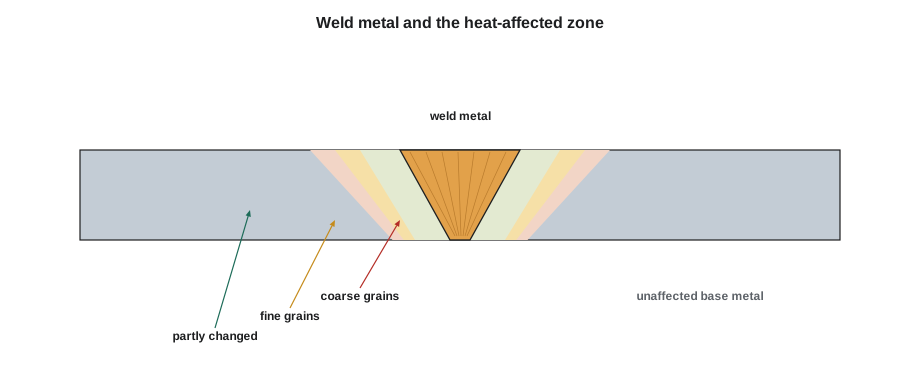
Grain size matters too. Fine grains give better toughness than coarse ones. Heat makes grains grow, so the part of the heat-affected zone next to the fusion line, which is heated close to melting, ends up with the coarsest grains and is often the least tough part of the joint. High heat input makes that coarse-grained zone wider. Multi-pass welds partly refine earlier passes, because each new pass reheats the one below. WLD-130 lessons 2 and 3 cover the structures and the iron-carbon diagram.
The weld zone and the heat-affected zone
A fusion weld has three regions. The weld metal is the part that melted and solidified, a mixture of filler and base metal, with a cast structure of columnar grains growing in from the fusion line. The heat-affected zone, the HAZ, is base metal that did not melt but was heated enough to change its structure; it has bands from coarse-grained near the fusion line to fine-grained and partly transformed farther out. Beyond it lies unaffected base metal. Exam questions ask which region is likely to be hardest, which is the coarse-grained HAZ in a hardenable steel cooled quickly, and which defects form where: hot cracks in the weld metal, hydrogen cracks usually in the HAZ, often at the toe or under the bead.
Mechanical properties and tests
Strength, ductility, hardness and toughness are tested in standard ways. A tensile test pulls a specimen until it breaks and gives yield strength, the stress at which it starts to stretch permanently; tensile strength, the highest stress it carries; and elongation, the stretch at fracture as a percentage, which measures ductility. A hardness test presses an indenter into the surface and measures the mark; harder steel is generally stronger and less ductile. A Charpy impact test breaks a notched bar with a swinging hammer and measures the energy absorbed, which shows toughness, and it is done at a stated temperature because many steels become brittle when cold. A bend test, which welders know best, shows ductility and soundness together.
Worked problem
Reading a tensile result
A tensile specimen from a procedure test has a cross-sectional area of 0.200 in². It yields at 10.6 kip and breaks at 15.3 kip. Its gauge length was 2.00 in and is 2.44 in after fracture. What are its yield strength, tensile strength and elongation?
Show solution
- Yield strength = yield load / area = 10,600 lb / 0.200 in² = 53,000 psi.
- Tensile strength = maximum load / area = 15,300 lb / 0.200 in² = 76,500 psi.
- Elongation = (final length − original length) / original length = (2.44 − 2.00) / 2.00 = 22 percent.
- Compare with the requirement for the filler class: a 70 ksi or 490 MPa electrode class needs at least that tensile strength.
Answer: Yield 53 ksi, tensile 76.5 ksi, elongation 22 percent: a sound result for a 70-class filler.
Carbon equivalent and hydrogen cracking
Hydrogen cracking, also called cold cracking or delayed cracking, is the metallurgy topic most likely to appear on any welding exam, because welders control so much of it. It needs three things at once: a hard, susceptible microstructure, usually martensite in the HAZ; hydrogen in the weld, from moisture in electrodes or flux, damp joints, rust, oil or the air; and tensile stress, from the shrinkage of the weld and the restraint of the joint. Remove any one and the crack does not form. It can appear hours or even days after welding, which is why some codes require inspection after a delay on high-strength steel.
Carbon equivalent turns a steel's chemistry into one number that predicts how easily it hardens. The common IIW formula adds carbon to fractions of the other elements: CE = C + Mn/6 + (Cr + Mo + V)/5 + (Ni + Cu)/15. A CE below about 0.40 is easy to weld; above about 0.45 to 0.50, preheat and low-hydrogen practice become important; above about 0.60, the steel needs careful procedures and often post-weld heat treatment. The loader boom in WLD-130 had a CE of 0.49, which is why its repair needed preheat. Thicker sections cool faster and need more preheat at the same CE.
# Metallurgy review: carbon equivalent, a preheat check and shrinkage
# 1. IIW carbon equivalent from a mill test report
steels = {
    'plate A': dict(C=0.16, Mn=1.30, Cr=0.05, Mo=0.02, V=0.00, Ni=0.10, Cu=0.20),
    'boom steel': dict(C=0.24, Mn=1.25, Cr=0.20, Mo=0.05, V=0.00, Ni=0.15, Cu=0.20),
    'casting': dict(C=0.32, Mn=1.40, Cr=0.30, Mo=0.10, V=0.02, Ni=0.20, Cu=0.10),
}
for name, s in steels.items():
    ce = s['C'] + s['Mn'] / 6 + (s['Cr'] + s['Mo'] + s['V']) / 5 + (s['Ni'] + s['Cu']) / 15
    band = 'good weldability' if ce < 0.40 else 'preheat and low hydrogen' if ce < 0.60 else 'special procedure'
    print(f"{name:<11} CE {ce:.2f}: {band}")

# 2. Illustrative preheat lookup: (CE limit, thickness limit) -> preheat
table = [(0.40, 1.5, 'none above 50 F'), (0.45, 1.5, '125 F'), (0.50, 1.5, '200 F'), (0.50, 4.0, '250 F'), (0.60, 4.0, '300 F')]
def preheat(ce, t):
    for ce_max, t_max, p in table:
        if ce <= ce_max and t <= t_max:
            return p
    return 'refer to the engineer'
print('boom repair preheat:', preheat(0.49, 1.25))

# 3. Free shrinkage of a heated bar: dL = alpha * L * dT
alpha = 6.7e-06
L, dT = 80, 900
print(f"a {L} in bar heated {dT} degrees grows {alpha * L * dT:.2f} in if free to expand")plate A CE 0.41: preheat and low hydrogen boom steel CE 0.52: preheat and low hydrogen casting CE 0.66: special procedure boom repair preheat: 200 F a 80 in bar heated 900 degrees grows 0.48 in if free to expand
The preheat table in the program is invented for practice; real values come from the procedure, the code's tables or the methods the codes give for hardness and hydrogen control. The boom steel's CE of 0.49 and its 1 1/4 in section give the same answer the WLD-130 capstone reached by three routes. The shrinkage result explains distortion: a 80 in bar heated 900 °F would grow about 0.48 in if free, and a weld that is not free to move turns that into stress.
Preheat and interpass temperature
Preheat slows the cooling of the weld and HAZ, which gives softer structures than martensite, and it gives hydrogen more time to diffuse out before the steel cools. It also dries the joint and reduces shrinkage stresses slightly. Preheat is measured on the base metal at a stated distance from the joint, commonly 3 in or the thickness of the part, on the side away from the heating source where practical, and it must be reached through the full thickness before welding starts. Temperature-indicating crayons and contact thermometers are the usual tools. The interpass temperature is the temperature of the joint just before each pass: a minimum, usually equal to the preheat, so the joint does not cool too far, and often a maximum, to protect toughness in quenched and tempered steels and to avoid sensitization in stainless steel.
Post-weld heat treatment is different from preheat. It heats the finished weldment to a temperature below the transformation range and holds it, to relieve residual stress and temper hard structures. Pressure codes require it for thick sections and for some alloy steels. A post-heat, sometimes called hydrogen bake-out, holds the weld at a moderate temperature for a time right after welding to drive hydrogen out, without the full stress-relief temperature. Exam questions often ask which is which and why. WLD-130 lesson 8 has the details.
Stainless steel and aluminum
Austenitic stainless steels such as 304 and 316 are welded without preheat because they do not form martensite. Their problems are different. They expand more than carbon steel and conduct heat less, so they distort more. Between about 800 and 1,600 °F, chromium carbides can form at grain boundaries, leaving chromium-poor zones that corrode; that is sensitization, and it is controlled with low-carbon L grades, low heat input and a maximum interpass temperature. A small amount of ferrite in the weld metal protects against hot cracking, which is why 308L filler is balanced to give a few percent ferrite, measured as a ferrite number.
Aluminum has a tough oxide that melts far above the metal, conducts heat several times better than steel, needs high heat input to start a puddle and then melts suddenly, shows no color change before melting, and is prone to porosity from hydrogen. Heat-treatable alloys such as 6061 lose much of their strength in the HAZ, which designers allow for. Hot cracking is controlled by choosing the right filler: 4043 or 5356, depending on the base alloy. WLD-130 lesson 9 and WLD-310 lesson 9 cover both metals.
Distortion and residual stress
A weld shrinks as it cools, and the shrinkage pulls the parts out of shape: longitudinal shrinkage along the weld, transverse shrinkage across it and angular distortion as the top of a weld shrinks more than the root. Where the parts cannot move, the shrinkage remains as residual stress, often close to the yield strength. Controls are about heat and balance: weld only as much as the design needs, because oversized fillets add shrinkage for no strength; use fewer passes with the right size; balance welds about the neutral axis, alternating sides; use backstep and skip sequences; preset parts so they shrink into place; and clamp or brace with strongbacks. Heat straightening can correct distortion after welding, within temperature limits for the steel. WLD-130 lesson 10 covers distortion.
Elena closes the session by giving each person one of the three questions from the start and asking for a sixty-second answer. Why do welds crack? Hot cracks from solidification stresses and impurities, cold cracks from hydrogen, hard structures and stress. Why does steel get hard? Fast cooling of carbon steel from austenite makes martensite. What can a welder do? Keep electrodes dry, clean the joint, preheat and control interpass temperature as the procedure says, use the right filler, keep heat input in range, size welds correctly and sequence them to balance shrinkage. Jun's answer is the best of the three, and he is still in his first period.
Heat input and toughness
One more link between settings and metallurgy appears often enough to deserve its own paragraph. Heat input, calculated in lesson 5 from voltage, current and travel speed, controls the cooling rate: low heat input cools fast, which can harden the HAZ of a hardenable steel; high heat input cools slowly, which avoids hardening but grows coarse grains and can lower toughness. That is why impact-tested procedures limit heat input from above and preheat requirements limit it from below, and why a welder who slows down to make a bigger bead on an impact-tested job can put the weld outside its procedure without changing a single dial.
Common mistakes
MistakeThinking preheat is only to dry the joint.
InsteadPreheat mainly slows cooling, avoiding hard structures and letting hydrogen escape.
MistakeMeasuring preheat right at the weld edge on the heated side.
InsteadMeasure at the stated distance on the base metal, through the thickness where possible.
MistakePreheating austenitic stainless steel like carbon steel.
InsteadIt does not form martensite; control interpass temperature and heat input instead.
MistakeMaking fillets bigger than the drawing to be safe.
InsteadOversized welds add shrinkage, distortion and cost without needed strength.
MistakeConfusing post-weld heat treatment with preheat.
InsteadPWHT relieves stress and tempers after welding; preheat controls cooling during welding.
Summary and key terms
- Steel changes to austenite when hot; fast cooling forms hard martensite, slow cooling soft ferrite and pearlite.
- The coarse-grained HAZ next to the fusion line is often the hardest and least tough region.
- Tensile, hardness, Charpy and bend tests measure strength, hardness, toughness and ductility.
- Hydrogen cracking needs a hard structure, hydrogen and stress; carbon equivalent predicts hardenability.
- Preheat slows cooling and lets hydrogen escape; interpass limits protect toughness and corrosion resistance.
- Distortion comes from shrinkage; control it with correct weld size, balance, sequence, presetting and restraint.
- Austenite
- The high-temperature form of iron, which dissolves much carbon.
- Martensite
- A hard, brittle structure formed when steel is cooled quickly from austenite.
- Heat-affected zone
- Base metal whose structure was changed by the heat of welding without melting.
- Carbon equivalent
- A number combining a steel's alloy content to predict how easily it hardens.
- Sensitization
- Chromium carbide formation at grain boundaries in stainless steel, which reduces corrosion resistance.
- Residual stress
- Stress left in a weldment after it cools, caused by restrained shrinkage.
Practice problems
Work each problem on paper first, then reveal the answer to check.
A steel has C 0.18, Mn 1.20, Cr 0.10, Mo 0.03, V 0, Ni 0.20, Cu 0.25. What is its CE?
Show answer
About 0.43: 0.18 + 0.20 + 0.026 + 0.03.
Name the three conditions for hydrogen cracking.
Show answer
A susceptible hard microstructure, hydrogen in the weld and tensile stress.
Why use 316L rather than 316 filler on a 316L pipe?
Show answer
Low carbon resists sensitization and intergranular corrosion.
Lesson quiz · 5 questions
Score 60% or more to complete this lesson.
Create a free account to save your progress, take quizzes and earn a certificate.