
WLD-340 · Lesson 3 of 12 · 19 min
Safety and shop practice review
The first group session belongs to Aisha. She has been asked to teach safety and shop practice, which every school final and every test facility's orientation covers, and she has prepared by going back through WLD-110 and writing a question for every lesson. She starts with a confession: on her first-year final she lost more marks in safety than anywhere else, not because she works unsafely but because the questions asked for the reason behind a rule, and she only knew the rule. Tonight's review is about the reasons. Priya Natarajan, Hartwell's safety coordinator, sits at the back to answer questions about the OSHA rules.
Hazards of the arc and the flame
Arc welding produces ultraviolet, visible and infrared radiation. Ultraviolet burns the cornea in seconds, which is arc flash or welder's flash: gritty, painful eyes some hours after exposure. It also burns exposed skin like sunburn. Infrared heats the eye and over years can contribute to cataracts. The defense is a filter of the right shade for the process and current, a helmet that covers the face, safety glasses under it, and screens that protect people nearby. Shade numbers rise with the current: a low-amperage gas tungsten arc needs less shade than a high-current air carbon arc gouge, and oxyfuel cutting needs much less than any arc process. WLD-110 lesson 2 has the full guide.
Exam questions on radiation tend to test one of three things: which shade is darker, why the lightest shade that still protects is chosen for the job, and what protects bystanders. A higher shade number is darker. The rule is to start at a shade dark enough for the current and go darker if the arc is uncomfortable, never lighter. Bystanders are protected by welding screens and curtains, which must be the type made for welding, because ordinary plastic sheet can melt or burn and some colored plastics do not block ultraviolet.
Worked problem
Choosing a filter shade
Devon is setting up to gouge a root at about 400 amperes with air carbon arc, then weld the fill with E7018 at 140 amperes. Which job needs the darker shade, and what is the rule for choosing within the range a guide gives?
Show solution
- Shade guides give higher shade numbers for higher currents and for processes with brighter arcs.
- Air carbon arc gouging at 400 amperes is near the top of the guide; a minimum around shade 12 with 14 suggested is typical.
- Stick welding at 140 amperes falls lower, with a minimum around 10 and 12 suggested.
- Within the range, start dark enough to protect and choose the shade that lets you see the puddle without discomfort.
Answer: The gouging needs the darker shade. Never use a lighter shade than the guide's minimum for the current.
Fumes and ventilation
Welding fume is a mixture of metal oxide particles and gases from the base metal, the filler, the flux, the shielding gas and any coating on the work. The particles are small enough to reach deep into the lungs. Manganese, in almost every steel filler, can damage the nervous system with long exposure. Hexavalent chromium, formed when welding stainless steel, causes cancer. Zinc from galvanizing causes metal fume fever, which feels like flu. Cadmium-plated parts and lead-painted steel can cause serious poisoning. The gases include ozone from the arc's ultraviolet, nitrogen oxides and carbon monoxide, and shielding gases such as argon and carbon dioxide can displace oxygen in a confined space.
The order of controls is the same as for any hazard: remove the hazard if you can, then engineer it away, then use administrative controls, and last of all personal protection. For fume that means removing coatings before welding, choosing a lower-fume process or filler where the procedure allows, using local exhaust close to the arc, then general ventilation, and respirators when exposure is still too high. OSHA sets permissible exposure limits, including a specific standard for hexavalent chromium, and many employers also follow the lower ACGIH threshold limit values. Priya measured fume in the stainless bay last spring and added a fume extraction gun to every station there.
Confined spaces bring fume, oxygen and fire hazards together. A confined space is one not designed for continuous occupancy, with limited entry and exit, where a hazardous atmosphere can build up. Before entry the atmosphere is tested for oxygen, flammable gases and toxic gases, in that order, because the flammable gas meter needs enough oxygen to read correctly. Cylinders stay outside. A trained attendant stays outside the space and does not enter to rescue; rescue is planned before entry. WLD-110 lesson 3 covers the steps in detail, and BLR-110 in the boilermaker program covers vessel entry if you want more.
Electrical safety
Arc welding uses low voltage and high current. The open-circuit voltage of a power source, the voltage between the electrode and the work before the arc strikes, is the shock hazard; it is usually well under 100 volts, but it can kill when the body's resistance is low, which happens when skin is wet with sweat or rain, or when the welder is lying on steel. Dry gloves in good condition, dry clothing, an insulating mat or board where you lie or kneel on the work, and never changing electrodes with bare hands are the basic defenses. Primary power, the 480 volt supply to the machine, is a separate and greater hazard and belongs to electricians.
The work lead deserves its own question on most exams. It must be connected to the workpiece as close to the weld as practical. If it is clamped to a table or a building structure far from the weld, the welding current can find a path through chains, hoist cables, pipework or a person, and it can arc at loose connections. Hartwell lost a hoist chain to that years ago: a welder clamped his work lead to the fixture stand, the current returned through the overhead crane, and the chain was arced so badly it had to be scrapped. WLD-120 lesson 3 covers cables and connections.
Fire and hot work
Sparks and spatter from welding and cutting travel farther than people expect, often 35 feet, and can drop through floor openings and smolder for hours. A hot work permit system controls that risk: before work starts in an area that is not a dedicated welding shop, someone checks the area, moves or covers combustibles, wets down or shields what cannot be moved, closes gaps in floors and walls, and posts a fire watch with an extinguisher. The fire watch stays during the work and for a time after it, because most hot work fires start after the welder has left.
The time a fire watch stays after work differs between rules. NFPA 51B, the hot work standard most US sites follow, calls for at least an hour after the work in its recent editions, while OSHA's general industry rule says at least half an hour. When two rules apply, the stricter one governs, so Hartwell uses the hour. WLD-110 lesson 5 has the permit steps. On a school test, expect a question on the order of steps, a question on what the fire watch does and a question on the extinguisher type.
Compressed gases
Cylinders are stored upright and secured, with valve caps on when not in use. Oxygen is stored apart from fuel gases, by a set distance or behind a fire-resistant barrier. Acetylene is dissolved in acetone inside a porous filler, so an acetylene cylinder must be used upright, and if it has been lying down it must stand upright for a time before use so the acetone settles. Acetylene must never be used above about 15 psi, because above that free acetylene can decompose explosively. And the rate at which it is drawn from a cylinder is limited, commonly to one seventh of the contents per hour, so that acetone is not pulled out with the gas.
The one-seventh rule is a favorite calculation. A cylinder's acetylene content is found by weight, not by pressure, because the gas is dissolved; the cylinder is weighed and the tare weight stamped on it is subtracted. Oxygen and inert gases, which are compressed rather than dissolved, are read by pressure. When a cutting job needs more acetylene per hour than one cylinder can safely give, cylinders are manifolded together. The code in this lesson works that out along with other common safety calculations.
# Safety and shop calculations for review
# 1. Acetylene withdrawal: at most 1/7 of the contents per hour
content = 13.0                 # acetylene in the cylinder, by weight
demand = 4.5                 # torch demand per hour
limit = content / 7
cyl = -(-demand // limit)
print(f"one cylinder gives up to {limit:.2f} lb/h; demand {demand} lb/h needs {int(cyl)} cylinder(s) manifolded")

# 2. Sling tension with two legs at an angle from vertical
import math
load = 4400
for angle in (0, 30, 45, 60):
    t = load / 2 / math.cos(math.radians(angle))
    print(f"  two legs at {angle:>2} deg from vertical: each leg carries {t:,.0f} lb")

# 3. Noise dose with an exchange rate
LIMIT, EXCHANGE = 90, 5
day = [(95, 2), (88, 4), (82, 2)]   # (level dBA, hours)
dose = 0
for level, hours in day:
    allowed = 8 / 2 ** ((level - LIMIT) / EXCHANGE)
    dose += hours / allowed
print(f"noise dose {dose:.0%} of the daily limit ({'over' if dose > 1 else 'within'} the limit)")one cylinder gives up to 1.86 lb/h; demand 4.5 lb/h needs 3 cylinder(s) manifolded two legs at 0 deg from vertical: each leg carries 2,200 lb two legs at 30 deg from vertical: each leg carries 2,540 lb two legs at 45 deg from vertical: each leg carries 3,111 lb two legs at 60 deg from vertical: each leg carries 4,400 lb noise dose 96% of the daily limit (within the limit)
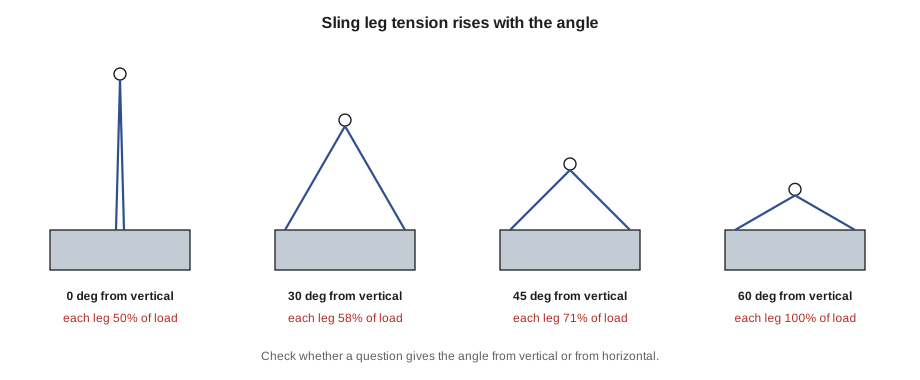
The three results are the ones test questions check. One cylinder holding 13 lb of acetylene gives at most about 1.9 lb an hour, so a demand of 4.5 lb an hour needs three cylinders on a manifold. Sling legs at 60 degrees from vertical carry the whole load each, twice what they carry hanging straight. And the noise dose, using OSHA's 90 dBA permissible limit with a 5 dB exchange rate, comes to over the limit for the day; OSHA also requires a hearing conservation program at a lower action level, which is why Hartwell's grinding bay is a hearing protection area.
Rigging, hoisting and handling
Common occupational skills include moving material safely. Welders rig and lift plates, beams and assemblies with overhead cranes, jib cranes and chain hoists every day, and the exam expects the basics: know the weight of the load before lifting it, inspect slings and hardware before each use, never exceed the rated capacity, account for sling angles, keep hands clear of pinch points, use tag lines to control swing, never stand under a load and use the agreed hand signals with one signal person. WLD-110 and the shop's rigging training cover it, and ELV-130 and BLR-120 in other programs go deeper.
Sling angle is the calculation most often tested. When a two-leg sling hangs straight down, each leg carries half the load. As the legs spread, each leg carries more, because only the vertical part of its tension holds the load up. At 30 degrees from vertical each leg carries about 58 percent of the load, at 45 degrees about 71 percent, and at 60 degrees the full load. Questions sometimes give the angle from horizontal instead, so read carefully: 60 degrees from horizontal is the same as 30 degrees from vertical.
Tools, documents and the trade
Common occupational skills also cover tools, documents and working with others. Grinders cause more injuries in welding shops than arcs do. Use the guard, a wheel rated for the grinder's speed, the right wheel for the job, a face shield over safety glasses, and keep the tool rest on a bench grinder within the gap the manufacturer sets. Never use a cutting disc for side grinding. Documents include the hazard assessment for the job, the hot work permit, the procedure, the drawing and the inspection record, and the exam expects you to know which one answers which question.
Mentoring is part of every apprenticeship standard too. A journey-level welder is expected to teach apprentices, explain hazards, demonstrate techniques and check understanding. Questions on mentoring are usually about method: show, then let the learner try with supervision, then check, and give feedback that is specific. Marta smiles at that one. She says the whole study group is a mentoring exercise.
Aisha finishes with a mixed set of twenty questions. The group scores well on fire and gases and poorly on fume, where three of them could name manganese but not say why stainless steel needs extra control. That goes on the flashcards, and Aisha's lesson is done.
Common mistakes
MistakeChoosing a lighter shade to see the puddle better.
InsteadNever go below the guide's minimum; improve the lighting or the position instead.
MistakeTesting a confined space for flammable gas before oxygen.
InsteadTest oxygen first, then flammables, then toxics.
MistakeClamping the work lead to the table across the shop.
InsteadConnect it to the work close to the weld.
MistakeReading acetylene contents from the pressure gauge.
InsteadAcetylene is dissolved; find the contents by weight.
MistakeConfusing sling angles from vertical with angles from horizontal.
InsteadCheck which reference the question uses before calculating.
Summary and key terms
- Filter shades rise with current; never go below the minimum.
- Fume control follows the order of controls, with extra care for stainless steel, coatings and confined spaces.
- Shock risk comes from open-circuit voltage and wet conditions; keep the work lead close to the weld.
- Hot work needs a permit, cleared area and a fire watch that stays after the work.
- Acetylene is used upright, below 15 psi, at no more than one seventh of the contents an hour.
- Sling leg tension grows with angle: at 60 degrees from vertical each leg carries the full load.
- Arc flash
- An eye injury from ultraviolet radiation from the arc.
- Open-circuit voltage
- The voltage between electrode and work before the arc strikes.
- Fire watch
- A person posted to watch for and put out fires during and after hot work.
- Hexavalent chromium
- A cancer-causing compound formed when welding or cutting stainless steel.
- Manifold
- A connection that draws gas from several cylinders together.
- Sling angle
- The angle of a sling leg, measured from vertical or from horizontal.
Practice problems
Work each problem on paper first, then reveal the answer to check.
A cylinder holds 14 lb of acetylene. What is the most it should supply each hour?
Show answer
About 2 lb, one seventh of 14 lb.
Two sling legs lift a 2,600 lb beam at 45 degrees from vertical. What does each leg carry?
Show answer
About 1,840 lb: 1,300 lb divided by cos 45, or 0.707.
What should a fire watch do if a fire starts that he cannot control?
Show answer
Sound the alarm and evacuate, as the permit and site plan direct.
Lesson quiz · 5 questions
Score 60% or more to complete this lesson.
Create a free account to save your progress, take quizzes and earn a certificate.