
TRD-107 · Lesson 8 of 12 · 19 min
State and local licensing and reciprocity
In the United States there is no national trade license. Whether you need a license to do plumbing, electrical or HVAC work, and what the license requires, depends on the state, and sometimes the county or city, where you work. A journeyworker licensed in one place may have to apply, test or document experience again to work in another. This lesson explains how state and local licensing works, how it applies in Ohio and Columbus, what reciprocity means and what national certifications add.
Who licenses what
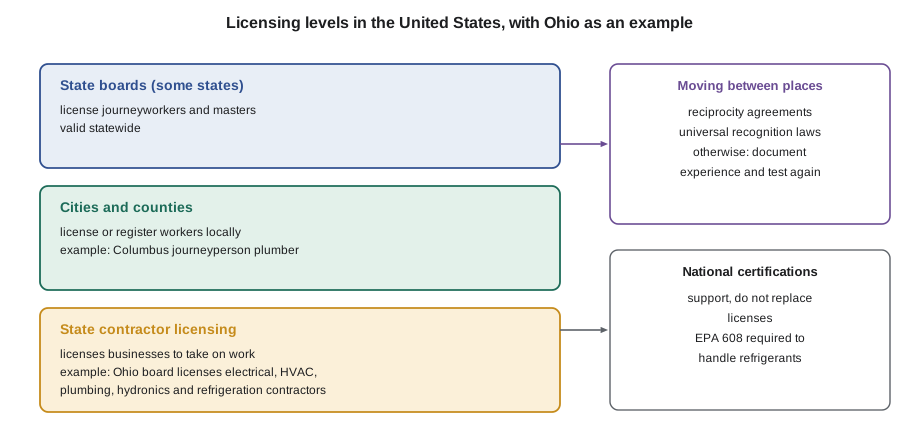
Licensing of trade workers happens at three levels. Some states license journeyworkers and masters statewide, with a state board that sets experience requirements, runs or approves exams and issues licenses that are valid anywhere in the state. Others leave individual licensing to counties and cities, which set their own rules. Many states also license contractors, the businesses that bid on and take responsibility for work, separately from the workers. And some trades, such as carpentry or drywall, often have no individual license anywhere.
Ohio is an example of a mixed system. The Ohio Construction Industry Licensing Board licenses commercial contractors in five trades: electrical, HVAC, plumbing, hydronics and refrigeration. It does not license individual journeyworkers. Instead, many cities and counties license or register journeyworkers in plumbing and electrical work. In Columbus, a journeyperson plumber license is issued by the city's building and zoning department after review by its Skilled Trades Review Board, based on experience or a registered apprenticeship and a passing score on a national standard exam. Residential contractors are often licensed or registered locally as well.
What licenses require
Most trade licenses require some combination of documented experience, an exam and a fee, and many require continuing education to renew. Experience is often measured in years, with a minimum number of hours in each year; for example, Columbus counts a full year for its plumbing license as 12 consecutive months with at least 1,600 working hours, and asks for five full years or completion of a registered plumbing apprenticeship. Exams are usually written by testing agencies and based on national model codes, sometimes with a local code section. Renewal may require proof of continuing education hours, especially for electrical licenses, where the National Electrical Code is revised every three years.
Contractor licenses usually require more. In Ohio, a commercial contractor license from the Ohio Construction Industry Licensing Board requires at least five years of experience in the trade, documented by tax records such as W-2s or Schedule Cs, plus one of several kinds of supporting evidence: five years of permits, a journeyman's card, completion of a state or federally approved apprenticeship, or certificates showing 40 hours of approved code training. Applicants must then pass the licensing exam, and licensed contractors must carry liability insurance and complete continuing education to renew. Lesson 12 returns to contractor licensing.
Reciprocity
Reciprocity is an agreement between licensing bodies to recognize each other's licenses, usually so that a licensee from one place can get a license in the other without retesting, or with a shorter test. Some states have reciprocity agreements for certain licenses with neighboring states; some licensing bodies accept passing scores on the same national exams. Others have no reciprocity, and a licensed worker from elsewhere must document experience and pass the local exam. Reciprocity agreements change and usually come with conditions, such as holding the original license for a minimum time and being in good standing.
In recent years, many states have also passed universal licensing recognition laws, which let people who hold an occupational license in another state, in good standing and for a set time, get a license without starting over, sometimes with a local law exam. These laws vary in which occupations they cover and whether they apply to trade licenses issued by cities. Ask the licensing body where you plan to work.
The program below shows a simple check of whether a worker is ready to apply for certification or a license by an experience route, comparing their documented experience against a set of invented requirements. Real requirements come from the regulator.
# readiness check for a journeyperson license by the experience route (invented example)
FULL_YEAR_HOURS = 1600          # a full year needs at least this many hours in 12 months
YEARS_NEEDED = 5
years = [  # year, hours worked in the trade
    (2021, 1720), (2022, 1840), (2023, 1450), (2024, 1910), (2025, 1880), (2026, 1690),
]
full_years = [y for y, h in years if h >= FULL_YEAR_HOURS]
print(f"full years: {len(full_years)} ({', '.join(str(y) for y in full_years)})")
short = [(y, h) for y, h in years if h < FULL_YEAR_HOURS]
for y, h in short:
    print(f"{y}: only {h} h, does not count as a full year")
print("eligible to apply for the exam" if len(full_years) >= YEARS_NEEDED else "not yet eligible")full years: 5 (2021, 2022, 2024, 2025, 2026) 2023: only 1450 h, does not count as a full year eligible to apply for the exam
National certifications
National certifications are not licenses, but they can strengthen a resume, satisfy employer requirements and sometimes count toward license requirements. Examples include certifications from the National Center for Construction Education and Research, the International Code Council's certifications for inspectors, industry certifications for welders, and manufacturer training on specific equipment. One federal certification is required by law: anyone who handles refrigerants in air conditioning and refrigeration equipment must hold EPA Section 608 certification, and technicians working on vehicle air conditioning need Section 609 certification.
Internationally trained tradespeople face different rules in each state and city. Some licensing bodies accept foreign experience if it can be documented and verified; others require some experience in the United States. Documents may need translation and evaluation. Community colleges and workforce agencies often offer exam preparation and bridging courses for experienced workers.
| Situation | What usually happens |
|---|---|
| Licensed in one state, moving to another | Check reciprocity or universal recognition; may need a local exam |
| Apprentice moving states | Transfer to a program there; a Certificate of Completion is recognized nationally |
| Experienced but never apprenticed | Document years and hours, then take the license exam |
| Trained outside the United States | Rules vary; documentation, verification and local exams |
Maya looks ahead
Maya's cousin worked in Indiana for two winters on industrial projects and came back with stories about the money and the travel. Maya asked Luis whether she could do the same after she was licensed. Luis explained that her Columbus license would not automatically be valid in other cities or states, but that her Certificate of Completion from a registered program was recognized nationally and that passing a national standard exam would help wherever she went. He told her to check each place's rules, and any reciprocity or universal recognition law, before taking a job there.
Local rules that still matter
Even with a license, some things still differ between places. Codes differ: each state or city adopts its own version of the model codes, sometimes years apart and with local amendments. Scopes of practice differ: what a licensed plumber or electrician may do, and what needs a separate license or certification, varies. Permit rules differ: who may pull a permit, and whether a licensed contractor must supervise the work, depends on the jurisdiction. A plumber licensed in Columbus who works in another Ohio city or a neighboring state needs to learn its code version, permit process and license rules before starting.
Safety rules also differ. Federal OSHA covers private employers in most states, but about half the states run their own approved state plans with rules that can be stricter, and some cities and states require specific training cards for construction workers. Employers usually help with this, but it is worth checking before you move so you are not held up on your first day.
Why standards and mobility matter
National standards and mobility rules exist because work moves. Large projects, such as mines, refineries, power plants, hospitals and transit lines, need more tradespeople than the local workforce can supply, and they draw workers from far away for months or years. Natural disasters create sudden demand for rebuilding. Economic cycles shift work from one region to another. Tradespeople who can move with the work, and whose credentials are recognized when they get there, have more opportunities and more security.
For employers and the public, common standards mean that a certified tradesperson from elsewhere can be trusted to know the core of the trade. For apprentices, they mean that training in one place is not wasted if life takes them somewhere else. That is also why it pays to keep your records, transcripts and experience letters organized long after you are certified: you may need them in a place and a year you cannot predict.
If you trained somewhere else
If you are new to the United States with trade experience, start by finding out what licenses are needed for your trade where you live, and what experience the licensing body accepts. Gather documents early: letters from past employers describing your duties, dates and hours; training certificates and transcripts; and licenses from your home country. Get certified translations and credential evaluations where required. Community colleges, workforce agencies and immigrant service organizations often offer help with this process and with exam preparation, including language support for the technical vocabulary of the trade.
Whatever your background, the exam will test local codes and practices, so plan time to learn them. Experience is a huge advantage, but the details of the local code are often the hardest part for experienced workers from elsewhere.
A checklist before you move
- Confirm what licenses the new state, county or city requires for your work.
- Check for reciprocity agreements or universal recognition laws that apply to your license.
- Gather copies of certificates, transcripts, logbooks and experience letters.
- Find out which code edition and local amendments apply, and plan time to learn them.
- Check the safety training the new jurisdiction or employer requires before your first day.
- Ask about separate certifications for related work, such as gas, refrigerants or medical gas.
Luis's advice to Maya was simple: a move goes smoothly when the paperwork is done before the truck is packed. Most of the problems he had seen were not about skill but about a missing letter, an expired card or a certificate that had not been recognized yet.
He also reminded her that movement works in both directions. Tradespeople from other states come to Ohio too, and on a busy site she might work beside a journeyworker from Indiana or Pennsylvania whose training and code were slightly different from hers. National exams and model codes mean they share the core of the trade; the differences are worth talking about, because each of them has picked up methods the other has not.
Mobility also matters during an apprenticeship. An apprentice who follows work to another state partway through should contact the registration agency or the new program sponsor promptly so that hours keep counting, and should ask how completed classes and on-the-job hours will be credited. Programs registered under the same national rules usually give credit, but the details differ, so it is worth getting the answer in writing before you move.
Common mistakes
MistakeAssuming a license from one city works everywhere.
InsteadCheck the rules in each state and city before working there.
MistakeConfusing a contractor license with a journeyworker license.
InsteadA contractor license lets a business take on work; individual workers may need their own license.
MistakeThinking national certifications replace licenses.
InsteadThey add credentials but do not license you, except where federal law requires them.
MistakeMoving without keeping records.
InsteadKeep copies of certificates, transcripts and experience letters; they are needed in every route.
Summary and key terms
- There is no national trade license; states, counties and cities set their own licensing rules.
- Ohio licenses commercial contractors in five trades; cities such as Columbus license journeyworkers in plumbing and electrical work.
- Licenses usually require documented experience, an exam and a fee, with continuing education to renew.
- Reciprocity and universal recognition laws can let licensed workers move without starting over, with conditions.
- National certifications support but do not replace licenses; EPA Section 608 certification is required to handle refrigerants.
- Keep copies of all certificates, transcripts and experience letters; every route depends on them.
- License
- Permission from a state or local government to do regulated trade work.
- Contractor license
- A license for a business to bid on and take responsibility for work in a trade.
- Reciprocity
- An agreement between licensing bodies to recognize each other's licenses, usually with conditions.
- Universal licensing recognition
- A state law that lets people licensed in another state get a license without starting over.
- EPA Section 608
- The federal certification required to handle refrigerants in air conditioning and refrigeration equipment.
Practice problems
Work each problem on paper first, then reveal the answer to check.
Which trades does the Ohio Construction Industry Licensing Board license contractors in?
Show answer
Electrical, HVAC, plumbing, hydronics and refrigeration.
Who licenses journeyperson plumbers in Columbus?
Show answer
The city's building and zoning department, after review by the Skilled Trades Review Board.
What is reciprocity?
Show answer
An agreement between licensing bodies to recognize each other's licenses, usually with conditions.
Name a federal certification required by law for some trade work.
Show answer
EPA Section 608 for handling refrigerants (Section 609 for vehicle air conditioning).
In the readiness program, why might a year of experience not count?
Show answer
Because it had fewer than the minimum hours needed for a full year.
What documents should you keep for any mobility route?
Show answer
Certificates, transcripts, logbooks and experience letters from employers.
Lesson quiz · 5 questions
Score 60% or more to complete this lesson.
Create a free account to save your progress, take quizzes and earn a certificate.