
TRD-107 · Lesson 8 of 12 · 19 min
The Red Seal Program and working across Canada
A certificate earned in one province is issued under that province's law. So what happens when a certified plumber from Hamilton wants to work in Calgary, or a Nova Scotia electrician takes a job in British Columbia? For most of the common trades, the answer is the Red Seal. This lesson explains what the Red Seal Program is, how it works with provincial certification, how tradespeople move between provinces, and the routes for people who learned a trade outside the apprenticeship system or outside Canada.
What the Red Seal is
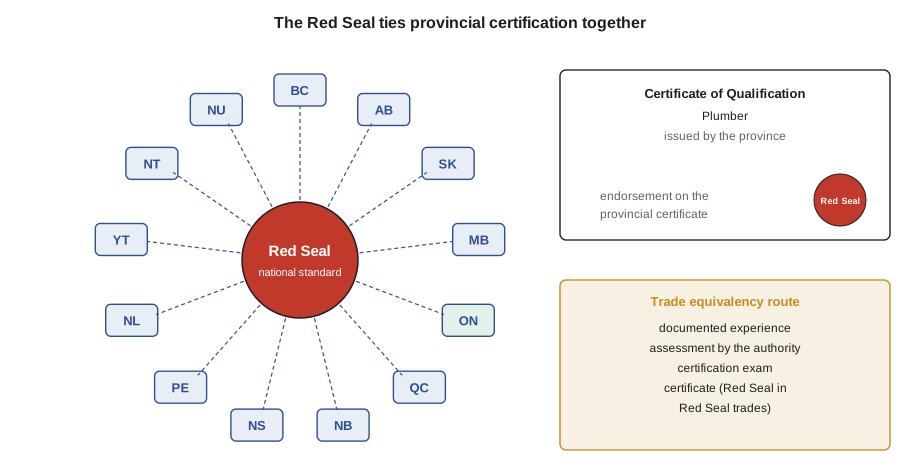
The Interprovincial Standards Red Seal Program, usually just called the Red Seal Program, sets common national standards for certain trades and gives a Red Seal endorsement to tradespeople who meet them. It is managed by the Canadian Council of Directors of Apprenticeship, with support from the federal government, and covers more than 50 trades, including plumber, construction electrician, steamfitter-pipefitter, sheet metal worker, carpenter, refrigeration and air conditioning mechanic, millwright, welder, heavy duty equipment technician, automotive service technician and cook. Not every trade is a Red Seal trade, and not every province designates every Red Seal trade.
The Red Seal is not a separate certificate issued by a separate body. When an apprentice in a Red Seal trade passes the Red Seal exam, their province issues its own certificate of qualification with a Red Seal endorsement on it. In Ontario, the Red Seal exam is the Certificate of Qualification exam for Red Seal trades, so passing it gives you both at once. The endorsement tells employers and regulators in every province that you have met the national standard.
Red Seal Occupational Standards
Each Red Seal trade has a national standard that describes what a certified worker does and must know. Older standards were called National Occupational Analyses; they are being replaced over time by Red Seal Occupational Standards, which are developed with industry across the country. The standard is the basis for the Red Seal exam, and provinces increasingly use it to build their own training standards and curricula, so apprentices in different provinces learn more similar content than they used to.
The Red Seal Program has also been modernizing. Changes announced by the federal government in 2026 include online exams, digital logbooks, secure digital credentials and a single national registered apprenticeship number for each apprentice, all intended to make certification faster and to make it easier to move between provinces during and after an apprenticeship.
Working in another province
A certified journeyperson with a Red Seal endorsement can generally work in any province or territory that designates the trade without rewriting the exam. In a compulsory trade, they may need to apply to the new province's authority to have their certificate recognized before starting work, but the process is usually a matter of paperwork rather than testing. Under the labour mobility rules of the Canadian Free Trade Agreement, provinces are expected to recognize certified workers from other provinces, though they can still require things like local safety training.
Apprentices can move too. An apprentice who moves to another province registers with the new authority, which usually credits the hours and in-school levels already completed, especially in Red Seal trades where training is harmonized. Some provinces have agreements to recognize each other's apprentices directly. Ask both authorities before you move, so you know what will transfer and what you will need to do.
The program below shows a simple check of whether a worker is ready to apply for certification or a licence by an experience route, comparing their documented experience against a set of invented requirements. Real requirements come from the regulator.
# readiness check for a trade equivalency application (invented requirements)
required_hours = 9000 * 1.5     # experience-route hours set at 1.5 times the apprenticeship (illustrative)
required_areas = {"drainage, waste and vent", "water distribution", "fixtures and appliances",
                  "hydronic and heating", "testing and inspection"}
experience = [  # employer, years, hours, areas covered
    ("Coastal Plumbing (NS)", 4, 7200, {"drainage, waste and vent", "water distribution", "fixtures and appliances"}),
    ("Ridge Heating (ON)", 3, 5400, {"hydronic and heating", "testing and inspection", "water distribution"}),
]
hours = sum(h for _, _, h, _ in experience)
areas = set().union(*(a for *_, a in experience))
print(f"documented hours: {hours} of {required_hours:.0f}")
missing = required_areas - areas
print("all areas covered" if not missing else f"missing areas: {', '.join(sorted(missing))}")
print("ready to apply" if hours >= required_hours and not missing else "not ready yet")documented hours: 12600 of 13500 all areas covered not ready yet
Trade equivalency and internationally trained workers
Not everyone gets certified through an apprenticeship. In Ontario, people with substantial experience in a trade, whether gained informally in Canada or in another country, can apply to Skilled Trades Ontario for a trade equivalency assessment. They submit proof of their experience, such as letters from employers describing their duties and hours, and any training certificates. If the assessment finds their experience matches the trade's standard, they can write the Certificate of Qualification exam. Every province has a similar route, often called a trade qualifier or challenge route.
Internationally trained tradespeople often face extra steps: getting documents translated, showing experience that matches Canadian standards and codes, and passing an exam that tests Canadian codes and practices. Many provinces and community organizations offer bridging programs, exam preparation and help with documents. In compulsory trades, some provinces issue a temporary or provisional credential that lets a qualified person work while they prepare for the exam; in Ontario, a Provisional Certificate of Qualification is one of the credentials that allows work in a compulsory trade.
| Situation | What usually happens |
|---|---|
| Certified with Red Seal, moving provinces | Apply for recognition; no rewrite in most cases |
| Apprentice moving provinces | Register in the new province; hours and levels usually credited |
| Experienced but never apprenticed | Apply for trade equivalency, then write the exam |
| Trained outside Canada | Trade equivalency, bridging programs, possibly a provisional credential |
Maya looks ahead
Maya's cousin worked in Alberta for two winters on industrial projects and came back with stories about the money and the travel. Maya asked Luis whether she could do the same after certification. Luis showed her the Red Seal on his own certificate and explained that, as a certified plumber with the endorsement, she could apply to work in Alberta without writing another exam, and that many Ontario plumbers had done exactly that during busy periods out west. He also told her to check the gas and medical gas rules separately, because some related certifications are handled differently from province to province.
Provincial differences that still matter
Even with a Red Seal, some things still differ between provinces. The list of compulsory trades is different, so a trade that needs certification in one province may not in another. Scopes of practice differ: what an electrician or plumber may do, and what needs a separate certificate, is not identical everywhere. Codes differ too: each province adopts its own building, plumbing and electrical codes, usually based on the national model codes but with local changes. A Red Seal plumber moving from Ontario to British Columbia, for example, needs to learn the British Columbia plumbing code amendments, and gas work is certified separately in each province.
Safety rules also differ. Each province has its own occupational health and safety act and regulations, and some require province-specific training, such as Ontario's working at heights training, before you start work. Employers usually help with this, but it is worth checking before you move so you are not held up on your first day.
Why standards and mobility matter
National standards and mobility rules exist because work moves. Large projects, such as mines, refineries, power plants, hospitals and transit lines, need more tradespeople than the local workforce can supply, and they draw workers from far away for months or years. Natural disasters create sudden demand for rebuilding. Economic cycles shift work from one region to another. Tradespeople who can move with the work, and whose credentials are recognized when they get there, have more opportunities and more security.
For employers and the public, common standards mean that a certified tradesperson from elsewhere can be trusted to know the core of the trade. For apprentices, they mean that training in one place is not wasted if life takes them somewhere else. That is also why it pays to keep your records, transcripts and experience letters organized long after you are certified: you may need them in a place and a year you cannot predict.
If you trained somewhere else
If you are new to Canada with trade experience, start by finding out whether your trade is compulsory in the province where you live, and what the provincial authority needs to assess your experience. Gather documents early: letters from past employers on letterhead describing your duties, dates and hours; training certificates and transcripts; and licences from your home country. Get certified translations where required. Many settlement agencies and colleges offer free help with this process and with preparing for the exam, including language support for the technical vocabulary of the trade.
Whatever your background, the exam will test local codes and practices, so plan time to learn them. Experience is a huge advantage, but the details of the local code are often the hardest part for experienced workers from elsewhere.
A checklist before you move
- Confirm the trade is designated, and whether it is compulsory, in the new province.
- Apply to the new province's authority for recognition of your certificate or transfer of your apprenticeship.
- Gather copies of certificates, transcripts, logbooks and experience letters.
- Find out which code edition and local amendments apply, and plan time to learn them.
- Check the safety training the new jurisdiction or employer requires before your first day.
- Ask about separate certifications for related work, such as gas, refrigerants or medical gas.
Luis's advice to Maya was simple: a move goes smoothly when the paperwork is done before the truck is packed. Most of the problems he had seen were not about skill but about a missing letter, an expired card or a certificate that had not been recognized yet.
He also reminded her that recognition works in both directions. Tradespeople from other provinces come to Ontario too, and on a busy site she might work beside a Red Seal plumber from Nova Scotia or Alberta whose training was slightly different from hers. The national standard means they share the core of the trade; the differences are worth talking about, because each of them has picked up methods the other has not.
Mobility also matters during an apprenticeship. An apprentice who follows work to another province partway through should register there promptly so that hours keep counting, and should ask whether in-school levels completed at home will be credited. In Red Seal trades they usually are, because the levels are built from the same national standard, but timing and level names can differ, so it is worth getting the answer in writing before you move.
Common mistakes
MistakeAssuming every trade has a Red Seal.
InsteadCheck whether your trade is a Red Seal trade and which provinces designate it.
MistakeStarting work in a compulsory trade in a new province before getting recognized.
InsteadApply for recognition first; it is usually quick.
MistakeThinking the Red Seal is issued separately from the provincial certificate.
InsteadIt is an endorsement on the provincial certificate.
MistakeMoving without keeping records.
InsteadKeep copies of certificates, transcripts and experience letters; they are needed in every route.
Summary and key terms
- The Red Seal Program sets national standards for more than 50 trades; the endorsement appears on the provincial certificate.
- In Ontario, the Red Seal exam is the Certificate of Qualification exam for Red Seal trades.
- Red Seal Occupational Standards describe each trade and are the basis for the exam.
- Red Seal journeypersons can generally work in other provinces without rewriting the exam, after applying for recognition.
- Experienced workers and internationally trained tradespeople can qualify through trade equivalency.
- Keep copies of all certificates, transcripts and experience letters; every route depends on them.
- Red Seal Program
- The Interprovincial Standards Red Seal Program, which sets national standards and endorses certificates in designated trades.
- Red Seal endorsement
- The seal on a provincial certificate showing the holder met the national standard.
- Red Seal Occupational Standard
- The national description of a Red Seal trade, used to build the exam.
- Trade equivalency
- A route to certification for experienced workers whose experience matches the trade standard.
- Provisional Certificate of Qualification
- An Ontario credential that allows work in a compulsory trade for a limited time while the holder prepares to certify.
Practice problems
Work each problem on paper first, then reveal the answer to check.
Who manages the Red Seal Program?
Show answer
The Canadian Council of Directors of Apprenticeship, with federal support.
Is the Red Seal a separate certificate?
Show answer
No; it is an endorsement on the provincial certificate.
What does a Red Seal journeyperson usually need to do to work in another province?
Show answer
Apply to the new province for recognition; usually no rewrite.
What is trade equivalency?
Show answer
A route for experienced workers to have their experience assessed and then write the exam.
In the readiness program, why might a year of experience not count?
Show answer
Because hours or areas covered fall short of the requirement.
What documents should you keep for any mobility route?
Show answer
Certificates, transcripts, logbooks and experience letters from employers.
Lesson quiz · 5 questions
Score 60% or more to complete this lesson.
Create a free account to save your progress, take quizzes and earn a certificate.