
TRD-107 · Lesson 2 of 12 · 19 min
Registered apprenticeship in the United States
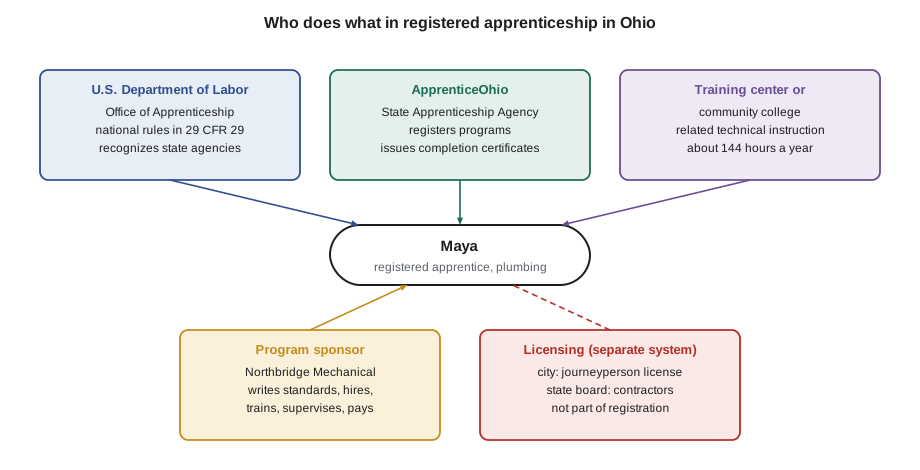
Apprenticeship in the United States has two layers that are easy to confuse. The first is registered apprenticeship, a national system set up under the National Apprenticeship Act of 1937 and run by the U.S. Department of Labor together with state agencies. The second is licensing, which states and cities control separately. A registered apprenticeship can help you qualify for a license, but finishing one does not license you, and many people learn trades in apprenticeships that are not registered at all. This lesson explains registered apprenticeship as it works in Ohio, where Maya is an apprentice.
Who does what in Ohio
Three groups share the work in Ohio. The U.S. Department of Labor's Office of Apprenticeship sets the national rules, found in Title 29 of the Code of Federal Regulations, part 29, and decides which states can run their own systems. Ohio is one of the states that has a State Apprenticeship Agency recognized by the Department of Labor: ApprenticeOhio, in the Ohio Department of Job and Family Services, registers programs, approves their standards and issues completion certificates on the state's behalf. In states without their own agency, the federal Office of Apprenticeship does this directly. And sponsors, who may be single employers, groups of employers, unions working with employers, or industry associations, run the programs, hire the apprentices and provide the training.
What registration means
A registered apprenticeship is one whose standards have been approved by the Department of Labor or a State Apprenticeship Agency. Registration means the program meets national requirements: a written plan of on-the-job learning, related technical instruction, a schedule of wage increases, supervision by experienced workers, safety training and a written agreement with each apprentice. Apprentices who finish receive a Certificate of Completion, a nationally recognized credential. Registration does not make a trade compulsory or licensed. Whether you need a license to do electrical or plumbing work depends on where you work; lesson 8 covers licensing.
Unregistered apprenticeships are common, especially with smaller contractors. Many tradespeople learn on the job under an informal arrangement and later qualify for a license through documented experience. That route works, but registration brings advantages: a structured training plan, a credential recognized across the country, guaranteed wage progression, eligibility for some funding and, on federally funded projects that require prevailing wages, the right to be paid at apprentice rates rather than full journeyworker rates.
How a registered program is structured
A registered program combines on-the-job learning with related technical instruction. Under 29 CFR part 29, a program can use one of three approaches. A time-based program requires a set number of hours of on-the-job learning, at least 2,000. A competency-based program requires the apprentice to demonstrate specific skills, with on-the-job learning still part of the program. A hybrid program combines a minimum and maximum range of hours with demonstrated competencies. Related technical instruction, often delivered in evening or day classes at a training center or community college, is recommended to be at least 144 hours for each year of the program. Plumbing and electrical programs typically run four to five years.
Most programs share a few common features: a written agreement between the apprentice and the sponsor, a schedule of wage increases as the apprentice progresses, a ratio of journeyworkers to apprentices so each apprentice is properly supervised, a probationary period at the start and a record of hours and skills. The details are covered in lessons 3 to 6.
| Feature | Registered apprenticeship (Ohio) |
|---|---|
| Registers apprentices | ApprenticeOhio, as Ohio's State Apprenticeship Agency |
| Sets training standards | The sponsor writes standards; the registration agency approves them |
| Classroom training | Related technical instruction, recommended 144 hours a year |
| Completion | Certificate of Completion from the registration agency |
| Right to work in the trade | Set by state and local licensing, separate from apprenticeship |
Federal and state roles
The federal government's role has grown and shifted over time. In April 2025, an executive order set a goal of reaching one million new active apprentices, and the Department of Labor has since issued guidance and funding aimed at expanding registered apprenticeship into more industries and making it easier for employers to start programs. In 2025, the Department also withdrew a large 2024 proposal to overhaul the apprenticeship rules and proposed replacing most of the detailed equal opportunity requirements in 29 CFR part 30 with a general requirement to follow federal and state anti-discrimination laws. Rules in this area change, so check the current version with your registration agency.
Each state also has its own approach. In states with a State Apprenticeship Agency, such as Ohio, the state registers programs and can add its own requirements. In other states, the federal Office of Apprenticeship registers programs directly. Either way, a Certificate of Completion from a registered program is recognized nationally, which matters if you move.
How Maya's apprenticeship is set up
Maya is registered in Northbridge Mechanical's plumbing apprenticeship program, a time-based program registered with ApprenticeOhio. Her apprenticeship agreement lists her start date, her wage schedule, the hours of on-the-job learning and related instruction required and the journeyworker-to-apprentice ratio. Luis signs her monthly log of hours and work processes, and she takes evening classes at a training center twice a week from September to April. When she finishes, she will receive a Certificate of Completion and can apply to take the journeyperson plumber exam required in Columbus.
The program below shows how the parts of a typical four-year apprenticeship add up. The hours are illustrative; your trade's standard sets the real numbers.
# how the hours in an invented four-year registered apprenticeship add up
years = 4
ojl_per_year = 2000          # on-the-job learning hours per year (time-based program)
rti_per_year = 144           # related technical instruction hours per year (recommended minimum)
ojl = years * ojl_per_year
rti = years * rti_per_year
total = ojl + rti
print(f"on-the-job learning: {ojl} h ({ojl / total:.0%} of the program)")
print(f"related technical instruction: {rti} h ({rti / total:.0%})")
print(f"evening classes needed per year at 2 nights x 3 h: {rti_per_year / 6:.0f} nights")on-the-job learning: 8000 h (93% of the program) related technical instruction: 576 h (7%) evening classes needed per year at 2 nights x 3 h: 24 nights
The numbers make a point that surprises many new apprentices: classroom instruction is a small share of an apprenticeship. Most of what you learn, you learn on the job, so the quality of your sponsor and your journeyworker matters more than anything else in the program.
Where apprenticeship came from
Apprenticeship is one of the oldest ways of passing on skill. In medieval European towns, craft guilds controlled who could work in a trade. A boy, and occasionally a girl, was bound to a master for a fixed term of years, often seven, and lived in the master's household while learning. At the end of the term the apprentice became a journeyman, free to work for wages, and might eventually present a masterpiece to the guild to become a master. The words master, journeyman and masterpiece all come from that system.
Modern American apprenticeship took shape in the 1930s. Wisconsin passed the first modern state apprenticeship law in 1911, and in 1937 Congress passed the National Apprenticeship Act, often called the Fitzgerald Act, which created the national registration system that still exists. Building trades unions and contractors built joint training programs around it after the Second World War. Since then, registered apprenticeship has spread well beyond construction into manufacturing, health care, information technology and many other fields.
What has not changed is the core idea: you learn a skilled occupation mostly by doing it, under someone who already knows it, while being paid for your work. The paperwork, the classroom training and the exams have been added around that core to make sure the training is thorough and the result is recognized.
Questions to ask about any program
Before you sign up with a sponsor, it is worth asking a few questions about how the apprenticeship will work. A good sponsor will answer them readily.
- Is the apprenticeship registered, and can I have a copy of the agreement and the training standard?
- What range of work does the company do, and will I get experience in every area the standard requires?
- Who will supervise me day to day, and how many apprentices does each journeyworker supervise?
- How and when is school scheduled, and does the company help with school costs or tools?
- What is the wage schedule, and when do the increases happen?
- How are my hours reported, and how often will someone sign off my skills?
- What happens if work slows down and I am laid off partway through?
The answers tell you a lot about the sponsor. A company that keeps careful records, schedules school predictably and rotates apprentices through different kinds of work is usually a company that takes training seriously.
Your responsibilities as a registered apprentice
Registration gives you rights, and it also gives you responsibilities. Apprentices are expected to show up reliably and work safely, to attend and complete classroom training when scheduled, to keep their records of hours and skills accurate, to tell the registration office about changes such as a new employer, a new address or a long break, and to work toward certification within a reasonable time. An apprentice who stops attending school or disappears for months can have their registration canceled.
If something goes wrong, such as a sponsor that refuses to schedule school, does not pay the agreed wage or keeps you on one narrow task for years, the registration office is the place to go. It can explain your options, mediate disputes and, if needed, help you transfer to another sponsor without losing the hours you have already earned.
Other routes into a trade
Registered apprenticeship is one route into a trade, but it is not the only one. Many licensing boards accept documented work experience instead of a completed apprenticeship, usually measured in years and hours of work in the trade. Community college programs in electrical, HVAC and plumbing technology can count toward experience requirements in some places. Workers trained in another country may be able to have their experience assessed, depending on the state or city. Each route has its own rules, so check with the licensing body and the registration agency before you plan around one.
Whatever route you take, the skills are the same and so is the final test: you must be able to do the work safely and well, and in most regulated trades you must pass an exam to prove it. Apprenticeship's advantage is that it gives you a structured path, a guaranteed range of training and pay from the first day.
Luis sometimes tells Maya how different his own start was. He learned the trade in the late 1990s, when record keeping was a paper logbook in his truck and school was scheduled by phone call. Today Maya's hours go into an app, her skills are signed off on a tablet and she can check her progress whenever she likes. The structure is the same as it was for him: a sponsor, a journeyworker, a standard to meet, school in blocks and an exam at the end. What has changed is how easily she can see where she stands, and how quickly a problem with her records can be spotted and fixed.
Common mistakes
MistakeAssuming finishing an apprenticeship gives you a license.
InsteadLicensing is separate; check what your state and city require.
MistakeAssuming all apprenticeships are registered.
InsteadAsk whether the program is registered and get a copy of its standards.
MistakeThinking classroom training is most of the program.
InsteadMost of the learning happens on the job; choose your sponsor carefully.
MistakeNot keeping a copy of your agreement.
InsteadKeep copies of your agreement, standards and records in case you change employers or move.
Summary and key terms
- Registered apprenticeship is a national system under the National Apprenticeship Act and 29 CFR part 29; licensing is separate.
- In Ohio, ApprenticeOhio registers programs as the State Apprenticeship Agency; sponsors write standards, hire apprentices and train them.
- Programs can be time-based (at least 2,000 hours), competency-based or hybrid, with related instruction recommended at 144 hours a year.
- Every program combines on-the-job training with classroom training, a written agreement, wage progression, supervision ratios and records.
- Most learning happens on the job, so the sponsor and journeyworker matter most.
- Registered apprenticeship
- An apprenticeship whose standards are approved by the Department of Labor or a State Apprenticeship Agency.
- Sponsor
- The employer, group, union-employer committee or association that runs a registered program.
- State Apprenticeship Agency
- A state agency recognized by the Department of Labor to register programs in that state.
- Related technical instruction
- The classroom part of a registered apprenticeship, recommended at 144 hours a year.
- Certificate of Completion
- The nationally recognized credential issued when an apprentice finishes a registered program.
- 29 CFR part 29
- The federal regulation that sets the standards for registered apprenticeship programs.
Practice problems
Work each problem on paper first, then reveal the answer to check.
What law created the national registered apprenticeship system?
Show answer
The National Apprenticeship Act of 1937.
Name three things a registered program must have.
Show answer
Any three of: a written plan of on-the-job learning, related instruction, a wage schedule, supervision, safety training, a written apprenticeship agreement.
What are the three approaches a registered program can use?
Show answer
Time-based, competency-based and hybrid.
Roughly what share of an apprenticeship is classroom training?
Show answer
A small share, around a tenth or less of the total hours.
Does finishing a registered apprenticeship license you?
Show answer
No; licensing is set separately by states and cities.
Why does the choice of sponsor matter so much?
Show answer
Most of the learning happens on the job under the sponsor's journeyworkers.
Lesson quiz · 5 questions
Score 60% or more to complete this lesson.
Create a free account to save your progress, take quizzes and earn a certificate.