
TRD-107 · Lesson 12 of 12 · 19 min
Running your own business
Many tradespeople dream of running their own business: choosing their work, setting their prices and building something of their own. Many succeed. Many others discover that being an excellent plumber or electrician and running a profitable business are different skills, and that the business side, with its licenses, insurance, taxes, pricing, cash flow and customers, decides whether the company survives. This lesson walks through the main steps of starting and running a small trade business, following Grace Lin, Northbridge's service plumber, as she plans her own service company. It also draws together the threads of the whole course.
Is it the right time?
Before starting, Grace asked herself some hard questions. Am I fully certified, with enough experience to work alone on anything a customer might call about? Do I have the licenses or qualifications my business will need? Do I have savings to live on while the business builds up, and to buy a vehicle, tools and stock? Do I have customers or a way to find them? Am I prepared to spend evenings on quotes, invoices, bookkeeping and phone calls? Do I understand what it costs to run a business, not just to do the work?
Most advisers suggest that tradespeople work for a few years after certification before going out on their own, ideally in a role that exposes them to the business side: service work with customers, estimating, or running jobs. Grace had six years as a certified plumber, three of them in service, and had watched Northbridge's service manager price jobs and handle complaints. She also had a written plan and enough savings for six months of living costs.
Choosing a business structure
A small trade business in the United States is usually set up as a sole proprietorship, a partnership, a limited liability company (LLC) or a corporation. A sole proprietorship is the simplest: you and the business are legally the same and you report business income on your personal return. An LLC is a popular choice for small contractors because it separates the business's liabilities from your personal assets while keeping taxes relatively simple. In Ohio, LLCs and corporations are registered with the Secretary of State, and a sole proprietor using a business name registers a trade name. Most businesses with employees need a federal Employer Identification Number from the IRS. An accountant can help you choose.
Licenses, registrations and insurance
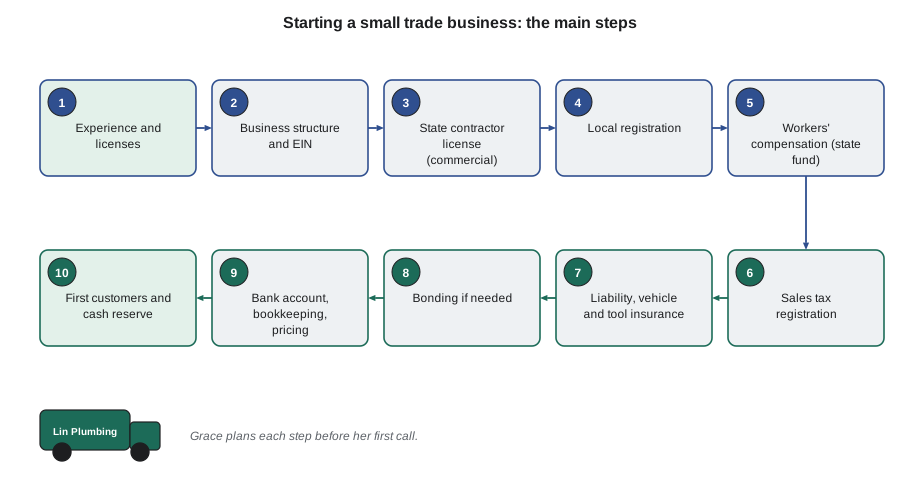
A trade business needs more than an individual license. The exact list depends on the trade and the place, but for a plumbing or mechanical business in Ohio it typically includes:
- A commercial contractor license from the Ohio Construction Industry Licensing Board if you will do commercial plumbing, HVAC, electrical, hydronics or refrigeration work. This requires at least five years of experience in the trade, supporting documents, a passing score on the exam, liability insurance and continuing education to renew.
- Local contractor registration or licensing in each city or county where you will work, such as Columbus's contractor registration, and individual licenses for the workers who need them.
- Workers' compensation coverage for employees. Ohio is one of a few states where most employers must buy coverage from the state fund, the Ohio Bureau of Workers' Compensation, rather than a private insurer.
- Registration with the Ohio Department of Taxation for sales tax where it applies, and an understanding of how sales tax applies to materials and labor in your type of work.
- General liability insurance, which covers damage or injury you cause to others' property or people; many general contractors and customers require proof of it before you start work.
- Vehicle insurance for business use, tool and equipment insurance, and possibly professional or errors-and-omissions coverage.
- Bonding, where required by contracts or by the place you work. A surety bond guarantees that you will complete work or pay what you owe; public and larger private jobs often require bid and performance bonds.
Residential work, home improvement and new home building have their own registration and consumer protection rules in many cities and states. Requirements change, so check with each authority before you start.
Pricing your work
The most common reason small trade businesses fail is underpricing. A new business owner who charges what they earned per hour as an employee is losing money, because the price must also cover everything the employer used to pay: the vehicle, tools, insurance, licenses, office costs, phone, software, advertising, accounting, unpaid time spent quoting and traveling, holidays, benefits and taxes, plus a profit for the risk of running the business. A useful starting point is to work out your overhead for a year and your billable hours, then build an hourly rate that covers both and leaves a profit.
Billable hours are the hours you can actually charge a customer for. A service plumber working alone might be at work 2,200 hours a year but bill only 1,200 to 1,400 of them, because the rest goes to driving, picking up parts, quoting, paperwork, callbacks and slow days. Using total hours instead of billable hours is a classic pricing mistake.
# work out a break-even and target hourly rate for a one-person service business (invented figures)
overhead = {  # yearly costs of running the business
    "van (payments, fuel, maintenance)": 18000, "insurance (liability, vehicle, tools)": 6500,
    "licenses, registrations, training": 2500, "phone, software, website, advertising": 7000,
    "accounting and bank fees": 3500, "tools and small equipment": 4000, "office and storage": 4800,
}
owner_pay = 85000          # what the owner wants to earn, before personal tax
benefits_and_retirement = 9000
billable_hours = 1300      # hours actually charged to customers in a year
profit_margin = 0.10       # profit for risk and growth, as a share of the price
costs = sum(overhead.values()) + owner_pay + benefits_and_retirement
break_even = costs / billable_hours
target = break_even / (1 - profit_margin)
print(f"yearly overhead {sum(overhead.values()):,} + owner pay and benefits {owner_pay + benefits_and_retirement:,}")
print(f"break-even rate: {break_even:.2f} per billable hour")
print(f"target rate with {profit_margin:.0%} profit: {target:.2f} per billable hour")yearly overhead 46,300 + owner pay and benefits 94,000 break-even rate: 107.92 per billable hour target rate with 10% profit: 119.91 per billable hour
Material is usually priced separately, with a markup that covers the cost of ordering, picking up, storing, handling returns and warranty. Many service businesses use flat-rate pricing for common jobs, such as replacing a toilet or a water heater, built from the time the job typically takes, the materials and the hourly rate. Flat rates are easier for customers to understand and reward efficiency, but they must be calculated carefully and updated as costs change.
Quotes, contracts and getting paid
Put every job in writing. A good quote describes the work, what is included and excluded, the price or how the price will be calculated, the timeline, payment terms and how changes will be handled. For larger jobs, a written contract is essential. For changes during a job, get written approval before doing the extra work, as covered in TRD-106. Clear paperwork prevents most disputes and makes the rest easier to resolve.
Cash flow, the timing of money in and out, sinks more small businesses than lack of profit. Material and wages must be paid before customers pay you. On construction projects, owners and general contractors often hold back retainage, commonly 5 to 10 percent of each payment, until the job is complete. Ohio's mechanic's lien law protects contractors and suppliers who are not paid, but it has strict notice and filing deadlines. A service business paid at the end of each call has fewer cash flow problems than one doing large jobs on credit.
Keep business and personal money separate, with a business bank account. Use bookkeeping software or an accountant from the start, keep every receipt, invoice customers promptly and follow up on late payments. Set money aside each month for taxes, so that a tax bill does not arrive as a surprise.
Finding customers and building a reputation
Most trade businesses grow by reputation: satisfied customers recommend you to friends, and builders and property managers call you back. That makes the customer service habits from TRD-106 central to the business: showing up when you said you would, protecting the customer's home, explaining the work and the price clearly, cleaning up and standing behind your work. A simple website, a business listing with accurate hours and service area, a clean, marked van and prompt replies to calls and messages all help new customers find and trust you.
Grace planned to start with service and small renovation work in neighborhoods she knew, to rely on referrals from customers she had served at Northbridge where that was allowed, and to build relationships with two property management companies. She decided not to take on new construction work for the first year, because it would tie up cash in material and long payment terms.
Hiring and training
Many trade businesses grow to the point where the owner needs help. Hiring brings new obligations: payroll, deductions, workers' compensation, employment standards, safety programs and training. It also brings the chance to train apprentices yourself, which is how the trades renew themselves. A small business that sponsors an apprentice gets a worker who learns its way of working and, with the employer supports covered in lesson 10, can be affordable. Grace planned to hire a first-year apprentice in her second year, if the business was steady by then, and to train them the way Luis trained Maya.
Putting the course together
This course has followed the business side of a trades career from start to finish. You choose a trade by matching it to yourself and reading the job market. You find a sponsor and register your apprenticeship, with an agreement that sets your wages and protects your rights. You keep careful records of hours and skills, complete your classroom training, and prepare for and pass your exam. Your license lets you work, and reciprocity or recognition laws can help you move. You choose between union and non-union paths, pay for your training with wages, grants, loans and smart budgeting, and then choose where your career goes next, perhaps all the way to your own business. At every step, the same habits matter: keep records, ask questions, plan ahead and do the work well.
| Business task | What it involves | Common mistake |
|---|---|---|
| Structure and registration | Sole proprietor, LLC or corporation; registration and EIN | Not getting advice on liability and tax |
| Licenses and insurance | Trade, contractor and local licenses; liability, vehicle and tool insurance; bonding | Starting work before coverage is in place |
| Pricing | Overhead plus owner pay over billable hours, plus profit; material markup | Charging an employee's hourly wage |
| Quotes and contracts | Written scope, price, terms and change process | Doing extra work on a verbal request |
| Cash flow | Payment timing, retainage, lien rights, tax set-asides | Taking large jobs on credit too early |
| Reputation | Reliable service, clear communication, standing behind work | Neglecting calls and callbacks when busy |
A word on risk
Running a business means accepting risk: slow months, customers who do not pay, jobs that go wrong, equipment that breaks. Insurance, written contracts, a cash reserve and careful pricing reduce the risk but cannot remove it. Many tradespeople find the independence worth it; others find they prefer the security of a steady wage and benefits. There is no wrong answer, and many people try both over a career.
Common mistakes
MistakePricing at your old hourly wage.
InsteadBuild a rate from overhead, owner pay and benefits, billable hours and profit.
MistakeUsing total hours instead of billable hours.
InsteadCount only the hours you can actually charge customers for.
MistakeStarting work before licenses and insurance are in place.
InsteadGet registrations, coverage and any bonds sorted first.
MistakeMixing business and personal money.
InsteadOpen a business account and keep books from day one.
MistakeTaking on large credit jobs too early.
InsteadStart with work that pays promptly and build a cash reserve.
Summary and key terms
- Starting a trade business takes certification, experience, savings, a plan and willingness to run the business side.
- Choose a structure (sole proprietorship, LLC or corporation), register with the state and get an EIN if needed.
- Get the contractor licenses, local registrations, workers' compensation, sales tax registration, insurance and any bonding your work requires.
- Price from overhead, owner pay and benefits, billable hours and profit; underpricing is the most common failure.
- Put quotes, contracts and changes in writing; manage cash flow, separate business money and set aside tax.
- Grow through reputation, and consider training apprentices as the business grows.
- Sole proprietorship
- A business owned by one person, legally the same as the owner.
- LLC
- A limited liability company, which separates business liabilities from the owner's personal assets.
- Overhead
- The costs of running a business that are not tied to a single job.
- Billable hours
- Hours that can actually be charged to customers.
- Retainage
- A share of each construction payment held back until the job is complete.
Practice problems
Work each problem on paper first, then reveal the answer to check.
Give three questions to ask yourself before starting a business.
Show answer
Any three of: Am I fully qualified and experienced? Do I have the licenses? Do I have savings? Do I have customers? Am I ready for paperwork? Do I understand the costs?
List four registrations or coverages an Ohio plumbing business typically needs.
Show answer
Any four of: OCILB contractor license for commercial work, local registration, workers' compensation, sales tax registration, liability insurance, vehicle and tool insurance, bonding.
Why is charging your old hourly wage a mistake?
Show answer
The price must also cover overhead, unpaid time, benefits, taxes and profit.
In the pricing program, what happens to the rate if billable hours fall from 1,300 to 1,100?
Show answer
The break-even and target rates rise, because the same costs are spread over fewer hours.
Why do cash flow problems sink profitable businesses?
Show answer
Costs must be paid before customers pay, so a business can run out of cash even when its jobs are profitable.
How do most trade businesses grow?
Show answer
Through reputation: reliable service and referrals from satisfied customers and repeat clients.
Lesson quiz · 5 questions
Score 60% or more to complete this lesson.
Create a free account to save your progress, take quizzes and earn a certificate.