
TRD-107 · Lesson 6 of 12 · 19 min
Related technical instruction: classes and study
On-the-job learning teaches you how the work is done. Related technical instruction teaches you why: the theory, codes, calculations and science behind the work, plus skills that are hard to practice safely on a live site. Most registered construction programs deliver it in evening or day classes at a training center or community college, typically a few hours a week through the school year, for every year of the apprenticeship. This lesson explains how the classes work, how to fit them around a full-time job, how they are paid for and how to get the most out of them.
How the classes work
Each registered program sets out what is taught in each year of related instruction, often following a curriculum developed by a national training organization for the trade, such as the union training trusts or contractor association curricula. In plumbing, the first year typically covers safety, tools, materials, math and basic code; later years go deeper into code, drainage and water systems, fixtures, gas, design calculations and preparation for licensing exams. Classes usually include tests, and you must pass each year to progress.
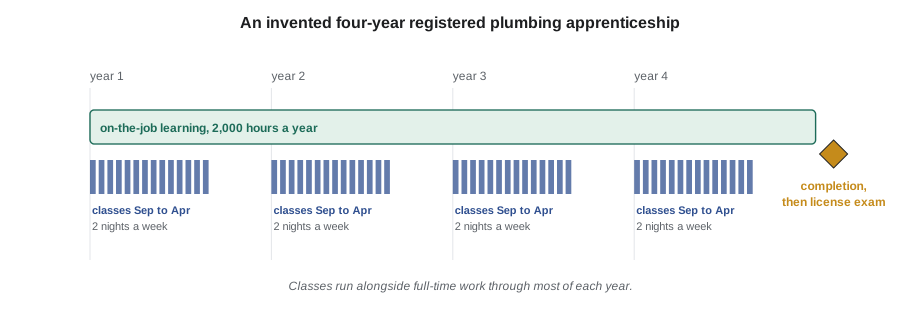
Many programs hold classes two evenings a week from late summer to spring, for a total of at least 144 hours a year. Others use day classes, a week or two of full-time instruction a few times a year, or online theory with in-person labs. Some programs pay apprentices for class time or require it on work days; most do not. Community college programs linked to apprenticeships may also award college credit, and some apprentices finish with an associate degree as well as their Certificate of Completion.
Why in-school training matters
Some apprentices treat school as time away from real work. That is a mistake. The code knowledge, calculations and theory you learn in school are exactly what the certification or licensing exam tests, and they are what separate a journeyworker who can solve unusual problems from one who can only repeat what they have seen. On Kingsway Tower, Luis is the person the crew asks when a fixture layout does not meet code or when a pipe size looks wrong on the drawings. He says he learned most of that in school and in the years he spent reading the code book after hours.
School also gives you hands-on practice that is hard to get on a busy site: making joints in materials your employer does not use, wiring circuits you would not be allowed to touch live, running tests and diagnosing faults on training rigs. And it puts you in a room with apprentices from other companies, who see different kinds of work. Those classmates often become the network that helps you find work later.
Preparing for school
- Review the math. Most in-school programs assume you can work with fractions, decimals, percentages, areas, volumes and basic algebra. TRD-102 covers it.
- Get your code book early and learn how it is organized. Tab the sections you use most.
- Ask your journeyworker what the level covers and practice those tasks on the job before you go.
- Sort out your schedule with your foreman and family before classes start, especially if your site works overtime.
- Plan your travel and, if the school is far away, your accommodation. Some apprentices travel hours each way or stay near the college for the block.
- Tell your family and friends what the schedule will be. A block of full-time study after months of physical work is tiring in its own way.
Fitting classes around work
Evening classes after a full day of physical work are hard. Apprentices who succeed usually treat class nights as fixed appointments: they tell their foreman early, avoid scheduling overtime on those nights when they can, eat before class, and do a little review on non-class nights rather than cramming before tests. If your site has long overtime or travel, talk to your program coordinator; many programs have make-up options or online material for missed sessions, but they have limits, and missing too many classes can delay your progress or end your enrollment.
The program below compares income during a school period with expenses, to show whether there is a gap to plan for. The figures are invented; use your own.
# weekly time budget for an apprentice with two evening classes (invented figures)
work = 5 * 9.5            # work days including travel
classes = 2 * 3.5         # two class nights including travel
study = 3                 # review on non-class nights and weekends
sleep = 7 * 7.5
meals_chores = 7 * 2.5
total = work + classes + study + sleep + meals_chores
free = 7 * 24 - total
print(f"work {work} h, classes {classes} h, study {study} h, sleep {sleep} h, meals and chores {meals_chores} h")
print(f"left for everything else: {free:.1f} h a week ({free / 7:.1f} h a day)")work 47.5 h, classes 7.0 h, study 3 h, sleep 52.5 h, meals and chores 17.5 h left for everything else: 40.5 h a week (5.8 h a day)
If the numbers look tight, plan for it: protect sleep, keep class nights clear, and use weekends for longer study sessions before tests. Classes are one of the main places apprentices fall behind, and falling behind delays both raises and completion.
Getting the most out of school
Treat school like a job. Arrive on time, take notes, and ask questions. Study a little each day rather than all at once before tests. Form a study group with classmates from other companies; explaining something to someone else is one of the best ways to learn it. Pay special attention to code and calculations, because they are hardest to pick up on the job and most heavily tested in exams. Ask instructors about anything you have seen on site that did not make sense.
Connect what you learn back to the job. When Maya studied drainage sizing in her basic level, she copied the fixture unit table into her notebook and, back on Kingsway Tower, added up the fixture units on a few of the stacks she had worked on to see whether the pipe sizes on the drawings matched. They did, and Luis was impressed enough to start asking her to check sizes on new layouts.
| Before school | During school | After school |
|---|---|---|
| Review math and code book | Attend every class and take notes | Use new knowledge on the job |
| Arrange income and travel | Study a little every day | Keep your notes and textbooks |
| Practice likely tasks on site | Join or form a study group | Check your wage step and records |
| Plan dates with your foreman | Ask about anything unclear from site | Plan the next level or year |
If you struggle
Many apprentices find school harder than they expected, especially if they had a hard time in high school or have been out of school for years. That is common and fixable. Ask instructors for help early, not the week before a test. Colleges and training centers usually offer tutoring, math refreshers and support for learning disabilities, test anxiety and language needs. If you fail a test or a level, find out exactly what you missed, get help with those areas and try again; most systems allow retakes. Apprentices who ask for help early almost always get through.
Learning the code book
For many trades, the code book is the most important book in your training. Plumbers work to the plumbing code adopted where they work, often based on a model code such as the International Plumbing Code or the Uniform Plumbing Code; electricians to the National Electrical Code as adopted by the state or city; gas fitters to the fuel gas code. Ohio adopts its own plumbing and mechanical codes based on model codes. These books are long, cross-referenced and written in precise language, and licensing exams test your ability to find and apply the right rule quickly.
Start by reading the table of contents and the definitions section, because many questions turn on the exact meaning of a word. Learn how the book is numbered and how exceptions and tables are laid out. Tab the sections you use most, with your instructor's guidance on what tabs are allowed in exams. Then use the book on the job: when your journeyworker tells you a rule, ask where it is in the code and look it up together. Over time you will remember where things are, which is what speeds you up in the exam.
Codes change. New editions come out every few years, and the edition that applies is the one adopted in your area at the time of the permit or the exam. Make sure you are studying the right edition, and when a new one comes out, find out what changed in the sections you use.
Hands-on labs
Most programs include shop or lab time where you practice skills under an instructor. Labs are a chance to make mistakes safely, to try materials and methods your employer does not use and to get feedback from someone whose job is to teach. Treat lab projects as real work: measure carefully, keep your area clean, follow the safety rules and ask the instructor to check your work before you move on. Employers notice apprentices who come back from school with sharper skills.
Labs also prepare you for practical exams, which some trades and licensing bodies include alongside written tests. A practical exam asks you to complete a task, such as installing and testing a section of piping, wiring a control circuit or diagnosing a fault, within a time limit and to a standard. The habits you build in labs, working neatly, checking your work and following procedure, are exactly what practical examiners look for.
Online and hybrid training
More programs now deliver theory online, with in-person sessions for labs and tests. Online learning is flexible, but it demands self-discipline. Set fixed times for online work as you would for a class, keep a quiet place to study, and do the practice questions rather than just reading. If you fall behind, contact the instructor early; it is much easier to catch up after one missed week than after five. Many programs also track online activity, so instructors can often see who is falling behind before you say anything.
Sam Torres took the theory part of his last year of electrical classes in a hybrid format. He blocked off two evenings a week at the kitchen table, did every practice question twice and kept a list of the code sections that tripped him up. When the in-person lab sessions came around, he arrived with questions ready, and the instructor used several of them to start the class. By the end of the year his list of tricky code sections had become his main study sheet for the licensing exam, and he said the habit of writing down what confused him was worth more than any single lesson.
Common mistakes
MistakeTreating school as time off from real work.
InsteadSchool teaches the theory and code the exam tests and the job depends on.
MistakeLeaving money planning until the block starts.
InsteadApply for income support and loans early and plan for any gap.
MistakeCramming before tests.
InsteadStudy a little every day and use a study group.
MistakeIgnoring the code book until the exam.
InsteadGet it early, learn its layout and use it on the job.
MistakeHiding problems until you fail.
InsteadAsk for help early; tutoring and support are usually available.
Summary and key terms
- Most registered programs deliver related instruction in evening or day classes, at least 144 hours a year.
- School teaches theory, code and calculations and gives hands-on practice that is hard to get on site.
- Prepare by reviewing math and code, practicing likely tasks and planning travel and schedule.
- Fitting classes around full-time work takes planning: protect class nights, sleep and regular review.
- Study a little every day, use study groups and connect school learning back to the job.
- If you struggle, ask for help early; tutoring and support are usually available.
- Related technical instruction
- The classroom part of a registered apprenticeship, often evening classes.
- Training center
- A school run by a union-employer committee or association for its apprentices.
- Curriculum
- The planned content of each year of related instruction.
- College credit
- Credit toward a college certificate or degree earned through apprenticeship classes.
- Make-up session
- A way to catch up on missed class material, within limits set by the program.
Practice problems
Work each problem on paper first, then reveal the answer to check.
How is related instruction usually delivered?
Show answer
In evening or day classes through the school year, at least 144 hours a year.
Give two reasons school matters even for a skilled apprentice.
Show answer
Any two of: it teaches the theory and code the exam tests, it gives hands-on practice hard to get on site, it builds a network.
Name three things to do before school starts.
Show answer
Any three of: review math, get the code book, practice likely tasks, arrange money, plan travel, tell family the schedule.
How can you keep up with classes during overtime-heavy periods?
Show answer
Tell your foreman early, protect class nights, use make-up options within limits and review between classes.
What is a good way to study code and calculations?
Show answer
Study a little every day, use the code book on the job and work through problems with a study group.
What should you do if you fail a test?
Show answer
Find out exactly what you missed, get help with those areas and retake it.
Lesson quiz · 5 questions
Score 60% or more to complete this lesson.
Create a free account to save your progress, take quizzes and earn a certificate.