
TRD-107 · Lesson 3 of 12 · 19 min
Finding an employer sponsor and getting registered
You cannot be an apprentice on your own. An apprenticeship is a relationship between you and an employer, or a group of employers, who agrees to hire you, train you and pay you while you learn. Finding that sponsor is often the hardest step, harder than any exam you will write later. This lesson covers who sponsors apprentices, how to find and approach them, what they look for, and the paperwork that turns a job into a registered apprenticeship.
Who sponsors apprentices
Sponsors come in several kinds. A single employer, like Northbridge Mechanical, may hire and train its own apprentices. A group of employers may share a program through an association, so that small contractors who cannot run a program alone can still train apprentices. A union and a group of unionized employers may run a joint program through a training center, in which the apprentice is dispatched to different employers over the course of the apprenticeship. And in some cases, a college or training organization helps match apprentices with employers.
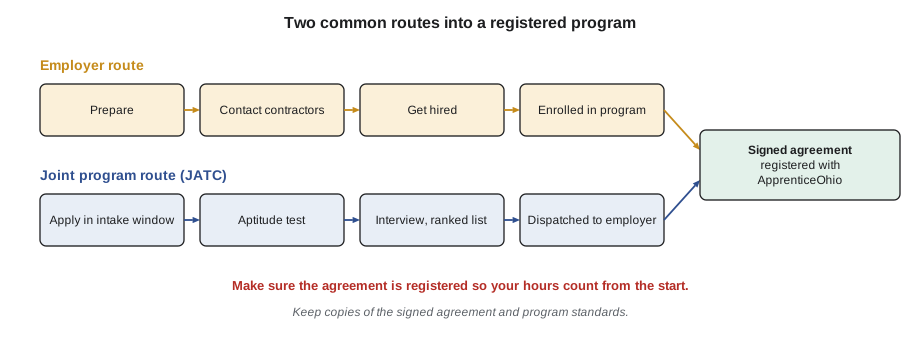
In a registered program, the sponsor is the organization whose program standards are registered: a single employer, a group of employers, a joint apprenticeship training committee made up of union and employer representatives, or an industry association. Apprentices are hired by participating employers, and the program standards set out how they are selected, supervised and trained. Union programs typically run through a joint apprenticeship training committee (JATC) and its training center; non-union programs are often run by contractor associations such as Associated Builders and Contractors, Independent Electrical Contractors or the Plumbing-Heating-Cooling Contractors Association.
Preparing before you apply
Sponsors take on an apprentice expecting to invest years of training. They look for signs that the investment will pay off: reliability, a willingness to learn, basic skills and a safe attitude. You can show those signs before you ever walk into an interview.
- Finish school or get the equivalent. Many trades and programs require a high school diploma or equivalent, often with particular courses such as math, English or science. Check the requirements for your trade.
- Strengthen your math. Trade work depends on fractions, measurement, geometry and basic algebra. TRD-102 covers trade math; doing it before you apply makes a real difference.
Get basic safety training. An OSHA 10-hour construction course, first aid and CPR show an employer you take safety seriously and save them time. TRD-101 covers construction safety.
Get a driver's license and reliable transportation. Sites move, start early and are often far from transit.
- Buy basic tools and boots once you know the trade. Your sponsor or school will tell you what the starter kit should include; TRD-104 covers tools.
- Keep your online presence clean. Employers do look.
Write a short resume that focuses on what a contractor cares about: any construction, maintenance, farm, warehouse or mechanical work; safety training and certificates; your driver's license; school courses in math, shop or technology; and a line about why you want this trade. One page is plenty. Add two references who can speak to your reliability, such as a former supervisor, coach or teacher.
Finding a sponsor
There is no single place where apprenticeships are posted. Successful apprentices usually use several channels at once and keep a simple record of who they contacted and when.
Direct contact. Call or visit contractors in your trade, especially smaller ones, and ask whether they hire apprentices. Visit active job sites at a sensible time, such as the end of the day, and ask for the foreman or superintendent.
Job boards and employer sites, plus apprenticeship.gov's apprenticeship finder, which lists registered openings by trade and location, and Ohio's state apprenticeship site.
Joint apprenticeship training committees. Union programs accept applications during set intake periods, often once or twice a year, and use aptitude tests and interviews to rank applicants.
American Job Centers and pre-apprenticeship programs, which often connect graduates directly with registered programs.
Personal connections. Many apprentices, like Maya, get their first introduction through a relative, friend or teacher. There is nothing wrong with using a connection; you still have to prove yourself once you are hired.
The program below keeps a simple log of contacts and reminds you who to follow up with. A follow-up a week or two after a first contact is often what turns a maybe into a yes.
# a simple job-lead log with follow-up reminders
from datetime import date, timedelta
today = date(2026, 3, 16)
leads = [  # contractor, how contacted, date of last contact, status
    ("Harbour Plumbing", "phone", date(2026, 3, 2), "call back after the 15th"),
    ("Westline Mechanical", "site visit", date(2026, 3, 9), "left resume with foreman"),
    ("Union training center", "online", date(2026, 2, 20), "intake opens in April"),
    ("Ridge Heating", "email", date(2026, 3, 12), "no reply yet"),
]
FOLLOW_UP = timedelta(days=7)
for name, how, last, status in leads:
    due = last + FOLLOW_UP
    flag = "FOLLOW UP" if due <= today else f"wait until {due}"
print(f"{name:22s} {how:10s} last {last} {status:28s} {flag}")Harbor Plumbing phone last 2026-03-02 call back after the 15th FOLLOW UP Westline Mechanical site visit last 2026-03-09 left resume with foreman FOLLOW UP Union training center online last 2026-02-20 intake opens in April FOLLOW UP Ridge Heating email last 2026-03-12 no reply yet wait until 2026-03-19
Approaching a contractor
Whether you call, email or walk onto a site, a short, direct approach works best. Say who you are, what trade you want to apprentice in, what you bring (safety training, license, any relevant experience, willingness to work) and ask whether they are taking on apprentices or know someone who is. Leave a resume. Ask when it would be all right to check back. Then check back when you said you would.
When Maya visited Northbridge's office, she said: I'm looking for a plumbing apprenticeship. I've finished a pre-apprenticeship course, I have working at heights and first aid, and I have my license and a car. My cousin, who works in your service department, suggested I talk to you. Are you taking on first-year apprentices this spring? The office manager took her resume, and Dave Kowal called her two weeks later to come in for an interview.
The interview
A trades interview is usually short and practical. The foreman or owner wants to know whether you will show up, work safely, learn and get along with the crew. Arrive early, dressed for a site rather than an office, with your resume and certificates. Expect questions such as: Why this trade? What have you built or fixed? Have you worked outdoors or in physical jobs? How will you get to work for a 7 a.m. start? What would you do if you were asked to do something you thought was unsafe? Answer honestly and briefly. If you do not know something, say so and say how you would find out.
Union programs usually require an aptitude test, often in math and reading, before an interview, and then rank applicants on a list. Applicants are dispatched to employers in rank order as jobs open, so a high ranking matters. Some programs also give credit for veterans' service, pre-apprenticeship completion or prior experience.
Ask your own questions too. What kind of work does the company do? Who would you be working with? How does the company schedule school? Will you get a range of work across the training standard? A good sponsor is happy to answer.
Registering the apprenticeship
Once an employer hires you into its registered program, or a JATC accepts and dispatches you, you sign an apprenticeship agreement, and the sponsor registers it with ApprenticeOhio within a set time. The agreement includes your information, the occupation, the term of the apprenticeship, the wage schedule, the hours of on-the-job learning and related instruction, the probationary period and the sponsor's commitments. Once it is registered, your hours count toward completion and you can be enrolled in classes. Keep a copy of the signed agreement and the program standards.
Make sure you are registered as soon as you start. Hours worked before registration may not count, and on projects that require prevailing wages, only registered apprentices may be paid apprentice rates. If your employer delays, ask why; registration protects both of you.
| Step | What you do | What to keep |
|---|---|---|
| Prepare | Finish school requirements, safety training, license, resume | Copies of certificates and transcripts |
| Search | Contact contractors, check postings, apply to union or association programs | A log of contacts and follow-ups |
| Interview | Show reliability, safety and willingness to learn | Notes on what each employer offers |
| Get hired | Accept an offer as an apprentice | Your offer and pay information |
| Register | Sign the apprenticeship agreement; the sponsor registers it | Signed agreement and program standards |
| Start | Log hours and skills; schedule classes | Your logbook or records from day one |
If it does not work out at first
Many apprentices apply to dozens of employers before getting hired. If you are not getting offers, ask for feedback, add a pre-apprenticeship program or safety course, widen your search area, consider a related trade with more openings, or take a helper or laborer job with a contractor that trains apprentices and show what you can do. Persistence and reliability are exactly what sponsors are looking for, and many foremen remember the applicant who kept coming back politely.
Starting strong in your first weeks
Getting hired is the beginning, not the end. The first few weeks set the impression your crew will have of you for a long time. Arrive early with your tools, boots and lunch. Learn names quickly. Watch how the crew works before suggesting changes. Ask questions at sensible moments, and write down the answers so you do not ask the same thing twice. Keep your phone in your pocket unless you are using it for work. When you finish a task, tell your journeyworker and ask what is next instead of waiting to be found.
Most first-year apprentices spend a lot of time carrying material, cleaning up, fetching tools and doing simple, repetitive tasks. That is normal, and how you handle it matters. Apprentices who do the simple jobs well and cheerfully get trusted with harder work sooner. Luis told Maya on her first day that he had swept a lot of floors in his first year and had learned more about how a site runs from sweeping than he expected, because it put him everywhere.
Start your records on the first day too. Write down your hours, the work you did and who you worked with, even if your employer also keeps records. Lesson 5 covers logbooks in detail.
What the sponsor commits to
The relationship runs both ways. By registering, the sponsor commits to giving you the range of work the training standard requires, supervising you with qualified journeyworkers, paying you at least the agreed wage for each stage, releasing you to attend school and keeping accurate records of your progress. If a sponsor cannot meet those commitments, for example because it has no work in one area of the standard, it should help you get that experience elsewhere. Knowing what the sponsor has agreed to helps you have a calm, factual conversation if something is not happening.
Common mistakes
MistakeSending one resume and waiting.
InsteadUse several channels at once, keep a log and follow up.
MistakeTurning up to a site at the busiest time of day.
InsteadVisit near the end of the day and ask for the foreman.
MistakeStarting work without a registered agreement.
InsteadRegister as soon as you are hired so your hours count.
MistakeWriting a long, general resume.
InsteadKeep it to one page focused on safety training, license, physical or mechanical work and math.
MistakeTreating the interview as one-way.
InsteadAsk about the range of work, the crew and how school is scheduled.
Summary and key terms
- An apprenticeship needs a sponsor: an employer, group of employers, union-employer committee or association.
- Prepare with school requirements, math, safety training, a license and a short resume.
- Search through direct contact, job boards, union or association programs, public employment services and personal connections, and follow up.
- Interviews are short and practical; show reliability, safety and willingness to learn, and ask your own questions.
- Sign the apprenticeship agreement and make sure the sponsor registers it so your hours count.
- If offers are slow, add training, widen your search or start as a helper and prove yourself.
- Sponsor
- The organization whose registered program hires, trains and pays apprentices.
- Apprenticeship agreement
- The signed agreement between apprentice and sponsor, registered with the registration agency.
- JATC
- Joint apprenticeship training committee: a union and employer committee that runs a registered program.
- Intake
- The period when a program accepts applications.
- Aptitude test
- A test, often of math and reading, used by many programs to rank applicants.
Practice problems
Work each problem on paper first, then reveal the answer to check.
Name four kinds of sponsor.
Show answer
A single employer, a group of employers or association, a union-employer committee, a college or training organization helping to match.
List four things that make you more attractive to a sponsor before you apply.
Show answer
Any four of: school requirements finished, strong math, safety training, driver's license and transportation, basic tools, a short focused resume.
Why keep a log of contacts?
Show answer
So you follow up on time and do not lose track of leads.
What should a short approach to a contractor include?
Show answer
Who you are, the trade, what you bring, a question about apprentices, and a resume, then a follow-up.
Why register as soon as you start?
Show answer
Hours before registration may not count, and the agreement protects you and allows you to work in the trade.
Give two things to do if you are not getting offers.
Show answer
Any two of: ask for feedback, add training, widen the search area, consider a related trade, take a helper job.
Lesson quiz · 5 questions
Score 60% or more to complete this lesson.
Create a free account to save your progress, take quizzes and earn a certificate.