
TRD-107 · Lesson 10 of 12 · 18 min
Paying for your apprenticeship: wages, grants, loans and tax breaks
An apprenticeship is cheaper than most other routes into a skilled career, because you are paid while you learn. It is not free. There are tools to buy, school periods with reduced income, books, travel, exam fees and, in the early years, wages well below what you will earn later. Apprentices who plan their money well are much more likely to finish, and to finish on time. This lesson covers the costs, the supports available to apprentices and their employers, and how to build a simple budget for the years of your apprenticeship.
The costs
The main costs of an apprenticeship are predictable. Tools come first: most trades expect apprentices to bring a basic set of hand tools and add to it over time, and some employers give tool allowances. Work boots, clothing and some protective equipment are often the worker's responsibility, though employers must provide much of the safety equipment the job requires. Classroom training may involve tuition or fees, books and supplies. School periods may mean travel or temporary accommodation. Exams and certificates carry fees, and so do license renewals later. Finally, there is the opportunity cost: apprentice wages start well below journeyworker wages, and time in school may mean weeks with reduced income.
None of these is large on its own, but they add up, and they tend to arrive at awkward times, such as at the start of a semester when you have just bought books and tools. Knowing what support is available, and applying early, makes a big difference.
Federal and state supports for apprentices
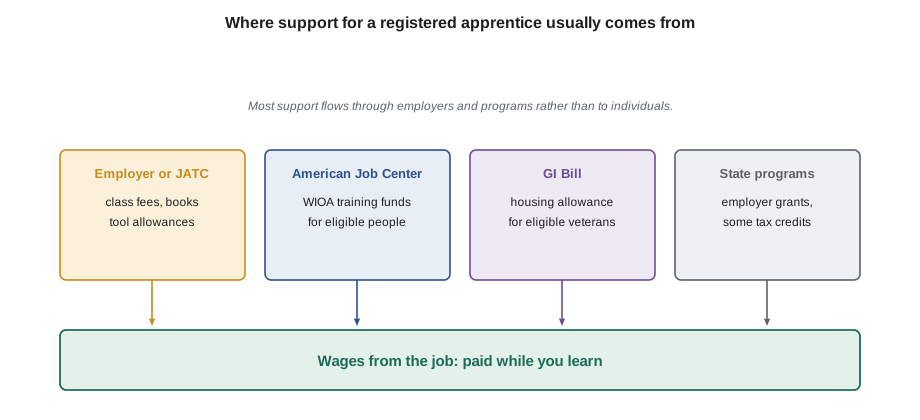
Support for apprentices in the United States comes from several sources, and most of it flows through programs rather than directly to individuals.
- Wages and employer support. The biggest support in a registered apprenticeship is the job itself: you are paid while you learn, and many employers or joint programs pay class fees and books.
- Workforce Innovation and Opportunity Act funding. American Job Centers can fund training costs, including pre-apprenticeship and related instruction, for eligible people, often through individual training accounts.
- GI Bill. Veterans in registered apprenticeships can use GI Bill benefits, including a monthly housing allowance that steps down as apprentice wages rise.
- Federal grants to programs. The Department of Labor funds states, sponsors and intermediaries to expand registered apprenticeship, which can mean lower costs, supportive services or free related instruction for apprentices in those programs.
- State programs. Many states, including Ohio, offer grants to employers that start or expand registered apprenticeships, and some offer tuition support or tax credits linked to apprenticeship. Ask your registration agency or local workforce office what is available.
Programs, amounts and eligibility change often and vary by state and region, so check the current rules before you count on any of them. Your program sponsor, training center or American Job Center can help you find and apply for support.
Support for employers
Some supports go to employers, which makes them more willing to hire apprentices. On federally funded construction, registered apprentices may be paid apprentice rates rather than full prevailing wages, which lowers the cost of training on those jobs. Some states give employers tax credits for each registered apprentice they employ, and many offer grants to start or expand programs. Knowing about these can help you when you approach a small contractor who is unsure whether they can afford an apprentice.
Tax breaks for tradespeople
Federal tax rules give employees little relief for work expenses: unreimbursed employee expenses, such as tools bought for your job, are generally not deductible on a federal return. That makes employer tool allowances and reimbursements especially valuable, and it is one reason to ask about them when comparing offers. Self-employed tradespeople can deduct business expenses, including tools, as lesson 12 explains. Education credits may apply to some tuition for college courses. Rules change, so check the IRS's current guidance or ask a tax preparer each year, and keep receipts.
Building a budget
A budget for an apprenticeship is a little different from a normal monthly budget, because income changes over time: it rises with each wage step and may dip during school periods. A simple approach is to plan a year at a time, with separate months for school periods. Start with take-home pay for working months, add any support during school months, and subtract regular expenses. Set aside money each working month for school months, tools and exam fees.
The program below builds a simple twelve-month budget for an invented first-year apprentice with an eight-week school block. It shows the months with a shortfall and how much to save each working month to cover them.
# a 12-month budget for an invented first-year apprentice with evening classes
take_home = 2700                 # monthly take-home pay
expenses = 2350                  # rent, food, phone, car, insurance
class_months = {"Sep", "Oct", "Nov", "Dec", "Jan", "Feb", "Mar", "Apr"}
class_costs = 60                 # gas and parking for class nights per month
lumps = {"Sep": 500, "Jan": 250, "Jun": 400}   # tools, books, boots
months = ["Sep", "Oct", "Nov", "Dec", "Jan", "Feb", "Mar", "Apr", "May", "Jun", "Jul", "Aug"]
balance = 0
for m in months:
    out = expenses + (class_costs if m in class_months else 0) + lumps.get(m, 0)
    balance += take_home - out
    print(f"{m}: in {take_home:5,} out {out:5,} net {take_home - out:6,} running {balance:7,}")
print("ends the year ahead" if balance >= 0 else "needs a plan for the shortfall")Sep: in 2,700 out 2,910 net -210 running -210 Oct: in 2,700 out 2,410 net 290 running 80 Nov: in 2,700 out 2,410 net 290 running 370 Dec: in 2,700 out 2,410 net 290 running 660 Jan: in 2,700 out 2,660 net 40 running 700 Feb: in 2,700 out 2,410 net 290 running 990 Mar: in 2,700 out 2,410 net 290 running 1,280 Apr: in 2,700 out 2,410 net 290 running 1,570 May: in 2,700 out 2,350 net 350 running 1,920 Jun: in 2,700 out 2,750 net -50 running 1,870 Jul: in 2,700 out 2,350 net 350 running 2,220 Aug: in 2,700 out 2,350 net 350 running 2,570 ends the year ahead
In this example the apprentice ends the year ahead, but the September and June purchases take most of the margin in those months. Planning lumpy costs ahead keeps them from becoming credit card debt.
Avoiding money traps
- High-interest debt. Tools, trucks and gadgets bought on credit cards or store financing can cost far more than their price. Buy the tools you need when you need them, and start with good-quality basics.
- The new truck. Many apprentices buy an expensive vehicle as soon as their wages rise. A reliable used vehicle is often the better choice until you are certified.
- Skipping school to keep earning. It feels like a gain, but it delays raises and certification and costs more over the long run.
- Ignoring retirement savings. Small contributions in your twenties grow for decades. If your employer or union has a pension or matching plan, join it.
- Not filing taxes. Filing every year is how you get refunds, credits and benefits you are entitled to, and some supports require it.
Maya's plan for her next block
Before her second year of classes, Maya sat down with her pay stubs and the program's information. Northbridge pays her class fees, but she needed a new code book and a set of meters her instructor recommended. She saved $100 from each pay for two months to buy them rather than putting them on a credit card, and asked Dave whether Northbridge had a tool allowance; it did, for apprentices who had completed their first year, and it covered half the cost of the meters. She kept her receipts in a folder. When classes started, she had no new debt.
| Cost | Possible support |
|---|---|
| Lost wages during school | Evening classes reduce lost wages; some employers pay for class time |
| Tuition and books | Employer or JATC payment, WIOA funds, GI Bill for veterans |
| Tools | Employer tool allowances or reimbursement |
| Travel and accommodation | Employer travel pay or per diem, GI Bill housing allowance for veterans |
| Exam fees | Sometimes paid by employers or programs |
| Completion | Higher wages and license-based opportunities |
Building good money habits early
The habits you build as an apprentice will follow you for decades. A few simple ones make a big difference. Pay yourself first: set up an automatic transfer to savings each payday, even a small one, before you spend anything. Keep an emergency fund that grows toward three months of expenses, because construction work can stop suddenly with a layoff, an injury or a slow season. Track your spending for a month or two to see where the money actually goes. And when your wage steps up, save part of each raise instead of spending all of it; you will barely notice the difference, and your savings will grow quickly.
Use the tax-advantaged accounts available to you. If your employer offers a 401(k) or similar plan with a match, contribute at least enough to get the full match; the match is part of your pay. An individual retirement account (IRA), including a Roth IRA, is useful once you have an emergency fund. If you are in a union with a defined benefit pension and an annuity fund, learn how they work and how your hours earn credit.
Credit and big purchases
Your credit history affects the interest you pay on vehicle loans, mortgages and business loans later. Pay every bill on time, keep credit card balances low and pay them off in full each month if you can, and avoid taking on several new debts at once. When you need a vehicle for work, compare the total cost of ownership, including insurance, fuel and maintenance, not just the monthly payment. A reliable used vehicle bought with savings and a small loan often leaves you far better off at the end of your apprenticeship than a new truck on a long loan.
Tools are an investment, but they can also become a habit. Buy good-quality basics, add specialized tools as you need them and as you learn which ones you actually use, and look after them. Ask your journeyworker which tools are worth paying more for and which ones you can buy at a lower price.
Finally, ask for help when you need it. Many unions, training centers, colleges and community organizations offer free financial literacy workshops, and some banks have staff who specialize in tradespeople and small business owners. A single hour with someone who can look at your whole picture, income that changes with wage steps and school periods, tool and vehicle costs, and savings goals, can save years of expensive mistakes.
Keep an eye on deadlines too. Programs funded through workforce agencies often have application windows and require paperwork before training starts, and GI Bill benefits must be set up with the program before payments begin. Employer tool allowances and reimbursements usually need receipts submitted within a set time. A missed deadline can mean losing money you were entitled to.
Common mistakes
MistakeAssuming support arrives automatically.
InsteadApply early; most supports need an application and proof.
MistakeCounting on a program without checking it is still open.
InsteadCheck current rules and dates; programs change.
MistakeBuying tools and trucks on high-interest credit.
InsteadSave for purchases and buy good basics as needed.
MistakeSkipping school to keep the paycheck.
InsteadSchool delays cost more over time than the weeks of reduced income.
MistakeThrowing away receipts.
InsteadKeep receipts for tools, travel, books and fees for tax time and claims.
Summary and key terms
- Apprenticeship is paid training, but tools, school periods, books, travel and exam fees still cost money.
- Support comes mainly through wages and employers, plus WIOA training funds, the GI Bill for veterans and state and federal grants to programs.
- Employer incentives make it easier for small contractors to hire apprentices.
- Employees generally cannot deduct tool costs federally, so tool allowances matter; keep receipts.
- Budget a year at a time, plan for school months and lumpy costs, and save during working months.
- Avoid high-interest debt, expensive vehicles early on and skipping school to keep earning.
- WIOA
- The Workforce Innovation and Opportunity Act, which funds training through American Job Centers.
- American Job Center
- A local public office that helps job seekers find work and training funds.
- GI Bill
- Education benefits for veterans that can be used in registered apprenticeships.
- Tool allowance
- An employer payment toward the cost of tools a worker must supply.
- Prevailing wage
- The wage rate required on publicly funded projects, with lower apprentice rates allowed for registered apprentices.
Practice problems
Work each problem on paper first, then reveal the answer to check.
List four costs of an apprenticeship besides lost wages.
Show answer
Any four of: tools, boots and clothing, tuition or fees, books, travel, accommodation, exam and certificate fees.
Where does most support for a registered apprentice come from?
Show answer
Wages and the employer or program, plus WIOA funds, the GI Bill for veterans and state or federal grants.
Why should you know about employer incentives?
Show answer
They can make a small contractor more willing to hire an apprentice.
In the budget program, which months need the most planning, and why?
Show answer
September and June, because of large purchases for tools, books and boots.
Name two money traps for apprentices.
Show answer
Any two of: high-interest debt, an expensive vehicle early, skipping school to keep earning, ignoring retirement savings, not filing taxes.
Why keep receipts?
Show answer
For tax deductions or credits, allowance claims and proof of costs.
Lesson quiz · 5 questions
Score 60% or more to complete this lesson.
Create a free account to save your progress, take quizzes and earn a certificate.