
ROOF-130 · Lesson 3 of 12 · 22 min
Removing old roofing
▶ Video coming soon A video version of this lesson is on the way.
Number 27 Linden Street was the house the crew had been dreading. From the ground it looked like any other house on the row: curling gray shingles and a sagging gutter. From the attic it was something else. Rory shone a light up between the rafters and saw daylight through gaps in the boards, and above the boards the undersides of old cedar shingles. "Two layers of asphalt over the original cedar," Wes said. "Spaced boards under the cedar. Every bit of it comes off, and the whole roof gets new sheathing."
Tear-off is the heaviest, dirtiest and most dangerous part of a re-roof. It is also where the quality of the new roof starts, because a clean, sound, dry deck is the only good base for new shingles. This lesson covers when the old roof must come off, how to plan and run a tear-off, how to handle the debris legally and safely, and how to protect the house, the neighbors and the crew.
Tear off or recover?
A recover, or overlay, means laying new shingles on top of the old ones. It is cheaper and faster, and there are times when it is allowed. But it has real costs: the deck cannot be inspected, the new shingles follow every bump in the old ones, the extra layer adds weight, the old roof holds heat that shortens the life of the new shingles, and many manufacturers reduce or refuse their warranty over an existing roof. The codes set limits:
- Under Section R908 of the Residential Code of Ohio, a recover is not allowed where the existing roof is water-soaked or so deteriorated that it is not a sound base, where it is wood shakes, slate, clay, cement or asbestos-cement tile, or where the roof already has two or more layers of covering. In those cases all existing layers must be removed down to the deck.
- Any roof with rot, soft deck or signs of leaks must come off, because those problems cannot be fixed from above an old roof.
- Old cedar shingles or shakes under asphalt, as at 27 Linden, are usually on spaced boards, which cannot hold shingle nails properly. They come off, and the roof is re-sheathed.
Ridgecap's policy is to tear off to the deck on every re-roof. It costs more on the day, but it lets the crew inspect and repair the deck, install ice barrier and underlayment properly, replace all the flashings and check the ventilation. The policy is written on every residential quote, so owners comparing prices know why.
| Recover (overlay) | Tear-off to the deck |
|---|---|
| cheaper and faster on the day | costs more for labor and disposal |
| deck hidden: rot and soft spots stay | deck inspected and repaired |
| old flashings often reused or buried | all flashings replaced |
| no new ice barrier under the old roof at the eave | new ice barrier and underlayment |
| bumps and curls telegraph through | flat, clean base |
| extra weight, more heat held in the shingles | normal weight and heat |
| often a shorter or reduced warranty | full manufacturer warranty possible |
Before the first shingle comes off
A tear-off is planned the day before. Wes's checklist for Crew 5:
- Weather: check the forecast for rain, wind and heat. Never open more roof than the crew can dry in (cover with underlayment) before the end of the day or before rain arrives.
- Hazardous materials: ask the owner about the age of the roof and any testing. Old roofing cements, felts and some shingles made before about 1980 can contain asbestos. OSHA's asbestos standard for construction, 29 CFR 1926.1101, covers removing it, including specific rules for roofing materials, and federal and Ohio EPA rules also apply to its disposal. If in doubt, stop and have it tested.
- Power lines: find the electrical service mast and any overhead lines. OSHA rules and Ridgecap's policy keep ladders, chutes and materials at least 10 ft from overhead lines up to 50 kV, and farther for higher voltages. The utility can drape or shut off the house service drop.
- Bin and access: book the disposal bin, and choose its spot so it can be loaded straight from the chute without blocking a neighbor's driveway. Put plywood or boards under the bin wheels to protect the driveway.
- Protection: tarps over gardens, shrubs, air conditioners and decks; plywood leaned over windows and doors below the work; gutters protected or removed if they are being replaced.
- Owner: tell the owner to move cars, take pictures off walls (the hammering shakes them), keep children and pets inside and cover belongings stored in the attic, because dust and granules fall through gaps in board decks.
- Fall protection: plan the anchor locations and ladder set-up for every slope.
Debris: never free-fall
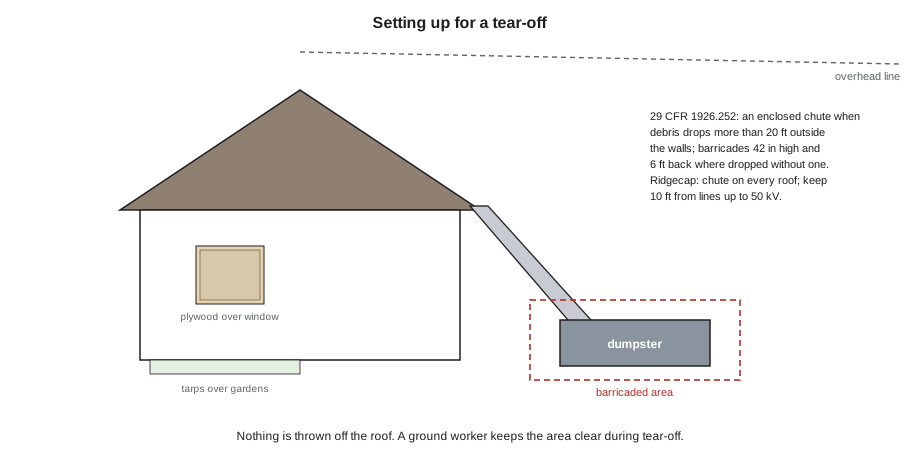
Rules on getting debris to the ground are strict, because a falling bundle of wet shingles can kill.
- Under 29 CFR 1926.252, debris dropped more than 20 ft to any point outside the exterior walls of the building must go down an enclosed chute. Where debris is dropped without a chute, the landing area must be enclosed with barricades at least 42 in high and at least 6 ft back from the edge above, with warning signs, and no one may work in it while dropping is going on. Scrap must be cleared from the work area as the work progresses.
- Ridgecap's rule on every house, whatever its height: nothing is thrown off the roof. Debris goes down a chute into the bin, or into the bin directly where a dump trailer or bin can be placed right under the eave with a short chute.
- On low roofs, a roofing trailer with a lift or a conveyor may be used instead.
The chute's top end is fastened at the eave with brackets, and a short hopper or a sheet of plywood guides debris into it. The bottom end hangs into the bin so debris cannot miss.
How much does it weigh?
Tear-off is heavy, and bins have weight limits. Ridgecap's working figures:
| Material torn off | Approximate weight per layer |
|---|---|
| Asphalt shingles with old felt and nails | about 225 lb per square (11 kg/m²) |
| Cedar shingles | about 150 lb per square (7 kg/m²) |
| Board or panel decking removed | about 200 lb per square (10 kg/m²) |
Worked problem
Bin weight for 27 Linden
The roof at 27 Linden is 1,206 ft² (12.06 squares). It has two layers of asphalt shingles over cedar shingles, and all the spaced boards come off too. The dumpster is rated for 8,000 lb (4 tons). Is one dumpster enough by weight?
Show solution
- Asphalt: 2 layers × 225 lb × 12.06 squares = 5,427 lb.
- Cedar: 150 lb × 12.06 = 1,809 lb.
- Boards: 200 lb × 12.06 = 2,412 lb.
- Total = 5,427 + 1,809 + 2,412 = 9,648 lb, about 4.8 tons.
Answer: No. At about 4.8 tons the load is over the 4-ton limit. Wes books a second, smaller dumpster for the boards, and the hauler swaps the first when it is full.
Running the tear-off
Crew 5 tears off one slope at a time, from the top down, so debris always moves downhill toward the chute:
- Set anchors and roof brackets for the slope. Lay a toe board or a row of brackets near the eave to catch debris and give footing.
- Remove ridge and hip caps, then old vents and pipe flashings that will be replaced.
- Starting at the ridge, slide a tear-off shovel (a flat, toothed spade) under the shingles and lever them up, nails and all, working down the slope in strips. Let the loosened material slide down to the eave and push it into the chute.
- Strip old step flashing, valley metal and drip edge. Keep any flashing that is built into a wall or chimney and is to be reused only if Wes says so.
- Pull or drive every remaining nail. A nail head left standing will punch through the new underlayment and shingles. Ridgecap pulls nails rather than driving them into board decks, because driven nails can split old boards.
- Sweep the deck clean of granules and debris, which make it slippery and can cause bumps.
- Inspect the deck (lesson 4), repair it, then dry it in with underlayment before moving to the next slope.
Never stand downhill of loose debris on a steep slope. A sheet of old shingles sliding on granules can take a worker's feet out from under them.
Worked problem
How much to open in a day
At 27 Linden, the south slope is 603 ft² and the north slope 603 ft². With three layers to strip, the crew tears off about 200 ft² an hour, then needs about 2 hours to re-sheathe and dry in each slope. They start at 7:00, and rain is forecast for 3:00 p.m. Can they open both slopes today?
Show solution
- South slope tear-off = 603 ÷ 200 = 3.0 h, so about 7:00 to 10:00.
- Re-sheathe and dry in: 2 h, to about noon.
- North slope tear-off: another 3.0 h, to about 3:00 p.m., then 2 h more to dry in, to about 5:00 p.m.
- Rain arrives at 3:00 p.m., while the north slope would still be open.
Answer: No. Open and dry in the south slope today, use the afternoon to finish the south slope details, and open the north slope tomorrow morning.
Drying in means the deck is covered and fastened well enough to keep rain out overnight. On a tear-off day, Ridgecap's crews always have rolls of underlayment and a few tarps on the roof before they start stripping.
Protecting people and property
- Ground crew: one person stays on the ground during tear-off to keep the area clear, watch the chute and bin, and stop anyone walking under the work. On a street like Linden, with houses close together, the barricade line may run along a neighbor's walk, so the neighbor is told the day before.
- Nails: a magnetic sweeper is run over the lawn, driveway and street at the end of every day and again at the end of the job. One nail in a car tire or a child's foot undoes a lot of goodwill.
- Dust and noise: tear-off is loud and dusty. Crew 5 wears hearing protection when using nailers and power tools, safety glasses all day, and dust masks or respirators when stripping dry, dusty material.
- Cuts and punctures: heavy gloves, long sleeves and boots with puncture-resistant soles. Old flashing edges are razor-sharp.
- Insects: old roofs often hide wasp nests under the shingles near the eaves. Look before lifting, and keep an epinephrine plan for anyone with a known allergy.
- Heat: tear-off is hard work. Water, shade and rest breaks follow Ridgecap's heat plan from ROOF-110.
Recycling old shingles
Asphalt shingles are mostly asphalt, glass fiber mat and mineral granules, and they can be recycled into paving asphalt and other products. Several facilities in Ohio accept clean tear-off shingles for recycling into paving, usually at a lower tipping fee than landfill. To qualify, the load must be shingles only: no wood, metal, plastic or garbage. On jobs near a recycler, Ridgecap uses a separate bin for clean shingles.
What 27 Linden showed
The tear-off took two days. Under the cedar, the crew found the 1920s spaced boards in good shape but far too open to hold shingle nails, and two short rafters split at old knots near the chimney. Wes stopped work on that bay and called the carpenter Ridgecap uses for framing repairs, who sistered both rafters before the new 5/8 in panels went on. Rory pulled what felt like ten thousand nails. "Nobody remembers the tear-off on a good roof," Wes said. "Everybody remembers it on a bad one."
Common mistakes
MistakeThrowing debris off the roof because the house is only one story.
InsteadLower debris by chute, container or hoist on every roof; nothing is thrown off.
MistakeOpening the whole roof first thing in the morning.
InsteadOpen only what can be dried in before the end of the day or before rain.
MistakeDriving old nails flush instead of pulling them.
InsteadPull nails, especially in board decks; a standing or driven head can punch through new roofing or split boards.
MistakeAssuming old roofing is safe to strip.
InsteadAsk about asbestos before work; stop and test when the material is old and unknown.
MistakeRecovering over a roof with two layers or a soft deck.
InsteadTear off to the deck when there are two or more layers, rot, water-soaked material or spaced boards.
Summary and key terms
- Ridgecap tears off to the deck on every re-roof so the deck, flashings, ice barrier and ventilation can all be done properly.
- Codes and manufacturers limit recovering; two or more layers, water-soaked or rotten roofs, and some materials always come off.
- Plan the weather, hazardous materials, power lines, bin, protection and fall protection before starting.
- Debris dropped more than 20 ft outside the walls must go down an enclosed chute under 29 CFR 1926.252; Ridgecap uses a chute on every roof.
- Tear off one slope at a time from the top down, pull every nail, inspect and repair the deck, and dry in before moving on.
- Estimate the tear-off weight so the bin is not overloaded.
- Recover
- Laying a new roof covering over an existing one.
- Tear-off
- Removing the old roof covering down to the deck.
- Dry in
- Cover an open deck with underlayment or other protection so it stays dry.
- Chute
- An enclosed slide that carries debris from the roof down to a bin.
- Tear-off shovel
- A flat, toothed spade used to lever old shingles and nails off the deck.
- Designated substance
- One of a list of hazardous substances, such as asbestos, that must be identified before construction work starts.
- Magnetic sweeper
- A rolling magnet used to pick up dropped nails from the ground.
Practice problems
Work each problem on paper first, then reveal the answer to check.
A roof of 10 squares has one layer of asphalt shingles. About how much does the tear-off weigh?
Show answer
10 × 225 = 2,250 lb, about 1.1 tons.
When does OSHA require an enclosed chute for debris?
Show answer
When debris is dropped more than 20 ft to a point outside the exterior walls.
How close may a chute come to a 13,800-volt overhead line?
Show answer
No closer than 10 ft.
Why are slopes torn off from the top down?
Show answer
So debris always moves downhill toward the eave and chute, and nobody stands below loose material.
What should happen if old felt is suspected of containing asbestos?
Show answer
Stop and have it tested before work continues.
Lesson quiz · 5 questions
Score 60% or more to complete this lesson.
Create a free account to save your progress, take quizzes and earn a certificate.