
RCDD-101 · Lesson 7 of 12 · 23 min
Standards that shape ICT design: TIA, ISO/IEC, CSA and NFPA
▶ Video coming soon A video version of this lesson is on the way.
In September, the Harbourview project's owner sends Lakehead Signal a forty-page document called ICT Design Standards. Daniel reads it with growing confusion. One page requires compliance with ANSI/TIA-568, another with CSA T529, a third with ISO/IEC 11801 for a lab used by an international research partner, and the electrical section refers to the National Electrical Code. 'Which one wins?' he asks. Roz smiles. 'That's the right question, and the answer is almost never one of them. They each cover different things, and the design has to satisfy all the ones that apply.' This lesson introduces the main families of standards that shape ICT design, what each family covers and how they relate to one another.
This lesson cites standards by number and subject only. It does not reproduce their text or tables. Standards are revised regularly, and the edition in force for a project is the one named in the project documents or adopted by the authority having jurisdiction, so always check which edition applies.
What a standard is
A standard is a document, developed by consensus through a recognized process, that sets out requirements, specifications or guidance for products, processes or systems. In ICT infrastructure, standards define things such as cabling performance categories, maximum lengths, the size and features of telecommunications spaces, pathway design, labeling schemes, bonding systems and test procedures. They let products from different manufacturers work together and let owners specify performance without dictating a particular brand.
Standards are voluntary in themselves. They become mandatory when a code adopts them by reference, when a contract or specification requires them, or when an owner's own standards make them a condition of a project. That is why the owner's document Daniel received matters: by naming particular standards, it turns them into contractual requirements for the Harbourview design.
The TIA family
The Telecommunications Industry Association develops the ANSI/TIA standards used most widely in North America. They are written by engineering committees made up of manufacturers, designers, installers, owners and testing companies, and approved through a process accredited by the American National Standards Institute. The most important for an RCDD form a family that covers the whole infrastructure.
| Standard | Subject |
|---|---|
| ANSI/TIA-568 series | Commercial building cabling: structure, topology, distances, and component and cabling performance for copper and fiber |
| ANSI/TIA-569 | Telecommunications pathways and spaces |
| ANSI/TIA-606 | Administration: labeling, identifiers and records |
| ANSI/TIA-607 | Telecommunications bonding and grounding (earthing) for customer premises |
| ANSI/TIA-758 | Customer-owned outside plant |
| ANSI/TIA-862 | Intelligent building systems cabling |
| ANSI/TIA-942 | Data center telecommunications infrastructure |
| ANSI/TIA-1179 | Healthcare facility telecommunications infrastructure |
| ANSI/TIA-570 | Residential telecommunications infrastructure |
| ANSI/TIA-4966 | Educational facilities telecommunications infrastructure |
The 568 series deserves special attention because so much of the exam and of daily design depends on it. It is divided into parts: a generic part that sets out principles common to all premises, a part for commercial buildings, and parts for balanced twisted-pair cabling and components, optical fiber cabling and components, and other media. It defines the cabling subsystems, the recognized media, the maximum lengths for horizontal and backbone cabling and the transmission performance categories that cable, connectors and installed links must meet. Later courses in this program study it in depth.
The TIA family is organized by function. One standard covers cabling, another the spaces and pathways that hold it, another the labels and records, another the bonding. Premises-specific standards for data centers, healthcare, education and homes then adapt the general rules to particular building types. This modular structure is also reflected in the TDMM.
The ISO/IEC family
Internationally, cabling standards are developed by a joint technical committee of the International Organization for Standardization and the International Electrotechnical Commission, known as ISO/IEC JTC 1. Its main cabling standard is the ISO/IEC 11801 series, which covers generic cabling for customer premises and is divided into parts for offices, industrial premises, homes, data centers and distributed building services. Installation, administration and testing are covered by the ISO/IEC 14763 series, among others.
ISO/IEC and TIA standards cover much the same ground, but they use different terms and sometimes different structures. For example, ISO/IEC describes performance as classes for installed cabling and categories for components, while TIA uses categories for both. ISO/IEC names cabling subsystems by distributors, such as floor distributor and building distributor, where TIA uses terms based on spaces and cross-connects. An RCDD working with international clients, or with equipment and manufacturers from outside North America, needs to translate between the two.
| Concept | TIA term | ISO/IEC term |
|---|---|---|
| Installed copper performance level | Category (for example Category 6A) | Class (for example Class EA) |
| Floor-level cross-connect | Horizontal cross-connect in a telecommunications room | Floor distributor |
| Building backbone cross-connect | Intermediate cross-connect | Building distributor |
| Campus cross-connect | Main cross-connect | Campus distributor |
| Outlet | Telecommunications outlet or connector | Telecommunications outlet |
CSA standards in Canada
In Canada, CSA Group develops national standards that are often harmonized with the TIA documents, publishing a telecommunications series sometimes referred to as the T500 series, and the Canadian Electrical Code. A US designer working on a Canadian project, or on a cross-border campus, needs to know that Canadian owners may cite CSA documents instead of or alongside TIA, and that electrical safety rules come from the Canadian Electrical Code as adopted by each province. Harmonization is close but not always exact, and CSA and TIA editions are not always published at the same time, so check both when a project cites them.
NFPA codes and standards
The National Fire Protection Association is best known in ICT for NFPA 70, the National Electrical Code, which covers the safe installation of electrical and communications wiring in the United States. Its chapter on communications systems sets rules for the listing, installation and protection of communications cables, including requirements based on where cables run, such as plenums and risers. NFPA also publishes NFPA 72, the National Fire Alarm and Signaling Code, which affects how fire alarm and emergency communications systems use building infrastructure, and NFPA 75 and 76, which address the protection of information technology equipment and telecommunications facilities.
For US designers, NFPA 70 is adopted into law by most states and many cities, often with amendments, and inspectors enforce it. Lesson 8 covers how that adoption works.
Application standards: IEEE
The standards above define the infrastructure. Application standards define what runs on it. The IEEE 802.3 family defines Ethernet, from older speeds up to multi-gigabit and beyond, and includes the power over Ethernet amendments that deliver increasing amounts of power over balanced twisted-pair cabling. IEEE 802.11 defines wireless LANs. When the IEEE defines a new application, the cabling standards respond: they may define new performance categories, set new limits on cable bundling to control heat from power delivery, or add guidance on how wireless access points should be cabled. An RCDD should understand which cabling supports which application, and why.
How standards fit together
No single standard covers a whole project. A design for the Harbourview Center will use the cabling standards for its horizontal and backbone systems, the pathways and spaces standard for its rooms and risers, the administration standard for labeling, the bonding standard for its grounding system, the healthcare standard for clinic areas, the education standard for classrooms and the outside plant standard for the link to the existing building, all within the limits of the electrical and building codes in force. When two documents differ, the designer usually satisfies the stricter one, unless the code or the contract says otherwise, and records the decision.
How standards are developed
Understanding how standards are made helps a designer read them well. Standards developers such as TIA and CSA work through committees of volunteers from manufacturers, designers, contractors, owners, test equipment companies and other interested parties. A proposal for a new standard or revision is drafted by a working group, circulated for comment, revised in response to comments and balloted by committee members. Consensus does not mean unanimity, but it does mean that objections have been considered and answered. Accredited processes require balance among interest groups so that no single group, such as manufacturers, can dominate.
This process has practical consequences. Standards tend to describe minimum requirements that the committee could agree on, which is why owners often add stricter requirements in their own design standards. Standards also lag technology slightly, because consensus takes time; a new product may appear on the market before the standards describe how to install or test it. And standards often include informative annexes, which give guidance but are not requirements, alongside normative content, which is mandatory for compliance. A careful designer notes which parts of a standard are normative before citing them in a specification.
Daniel discovers that one of the engineers at a firm he worked with in Duluth has served on a TIA engineering committee for years. Over coffee, she explains how a single clause about patch cord lengths took three meetings and two ballots to settle. 'When you read a standard,' she tells him, 'remember that every sentence was argued over. If it says should rather than shall, that was a deliberate choice.'
Owner design standards
Large owners such as universities, hospital systems, governments and corporations often publish their own ICT design standards, like the document Daniel received for the Harbourview project. These documents usually adopt industry standards by reference and then add owner-specific requirements: preferred cable categories, outlet counts per room type, labeling formats compatible with the owner's records system, approved manufacturers, room layouts and testing procedures. For the designer, the owner's standard is usually the most specific and most binding document on the project, because the contract requires it. Read it first, note every requirement that is stricter than the industry standards, and ask the owner about any requirement that seems to conflict with a code.
Worked problem
Resolving overlapping requirements
The owner's standards require Category 6A cabling to every outlet. A manufacturer's warranty program requires a minimum bend radius larger than the one in the cabling standard. The electrical code requires a particular listing for cables in the plenum space above the second-floor ceiling. How should Daniel reflect these in the specification?
Show solution
- Treat the code requirement as mandatory: cables in the plenum must carry the required listing regardless of other preferences.
- Treat the owner's standard as contractual: specify Category 6A components and installed performance.
- Where the manufacturer's requirement is stricter than the cabling standard and the owner wants the warranty, specify the stricter requirement.
- Record each source in the specification so the contractor knows why each requirement exists.
Answer: The specification should require code-compliant listings, Category 6A performance and the manufacturer's stricter bend radius, citing the source of each, so that all applicable documents are satisfied.
Keeping track of editions
Standards are reviewed and revised on regular cycles, usually every five years or so, and amendments or addenda may be issued in between. A project should state which editions apply. If the project documents say only 'the latest edition', that can cause disputes when a new edition appears during construction. Good practice is to name the edition, or to state that the edition current at the date of the contract applies.
On the exam, questions are based on the standards as reflected in the TDMM edition used for the exam. In practice, you should check the edition actually in force. Subscriptions to standards services, membership in standards committees and continuing education help RCDDs keep track. Many RCDDs volunteer on TIA, CSA or ISO/IEC committees, which is both a service to the industry and a good way to understand where the requirements come from.
Common mistakes
MistakeAssuming one standard governs the whole project.
InsteadSeveral standards apply to different subjects; the design must satisfy each.
MistakeTreating standards as law.
InsteadThey become mandatory through codes, contracts or owner requirements.
MistakeMixing TIA and ISO/IEC terms carelessly.
InsteadTranslate categories and classes, cross-connects and distributors precisely.
MistakeSpecifying the latest edition without naming it.
InsteadName the edition or the date that fixes it.
MistakeIgnoring application standards.
InsteadIEEE 802.3 and 802.11 define what the cabling must support.
Summary and key terms
- Standards are consensus documents that become mandatory through codes, contracts or owner requirements.
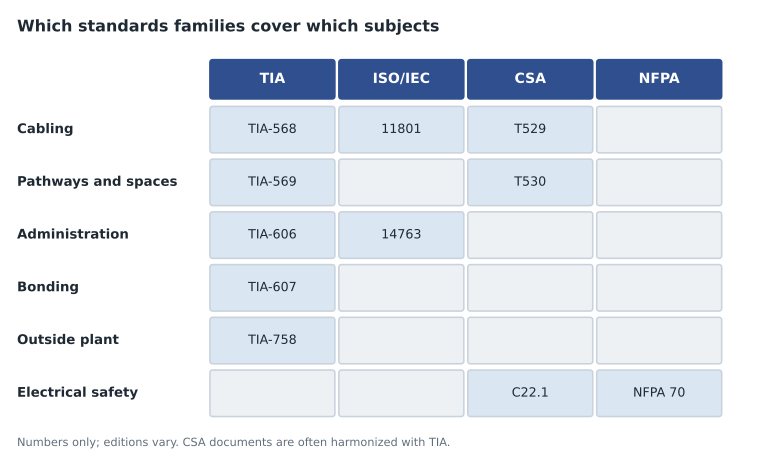
- The ANSI/TIA family covers cabling (568), pathways and spaces (569), administration (606), bonding (607), outside plant (758) and premises types.
- ISO/IEC 11801 and related standards cover the same ground internationally, using classes and distributors.
- CSA publishes Canadian cabling standards harmonized with TIA, and the Canadian Electrical Code.
- NFPA publishes the National Electrical Code (NFPA 70) and fire and IT protection documents.
- IEEE application standards define what the infrastructure must support.
- Standard
- A consensus document setting requirements or guidance.
- ANSI
- American National Standards Institute, which accredits standards developers such as TIA.
- Category
- A TIA performance level for copper components and cabling.
- Class
- An ISO/IEC performance level for installed cabling.
- Distributor
- ISO/IEC term for a cross-connect location in the cabling hierarchy.
- Harmonized standard
- A standard aligned closely with another body's document.
- NFPA 70
- The National Electrical Code.
- Edition
- A particular version of a standard identified by its publication date.
Practice problems
Work each problem on paper first, then reveal the answer to check.
Which ANSI/TIA standard covers pathways and spaces?
Show answer
ANSI/TIA-569.
Which covers bonding and grounding?
Show answer
ANSI/TIA-607.
Which covers labeling and administration?
Show answer
ANSI/TIA-606.
What is the ISO/IEC equivalent term for a category of installed copper cabling?
Show answer
A class.
What does CSA C22.1 contain?
Show answer
The Canadian Electrical Code, Part I.
What is NFPA 70?
Show answer
The National Electrical Code.
How do standards become mandatory on a project?
Show answer
Through codes, contracts or owner requirements.
When two applicable documents differ, what does a designer usually do?
Show answer
Satisfy the stricter one unless the code or contract says otherwise, and record the decision.
Lesson quiz · 5 questions
Score 60% or more to complete this lesson.
Create a free account to save your progress, take quizzes and earn a certificate.