
RCDD-101 · Lesson 5 of 12 · 23 min
The exam format and the TDMM as the reference
▶ Video coming soon A video version of this lesson is on the way.
On the Friday after his application goes in, Daniel stays late at the studio and asks Roz what the exam was like when she took it. She laughs. 'Long ago, and different,' she says. 'The format has changed several times since. What hasn't changed is that it rewards people who understand why the manual says what it says, not people who memorized page numbers.' This lesson describes the current format of the RCDD exam as BICSI publishes it, how its content is defined, the kinds of questions it uses and the role of the TDMM as the reference behind it.
A criterion-referenced professional exam
The RCDD exam is a professional certification exam built from a job task analysis. A job task analysis is a structured study, carried out with experienced practitioners, of what people in the role actually do and what they need to know to do it well. The results are organized into an exam outline, sometimes called a blueprint, that groups tasks into domains and sets how much of the exam each domain receives. Questions are then written to match the outline, reviewed by subject matter experts, tested and only then used to count toward a candidate's score.
The exam is criterion-referenced. That means you pass by meeting a fixed standard of performance, not by beating other candidates. If everyone who sits the exam in a given month is well prepared, everyone can pass. BICSI sets the standard through a formal standard-setting process using the Angoff method, described in lesson 10. You do not need to know the method in detail for the exam, but understanding it removes some of the anxiety around scores.
The format in numbers
According to BICSI's current handbook, the RCDD exam is delivered by Pearson VUE as a computer-based test, either at a Pearson VUE test center or online through Pearson's remote proctoring service, OnVUE. It contains 100 scored items and allows two and a half hours. There are no scheduled breaks, and any break you take counts against your time. Questions have between three and five answer options.
| Feature | Current RCDD exam |
|---|---|
| Delivery | Computer-based through Pearson VUE, at a test center or online with remote proctoring |
| Length | 100 scored items |
| Time | Two and a half hours (150 minutes), no scheduled breaks |
| Item types | Multiple choice, multiple response and enhanced matching |
| Options per item | Three to five |
| Passing standard | Fixed standard set by the Angoff method; the cut score is not published |
| Reference | The TDMM, 15th edition, for the current version of the program |
Two and a half hours for 100 items gives an average of 1.5 minutes per item. That sounds generous until you meet a question that asks you to calculate the fill of a conduit, size a bonding conductor or work through a loss budget, each of which can take three or four minutes. Lesson 9 covers pacing strategies.
Item types
The handbook names three types of item. A multiple choice item has one correct answer among three to five options. A multiple response item asks you to select more than one correct answer, and it usually tells you how many to choose. An enhanced matching item asks you to pair items from two lists, for example matching cable types to applications or standards to subjects. All three are scored automatically.
Most items are written as short scenarios or direct questions. A scenario item might describe a building, a room or a design decision and ask what the designer should do or what a standard requires. A direct item might ask for a definition, a limit or the name of a component. Calculation items appear throughout and expect you to know the method, not just a number. The exam does not usually give you a formula.
Many items include distractors that are partly right. An option might state a real requirement from the wrong standard, a correct limit for the wrong cable type or a good practice that does not answer the question asked. This is why understanding beats memorization. If you know why a limit exists, you can spot the option that applies it in the wrong place.
A practical consequence of the outline's structure is that practice questions should be mixed early. If you only ever answer questions grouped by chapter, you always know which part of the manual the answer comes from. On the exam you will not, and recognizing which principle applies is half the challenge. Lesson 11 returns to this idea under the name interleaving.
It is also worth noting that the exam is written for an international audience. Items describe principles that apply in many countries and avoid depending on one jurisdiction's amendments. When an item mentions a code, it is usually testing a principle common to codes generally, such as fire ratings by space or protection at the entrance, rather than a local detail.
Worked problem
Reading a scenario item carefully
Consider this style of item (written for this course, not taken from the exam): "A designer is planning horizontal cabling for a floor where some outlets are about 95 meters (about 312 feet) of cable from the telecommunications room. The owner wants to support 10 gigabit Ethernet. What is the best response?" The options are: (a) use a higher category of cable so the long links pass; (b) move or add a telecommunications room so that links fall within the horizontal distance limit; (c) specify shorter patch cords at the outlet; (d) request a test exemption from the manufacturer.
Show solution
- Identify the real issue: the horizontal cabling standards set a maximum length for the permanent link and the channel; 95 meters of installed cable is already beyond the 90-meter (295-foot) limit that the horizontal cabling standards set for the permanent link, before any patch cords are added.
- Option (a) treats a length problem as a performance problem; a better cable does not change the distance limit in the standard.
- Option (c) helps only marginally and does not fix a permanent link that is already too long.
- Option (d) is not a design solution.
- Option (b) addresses the cause by bringing the links within the limit.
Answer: Option (b). The question tests the horizontal distance limit, and the distractors offer plausible fixes that do not address it.
How the content is organized
The RCDD outline is organized around the tasks of a designer rather than around chapters of the TDMM. Published summaries of the current outline describe four broad domains: defining the scope of ICT design, designing ICT solutions, supporting the bid or tender process and supporting the installation process. Designing ICT solutions is by far the largest, commonly reported at about two thirds of the exam, with the others sharing the rest. BICSI's handbook is the authoritative source for the current outline and weights, so read it rather than relying on summaries.
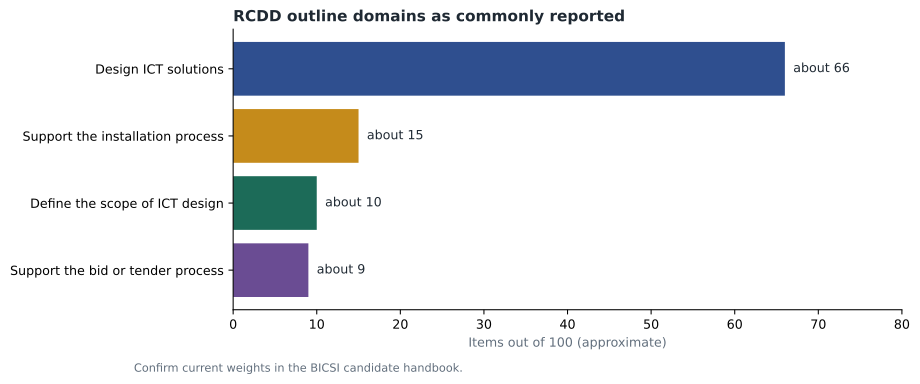
The domain structure tells you something important about how to study. Because the domains follow the designer's job, a single domain draws on many parts of the TDMM. Designing ICT solutions covers transmission, spaces, pathways, cabling, bonding, power, wireless and the special systems. Supporting the bid process covers specifications, drawings, bills of materials and estimating. Supporting installation covers submittals, site visits, testing and documentation. Defining scope covers needs analysis and project planning. You cannot skip a chapter of the manual because it seems to belong to a small domain; its content may appear in the large one.
The TDMM as the reference
BICSI uses the Telecommunications Distribution Methods Manual as the primary reference for the RCDD exam. The current version of the program uses the 15th edition, released in 2024. When a question asks what is recommended or required, the expected answer is the one consistent with the TDMM, which in turn draws on the standards and codes it references.
This matters because practice in the field sometimes differs from the manual. A contractor may habitually fill conduit beyond the recommended limit, an owner may accept longer channels than the standards allow, or a manufacturer may recommend a different bend radius. On the exam, the TDMM's position is the reference answer. In real projects, you apply the TDMM alongside codes, standards, owner requirements and manufacturer instructions, as lessons 7 and 8 explain.
It also matters which edition you study. Each edition of the TDMM reflects the standards and technology at the time it was written, and editions differ in organization and content. Studying an older edition risks learning superseded limits or missing new topics. Use the edition named in the current candidate handbook, and if you buy a used copy, check the edition carefully.
Closed book, open mind
Candidates generally cannot bring the TDMM or notes into the exam; the exam is commonly described as closed book. Check the handbook and Pearson VUE's rules for what you may bring, such as identification and, if permitted, a calculator or on-screen calculator. Because you cannot look things up, the exam rewards knowledge you have internalized: core principles, key limits and the reasoning behind them. You do not need to memorize every table in the manual, but you do need to know the limits that drive design decisions and the logic behind the rest.
| Know thoroughly | Understand well enough to reason with | Recognize |
|---|---|---|
| Distance and length limits for horizontal and backbone cabling | Transmission parameters and why they limit performance | Names of less common standards and documents |
| Space and pathway sizing principles and fill rules | How to size rooms and pathways from requirements | Specialized connector and product types |
| Bonding and grounding components and their roles | How protection works for lightning and power faults | Historic cabling systems |
| The design process and project documents | Wireless, audiovisual and security system needs | Detailed manufacturer practices |
What the exam does not test
The RCDD exam does not test your ability to operate network equipment, configure wireless controllers or write software. It does not ask about specific manufacturers' products by brand. It does not test hands-on installation skills, which BICSI's installer and technician credentials cover. It also does not test local law in detail; questions about codes are about principles and widely used requirements rather than one province's or state's amendments.
It does test judgment. Many items ask what the designer should do first, what is the best solution or which option meets the requirement most completely. Those words matter. 'First' asks about sequence, often planning or coordination before action. 'Best' asks you to compare options that may all work and choose the one that meets the requirement with the least risk or cost. 'Most completely' asks for the option that covers every condition in the scenario.
Accommodations and languages
Candidates who need testing accommodations because of a disability or medical condition can request them through BICSI according to the process in the handbook, usually with supporting documentation and before scheduling. Requests take time to process, so raise them when you apply. If English is not your first language, check the handbook for any provisions that apply; the RCDD is an international credential, and BICSI publishes guidance for candidates outside North America.
Daniel has no accommodation needs, but he does have a habit Roz wants him to break: reading the first half of a question and jumping to an answer. 'The exam writers know you do that,' she tells him. 'Half the distractors are built for people who stop reading at the comma.'
Common mistakes
MistakeMemorizing page numbers or table layouts.
InsteadLearn principles, limits and the reasons behind them.
MistakeStudying an older edition of the TDMM.
InsteadUse the edition named in the current handbook.
MistakeAssuming field habits are the right answer.
InsteadOn the exam, the TDMM's position is the reference.
MistakeIgnoring words like first, best and most completely.
InsteadThey define what the item is really asking.
MistakeSkipping topics that seem to belong to small domains.
InsteadThe large design domain draws on almost every part of the manual.
Summary and key terms
- The RCDD exam is a criterion-referenced professional exam built from a job task analysis.
- It has 100 scored items, two and a half hours and no scheduled breaks, delivered by Pearson VUE at a center or online.
- Item types are multiple choice, multiple response and enhanced matching, with three to five options.
- The outline is organized by designer tasks, with designing ICT solutions by far the largest domain.
- The TDMM, 15th edition, is the reference for the current exam; its position is the expected answer.
- The exam rewards understanding and judgment rather than memorized page references.
- Job task analysis
- A study of what practitioners do, used to build the exam outline.
- Exam outline
- The list of domains, tasks and weights that defines exam content.
- Criterion-referenced
- Scored against a fixed standard rather than against other candidates.
- Multiple response
- An item with more than one correct answer.
- Enhanced matching
- An item that asks you to pair entries from two lists.
- Distractor
- A plausible but incorrect option.
- Pearson VUE
- The testing company that delivers the RCDD exam.
- OnVUE
- Pearson VUE's online remote-proctored testing service.
Practice problems
Work each problem on paper first, then reveal the answer to check.
How many scored items does the RCDD exam contain?
Show answer
100.
How long is the exam?
Show answer
Two and a half hours.
Name the three item types.
Show answer
Multiple choice, multiple response and enhanced matching.
What does criterion-referenced mean?
Show answer
You pass by meeting a fixed standard, not by outperforming others.
Which domain is the largest?
Show answer
Designing ICT solutions.
Which edition of the TDMM supports the current exam?
Show answer
The 15th edition.
What is the average time available per item?
Show answer
1.5 minutes.
Does the exam test hands-on installation skill?
Show answer
No; BICSI's installer and technician credentials do.
Lesson quiz · 5 questions
Score 60% or more to complete this lesson.
Create a free account to save your progress, take quizzes and earn a certificate.