
RCDD-101 · Lesson 10 of 12 · 25 min
Scoring, results and retakes
▶ Video coming soon A video version of this lesson is on the way.
Candidates rarely ask about scoring until they are sitting in front of a result. Roz wants Daniel to understand it months earlier. 'If you know how the pass mark is set,' she says, 'you stop chasing a magic number from some forum and start doing what actually matters, which is knowing the material across the whole outline.' This lesson explains how the RCDD passing standard is set, what candidates learn from their results, how retakes work under the current handbook and how to plan a second attempt if one is needed.
How a passing standard is set
Professional certification exams set their passing standards through a process called standard setting. The aim is to decide, in a defensible way, how much a candidate must know to be considered competent at the level the credential represents. BICSI's handbook states that the RCDD passing score is established through standard setting using the Angoff method, and that candidates are measured against that fixed standard rather than against one another.
In an Angoff study, a panel of experienced practitioners, in this case RCDDs and other subject matter experts, first agrees on a description of the minimally competent candidate: someone who just meets the standard for the credential. Each panellist then looks at every item and estimates the probability that such a candidate would answer it correctly. If most panellists think a minimally competent candidate would get an easy definition item right nine times in ten, it receives a high estimate; a demanding calculation might receive a lower one. The estimates are discussed, sometimes adjusted after reviewing data on how candidates actually performed, and then combined across items to produce the passing score.
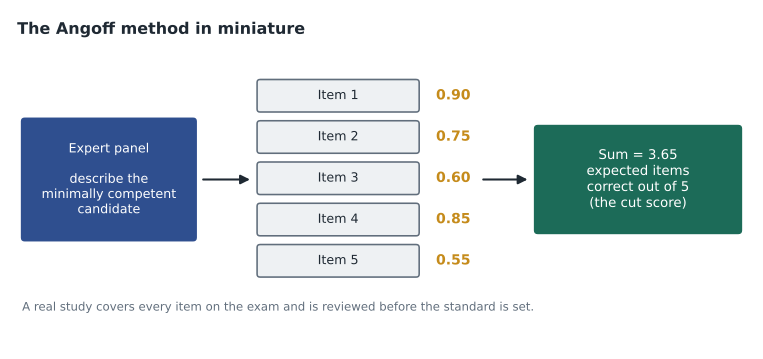
Two consequences follow. First, the passing score depends on the difficulty of the items, not on a predetermined share of the items. If a form of the exam happens to contain harder items, the passing score for that form reflects it. Second, there is no quota: if every candidate in a period meets the standard, every candidate passes. BICSI does not publish the cut score, and figures quoted on third-party sites are not official.
Why the passing score is not a simple published number
Candidates often want a simple number, such as seventy out of a hundred, and some websites supply one. There are good reasons why a criterion-referenced program does not publish its cut score in that form. A fixed count of correct answers on one form of the exam would not mean the same on another form with harder or easier items. Publishing it would encourage candidates to aim for a target number of correct answers rather than for competence across the outline. And a single number can be misread as a pass rate, which it is not. What a candidate needs to know is that the standard is fixed, defensible and the same for everyone, and that the safest way to meet it is to know the whole outline well.
It also follows that there is no benefit in trying to guess how many items you got right during the exam. Some items are harder than others, some may be unscored, and your sense of how well you did is a poor guide. Many candidates who feel they failed have passed, and some who feel confident have not. Concentrate on each item in turn and leave the scoring to the program.
Finally, remember the waiting period when you schedule your first attempt late in a month or before a holiday. A retake 30 days later may fall in a busy period when test center seats are scarce, so check availability early if you think you may need it.
Worked problem
A small Angoff calculation
Imagine a five-item quiz where panellists' average estimates for a minimally competent candidate are 0.90, 0.75, 0.60, 0.85 and 0.55. What cut score would the Angoff method suggest, and what does it mean?
Show solution
- Add the estimates: 0.90 + 0.75 + 0.60 + 0.85 + 0.55 = 3.65.
- This is the number of items a minimally competent candidate is expected to answer correctly.
- Round according to the program's policy, for example to 4 items out of 5 if the rule rounds up.
- A candidate who answers at least that many items correctly meets the standard.
Answer: The suggested cut is 3.65 items, the equivalent of about 73 items in 100 for this small example. The real RCDD study covers every item and is reviewed by BICSI, and its result is not published.
Equating and different exam forms
Large exam programs use more than one version, or form, of the exam so that items are not overexposed. Different forms may vary slightly in difficulty. Programs use statistical methods, generally called equating, to make sure that passing on one form means the same as passing on another. You do not need to understand the statistics. The practical point is that you cannot compare your result with a friend's by counting how many items each of you thinks you got right, and that the form you see is designed to be as fair as any other.
Exams also commonly include a small number of unscored items being tried out for future forms. BICSI's handbook refers to 100 scored items. If unscored items are included, you will not be able to tell which they are, so treat every item as if it counts.
What your result tells you
According to the handbook, candidates who pass are notified at the testing facility, and the electronic certificate is available within three days. Candidates who do not pass receive a score report. The exam is reported as pass or fail. A failing score report gives feedback on performance that helps with further study; read the details provided with your own report to see exactly what it shows.
Passing means you have met the standard and, once BICSI issues the credential, may use the RCDD title. Your credential period begins on the day you pass, as lesson 12 explains. Failing means only that you did not meet the standard on that attempt. Many respected RCDDs needed more than one attempt. What matters is what you do next.
Retake rules
The current handbook sets out the following rules for candidates who do not pass. There is a 30-day waiting period between unsuccessful attempts. After a third unsuccessful attempt, the waiting period becomes 90 days, and further attempts may be allowed after that wait as long as your eligibility period is still valid. Each retest requires a fee, paid to Pearson VUE, with different prices for BICSI members and non-members. If you do not pass within your one-year eligibility period, you must submit a new application to continue.
| Situation | Rule in the current handbook |
|---|---|
| After a first or second unsuccessful attempt | Wait at least 30 days before the next attempt |
| After a third unsuccessful attempt | Wait at least 90 days; further attempts possible if eligibility is still valid |
| Retest fee | 230 US dollars for members, 355 US dollars for non-members, paid to Pearson VUE |
| Eligibility period ends without a pass | A new application is required |
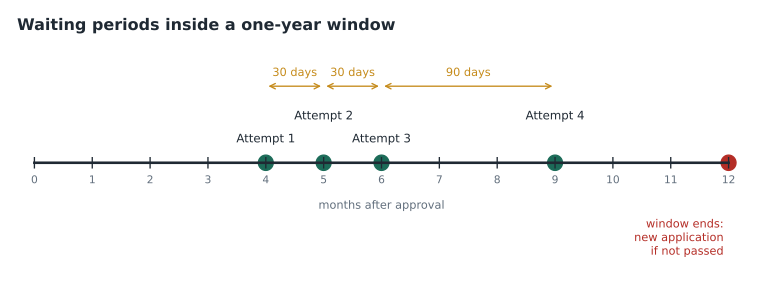
The timeline shows why the timing advice in lesson 4 matters. A candidate who sits for the first time in the eleventh month of the window has almost no room for a retake. A candidate who sits in the fourth month has room for several. Planning a first attempt with time to spare is one of the simplest ways to reduce risk.
Planning a second attempt
If you do not pass, take a day or two before deciding what to do, then read your score report carefully. Identify the areas where your performance was weakest. Compare them with your study log: did you spend less time there, or did you study them in a way that did not stick? Then build a focused plan for the next four to eight weeks that spends most of the time on those areas, while keeping the rest of the outline fresh with short reviews and mixed practice questions.
Think also about how you studied, not just what. Many unsuccessful candidates read a great deal but practiced too little under timed conditions. Others knew the material but ran out of time or misread qualifiers. A score report cannot tell you about pacing or reading, but your memory of the exam can. Write down, soon after the exam, what felt hard: types of items, topics, time pressure. That record is valuable in planning.
Worked problem
Using the window wisely
A colleague of Daniel's, Marisa, was approved on March 1 and sat the exam for the first time on September 20, without passing. Her window ends on February 28 of the following year. Using the handbook rules, what is the earliest date for her second attempt, and how many attempts could she still fit in the window if she needed them?
Show solution
- Second attempt: at least 30 days after September 20, so on or after October 20.
- Third attempt: at least 30 days after the second; if the second is on October 20, the third could be on or after November 19.
- Fourth attempt: after a third failure the wait is 90 days, so on or after about February 17, still inside the window ending February 28.
- In practice, she should plan for one well-prepared retake rather than several rushed ones.
Answer: Her earliest retake is October 20. In theory she could fit three more attempts before the window ends, but a focused six- to eight-week plan for one strong second attempt is the better strategy.
Keeping perspective
The RCDD exam is designed to be demanding, and a failing result is common enough that nobody in the industry treats it as unusual. What employers and clients see is whether you hold the credential, not how many attempts it took. The knowledge you build while preparing, including for a retake, is valuable in itself and makes you a better designer.
It is also worth remembering what the exam cannot measure. It cannot measure your judgment on a real project, your ability to communicate with owners and contractors or your care in checking drawings. Those qualities come from experience and habits, and they matter as much as the credential.
Exam security and confidentiality
Candidates agree to keep exam content confidential. That means you must not share or record the items you saw, and you must not use materials that claim to contain real exam questions. Sharing exam content harms the credential's value and can lead to sanctions, including loss of the credential. Discussing topics and general difficulty with colleagues is normal; reproducing items is not. Legitimate preparation materials, like this course, are written independently and do not contain real exam items.
Roz tells Daniel about a designer she once met who boasted of having a set of 'actual RCDD questions'. 'Two things were true about that set,' she says. 'Half of it was wrong, and anyone caught using it would have been in breach of the ethics they'd signed. Study the field, not the test.'
Common mistakes
MistakeChasing a rumoured pass mark.
InsteadThe cut score is set by the Angoff method and not published; aim to know the whole outline well.
MistakeRetaking the exam as soon as the waiting period ends without a new plan.
InsteadAnalyze the score report and study log, then focus on weak areas.
MistakeSitting for the first time late in the window.
InsteadLeave room for waiting periods and a retake.
MistakeUsing materials that claim to contain real exam items.
InsteadThey breach exam confidentiality and are often wrong.
MistakeTreating a failing result as a verdict on your ability.
InsteadMany RCDDs needed more than one attempt; the next plan matters most.
Summary and key terms
- The RCDD passing standard is set by the Angoff method, based on expert estimates of minimally competent performance.
- Candidates are measured against a fixed standard, not against each other, and the cut score is not published.
- Different exam forms are equated so that a pass means the same on every form.
- Passing candidates are notified at the test site; unsuccessful candidates receive a score report.
- Retakes require a 30-day wait, rising to 90 days after a third unsuccessful attempt, and a retest fee, all within the eligibility window.
- Exam content is confidential; prepare from legitimate materials.
- Standard setting
- A formal process for deciding the score needed to pass.
- Angoff method
- A standard-setting method based on experts' estimates of how a minimally competent candidate would perform on each item.
- Minimally competent candidate
- A candidate who just meets the standard for the credential.
- Cut score
- The score that separates passing from failing.
- Exam form
- One version of an exam drawn from the item bank.
- Equating
- Statistical adjustment so that results on different forms are comparable.
- Score report
- Feedback given to candidates who do not pass.
Practice problems
Work each problem on paper first, then reveal the answer to check.
Which method does BICSI use to set the RCDD passing score?
Show answer
The Angoff method.
What is a minimally competent candidate?
Show answer
A candidate who just meets the standard for the credential.
Does the RCDD have a fixed pass rate or quota?
Show answer
No; candidates are measured against a fixed standard.
How long must you wait after a first unsuccessful attempt?
Show answer
30 days.
How long must you wait after a third unsuccessful attempt?
Show answer
90 days.
Who receives the retest fee?
Show answer
Pearson VUE.
What happens if your eligibility period ends before you pass?
Show answer
You must submit a new application.
Why should you not use "actual exam questions" from the internet?
Show answer
It breaches exam confidentiality and the materials are often wrong.
Lesson quiz · 5 questions
Score 60% or more to complete this lesson.
Create a free account to save your progress, take quizzes and earn a certificate.