
RCDD-101 · Lesson 2 of 12 · 23 min
BICSI and the ICT design landscape
▶ Video coming soon A video version of this lesson is on the way.
Daniel's first assignment is not a drawing. Roz hands him a list of organizations and asks him to write one paragraph on each: who they are, what they publish and why a designer on the Harbourview project might care. 'Half the confusion people have in this field,' she says, 'comes from not knowing who writes what. A standard, a code, a manufacturer's guide and a reference manual are four very different things, and the exam expects you to know which is which.' This lesson covers the same ground: BICSI as an organization, the family of credentials it offers, the other bodies that shape ICT infrastructure and how the RCDD fits among other professional designations.
BICSI as an organization
BICSI is a professional association for the ICT infrastructure industry. It began in 1974 as the Building Industry Consulting Service International, formed by telephone company engineers who were responsible for planning cabling in new buildings. As the industry changed and the regulated telephone companies gave way to competitive markets, the organization broadened its scope and now uses the name BICSI on its own. It is headquartered in Tampa, Florida, and has members and credential holders in close to one hundred countries, organized into regional districts and country chapters, with districts across the United States and regional conferences
BICSI does three main things that matter to a candidate. It publishes technical manuals and its own standards. It runs education, from short online courses to multi-day instructor-led classes. And it administers credentials, including the RCDD, through a credentialing program that defines eligibility, develops exams and manages renewal. It also runs conferences where designers, contractors and manufacturers meet, and those conferences are one way RCDDs earn the continuing education credits described in lesson 12.
It is worth understanding that BICSI is not a government body and does not enforce anything by law. Its manuals describe good practice, and its standards are voluntary unless an owner, a specification or a contract makes them mandatory. Codes, by contrast, are adopted into law by governments and enforced by inspectors. Lesson 8 returns to this distinction because it shows up constantly in design work and on the exam.
BICSI publications
The publication that matters most for the RCDD is the Telecommunications Distribution Methods Manual, known as the TDMM. It is a large reference manual that describes the principles and practices of ICT distribution design across the whole field, and BICSI uses it as the primary reference for the RCDD exam. The 15th edition was released in 2024 and serves as the reference for the current version of the exam. Lessons 5 and 6 describe the manual and how to navigate it.
BICSI also publishes other manuals that go deeper into particular areas, such as outside plant design, ICT project management, information technology systems installation methods, data center design and wireless design. Some of these are references for BICSI's specialty credentials. In addition, BICSI develops its own standards through an accredited process, covering topics such as data center design and implementation, health care facilities, educational facilities, electronic safety and security, and ICT systems installation practices. These standards complement the cabling standards published by other bodies rather than replacing them.
A candidate does not need to own every BICSI publication. The TDMM is essential for the RCDD exam. The other manuals and standards are useful for practice and for specialty credentials, and you will meet references to them in the TDMM itself.
The BICSI credential family
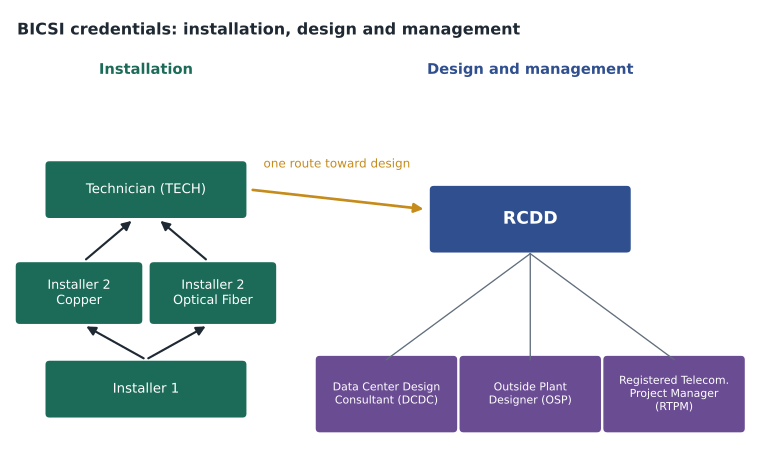
BICSI offers credentials for installers, technicians, designers and project managers. Knowing how they relate helps you understand where the RCDD sits and why some of them count toward RCDD eligibility, as lesson 3 explains.
| Credential | Focus |
|---|---|
| Installer 1 (INST1) | Entry level: basic cabling installation tasks under supervision |
| Installer 2 Copper and Installer 2 Optical Fiber | Experienced installers who install, terminate and test copper or fiber cabling |
| Technician (TECH) | Leads installation teams, troubleshoots, tests and documents complex systems |
| RCDD | Designs ICT distribution systems for buildings and campuses |
| Data Center Design Consultant (DCDC) | Specialty in data center ICT design, power, cooling and availability |
| Outside Plant Designer (OSP) | Specialty in campus and outside plant pathways and cabling |
| Registered Telecommunications Project Manager (RTPM) | Manages ICT infrastructure projects from planning to closeout |
Three features of this family matter for a candidate. First, the installer and technician credentials test hands-on skill, often with practical exams, while the RCDD tests design knowledge in a written exam. Second, several of the specialty credentials, such as data center and outside plant design, were originally aimed at people who already held the RCDD; check BICSI's current rules for each. Third, under the current RCDD eligibility rules, holding the TECH, RTPM, DCDC or OSP credential is one of the ways to shorten the experience requirement, which lesson 3 covers in detail.
Other organizations that shape ICT infrastructure
The TDMM draws heavily on standards written by other organizations, and a designer must know who they are. The main ones are standards developers, code-writing bodies and testing and listing organizations.
| Organization | What it does | Examples relevant to ICT |
|---|---|---|
| TIA (Telecommunications Industry Association) | Develops North American telecommunications cabling standards through accredited committees | ANSI/TIA-568 cabling, -569 pathways and spaces, -606 administration, -607 bonding, -758 outside plant, -862 building automation |
| ISO/IEC JTC 1 | Joint committee of the international standards bodies; writes international cabling standards | ISO/IEC 11801 series, ISO/IEC 14763 series |
| CSA Group | Canadian standards developer; publishes Canadian versions of many cabling standards and the Canadian Electrical Code | CSA T5xx series, CSA C22.1 |
| NFPA (National Fire Protection Association) | Develops fire and electrical codes used across the United States | NFPA 70 (National Electrical Code), NFPA 72, NFPA 75 and 76 |
| IEEE | Writes networking and power standards that set what the cabling must support | IEEE 802.3 Ethernet, including power over Ethernet, IEEE 802.11 wireless |
| Testing and listing laboratories | Test products for safety and mark them as listed or certified | UL Solutions, CSA, Intertek and others |
As a designer in the United States, Daniel will work mainly with the ANSI/TIA cabling standards and with NFPA 70, the National Electrical Code, which states and municipalities adopt with their own amendments. He will also meet the ISO/IEC international standards, because global clients and manufacturers use them, and the TDMM explains principles using both North American and international documents. Lesson 7 looks at these standards families in more detail.
The IEEE deserves a special mention because it sets what the cabling must support rather than how it is built. When IEEE 802.3 defines a new Ethernet speed or a higher power level for power over Ethernet, cabling standards and manufacturers respond with performance categories, installation guidance and testing limits. A designer who understands the link between application standards and cabling standards can explain to an owner why a particular cable category is worth the extra cost.
Manufacturers and warranties
Manufacturers are part of the landscape too. Most cabling systems are sold with a manufacturer's extended warranty, often fifteen to twenty-five years, which requires installation by a certified contractor using matching components and passing specified tests. Manufacturer installation guides and warranty programs often set requirements stricter than the standards, such as tighter bend radii or specific test settings. A designer needs to know when a specification calls for a particular manufacturer's system, how that affects competition among bidders and how to write a performance-based specification that allows several manufacturers to compete.
Manufacturers also publish a great deal of training material and white papers. Much of it is excellent, but it is written to sell products. On the exam and in design, rely first on standards, codes and the TDMM, and treat manufacturer literature as supporting information.
Where the RCDD sits among professional designations
Designers on a building project often hold a mix of designations. The RCDD complements rather than replaces them.
| Designation | What it covers | Relationship to the RCDD |
|---|---|---|
| PE (professional engineer) | Legal license to practice engineering, granted by a provincial or state regulator | Required for work the law reserves for engineers; many ICT designers hold both |
| Engineering technician or technologist certifications | Recognized technical qualification below the engineering license | Common background for ICT designers |
| Architect | Legal license to design buildings | Architects allocate space; RCDDs specify what that space must provide |
| Network certifications (for example vendor routing and switching credentials) | Configuration and operation of active network equipment | Network teams use the infrastructure the RCDD designs |
| Audiovisual and security credentials | Design of specialty systems | Specialty designers rely on the RCDD's pathways, spaces and cabling |
In the United States, engineering is regulated by state licensing boards, and the scope of what an RCDD may do without a license depends on state law. In practice, the RCDD designs the telecommunications infrastructure while an electrical engineer designs power and seals the electrical drawings. Some jurisdictions treat low-voltage communications design as engineering in certain building types, so an RCDD who is not an engineer should check local rules and, where needed, work under an engineer's supervision.
Worked problem
Who writes what?
During a design meeting for the Harbourview project, Marcus Feld, the general contractor's project manager, says: "The BICSI manual says the telecom room needs its own cooling, so the code requires it." Is he right?
Show solution
- Identify the document: the TDMM is a BICSI reference manual describing good practice. It is not a code.
- Ask what the codes actually require: the electrical and building codes adopted in the jurisdiction govern safety; they may say nothing about room cooling for telecommunications.
- Ask what the project documents require: if the owner's standards or the specification call for dedicated cooling, it becomes a contractual requirement.
- Conclude: the requirement may be real, but its source is the design and contract, not the code.
Answer: Marcus is mixing up sources. Dedicated cooling is good practice described in the TDMM and the pathways and spaces standards; it becomes mandatory on this project only if the specifications or owner standards require it.
Keeping up with a changing industry
The ICT field changes quickly. New cable categories, higher power over Ethernet, new wireless generations, single-pair Ethernet for building devices, higher-density fiber connectors and new security threats to building systems all appear within a few years of each other. BICSI responds by revising the TDMM, updating its standards and periodically revising the RCDD exam to match a new job task analysis. A candidate should always study from the edition named in the current candidate handbook and should expect the field to keep moving after they pass. That is one reason the RCDD requires continuing education, covered in lesson 12.
Daniel finishes his assignment with a one-page table much like the ones in this lesson. Roz reads it, crosses out one line where he had called the TDMM a standard and writes in the margin: reference manual, not a standard. 'Get that distinction right,' she says, 'and a whole category of exam questions becomes easy.'
Common mistakes
MistakeCalling the TDMM a standard or a code.
InsteadIt is a BICSI reference manual describing good practice; standards and codes are separate documents.
MistakeAssuming BICSI enforces its recommendations.
InsteadBICSI is a professional association; codes are enforced by authorities, and standards apply through contracts.
MistakeConfusing installer credentials with the RCDD.
InsteadInstaller and technician credentials test hands-on skill; the RCDD tests design knowledge.
MistakeRelying on manufacturer literature as the final word.
InsteadUse standards, codes and the TDMM first; treat manufacturer material as supporting.
MistakeIgnoring application standards such as IEEE 802.3.
InsteadThey set what the cabling must support, including power over Ethernet levels.
Summary and key terms
- BICSI is a global professional association for ICT infrastructure that publishes manuals and standards, runs education and administers credentials.
- The TDMM is BICSI's primary reference for ICT distribution design and for the RCDD exam; the 15th edition was released in 2024.
- BICSI credentials run from installer and technician levels through the RCDD to specialty design and project management credentials.
- TIA, ISO/IEC, CSA, NFPA, IEEE and testing laboratories all shape ICT infrastructure.
- Codes are law, standards are voluntary unless required by contract, and manuals describe good practice.
- The RCDD complements engineering licenses and other designations rather than replacing them.
- BICSI
- Professional association for the ICT infrastructure industry that awards the RCDD.
- TDMM
- Telecommunications Distribution Methods Manual, BICSI's main design reference.
- TIA
- Telecommunications Industry Association, which develops North American cabling standards.
- ISO/IEC JTC 1
- Joint international committee that writes international cabling standards.
- CSA Group
- Canadian standards developer that publishes the Canadian Electrical Code and Canadian cabling standards.
- NFPA
- National Fire Protection Association, publisher of the National Electrical Code and fire codes.
- IEEE 802.3
- The Ethernet standard family, including power over Ethernet.
- Listing
- A testing laboratory's confirmation that a product meets a safety standard.
Practice problems
Work each problem on paper first, then reveal the answer to check.
What did the letters BICSI originally stand for?
Show answer
Building Industry Consulting Service International.
Which BICSI publication is the primary reference for the RCDD exam?
Show answer
The Telecommunications Distribution Methods Manual (TDMM).
Name two BICSI credentials that can shorten the RCDD experience requirement.
Show answer
Any two of TECH, RTPM, DCDC and OSP.
Which organization publishes ANSI/TIA-568?
Show answer
The Telecommunications Industry Association.
What is the difference between a code and a standard?
Show answer
A code is adopted into law and enforced; a standard is voluntary unless required by contract or code.
Why does IEEE 802.3 matter to cabling designers?
Show answer
It defines the Ethernet applications and power levels the cabling must support.
What does a manufacturer's extended warranty usually require?
Show answer
Installation by a certified contractor with matching components and passing tests.
Does the RCDD replace an engineering license?
Show answer
No; it complements it.
Lesson quiz · 5 questions
Score 60% or more to complete this lesson.
Create a free account to save your progress, take quizzes and earn a certificate.