
RCDD-101 · Lesson 4 of 12 · 25 min
The application, approval and fees
▶ Video coming soon A video version of this lesson is on the way.
In late July, Daniel's experience log is finished, Roz has read it twice and the two of them agree that he qualifies. The next step is the application. 'This is the boring part,' Roz says, 'and the part people get wrong. Fill it in once, carefully, and keep a copy of everything you upload.' This lesson walks through how the RCDD application works, how long approval takes, what the fees cover, how long an approval lasts and how to time the application so that the eligibility window fits your study plan.
Fees and procedures in this lesson are those published in BICSI's current RCDD certification handbook. They are stated in United States dollars because that is how BICSI publishes them. BICSI updates its fees from time to time, so check the handbook and your online account before paying.
Where the application lives
The RCDD application is completed through the candidate's online profile on BICSI's website. If you do not already have an account, you create one, which is the same account used for BICSI membership, course registrations and, later, continuing education records. Keep the login details safe and use an email address you will still have in three or four years. Many credential holders lose track of renewal notices because they applied with an employer's address and then changed jobs.
The application itself asks for three main things: the completed RCDD exam application form, a current résumé and copies of any degrees, diplomas or certifications you are relying on. The résumé should be consistent with your experience log from lesson 3. If your log says you spent fourteen months designing cabling at Lakehead Signal, your résumé should say the same, with the same dates. Inconsistencies are the most common reason applications are delayed while BICSI asks for clarification.
| Item | What to include | Tip |
|---|---|---|
| Application form | Personal details, the eligibility option you are using and your experience details | Choose the option your evidence supports most clearly |
| Résumé | Roles, employers, dates and duties, focused on ICT work | Match dates and titles to your experience log |
| Education documents | Diplomas, certificates or transcripts for coursework used under option 2 | Scan clearly and include translations if needed |
| Credential evidence | Proof of a current TECH, RTPM, DCDC or OSP credential for option 1 | Check the expiry date first |
| Payment | The application fee, which includes the first exam attempt | Note member and non-member prices |
Verification and approval
BICSI verifies the ICT experience candidates claim and may require additional proof, such as letters from employers or clients. Verification is why the detailed log in lesson 3 matters. If BICSI contacts a former supervisor, that person should recognize your description of the work.
The handbook asks candidates to allow 30 days for approval. In practice, the time can be shorter or longer depending on how complete the application is and how busy the credentialing team is. Applications that need extra documents take longer. Do not book travel or block vacation time for an exam date until your approval arrives.
Once approved, you receive confirmation and the information you need to schedule your exam with the testing provider, as lesson 9 describes. From that approval date, a clock starts.
The eligibility window
An approval is valid for one year from the approval date. Within that year you must schedule and sit the exam, and, if you are unsuccessful, any retakes as well, subject to the waiting periods in lesson 10. If the year ends without a pass, you need to submit a new application, with a new fee, to continue.
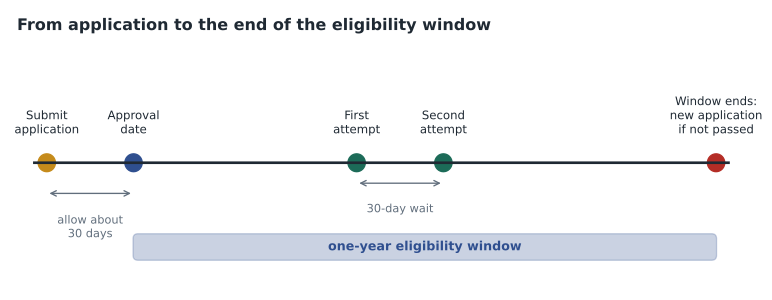
This window is the reason timing matters. A candidate who applies early, before they have started studying, may find that half the window has gone before they are ready. A candidate who applies too late may have finished studying and then wait a month for approval while their knowledge fades. The best approach is to start serious study first, apply when you are roughly halfway through your plan, and schedule the exam for a date that leaves time for at least one retake inside the window if you need it.
Writing the experience section
The experience section of the application is where most of the judgment lies. Describe each role in a few clear sentences that show what you designed, for whom and with what result. Use active verbs such as designed, specified, sized, surveyed, documented and reviewed, and name the kind of building or system involved. Where a role mixed design with other work, say roughly how much of your time went to design. Avoid jargon that only your former employer would recognize, such as internal project codes or product nicknames, because the person reading your application may work in another country and another part of the industry.
It also helps to connect your experience to the language of the exam outline. If you prepared bills of materials and answered contractor questions during bidding, that is support for the bid process. If you reviewed submittals and test results, that is support for installation. If you met users to count outlets and plan growth, that is defining scope. You are not trying to impress anyone; you are making it easy for BICSI to see that your experience matches what the credential represents.
Finally, ask someone to read your draft before you submit. Daniel asks Roz, who points out that he has described two years of work at his previous employer without once mentioning the word design, even though most of what he did there was layout and documentation. He rewrites the section in an evening, and it becomes the clearest part of the application.
One more practical point: if your employer is paying, find out who in the company will make the payment and when. Applications sometimes sit unfinished for weeks while an expense request moves through approvals, and the delay can push the eligibility window later than your plan intended.
Worked problem
Timing the application
Daniel plans to study for about nine months, from August to April, and to sit the exam in mid-April 2027. When should he apply so that he is approved in time and still has room for a retake within the window?
Show solution
- He needs approval before he can book, so he must allow about 30 days for approval.
- If he applies in late November, approval should arrive by late December, about four months before his target date.
- The window then runs to late December 2027, which leaves about eight months after a mid-April attempt for waiting periods and retakes if needed.
- Applying in August would also work, but the window would end in August 2027, leaving less margin if his study runs late.
Answer: Applying around late November gives Daniel approval well before his April date and leaves most of the window available for retakes. Applying much earlier would shrink his margin for no benefit.
What the fees cover
The RCDD application fee is non-refundable and is paid to BICSI. It includes the fee for the first exam attempt. The current handbook lists two prices, one for BICSI members and one for non-members.
| Fee | BICSI member | Non-member | Paid to |
|---|---|---|---|
| Application, including first exam attempt | 510 US dollars | 725 US dollars | BICSI |
| Retest, each later attempt | 230 US dollars | 355 US dollars | The testing provider (Pearson VUE) |
| Recertification every three years | 225 US dollars | 385 US dollars | BICSI |
The application fee does not include study materials, preparation courses, travel to a test center or retest fees. Those can easily cost more than the application. The TDMM alone is a substantial purchase, and an instructor-led preparation course costs more again. Lesson 11 discusses how to choose study resources wisely.
US candidates pay the listed amounts directly. Many employers pay for the application and study materials, sometimes in exchange for an agreement to stay with the company for a period after certification. If your employer offers this, read the agreement carefully and understand what happens if you leave.
Is BICSI membership worth it?
The difference between member and non-member prices is large enough that membership often pays for itself during the application and the first renewal. Membership also brings discounts on manuals and courses, access to member resources and the BICSI magazine, and lower prices for conferences where you can earn continuing education credits.
Worked problem
Comparing member and non-member costs
Suppose annual BICSI membership costs about 200 US dollars (check the current price, which varies by membership type). Daniel expects to pay the application fee once and, being careful, budgets for one retest in case he needs it. Is membership worth it for the application year?
Show solution
- Non-member cost: 725 + 355 = 1,080 US dollars.
- Member cost before membership: 510 + 230 = 740 US dollars.
- Member cost including one year of membership: 740 + 200 = 940 US dollars.
- Saving: 1,080 − 940 = 140 US dollars, before any discounts on the TDMM or courses.
Answer: Under these assumptions, membership saves about 140 US dollars in the application year even if he needs a retest, and more if he buys the TDMM or a course at member prices. Without a retest the fee saving alone is 215 − 200 = 15 US dollars, so the case rests mostly on the other member discounts.
The membership price in that example is an illustration. BICSI offers several membership types, and prices change, so do the calculation with current figures. The principle holds: if you will buy the TDMM, take a course and renew the credential, membership usually costs less overall.
Avoiding application problems
Most delays come from a small number of avoidable mistakes. The first is inconsistency between the application, the résumé and supporting documents. The second is vague descriptions of experience that do not show design work clearly. The third is missing education evidence, especially for older diplomas that need to be requested from a registrar. The fourth is choosing the wrong eligibility option, for example applying under option 1 with an expired credential. The fifth is simple: applying with an email address that later stops working, so messages from BICSI never arrive.
A good habit is to keep a folder, on paper or on your computer, with everything you submit: the completed form, the résumé, each document, payment receipts and every message from BICSI. You will need some of it again when you renew, and if BICSI ever audits your application or your continuing education, you will have the evidence in one place.
Daniel scans his associate degree from Lake Superior College and his technician credential, saves a copy of his résumé as submitted and sets a calendar reminder for 30 days after submission. Roz adds one more piece of advice. 'When the approval comes,' she says, 'don't celebrate by booking the earliest date you can find. Book the date your plan says you'll be ready.'
What approval does and does not mean
Approval means BICSI has accepted that you meet the eligibility requirements and may sit the exam during your window. It does not mean you are an RCDD, and it does not guarantee a pass. You may not use the RCDD title or abbreviation until you have passed and BICSI has issued the credential. Using it earlier, even informally on a business card or in a proposal, breaches the code of ethics described in lesson 12 and can lead to sanctions.
Common mistakes
MistakeApplying before checking that the résumé matches the experience log.
InsteadMake dates, titles and duties consistent across every document.
MistakeBooking travel before approval arrives.
InsteadAllow about 30 days and wait for confirmation.
MistakeApplying too early in the study plan.
InsteadApply part way through so the one-year window covers the exam and any retake.
MistakeIgnoring the cost of materials and retests.
InsteadBudget for the TDMM, courses and at least one possible retest.
MistakeUsing the RCDD title after approval but before passing.
InsteadUse it only after BICSI issues the credential.
Summary and key terms
- The RCDD application is made through your BICSI online profile with the application form, a résumé and supporting documents.
- BICSI verifies claimed experience and may ask for more proof; allow about 30 days for approval.
- Approval lasts one year, during which you must pass the exam, including any retakes.
- The non-refundable application fee includes the first attempt; retests are paid separately to the testing provider.
- BICSI members pay lower fees, which often makes membership worthwhile.
- Keep copies of everything you submit and use a permanent email address.
- Online profile
- Your BICSI account, used for applications, courses and continuing education.
- Approval
- BICSI's confirmation that you meet eligibility and may sit the exam.
- Eligibility window
- The one-year period after approval during which you must pass.
- Application fee
- The non-refundable fee paid to BICSI that includes the first exam attempt.
- Retest fee
- The fee for each later attempt, paid to the testing provider.
- Verification
- BICSI's check that claimed experience is genuine.
Practice problems
Work each problem on paper first, then reveal the answer to check.
How long does the handbook ask candidates to allow for approval?
Show answer
30 days.
How long is an approval valid?
Show answer
One year from the approval date.
Does the application fee include the first exam attempt?
Show answer
Yes.
Who receives the retest fee?
Show answer
The testing provider, Pearson VUE.
Name three items submitted with the application.
Show answer
The application form, a current résumé and degrees, diplomas or certifications.
What happens if the window ends without a pass?
Show answer
A new application and fee are required.
May you call yourself an RCDD once your application is approved?
Show answer
No; only after you pass and the credential is issued.
Why use a permanent email address?
Show answer
So renewal and credentialing messages still reach you after a job change.
Lesson quiz · 5 questions
Score 60% or more to complete this lesson.
Create a free account to save your progress, take quizzes and earn a certificate.