
RCDD-101 · Lesson 1 of 12 · 27 min
What an RCDD does and why the credential matters
▶ Video coming soon A video version of this lesson is on the way.
On a cold Monday in January, Rosalind Achterberg pins a drawing to the wall of the small studio that Lakehead Signal Design Group rents above a hardware store in Duluth. It is the first floor plan of the Harbourview Health & Learning Center, a four-story building that will hold a medical clinic, college classrooms and offices, with a small data room in the basement and a fiber link to an older building about 400 meters (a quarter mile) away. Roz, as everyone calls her, has been designing information and communications technology (ICT) systems for twenty-two years and has held the RCDD credential for most of them. Across the table sits Daniel Oyelaran, who spent five years pulling, terminating and testing cable before joining the firm as a junior designer. He wants to sit the RCDD exam in the spring of 2027. 'Before you open a single book,' Roz tells him, 'you need to understand what the letters after my name actually mean, and what they don't.'
This course follows Daniel through that year of preparation. It explains how the Registered Communications Distribution Designer credential works: who awards it, who it is for, how to qualify, what the exam looks like, how to study for it and how to keep it once you have it. The later courses in this program cover the design knowledge itself, from transmission principles to data centers and outside plant. This first lesson sets the scene by describing the work an RCDD does, the problems the role exists to solve and why owners, engineers and contractors value the credential.
A note on this program
HSM University is not affiliated with, endorsed by or authorized by BICSI. RCDD, Registered Communications Distribution Designer and TDMM are marks of BICSI. This course and the rest of the RCDD Exam Prep program are independent study materials written from publicly available information. They do not reproduce BICSI manuals, do not contain real exam questions and do not entitle you to sit the exam. Facts about eligibility, fees and exam rules are given as published by BICSI at the time of writing, and BICSI changes them from time to time, so always confirm the current rules in BICSI's own candidate handbook before you apply or pay for anything.
What ICT distribution design is
Every modern building depends on a network of cables, connectors, rooms and pathways that carries voice, data, video, wireless signals, security systems and building controls. The people who use the building rarely see this infrastructure. They see a wall outlet, a wireless access point on the ceiling, a camera, a display in a meeting room or a badge reader at a door. Behind each of those devices is a chain of decisions: which cable type to use, how far it can run, which room it terminates in, how that room is cooled and powered, how the cable gets there through walls and floors, how it is protected from fire spread and electrical hazards, how it is labeled and how it will be tested before the owner accepts it.
ICT distribution design is the discipline of making those decisions deliberately and documenting them so that contractors can build them. The word distribution is important. The RCDD is not primarily about network switches, routers or software, although an RCDD must understand what they need. It is about the physical layer and the supporting infrastructure that distributes communications services through buildings and across campuses: telecommunications spaces such as entrance facilities, equipment rooms and telecommunications rooms; pathways such as conduit, cable tray and sleeves; backbone and horizontal cabling in copper and optical fiber; bonding and grounding; and the many specialty systems that now share that infrastructure.
A useful way to picture the field is as a set of layers. At the bottom are the building itself and the codes that govern it. Above that sit the spaces and pathways that give cabling somewhere to live and a way to get there. Then come the cables and connecting hardware, then the protection systems that keep people and equipment safe, then the active systems that run on top, and finally the processes that turn a design into a working, documented installation. An RCDD is expected to understand every layer well enough to design it, coordinate it with other trades and defend the choices to an owner or inspector.
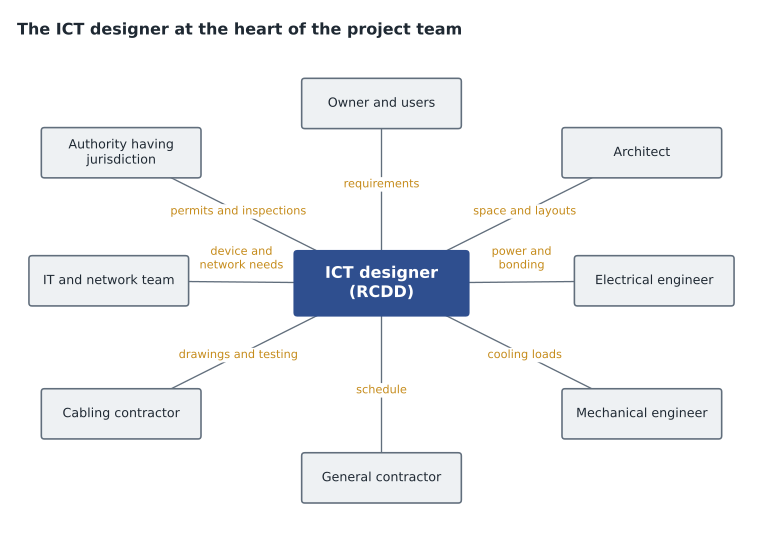
What an RCDD actually does
Job titles vary. RCDDs work as ICT designers in engineering and architecture firms, as consultants who represent building owners, as designers and project managers for cabling contractors, as infrastructure managers for universities, hospitals, governments and large companies, as product specialists for manufacturers and as technical staff for service providers. What they share is a set of tasks that runs through the life of a project.
| Project stage | Typical RCDD tasks |
|---|---|
| Planning and needs analysis | Meet the owner and users, identify current and future services, count devices, set performance goals and budgets |
| Schematic design | Choose the cabling topology, locate and size telecommunications spaces, plan main pathways and the service entrance |
| Design development | Coordinate with architects and engineers on room sizes, power, cooling, bonding, ceiling space and fire separations |
| Construction documents | Produce drawings, details, specifications and bills of materials that a contractor can price and build |
| Bid or tender | Answer contractor questions, review substitutions, help evaluate bids |
| Construction administration | Review submittals, visit the site, resolve conflicts, handle change requests |
| Testing and closeout | Review test results, check labeling and as-built records, recommend acceptance |
Daniel has seen the last two stages many times from the other side. As a technician he received drawings, pulled cable along the routes shown, terminated it in the rooms indicated and handed test results to a foreman. What he has not done is make the decisions that produced those drawings. 'The first time you sit in a design meeting,' Roz tells him, 'you'll notice that nobody asks you how to terminate a jack. They ask you how big the telecom room has to be, whether it can share a wall with the electrical room, how many outlets a clinic exam room needs and what happens if the college wants to double its wireless coverage in five years. The RCDD is about answering those questions well.'
The problems the role exists to solve
It helps to understand why the role exists at all. In many projects, communications infrastructure was historically treated as an afterthought. Architects allocated leftover closets for telecommunications rooms. Electrical engineers added a few empty conduits to the drawings. The cabling contractor was hired late and asked to make it work. The results were predictable: rooms too small for the equipment, no dedicated cooling, pathways full before the building opened, cables running past fluorescent ballasts and motors, missing bonding, poor labeling and test results that nobody reviewed. Owners then paid to fix problems that would have cost little to prevent on paper.
A trained ICT designer prevents those problems by representing communications in the design process from the start. Space is the classic example. Once concrete is poured and walls are framed, a telecommunications room cannot easily grow. If the designer secures the right size, location and stacking of rooms early, and coordinates power, cooling, lighting and door swings with the other disciplines, the building can support its ICT systems for decades. The same is true of pathways: a few extra sleeves through a fire-rated floor during construction cost a small fraction of what coring and firestopping them later will cost.
The second problem is performance. Copper and fiber cabling systems are engineered to meet specific transmission limits over specific distances. A channel that is a few meters too long, a cable bent too tightly, a patch cord of the wrong category or a splice with too much loss can turn a system that should support today's and tomorrow's applications into one that fails intermittently. The designer's job is to choose media and layouts that meet the standards with margin and to specify the tests that prove it.
The third problem is coordination. Communications infrastructure now carries far more than telephones and computers. Wireless access points, distributed antenna systems for cellular and public safety radio, security cameras, access control, audiovisual systems, building automation, lighting controls, nurse call and many internet of things devices all depend on it, often with power delivered over the same cable. Each system has its own vendors, standards and stakeholders. The ICT designer is often the only person who sees all of them together and can plan a converged infrastructure rather than a tangle of separate networks.
Worked problem
Spotting a problem before it is built
The architect for the Harbourview project proposes a telecommunications room on the second floor in a space of about 2.4 by 2.4 meters (8 by 8 feet), tucked behind the elevator machine room and sharing a wall with the main electrical room. What should Daniel flag before the layout is fixed?
Show solution
- Compare the room size with the floor area it serves and the equipment it must hold; a floor of clinics and classrooms will need racks, cable management, wireless and security equipment, and space for growth.
- Note the location next to the elevator machine room and electrical room, both sources of electromagnetic interference and heat, and the shared wall that may limit where cable can enter.
- Check whether the room stacks vertically with the rooms above and below so that backbone pathways can run straight between floors.
- Ask about dedicated cooling, power circuits and the door swing, which are often forgotten in early layouts.
Answer: The room is likely too small, poorly placed next to interference sources and may not stack; Daniel should raise these points now, while moving a wall costs nothing but a revised drawing.
What the credential shows
The RCDD certifies that the holder has a defined level of knowledge of ICT distribution design and enough experience to apply it. To earn it, a candidate must show qualifying experience, sometimes combined with education or another BICSI credential, pass a demanding exam based on BICSI's reference manual, agree to a code of ethics and then keep the credential current through continuing education. Lessons 3 to 12 explain each of those steps.
Because the exam is based on a large reference manual that covers the whole field, the RCDD is a breadth credential. A candidate who has spent years in data centers must also know healthcare facilities, outside plant, wireless, audiovisual systems and bonding. A candidate from the cabling trade must learn project documentation, specifications and bid processes. This breadth is deliberate. Owners hire an RCDD to see the whole picture, and the credential is meant to show that the holder can.
The RCDD is also a credential about design judgment rather than installation skill. Many RCDDs started as installers and technicians, and that background is valuable, but the exam does not ask you to terminate a connector or splice fiber. It asks you to choose correctly between alternatives, apply standards and codes, calculate quantities and sizes and recognize the consequences of design decisions. BICSI offers separate installer and technician credentials for hands-on skills, and lesson 2 shows how they relate.
Why owners and employers value it
There are several reasons the RCDD carries weight in the industry. First, it has a long history: BICSI introduced it in 1984, and it has become the most widely recognized credential for ICT infrastructure design. Second, many owners, especially governments, universities, hospitals and large corporations, require that communications design documents be prepared or stamped by an RCDD, in the same way they require a licensed engineer for electrical design. Requests for proposals often list the RCDD as a mandatory qualification for the consultant or for the contractor's project lead.
In the United States, the RCDD is commonly required in federal, state and municipal requests for proposals for ICT design, in the design standards of universities, health systems and large corporations, and in some federal agency guidance for telecommunications infrastructure. It is not a legal license: work that state law reserves for licensed professional engineers still needs a PE, and an RCDD who is not an engineer must work within those limits. Many ICT designers in the United States hold both a PE or engineering technician credential and the RCDD.
Third, the credential gives a common language. When an architect, an electrical engineer and a cabling contractor all know that the ICT consultant is an RCDD, they can assume a shared understanding of terms, standards and good practice. That shortens meetings and reduces mistakes. Finally, the credential's continuing education requirement means that holders are expected to keep up with changes in standards and technology, which matter in a field where cable categories, wireless generations and power delivery limits change every few years.
As with any credential, it is wise to treat claims about salary premiums cautiously. RCDD holders tend to be experienced, so part of any reported pay difference reflects seniority rather than the credential itself. A fairer statement is that the RCDD opens doors to projects and roles that require it and strengthens a designer's standing with clients and employers.
Is the RCDD right for you now?
Daniel's situation is typical. He has field experience, a good grasp of cabling, testing and installation practice and enough exposure to design to know he wants more. He does not yet have experience writing specifications or sizing rooms. Roz's advice to him is the advice this course gives you: be honest about what you already know, check that you meet the eligibility rules before investing in study, plan the year rather than cramming and use the preparation to become a better designer, not just to pass a test.
| Your situation | Sensible next step |
|---|---|
| New to ICT cabling | Gain field experience and consider an installer or technician credential first |
| Experienced technician moving into design | Start design work under an RCDD and check the eligibility options in lesson 3 |
| Designer with several years of ICT design | Confirm eligibility, apply and build a study plan |
| Engineer or architect who coordinates ICT | Consider the RCDD to deepen ICT knowledge and meet owner requirements |
| Already an RCDD | Specialty credentials such as data center or outside plant design, and continuing education |
How this course is organized
The twelve lessons follow the order in which a candidate meets each part of the process. Lesson 2 describes BICSI and the wider landscape of ICT credentials and organizations. Lessons 3 and 4 cover eligibility, the application and fees. Lessons 5 and 6 describe the exam and the reference manual it is based on, and how to find your way around it. Lessons 7 and 8 introduce the standards and codes that shape every design. Lessons 9 and 10 explain booking, exam day, scoring and retakes. Lesson 11 builds a study plan, and lesson 12 covers continuing education, renewal and the code of ethics. Each lesson ends with common mistakes, a summary, key terms, practice questions and a short quiz.
Common mistakes
MistakeThinking the RCDD is an installation credential.
InsteadIt certifies design knowledge and judgment; BICSI has separate installer and technician credentials.
MistakeAssuming the RCDD is a legal license.
InsteadIt is a professional certification; work reserved for licensed engineers still needs one.
MistakeStudying only the systems you already know.
InsteadThe exam spans the whole field, from bonding to outside plant to healthcare.
MistakeTreating communications as an afterthought in design.
InsteadSpace, pathways and coordination must be secured early, when changes cost least.
MistakeRelying on old fee or rule summaries.
InsteadAlways confirm current rules in BICSI's candidate handbook.
Summary and key terms
- ICT distribution design covers the spaces, pathways, cabling, protection and supporting infrastructure for communications in buildings and campuses.
- An RCDD plans, designs, documents and oversees that infrastructure across the life of a project.
- The role exists to prevent undersized rooms, full pathways, poor performance and uncoordinated systems.
- The credential shows breadth of design knowledge, verified experience, ethical commitment and ongoing learning.
- Many owners require an RCDD on ICT design work, but it does not replace an engineering license.
- This course explains how the credential works; later courses teach the design knowledge itself.
- RCDD
- Registered Communications Distribution Designer, BICSI's credential for ICT infrastructure design.
- ICT
- Information and communications technology: voice, data, video, wireless and related systems.
- Distribution design
- Design of the physical infrastructure that carries communications through buildings and campuses.
- Telecommunications space
- A room or area that houses ICT cabling and equipment, such as an equipment room or telecommunications room.
- Pathway
- A facility such as conduit, tray or a sleeve that carries cable from one place to another.
- Converged infrastructure
- One cabling infrastructure shared by many systems such as data, wireless, security and building controls.
- Owner
- The organization that commissions and will operate the building.
- Construction documents
- The drawings and specifications a contractor uses to price and build the work.
Practice problems
Work each problem on paper first, then reveal the answer to check.
What does the word distribution emphasize in the RCDD title?
Show answer
The physical infrastructure that distributes communications services, not network electronics.
Name three project stages where an RCDD has a role.
Show answer
Any three of needs analysis, schematic design, design development, construction documents, bid, construction administration, testing and closeout.
Why should telecommunications rooms be secured early in design?
Show answer
They are hard and costly to enlarge or move once the structure is built.
Give two sources of interference to avoid next to a telecommunications room.
Show answer
Electrical rooms, elevator machine rooms, large motors or transformers.
Is the RCDD a legal license to practice engineering?
Show answer
No; it is a professional certification.
Why is the RCDD described as a breadth credential?
Show answer
Its exam covers the whole field of ICT distribution design.
Name four systems that commonly share ICT infrastructure today.
Show answer
Wireless, security cameras, access control, audiovisual, building automation, lighting controls, distributed antenna systems.
When was the RCDD introduced?
Show answer
In 1984.
Lesson quiz · 5 questions
Score 60% or more to complete this lesson.
Create a free account to save your progress, take quizzes and earn a certificate.