
PYTH-201 · Lesson 12 of 12 · 28 min
Capstone: solving problems efficiently
▶ Video coming soon A video version of this lesson is on the way.
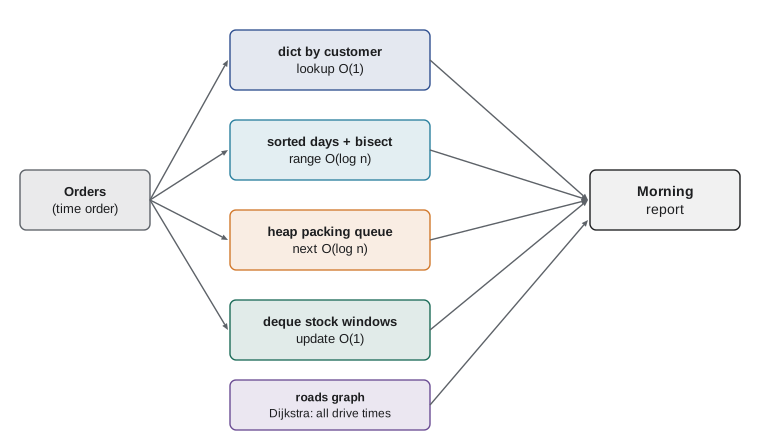
Rosa has asked Jordan for a dispatch assistant for the wholesale business. Every morning it must take the day's orders and the delivery network, decide the order in which to pack, find the quickest drive to each customer, answer questions such as how many bags went to the Alder Hotel last month, and flag coffees that will run out before the next roast. The data is growing quickly: thousands of orders a month, dozens of customers and a year of sales history. The first version Jordan wrote, a pile of nested loops, took most of a minute on a laptop. This capstone rebuilds it with the structures from this course.
Rather than introduce new structures, this lesson shows how to choose among the ones you know. It starts with a method for turning requirements into a choice of structure, applies it to each feature of the dispatch assistant, measures the difference with step counts, and ends with a checklist you can use on any program that has become slow.
A method for choosing structures
Most performance problems in business code are not solved by clever tricks but by choosing a structure whose cheap operations match what the program does most. Four questions lead to the choice. First, list the operations the program performs: lookups by key, insertions, removals of the smallest item, range queries, ordered listings, connections between things. Second, estimate how often each runs and how big the data will become. Third, find the structure that makes the frequent operations cheap, using the costs from this course. Fourth, measure before and after, and keep the simpler solution when the difference does not matter.
| If the program mostly needs to... | Use | Typical cost |
|---|---|---|
| Look up items by an exact key, or test membership | dict or set | O(1) average |
| Add and remove at the ends, in arrival order | collections.deque | O(1) |
| Undo or match nested things | list as a stack | O(1) |
| Always take the most urgent or smallest item | heapq priority queue | O(log n) |
| Find items in a range, or the nearest value | sorted list with bisect | O(log n + k) |
| Count or group records | Counter or defaultdict | O(n) for one pass |
| Work with connections between things | graph as an adjacency list | O(V + E) searches |
| Show items in order | sorted() once, or keep sorted | O(n log n) once |
Step 1: indexing customers and orders
Jordan's first version stored orders in one long list and, for every report, looped over the list looking for matching customers or coffees. Each report was O(n), and the morning summary ran dozens of reports, each scanning thousands of orders. The fix is to build indexes once, as the data is loaded, so later questions become dictionary lookups. A dictionary from customer to their orders, and another from coffee to bags sold, replace almost every scan.
from collections import defaultdict, Counter

orders = [
    {"id": 2001, "day": "2026-10-02", "customer": "Alder Hotel", "sku": "RC-101", "bags": 12, "priority": 1},
    {"id": 2002, "day": "2026-10-02", "customer": "Bayside Bakery", "sku": "RC-104", "bags": 6, "priority": 2},
    {"id": 2003, "day": "2026-10-09", "customer": "Alder Hotel", "sku": "RC-106", "bags": 8, "priority": 0},
    {"id": 2004, "day": "2026-10-15", "customer": "Lakeview Cafe", "sku": "RC-101", "bags": 20, "priority": 2},
    {"id": 2005, "day": "2026-10-23", "customer": "Alder Hotel", "sku": "RC-101", "bags": 10, "priority": 1},
    {"id": 2006, "day": "2026-11-02", "customer": "Hilltop Market", "sku": "RC-102", "bags": 5, "priority": 2},
]

by_customer = defaultdict(list)
bags_by_sku = Counter()
for o in orders:                                   # one pass builds both indexes
    by_customer[o["customer"]].append(o)
    bags_by_sku[o["sku"]] += o["bags"]

print("Alder Hotel orders:", [o["id"] for o in by_customer["Alder Hotel"]])
print("Alder Hotel bags:", sum(o["bags"] for o in by_customer["Alder Hotel"]))
print("best sellers:", bags_by_sku.most_common(2))Alder Hotel orders: [2001, 2003, 2005]
Alder Hotel bags: 30
best sellers: [('RC-101', 42), ('RC-106', 8)]The indexes cost one pass and some memory, O(n), and then each question costs only the size of its answer. This is the trade from lesson 1 of space for time, and it is almost always worth making for data that is queried repeatedly.
Step 2: date ranges with binary search
Anita's questions are usually about periods: bags sold to the Alder Hotel in October, or every order in the last two weeks. Because orders are recorded in time order, the list of days is already sorted, and the binary search range technique from lesson 7 finds the start and end of any period in O(log n). For per-customer periods, each customer's order list is also in time order, so the same technique works on it.
from bisect import bisect_left, bisect_right

days = ["2026-10-02", "2026-10-02", "2026-10-09", "2026-10-15", "2026-10-23", "2026-11-02"]
bags = [12, 6, 8, 20, 10, 5]

def bags_between(first, last):
    lo, hi = bisect_left(days, first), bisect_right(days, last)
    return sum(bags[lo:hi]), hi - lo

print("October:", bags_between("2026-10-01", "2026-10-31"))
print("first half of October:", bags_between("2026-10-01", "2026-10-15"))
print("December:", bags_between("2026-12-01", "2026-12-31"))October: (56, 5) first half of October: (46, 4) December: (0, 0)
If Anita needed many range totals over a large, unchanging history, a further refinement would store running totals (the prefix sums you built in lesson 2's exercise) so that each total is a subtraction of two running totals instead of a sum over the slice: O(log n) per question regardless of the period's length.
Try it yourself
Range totals with prefix sums
Write a class DailyTotals that is created with two parallel lists: sorted days (ISO date strings) and bags (whole numbers). In __init__, build a list of running totals. Then write between(first, last) that returns the total bags on days from first to last inclusive, using bisect and two running totals, with no loop over the period.
For days ["2026-10-02", "2026-10-09", "2026-10-15"] and bags [12, 8, 20], between("2026-10-05", "2026-10-31") is 28.
class DailyTotals:
    def __init__(self, days, bags):
        self.days, self.bags = days, bags

    def between(self, first, last):
        return sum(b for d, b in zip(self.days, self.bags) if first < d < last)

t = DailyTotals(['2026-10-02', '2026-10-09', '2026-10-15'], [12, 8, 20])
print(t.between('2026-10-05', '2026-10-31'))
Step 3: packing by priority
Each morning's orders must be packed most urgent first: priority 0 for wholesale orders due today, 1 for express and 2 for standard, with ties in arrival order. Jordan's first version sorted the whole list every time an order arrived, O(n log n) per arrival. A heap, from lesson 10, makes each arrival and each packing step O(log n), and a counter breaks ties so equal priorities stay first come, first served.
import heapq, itertools

class PackingQueue:
    def __init__(self):
        self.heap, self.seq = [], itertools.count()
    def add(self, order):
        heapq.heappush(self.heap, (order["priority"], next(self.seq), order["id"]))
    def next(self):
        return heapq.heappop(self.heap)[2] if self.heap else None

q = PackingQueue()
for o in [{"id": 2101, "priority": 2}, {"id": 2102, "priority": 1},
          {"id": 2103, "priority": 2}, {"id": 2104, "priority": 0}]:
    q.add(o)
print([q.next() for _ in range(5)])[2104, 2102, 2101, 2103, None]
Step 4: drive times
The van's route needs drive times from the roastery to every customer. Running Dijkstra's algorithm, from lesson 11, once from the roastery gives the quickest time to every place at once, so there is no need to search separately for each customer. Those times then feed a simple rule: deliver to customers in order of drive time from the roastery, a reasonable plan for a small van, though choosing the truly best order of many stops is a famously hard problem (the traveling salesperson problem) that real delivery companies tackle with specialized optimization tools.
import heapq

def drive_times(graph, start):
    best = {start: 0}
    heap = [(0, start)]
    while heap:
        t, place = heapq.heappop(heap)
        if t > best[place]:
            continue
        for nxt, minutes in graph[place].items():
            if t + minutes < best.get(nxt, float("inf")):
                best[nxt] = t + minutes
                heapq.heappush(heap, (t + minutes, nxt))
    return best

roads = {
    "Roastery": {"Cafe": 6, "Warehouse": 9}, "Cafe": {"Roastery": 6, "Lakeview Cafe": 12, "Warehouse": 5},
    "Warehouse": {"Roastery": 9, "Cafe": 5, "Bayside Bakery": 7, "Pine St Deli": 14},
    "Lakeview Cafe": {"Cafe": 12, "Alder Hotel": 15}, "Bayside Bakery": {"Warehouse": 7, "Alder Hotel": 10},
    "Alder Hotel": {"Lakeview Cafe": 15, "Bayside Bakery": 10},
    "Pine St Deli": {"Warehouse": 14, "Hilltop Market": 8}, "Hilltop Market": {"Pine St Deli": 8},
}
times = drive_times(roads, "Roastery")
customers = ["Alder Hotel", "Bayside Bakery", "Hilltop Market", "Lakeview Cafe"]
for c in sorted(customers, key=times.get):
print(f"{c:<15} {times[c]:>3} min")Bayside Bakery 16 min Lakeview Cafe 18 min Alder Hotel 26 min Hilltop Market 31 min
Try it yourself
Nearest open customer
times is a dictionary of drive times in minutes from the roastery (as produced by drive_times), and open_now is a set of customers who are currently open. Write nearest_open(times, open_now) that returns the open customer with the shortest drive time, or None if no open customer can be reached.
If two customers have the same time, return the one that comes first alphabetically. Places in open_now that are missing from times cannot be reached.
def nearest_open(times, open_now):
    return min(open_now)

print(nearest_open(times, {'Alder Hotel', 'Lakeview Cafe'}))
Step 5: stock alerts
Kai needs to know which coffees will run out before the next roast in three days. A sliding window from lesson 3 gives the average daily sales over the last week for each coffee in O(1) per new day, and comparing stock with three days of average sales flags the coffees at risk. A heap's nsmallest then lists the coffees with the fewest days of stock left, so Kai sees the most urgent first.
import heapq
from collections import deque

stock = {"RC-101": 30, "RC-102": 40, "RC-104": 9, "RC-106": 16}
daily = {                                       # bags sold on each of the last 9 days
    "RC-101": [9, 11, 8, 12, 10, 9, 13, 11, 12],
    "RC-102": [2, 1, 3, 2, 2, 1, 2, 3, 2],
    "RC-104": [3, 2, 4, 3, 3, 4, 3, 2, 4],
    "RC-106": [4, 5, 3, 6, 4, 5, 4, 6, 5],
}

def weekly_average(sales, days=7):
    window, total = deque(maxlen=days), 0
    for s in sales:
        if len(window) == days:
            total -= window[0]
        window.append(s)
        total += s
    return total / len(window)

days_left = {sku: stock[sku] / weekly_average(daily[sku]) for sku in stock}
at_risk = [sku for sku, d in days_left.items() if d < 3]
print("at risk before the next roast:", sorted(at_risk))
print("most urgent:", [(s, round(days_left[s], 1)) for s in heapq.nsmallest(3, days_left, key=days_left.get)])at risk before the next roast: ['RC-101', 'RC-104']
most urgent: [('RC-104', 2.7), ('RC-101', 2.8), ('RC-106', 3.4)]Measuring the improvement
How much faster is the new version? Counting the basic operations each version performs gives an answer that does not depend on the computer. The listing models the morning workload of Jordan's first version and of the new one for growing numbers of orders. The old version scanned every order for each of the c customers and re-sorted the waiting orders at every arrival; the new one indexes the orders once and uses a heap.
import math

def old_steps(n, customers=40):
    scans = customers * n                           # one full scan per customer report
    resorts = sum(k * math.log2(k) for k in range(2, n + 1))   # sort on every arrival
    return scans + resorts

def new_steps(n, customers=40):
    index = n                                       # one pass builds the indexes
    reports = n                                     # each order appears in one customer's list
    heap = n * math.log2(n)                         # push and pop each order once
    return index + reports + heap

print(f"{'orders':>8} {'old steps':>16} {'new steps':>12} {'times faster':>13}")
for n in [100, 1_000, 10_000]:
    o, w = old_steps(n), new_steps(n)
print(f"{n:>8,} {o:>16,.0f} {w:>12,.0f} {o / w:>13,.0f}") orders old steps new steps times faster
100 33,946 864 39
1,000 4,667,202 11,966 390
10,000 628,784,683 152,877 4,113The model is rough, since real costs depend on constants the counts ignore, but the trend is unmistakable and matches what Jordan measured: the old version's cost grows roughly with n² log n because of the repeated sorting, while the new version grows with n log n. At ten thousand orders the gap is a factor of thousands. Timing the real program with the methods from lesson 1, on realistic data, confirms the estimate before anyone relies on it.
Try it yourself
Top coffee each day
sales is a list of (day, sku, bags) tuples in any order. Write top_coffee_by_day(sales) that returns a dictionary mapping each day to the SKU with the most bags sold that day. If two SKUs tie, choose the one that comes first alphabetically.
Do it in one pass to build a dictionary of Counters (or a dictionary of dictionaries), then pick each day's best; avoid scanning the whole list once per day.
def top_coffee_by_day(sales):
    result = {}
    for day, sku, bags in sales:
        result[day] = sku
    return result

print(top_coffee_by_day([('10-02', 'RC-101', 12), ('10-02', 'RC-104', 6), ('10-02', 'RC-104', 9)]))
A checklist for slow programs
The same reasoning applies to any program that has become slow as its data grew. Work through these steps in order, and stop as soon as the program is fast enough; simpler code is easier to trust.
- Measure first. Time the program on realistic data, and find which part is slow before changing anything.
- Look for hidden loops: in on a list, list.remove, list.insert(0, x), list.pop(0), slicing in a loop, and sorting inside a loop.
- Replace repeated searches with an index built once: a dict, a set, a Counter or a defaultdict.
- Keep data sorted if you search ranges, and use bisect instead of scanning.
- Use the right container for the access pattern: deque for queues, heapq for priorities, a graph for connections.
- Cache expensive results that are requested again, with functools.cache or a dictionary.
- Check correctness after every change by comparing the new output with the old on the same data.
Worked problem
Reviewing a slow function
Sam wrote a function that, for each of n orders, checks whether the order's customer is in a list of m customers with overdue invoices, using if order["customer"] in overdue_list. The function takes many seconds on a year of orders. What is wrong and how should it be fixed?
Show solution
- in on a list scans the list, O(m), and it runs once per order, so the function is O(n·m).
- Convert the overdue customers to a set once before the loop: overdue = set(overdue_list), O(m).
- Each membership test is now O(1) on average, so the loop is O(n).
- The total cost becomes O(n + m) instead of O(n·m); with 20,000 orders and 300 overdue customers, about 20,300 steps instead of 6 million.
- Run the old and new versions on the same data and compare the flagged orders to confirm nothing changed.
Answer: Build a set of overdue customers once; membership tests become O(1) and the function becomes O(n + m).
Common mistakes
MistakeOptimizing code before measuring which part is slow.
InsteadTime or profile the program on realistic data first.
MistakeBuilding an index inside the loop that uses it.
InsteadBuild dictionaries and sets once, before the loop.
MistakeRe-sorting a whole list whenever one item arrives.
InsteadUse a heap for priorities, or bisect.insort for occasional insertions.
MistakeRunning one shortest-path search per customer.
InsteadOne Dijkstra run from the start gives times to every place.
MistakeChoosing a sophisticated structure for tiny, stable data.
InsteadPrefer the simplest code that is fast enough at realistic sizes.
MistakeChanging the algorithm without checking the results still match.
InsteadCompare old and new outputs on the same data after every change.
Summary and key terms
- Performance problems are usually solved by choosing structures whose cheap operations match what the program does most.
- List the operations, estimate their frequency and data size, pick the matching structure, then measure.
- Indexes built once with dict, set, Counter or defaultdict replace repeated O(n) scans.
- Sorted data with bisect, and prefix sums, answer range questions in O(log n).
- A heap keeps a priority queue at O(log n) per operation; one Dijkstra run gives all drive times.
- Step counts and timing on realistic data confirm an improvement before it is trusted.
- A checklist of hidden loops, indexes, sorted data and the right containers fixes most slow programs.
- index
- A structure built once so later lookups are fast, such as a dict from customer to orders.
- prefix sums
- Running totals that let any range total be computed by one subtraction.
- bottleneck
- The part of a program that limits its overall speed.
- profiling
- Measuring where a program spends its time.
- trade-off
- Gaining one benefit, such as speed, at the cost of another, such as memory.
- requirements
- The operations and limits a program must support.
- heuristic
- A practical rule that gives a good answer, not necessarily the best one.
- traveling salesperson problem
- Finding the shortest route that visits every stop once, a famously hard problem.
- scalability
- How well a program keeps performing as its data grows.
- regression check
- Confirming that a change has not altered results that were correct.
Practice problems
Work each problem on paper first, then reveal the answer to check.
A report checks if sku in discontinued_list for each of 50,000 sales. What change makes it fast?
Show answer
Convert discontinued_list to a set once before the loop.
Why does building an index cost O(n) but still save time?
Show answer
It is paid once, and then each question is a fast lookup instead of a full scan.
How do prefix sums answer a range total in O(1) after the range is found?
Show answer
Subtract the running total before the range from the running total at its end.
Why run Dijkstra's algorithm once rather than once per customer?
Show answer
A single run from the start finds the quickest time to every place.
Which structure suits a queue where express orders jump ahead of standard ones?
Show answer
A heap-based priority queue.
What should you always do after replacing an algorithm with a faster one?
Show answer
Check that it gives the same results on the same data.
Lesson quiz · 5 questions
Score 60% or more to complete this lesson.
Create a free account to save your progress, take quizzes and earn a certificate.