
PYTH-201 · Lesson 1 of 12 · 25 min
Measuring efficiency: big O
▶ Video coming soon A video version of this lesson is on the way.
Ridgeline Coffee Roasters started with six coffees, a dozen online orders a day and a stock file that fit on one screen. Jordan's PYTH-102 package handled that easily. Now Rosa is talking about wholesale accounts, a second cafe and a loyalty program with thousands of members, and Theo has started asking a new kind of question: not whether the tools give the right answer, but whether they will still give it quickly when the shop is ten or a hundred times bigger. A report that takes a second today could take a minute or an hour next year, depending on how it was written.
This course is about writing programs that stay fast as their data grows. It covers the classic data structures (lists, stacks, queues, linked lists, hash tables, trees, heaps and graphs) and the algorithms that work on them (searching, sorting and graph search). This first lesson builds the vocabulary for everything that follows: how to measure the cost of an algorithm by counting its steps, how big O notation describes the way that cost grows, and how to read a piece of code and estimate its growth rate before you ever run it.
Why speed depends on growth, not on seconds
The obvious way to compare two programs is to time them. Timing is useful, and the last section of this lesson shows how to do it properly, but on its own it misleads. A program's running time depends on the computer, on what else the computer is doing, on the version of Python and on the particular data used for the test. Two programs that both finish in a blink with 100 orders can behave completely differently with 100,000. What matters most is how the work grows as the input grows.
Computer scientists therefore describe an algorithm by counting basic steps, such as comparisons, additions or list lookups, as a function of the input size, usually called n. For Ridgeline, n might be the number of orders, coffees, customers or roast batches. We do not care whether one step takes a nanosecond or a microsecond; we care whether doubling n doubles the work, quadruples it, or barely changes it.
def count_matches(orders, sku):
    """Count orders for one SKU, and count the comparisons made."""
    steps = 0
    found = 0
    for order in orders:
        steps += 1                 # one comparison per order
        if order == sku:
            found += 1
    return found, steps

for n in [10, 100, 1000, 10000]:
    orders = ["RC-101", "RC-104", "RC-106", "RC-102", "RC-103"] * (n // 5)
    found, steps = count_matches(orders, "RC-104")
print(f"n = {n:>6}: found {found:>5}, comparisons {steps:>6}")n = 10: found 2, comparisons 10 n = 100: found 20, comparisons 100 n = 1000: found 200, comparisons 1000 n = 10000: found 2000, comparisons 10000
Ten times more orders means ten times more comparisons. That pattern, work proportional to n, is called linear growth, and it is the first of several growth rates you will learn to recognize.
Counting steps in a nested loop
Now consider a different question. Mei wants to know whether any two loyalty members share the same phone number, which would suggest a duplicate account. The most direct approach compares every member with every other member. That is a loop inside a loop, and the number of comparisons grows much faster.
def has_duplicate_slow(phones):
    steps = 0
    for i in range(len(phones)):
        for j in range(i + 1, len(phones)):
            steps += 1
            if phones[i] == phones[j]:
                return True, steps
    return False, steps

for n in [10, 100, 1000, 2000]:
    phones = [f"555-{k:04d}" for k in range(n)]      # no duplicates: the worst case
    dup, steps = has_duplicate_slow(phones)
print(f"n = {n:>5}: duplicate {dup}, comparisons {steps:>9,}")n = 10: duplicate False, comparisons 45 n = 100: duplicate False, comparisons 4,950 n = 1000: duplicate False, comparisons 499,500 n = 2000: duplicate False, comparisons 1,999,000
With 1,000 members the function makes 499,500 comparisons; doubling to 2,000 members roughly quadruples that to almost two million. The exact count is n(n - 1)/2, but the important fact is that it grows like n squared. Lesson 5 shows how a set answers the same question with about n steps, which for Ridgeline's eventual 50,000 loyalty members is the difference between 50,000 steps and over a billion.
Big O notation
Big O notation is the standard shorthand for growth rates. Saying an algorithm is O(n), read as order n or big O of n, means its work grows at most in proportion to n once n is large enough. O(n²) means the work grows at most like n squared. Formally, a function f(n) is O(g(n)) if there are constants c and n₀ such that f(n) ≤ c·g(n) for every n ≥ n₀; in practice, you find the big O by keeping the fastest-growing term and dropping constant factors.
For f(n) = 3n² + 5n + 20, the n² term dominates once n is moderately large: at n = 1,000 it contributes 3,000,000 of the 3,005,020 steps. The constant 3 depends on details such as how many operations one loop iteration really takes, and those details change with the machine and the language, so big O ignores it. Dropping lower terms and constants is not sloppiness; it is a deliberate focus on what decides whether a program scales.
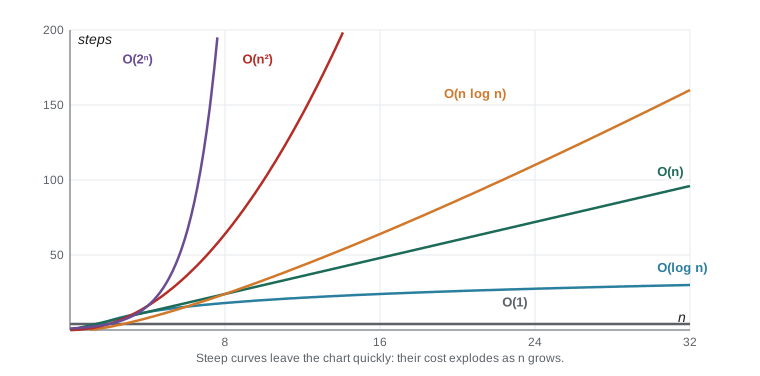
The growth rates you will meet most often, from best to worst, are these:
- O(1), constant: the work does not depend on n, such as reading one item of a list by index or looking up a dictionary key.
- O(log n), logarithmic: the work grows by one step each time n doubles, such as binary search in a sorted list.
- O(n), linear: the work is proportional to n, such as one pass through a list.
- O(n log n), linearithmic: slightly more than linear, the cost of good sorting algorithms.
- O(n²), quadratic: the work grows with the square of n, typical of comparing every pair.
- O(2ⁿ), exponential: the work doubles with each extra item, such as trying every subset of a set of items.
import math

print(f"{'n':>8} {'log2 n':>8} {'n log2 n':>12} {'n squared':>15} {'2 to the n':>14}")
for n in [8, 64, 1024, 65536]:
    two_n = f"{len(str(2 ** n))} digits" if n <= 1024 else "far bigger"
print(f"{n:>8} {math.log2(n):>8.0f} {n * math.log2(n):>12,.0f} {n * n:>15,} {two_n:>14}") n log2 n n log2 n n squared 2 to the n
8 3 24 64 3 digits
64 6 384 4,096 20 digits
1024 10 10,240 1,048,576 309 digits
65536 16 1,048,576 4,294,967,296 far biggerThe table shows why the categories matter more than constants. An O(n log n) sort of 65,536 orders needs about a million steps; an O(n²) method needs over four billion. No faster computer rescues an exponential algorithm: 2 to the 1024 is a number with more than 300 digits.
Best, worst and average cases
The number of steps often depends on the data as well as its size. Searching a list for a coffee that happens to be first takes one comparison; searching for one that is last, or absent, takes n. Analysts therefore distinguish the best case, the worst case and the average case. Big O is usually quoted for the worst case, because it is a guarantee: whatever the input, the algorithm will not do worse.
def find_index(skus, target):
    for i, sku in enumerate(skus):
        if sku == target:
            return i, i + 1            # position and comparisons used
    return -1, len(skus)

skus = ["RC-101", "RC-102", "RC-103", "RC-104", "RC-105", "RC-106"]
for target in ["RC-101", "RC-104", "RC-106", "RC-999"]:
    pos, comps = find_index(skus, target)
print(f"{target}: position {pos:>2}, comparisons {comps}")RC-101: position 0, comparisons 1 RC-104: position 3, comparisons 4 RC-106: position 5, comparisons 6 RC-999: position -1, comparisons 6
If every coffee is equally likely to be the target, the average successful search makes about n/2 comparisons, which is still O(n): halving a linear cost does not change its growth rate. Average-case analysis needs an assumption about what inputs are likely, so it is less of a guarantee, but it can be more realistic. Lesson 5 explains why dictionaries are O(1) on average even though their worst case is linear.
Reading code to find its big O
With practice you can estimate the big O of most code by reading it. A few rules cover the common cases. Simple statements such as assignments, arithmetic and indexing a list are O(1). A loop that runs n times around an O(1) body is O(n). A loop nested inside another, each running n times, is O(n²). Steps in sequence add, and the larger term wins, so an O(n) loop followed by an O(n²) loop is O(n²). A loop that halves the remaining work on each pass is O(log n).
Hidden loops deserve special care. Built-in operations look like single steps but may loop internally: x in some_list scans the list (O(n)), some_list.insert(0, x) shifts every item (O(n)), sorted(items) is O(n log n), and building a string with + inside a loop can copy the growing string each time. Lesson 2 measures several of these list operations.
def halvings(n):
    """How many times can n be halved before reaching 1?"""
    count = 0
    while n > 1:
        n //= 2
        count += 1
    return count

for n in [16, 1000, 1_000_000, 1_000_000_000]:
print(f"{n:>13,} can be halved {halvings(n):>2} times") 16 can be halved 4 times
1,000 can be halved 9 times
1,000,000 can be halved 19 times
1,000,000,000 can be halved 29 timesA billion can be halved only about 30 times before reaching 1. That is why logarithmic algorithms feel almost free: binary search, which lesson 7 develops, finds any item among a billion sorted items in about 30 comparisons.
Worked problem
Finding the big O of a stock report
Theo's nightly report does three things for n coffees: (1) totals the stock value with one loop; (2) for each coffee, checks every sale from the day (m sales) to count how many bags of that coffee sold; (3) sorts the coffees by value. What is the big O, and which part should be improved first?
Show solution
- Part 1 is one pass over the coffees: O(n).
- Part 2 is a loop over n coffees with a loop over m sales inside: O(n × m). With two inputs, keep both letters.
- Part 3 is a sort of n coffees: O(n log n).
- Add the parts: O(n + n·m + n log n). The middle term dominates whenever the day has more than a handful of sales, so the report is O(n·m).
- Improving part 2 matters most: one pass over the sales that adds each sale to a dictionary of totals by SKU makes it O(m), and the whole report becomes O(m + n log n).
Answer: O(n·m), dominated by the nested loop; replacing it with a single pass that fills a dictionary reduces the report to O(m + n log n).
Try it yourself
Counting pair comparisons
Write a function pair_steps(n) that returns how many comparisons the every-pair duplicate check makes for n items in the worst case, that is, the number of pairs i < j.
Do it with a formula, not a loop, so it is O(1). For example, pair_steps(4) is 6 and pair_steps(1000) is 499500.
def pair_steps(n):
    return n * n

print(pair_steps(4))
Timing code honestly
Big O tells you how code scales; measurements tell you how fast it actually is on a real machine with real data. Both matter. Python's timeit module runs a small piece of code many times and reports the total time, which smooths out noise from other programs. Results vary from machine to machine and run to run, so the listing below is shown with sample output only; edit and run it to see your own numbers.
import timeit

skus = [f"RC-{k:04d}" for k in range(10_000)]
as_set = set(skus)

t_list = timeit.timeit(lambda: "RC-9999" in skus, number=200)
t_set = timeit.timeit(lambda: "RC-9999" in as_set, number=200)
print(f"list membership: {t_list:.5f} s for 200 checks")
print(f"set membership: {t_set:.5f} s for 200 checks")list membership: 0.01523 s for 200 checks set membership: 0.00001 s for 200 checks
A few habits make timing trustworthy. Time realistic data sizes, and several sizes rather than one, so you can see growth. Repeat the measurement and take the best or the median. Time only the part you care about, not the set-up. And always check that a faster version still gives the same answer. In PYTH-250 you will use profilers to find which part of a large program is slow before changing anything; measuring first avoids optimizing code that was never the problem.
Try it yourself
Classify the growth rate
Write a function growth(steps_small, steps_big) that is given the step counts an algorithm used for an input of size n and for an input of size 2n.
Return "constant" if the steps stayed the same, "linear" if they doubled, and "quadratic" if they quadrupled. Allow a little slack: treat a ratio between 1.8 and 2.2 as doubling and between 3.6 and 4.4 as quadrupling. Return "other" for anything else.
def growth(steps_small, steps_big):
    if steps_big == steps_small:
        return 'constant'
    return 'linear'

print(growth(100, 200))
Space complexity
Time is not the only cost. An algorithm also uses memory, and the same big O notation describes how that memory grows. Counting matches in a list needs only two counters however long the list is, so it uses O(1) extra space. Building a dictionary of totals by SKU needs one entry per distinct SKU, O(k) for k SKUs. Making a sorted copy of a list needs O(n) extra space, while sorting it in place with list.sort() needs very little.
Often you can trade one cost for the other. The set-based duplicate check in lesson 5 uses O(n) extra memory to cut the time from O(n²) to O(n). Caching, which you met with functools.lru_cache in PYTH-102, stores answers in memory to avoid recomputing them. For Ridgeline's data sizes memory is cheap and time matters more, but on very large data, such as a year of sales on a small cloud server, space becomes just as important.
import sys

counts = {}
for sku in ["RC-101", "RC-104", "RC-101", "RC-106", "RC-101"]:
    counts[sku] = counts.get(sku, 0) + 1
print(counts)

small, big = list(range(1_000)), list(range(100_000))
print(sys.getsizeof(small) < sys.getsizeof(big), len(big) // len(small)){'RC-101': 3, 'RC-104': 1, 'RC-106': 1}
True 100Common mistakes
MistakeJudging an algorithm by one timing on a tiny input.
InsteadCount steps or time several input sizes, and look at how the cost grows.
MistakeKeeping constants and small terms, as in O(3n + 10).
InsteadDrop them: O(3n + 10) is O(n).
MistakeTreating x in some_list, list.insert(0, x) or sorted() as single steps.
InsteadRemember the loops hidden inside built-in operations.
MistakeCalling a nested loop over two different inputs O(n²).
InsteadUse both sizes: a loop over n items inside a loop over m items is O(n·m).
MistakeQuoting only the best case as an algorithm's cost.
InsteadQuote the worst case as the guarantee, and the average case when it is meaningful.
MistakeOptimizing before measuring.
InsteadFind the slow part first; most code is not the bottleneck.
Summary and key terms
- The cost of an algorithm is measured by how its work grows with the input size n, not by seconds on one machine.
- Big O describes that growth: keep the fastest-growing term and drop constant factors.
- Common growth rates, from best to worst, are O(1), O(log n), O(n), O(n log n), O(n²) and O(2ⁿ).
- Big O is usually quoted for the worst case; best and average cases describe other inputs.
- Loops multiply, steps in sequence add, and halving loops are logarithmic; built-in operations can hide loops.
- Space complexity uses the same notation for memory, and time and space can often be traded.
- Timing with timeit is valuable for real speed, but only on realistic data and repeated measurements.
- algorithm
- A precise, step-by-step method for solving a problem.
- input size
- The quantity n that measures how big the problem is, such as the number of orders.
- big O notation
- A description of how an algorithm's cost grows, ignoring constants and lower terms.
- constant time
- O(1): cost that does not depend on n.
- logarithmic time
- O(log n): cost that grows by one step each time n doubles.
- linear time
- O(n): cost proportional to n.
- quadratic time
- O(n²): cost proportional to n squared.
- worst case
- The input of a given size that makes the algorithm do the most work.
- space complexity
- How the extra memory an algorithm uses grows with n.
- timeit
- The standard library module for timing small pieces of code repeatedly.
Practice problems
Work each problem on paper first, then reveal the answer to check.
What is the big O of 5n³ + 2n² + 100?
Show answer
O(n³).
A function loops over n coffees, and for each one loops over all n coffees again. What is its big O?
Show answer
O(n²).
Doubling n doubles the running time of an algorithm. What growth rate does that suggest?
Show answer
Linear, O(n).
Roughly how many times can 1,000,000 be halved before reaching 1?
Show answer
About 20 times, since 2 to the 20 is about a million.
Why is "RC-104" in skus O(n) for a list but O(1) on average for a set?
Show answer
A list must be scanned item by item; a set finds items by their hash.
An algorithm runs in O(n) time and builds a list of n results. What is its space complexity?
Show answer
O(n).
Lesson quiz · 5 questions
Score 60% or more to complete this lesson.
Create a free account to save your progress, take quizzes and earn a certificate.