
PYTH-201 · Lesson 11 of 12 · 25 min
Graphs and graph search
▶ Video coming soon A video version of this lesson is on the way.
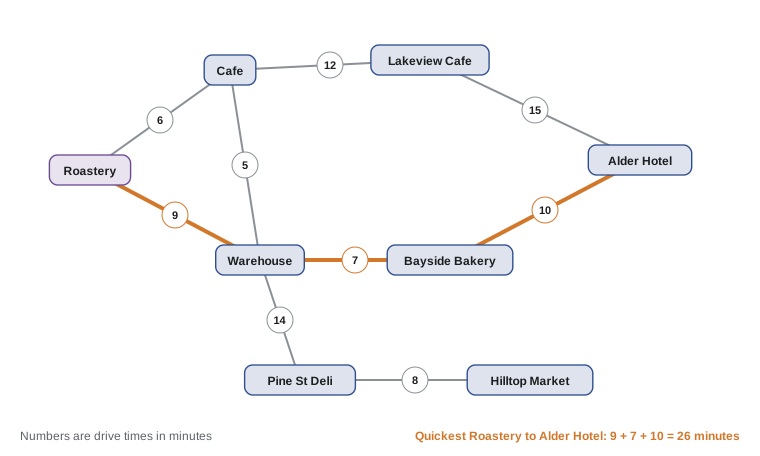
Ridgeline's wholesale deliveries now cover a small network of places: the roastery, the cafe, a warehouse, and cafes, bakeries and hotels around town, connected by roads with known drive times. Theo wants answers to questions such as: which customers can the van reach without passing the bridge that is closed for repairs? What is the route with the fewest stops from the roastery to the Alder Hotel? And what is the quickest route in minutes? None of these fits a list or a tree, because places connect to each other in every direction. They are questions about a graph.
Graphs model anything made of things and connections between them: road networks, social networks, links between web pages, dependencies between tasks and the flow of goods through a supply chain. This lesson introduces graph vocabulary, two standard ways to store a graph, and the three fundamental graph algorithms: breadth-first search, depth-first search and Dijkstra's shortest-path algorithm, all built from the stacks, queues, sets and heaps of earlier lessons.
Graph vocabulary
A graph is a set of vertices (also called nodes) and a set of edges, each connecting two vertices. In an undirected graph, edges work both ways, like a two-way road. In a directed graph, each edge has a direction, like a one-way street or a task that must come before another. A weighted graph gives each edge a number, such as a drive time or a distance. Two vertices joined by an edge are neighbors, and the number of edges at a vertex is its degree. A path is a sequence of vertices joined by edges, and a cycle is a path that returns to where it started. Trees, from lesson 9, are simply connected graphs with no cycles.
Storing a graph
The most common representation in Python is an adjacency list: a dictionary that maps each vertex to its neighbors. For an unweighted graph, the neighbors can be a list or a set; for a weighted graph, a dictionary from neighbor to weight. An adjacency list uses space proportional to the number of vertices plus edges, written O(V + E), and lists a vertex's neighbors quickly, which is what graph algorithms need most.
The alternative is an adjacency matrix, a V by V grid where entry [i][j] holds the weight of the edge from vertex i to vertex j, or nothing if there is none. Checking whether a particular edge exists is O(1), but the matrix needs O(V²) space even if most pairs are not connected. Road networks, like most real graphs, are sparse, with far fewer edges than possible pairs, so adjacency lists are the usual choice.
from collections import defaultdict

roads = [("Roastery", "Cafe", 6), ("Roastery", "Warehouse", 9), ("Cafe", "Lakeview Cafe", 12),
         ("Warehouse", "Bayside Bakery", 7), ("Bayside Bakery", "Alder Hotel", 10),
         ("Lakeview Cafe", "Alder Hotel", 15), ("Warehouse", "Pine St Deli", 14),
         ("Pine St Deli", "Hilltop Market", 8), ("Cafe", "Warehouse", 5)]

graph = defaultdict(dict)
for a, b, minutes in roads:
    graph[a][b] = minutes             # undirected: add both directions
    graph[b][a] = minutes

print(sorted(graph["Warehouse"].items()))
print("degree of Cafe:", len(graph["Cafe"]))
print("vertices:", len(graph), "edges:", sum(len(n) for n in graph.values()) // 2)[('Bayside Bakery', 7), ('Cafe', 5), ('Pine St Deli', 14), ('Roastery', 9)]
degree of Cafe: 3
vertices: 8 edges: 9Try it yourself
Build an adjacency list
Write build_graph(edges) that takes a list of (a, b) pairs for two-way roads and returns a dictionary mapping every place to a sorted list of its neighbors.
Places with roads in both directions must list each other, and every place that appears in an edge must be a key.
def build_graph(edges):
    graph = {}
    for a, b in edges:
        graph[a] = [b]
    return graph

print(build_graph([('Roastery', 'Cafe'), ('Cafe', 'Warehouse')]))
Breadth-first search
Breadth-first search (BFS) explores a graph outward from a starting vertex in layers: first the start, then all its neighbors, then all their unvisited neighbors, and so on. A queue keeps the layers in order, exactly as in the level-order tree traversal of lesson 9, and a set of visited vertices stops the search from going round in cycles. Because BFS reaches every vertex by the smallest possible number of edges, it finds the route with the fewest stops in an unweighted graph. Recording each vertex's parent, the vertex it was discovered from, lets you rebuild the route afterward.
from collections import deque

graph = {
    "Roastery": ["Cafe", "Warehouse"], "Cafe": ["Roastery", "Lakeview Cafe", "Warehouse"],
    "Warehouse": ["Roastery", "Cafe", "Bayside Bakery", "Pine St Deli"],
    "Lakeview Cafe": ["Cafe", "Alder Hotel"], "Bayside Bakery": ["Warehouse", "Alder Hotel"],
    "Alder Hotel": ["Lakeview Cafe", "Bayside Bakery"], "Pine St Deli": ["Warehouse", "Hilltop Market"],
    "Hilltop Market": ["Pine St Deli"],
}

def fewest_stops(graph, start, goal):
    parent = {start: None}
    queue = deque([start])
    while queue:
        place = queue.popleft()
        if place == goal:
            route = []
            while place is not None:          # walk the parents back to the start
                route.append(place)
                place = parent[place]
            return route[::-1]
        for nxt in graph[place]:
            if nxt not in parent:             # parent doubles as the visited set
                parent[nxt] = place
                queue.append(nxt)
    return None

print(fewest_stops(graph, "Roastery", "Alder Hotel"))
print(fewest_stops(graph, "Hilltop Market", "Lakeview Cafe"))['Roastery', 'Cafe', 'Lakeview Cafe', 'Alder Hotel'] ['Hilltop Market', 'Pine St Deli', 'Warehouse', 'Cafe', 'Lakeview Cafe']
Each vertex is added to the queue at most once and each edge is examined at most twice, so BFS runs in O(V + E) time. Marking a vertex as visited when it is added to the queue, rather than when it is removed, matters: otherwise the same vertex could be queued many times through different neighbors.
Try it yourself
How many stops away?
graph is an adjacency list (a dictionary of neighbor lists). Write stops_from(graph, start) that returns a dictionary mapping every place reachable from start to the fewest number of road segments needed to reach it. The start itself is 0 stops away.
Use breadth-first search with a collections.deque.
def stops_from(graph, start):
    return {place: 1 for place in graph[start]}

print(stops_from(net, 'Roastery'))
Depth-first search
Depth-first search (DFS) explores as far as possible along one branch before backing up and trying the next, like walking a maze by keeping one hand on the wall. It can be written recursively, with the call stack doing the bookkeeping, or with an explicit stack, as below. DFS also runs in O(V + E), but it does not find the fewest stops. Its strengths are other questions: whether a vertex can be reached at all, how a graph splits into connected pieces, whether it contains a cycle, and putting tasks in dependency order.
def reachable(graph, start, closed=frozenset()):
    """Every place reachable from start without using a closed place."""
    seen, stack = {start}, [start]
    while stack:
        place = stack.pop()
        for nxt in graph[place]:
            if nxt not in seen and nxt not in closed:
                seen.add(nxt)
                stack.append(nxt)
    return seen

graph = {
    "Roastery": ["Cafe", "Warehouse"], "Cafe": ["Roastery", "Lakeview Cafe", "Warehouse"],
    "Warehouse": ["Roastery", "Cafe", "Bayside Bakery", "Pine St Deli"],
    "Lakeview Cafe": ["Cafe", "Alder Hotel"], "Bayside Bakery": ["Warehouse", "Alder Hotel"],
    "Alder Hotel": ["Lakeview Cafe", "Bayside Bakery"], "Pine St Deli": ["Warehouse", "Hilltop Market"],
    "Hilltop Market": ["Pine St Deli"],
}
everywhere = reachable(graph, "Roastery")
with_closure = reachable(graph, "Roastery", closed={"Pine St Deli"})
print(len(everywhere), "places reachable")
print("cut off by the closure:", sorted(everywhere - with_closure))8 places reachable cut off by the closure: ['Hilltop Market', 'Pine St Deli']
Swapping the stack for a queue turns this code into BFS; the difference between the two searches is entirely the order in which waiting vertices are taken. With Pine St Deli closed, Hilltop Market can no longer be reached, so Theo knows to call that customer before loading the van.
Ordering tasks: topological sort
Directed graphs often describe dependencies. Before a batch can be bagged, it must be roasted; before roasting, the green beans must be weighed and the roaster preheated; labels must be printed before bagging. A topological order lists the tasks so that every task comes after all the tasks it depends on. One classic method, Kahn's algorithm, repeatedly takes a task with no unfinished prerequisites, using a queue and a count of remaining prerequisites for each task. If tasks are left over at the end, the dependencies contain a cycle, and no valid order exists.
from collections import deque

needs = {                                    # task -> tasks that must happen first
    "weigh beans": [], "preheat roaster": [], "print labels": [],
    "roast": ["weigh beans", "preheat roaster"],
    "cool": ["roast"],
    "bag": ["cool", "print labels"],
}

def task_order(needs):
    waiting = {task: len(before) for task, before in needs.items()}
    unlocks = {task: [] for task in needs}
    for task, before in needs.items():
        for b in before:
            unlocks[b].append(task)
    ready = deque(sorted(t for t, n in waiting.items() if n == 0))
    order = []
    while ready:
        task = ready.popleft()
        order.append(task)
        for nxt in unlocks[task]:
            waiting[nxt] -= 1
            if waiting[nxt] == 0:
                ready.append(nxt)
    if len(order) < len(needs):
        raise ValueError("the dependencies contain a cycle")
    return order

print(task_order(needs))['preheat roaster', 'print labels', 'weigh beans', 'roast', 'cool', 'bag']
Shortest paths with Dijkstra's algorithm
BFS counts stops, but Theo cares about minutes, and a route with more stops can be quicker. In a weighted graph with no negative weights, Dijkstra's algorithm, published by Edsger Dijkstra in 1959, finds the quickest route from a start to every other vertex. It keeps the best known time to each vertex and repeatedly settles the unsettled vertex with the smallest known time, which is exactly the job of the priority queue from lesson 10. When a vertex is settled, its time is final, and the algorithm checks whether going through it improves the times of its neighbors.
import heapq

graph = {
    "Roastery": {"Cafe": 6, "Warehouse": 9}, "Cafe": {"Roastery": 6, "Lakeview Cafe": 12, "Warehouse": 5},
    "Warehouse": {"Roastery": 9, "Cafe": 5, "Bayside Bakery": 7, "Pine St Deli": 14},
    "Lakeview Cafe": {"Cafe": 12, "Alder Hotel": 15}, "Bayside Bakery": {"Warehouse": 7, "Alder Hotel": 10},
    "Alder Hotel": {"Lakeview Cafe": 15, "Bayside Bakery": 10},
    "Pine St Deli": {"Warehouse": 14, "Hilltop Market": 8}, "Hilltop Market": {"Pine St Deli": 8},
}

def quickest(graph, start, goal):
    best = {start: 0}
    parent = {start: None}
    heap = [(0, start)]
    while heap:
        minutes, place = heapq.heappop(heap)
        if place == goal:
            route = []
            while place is not None:
                route.append(place)
                place = parent[place]
            return minutes, route[::-1]
        if minutes > best[place]:
            continue                                  # an out-of-date entry: skip it
        for nxt, drive in graph[place].items():
            t = minutes + drive
            if t < best.get(nxt, float("inf")):
                best[nxt] = t
                parent[nxt] = place
                heapq.heappush(heap, (t, nxt))
    return None

print(quickest(graph, "Roastery", "Alder Hotel"))
print(quickest(graph, "Lakeview Cafe", "Hilltop Market"))(26, ['Roastery', 'Warehouse', 'Bayside Bakery', 'Alder Hotel']) (39, ['Lakeview Cafe', 'Cafe', 'Warehouse', 'Pine St Deli', 'Hilltop Market'])
The skipped out-of-date entries are the lazy deletion idea from lesson 10: instead of updating a vertex's entry in the heap, the code pushes a new, better entry and ignores the old one when it surfaces. With a binary heap, Dijkstra's algorithm runs in O((V + E) log V). Mapping apps use refined versions of it, with extra tricks to search millions of road segments quickly. If some weights can be negative, such as a route that earns a refund, Dijkstra's algorithm can give wrong answers, and slower algorithms such as Bellman-Ford are needed.
Worked problem
Choosing the right graph search
For each question, choose BFS, DFS, topological sort or Dijkstra: (a) the fewest transfers between two stations in a transit map; (b) the quickest drive between two customers given road times; (c) whether every customer can still be reached when the bridge is closed; (d) the order in which to install software packages that depend on each other.
Show solution
- (a) Fewest edges in an unweighted graph: BFS.
- (b) Smallest total weight with non-negative weights: Dijkstra.
- (c) Reachability: DFS (BFS also works); compare the reachable set with the full set of customers.
- (d) A valid order of dependencies in a directed graph: topological sort.
Answer: BFS for (a), Dijkstra for (b), DFS for (c), topological sort for (d).
Try it yourself
Can the van reach every customer?
Write unreachable(graph, start) that returns a sorted list of the places in graph that cannot be reached from start by following roads. graph is an adjacency list. Use depth-first search with a stack (a list).
If every place can be reached, return an empty list.
def unreachable(graph, start):
    return sorted(p for p in graph if p not in graph[start] and p != start)

print(unreachable(net, 'Roastery'))
Common mistakes
MistakeForgetting the visited set, so the search loops forever around a cycle.
InsteadTrack visited vertices and skip them.
MistakeMarking vertices visited only when they leave the queue.
InsteadMark them when they are added, so each is queued once.
MistakeUsing BFS to find the quickest route in a weighted graph.
InsteadBFS counts edges; use Dijkstra's algorithm for weights.
MistakeRunning Dijkstra's algorithm with negative weights.
InsteadUse Bellman-Ford when weights can be negative.
MistakeAdding an undirected edge in only one direction.
InsteadAdd both graph[a][b] and graph[b][a].
MistakeUsing an adjacency matrix for a large, sparse network.
InsteadUse an adjacency list: O(V + E) space instead of O(V²).
Summary and key terms
- A graph is a set of vertices joined by edges, which may be directed or undirected, weighted or unweighted.
- An adjacency list (a dict of neighbors) uses O(V + E) space and suits sparse real-world graphs.
- Breadth-first search uses a queue, explores in layers and finds the fewest edges, in O(V + E).
- Depth-first search uses a stack or recursion and answers reachability, components and cycle questions.
- A topological order lists tasks after their prerequisites; Kahn's algorithm finds one or detects a cycle.
- Dijkstra's algorithm uses a min-heap to find quickest routes when weights are not negative.
- Choosing the right search depends on whether you count edges, add weights or check reachability or order.
- graph
- A set of vertices and the edges that connect them.
- vertex
- One of the things a graph connects, also called a node.
- edge
- A connection between two vertices.
- directed graph
- A graph whose edges point one way.
- weighted graph
- A graph whose edges carry numbers such as times or distances.
- adjacency list
- A mapping from each vertex to its neighbors.
- breadth-first search
- Exploring a graph in layers outward from the start, using a queue.
- depth-first search
- Exploring as far as possible along each branch before backing up, using a stack.
- topological order
- An ordering of a directed graph's vertices in which every edge points forward.
- Dijkstra's algorithm
- A shortest-path algorithm for graphs with non-negative edge weights.
Practice problems
Work each problem on paper first, then reveal the answer to check.
Is a one-way street network directed or undirected?
Show answer
Directed.
Why do most programs store road networks as adjacency lists?
Show answer
Road networks are sparse, so lists use O(V + E) space instead of O(V²).
Which data structure drives BFS, and which drives DFS?
Show answer
A queue for BFS; a stack (or recursion) for DFS.
What is the quickest route from the Roastery to the Alder Hotel in the lesson's network, and how long does it take?
Show answer
Roastery, Warehouse, Bayside Bakery, Alder Hotel: 26 minutes.
What does it mean if Kahn's algorithm finishes with tasks left over?
Show answer
The dependencies contain a cycle, so no valid order exists.
When does Dijkstra's algorithm fail?
Show answer
When some edge weights are negative.
Lesson quiz · 5 questions
Score 60% or more to complete this lesson.
Create a free account to save your progress, take quizzes and earn a certificate.