
PYTH-201 · Lesson 10 of 12 · 24 min
Heaps and priority queues
▶ Video coming soon A video version of this lesson is on the way.
Theo's packing queue from lesson 3 serves orders strictly in arrival order. That was fine until Ridgeline started selling express shipping. Now an express order that arrives at 10:40 must be packed before a standard order that arrived at 9:15, and wholesale orders due today come before both. The next order to pack is no longer the oldest one but the one with the highest priority. A structure that always hands back the most urgent item, while new items keep arriving, is called a priority queue.
This lesson shows how to build a priority queue efficiently with a binary heap, a clever tree stored inside a plain list. You will learn how a heap keeps its smallest item at the front with O(log n) insertions and removals, use Python's heapq module, handle ties and maximum-first ordering, and apply heaps to some of the most common practical problems: processing work by priority, finding the top k items in a large dataset and merging sorted streams.
Why not a sorted list?
A priority queue needs two operations: insert an item with a priority, and remove the item with the best priority. One obvious approach keeps a list sorted by priority. Removing the best item is then easy, but every insertion must find its place and shift the items after it, O(n). Another approach appends new items in O(1) but scans the whole list to find the best one, also O(n). A heap gets both operations down to O(log n), which for thousands of waiting orders is the difference between a few steps and thousands.
| Implementation | Insert | Remove the best | Peek at the best |
|---|---|---|---|
| Unsorted list | O(1) | O(n) | O(n) |
| Sorted list | O(n) | O(1) from the end | O(1) |
| Binary heap | O(log n) | O(log n) | O(1) |
The binary heap
A binary heap is a binary tree with two rules. The shape rule says the tree is complete: every level is full except possibly the last, which fills from left to right. The heap rule says every node is less than or equal to its children. Together they guarantee that the smallest item is always at the root, while saying nothing about the order of brothers and sisters, which is what makes heaps cheap to maintain: a heap is only partly sorted.
Because the tree is complete, it can be stored in a list with no gaps and no references. The root is at index 0, and the children of the node at index i are at 2i + 1 and 2i + 2, so the parent of the node at index i is at (i - 1) // 2. Moving around the tree is just arithmetic on indexes.
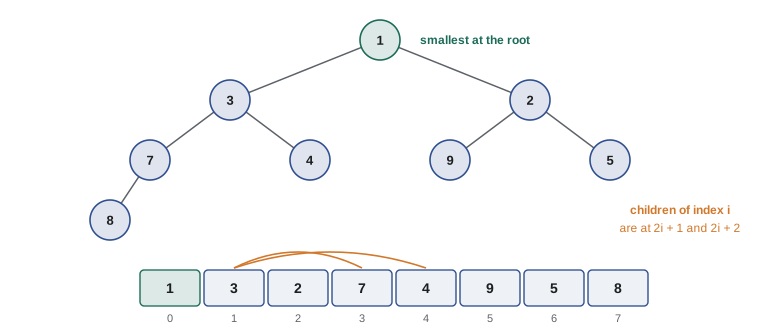
Inserting an item appends it at the end of the list, the next free spot in the bottom level, then lets it sift up: while it is smaller than its parent, swap the two. Removing the smallest item takes the root, moves the last item into the root's place, then lets it sift down: while it is larger than its smaller child, swap them. Each sift moves one level per step, and a complete tree of n items has about log₂ n levels, so both operations are O(log n).
class MinHeap:
    def __init__(self):
        self.a = []

    def push(self, item):
        a = self.a
        a.append(item)
        i = len(a) - 1
        while i > 0 and a[i] < a[(i - 1) // 2]:            # sift up
            p = (i - 1) // 2
            a[i], a[p] = a[p], a[i]
            i = p

    def pop(self):
        a = self.a
        smallest, last = a[0], a.pop()
        if a:
            a[0], i = last, 0
            while True:                                    # sift down
                c = 2 * i + 1
                if c >= len(a):
                    break
                if c + 1 < len(a) and a[c + 1] < a[c]:
                    c += 1                                 # the smaller child
                if a[i] <= a[c]:
                    break
                a[i], a[c] = a[c], a[i]
                i = c
        return smallest

h = MinHeap()
for p in [7, 3, 9, 1, 4, 5, 2, 8]:
    h.push(p)
print("stored as:", h.a)
print("popped:", [h.pop() for _ in range(8)])stored as: [1, 3, 2, 7, 4, 9, 5, 8] popped: [1, 2, 3, 4, 5, 7, 8, 9]
The heapq module
Python's heapq module provides these operations as functions that work on an ordinary list, written in C for speed. heappush adds an item, heappop removes and returns the smallest, and heap[0] peeks at the smallest without removing it. heapify turns an existing list into a heap in place in O(n), faster than pushing the items one by one. heapq always builds a min-heap: the smallest item comes out first.
import heapq

stock = [42, 15, 27, 9, 12, 30, 21]
heapq.heapify(stock)                     # O(n), in place
print("smallest:", stock[0])
heapq.heappush(stock, 5)
print([heapq.heappop(stock) for _ in range(3)])
print("left:", sorted(stock))smallest: 9 [5, 9, 12] left: [15, 21, 27, 30, 42]
Priorities, ties and maximum first
Real priority queues store items with priorities, usually as tuples, because tuples compare element by element. Theo uses (priority, arrival, order_id), where priority 0 is wholesale due today, 1 is express and 2 is standard. The arrival number breaks ties so that equal priorities come out first in, first out, and it also prevents Python from ever comparing the order objects themselves, which might not support comparison. For a maximum-first queue, push the negated priority, since the smallest negative number corresponds to the largest value.
import heapq, itertools

arrival = itertools.count()              # 0, 1, 2, ... a tie-breaker in arrival order
queue = []

def add(order_id, priority):
    heapq.heappush(queue, (priority, next(arrival), order_id))

add(1041, 2); add(1042, 2); add(1043, 1); add(1044, 0); add(1045, 1)
while queue:
    priority, _, order_id = heapq.heappop(queue)
    print(f"pack {order_id} (priority {priority})")

biggest_first = []
for total in [41.5, 18.5, 64.25, 22.0]:
    heapq.heappush(biggest_first, -total)
print([-heapq.heappop(biggest_first) for _ in range(2)])pack 1044 (priority 0) pack 1043 (priority 1) pack 1045 (priority 1) pack 1041 (priority 2) pack 1042 (priority 2) [64.25, 41.5]
Try it yourself
Pack orders by priority
Each order is a tuple (order_id, priority); lower priority numbers are more urgent. Write packing_order(orders) that returns the order ids in the sequence they should be packed: most urgent first, and orders with the same priority in their original order.
Use heapq with a tie-breaking counter.
def packing_order(orders):
    return [order_id for order_id, priority in orders]

print(packing_order([(1041, 2), (1042, 1), (1043, 2), (1044, 0)]))
Top k with a heap
Rosa wants the ten biggest loyalty spenders out of 50,000 members for a thank-you mailing. Sorting all 50,000 is O(n log n) and does more work than needed. heapq.nlargest(k, items, key=...) keeps a min-heap of just the best k seen so far: each new member is compared with the smallest of the current top k at the root, and only replaces it if bigger. That costs O(n log k), and with k = 10, log k is tiny, so it is nearly a single pass. heapq.nsmallest works the same way for the smallest items.
import heapq, random

random.seed(201)
members = [(f"M{k:05d}", round(random.uniform(5, 900), 2)) for k in range(50_000)]
top = heapq.nlargest(5, members, key=lambda m: m[1])
for member, spent in top:
    print(member, spent)

def top_k(items, k):
    """The k largest values, using a min-heap of size k."""
    heap = []
    for x in items:
        if len(heap) < k:
            heapq.heappush(heap, x)
        elif x > heap[0]:
            heapq.heapreplace(heap, x)     # pop the smallest and push x in one step
    return sorted(heap, reverse=True)

print(top_k([spent for _, spent in members], 3) == [s for _, s in top[:3]])M35591 899.95 M16633 899.93 M12632 899.85 M30076 899.84 M00652 899.8 True
Try it yourself
Lowest stock alerts
Write lowest_stock(stock, k) where stock is a dictionary mapping SKUs to bags in stock. Return a list of the k SKUs with the fewest bags, fewest first. If two SKUs have the same stock, the one that comes first alphabetically goes first.
Use heapq.nsmallest. If k is larger than the number of SKUs, return them all.
def lowest_stock(stock, k):
    return list(stock)[:k]

print(lowest_stock({'RC-101': 42, 'RC-104': 9, 'RC-105': 12, 'RC-102': 15}, 2))
Changing priorities
Real queues change while items wait. A customer upgrades an order to express shipping, or cancels it altogether. A heap has no fast way to find an item in the middle of its list, since only the root is in a known place, so searching for the order and repairing the heap would cost O(n). The standard technique is lazy deletion: instead of removing the old entry, mark it as canceled and push a new entry if the priority changed. When a canceled entry reaches the top, it is simply thrown away. A dictionary from order id to its current entry makes the marking O(1).
import heapq, itertools

class OrderQueue:
    CANCELLED = None

    def __init__(self):
        self.heap, self.entries, self.count = [], {}, itertools.count()

    def add(self, order_id, priority):
        if order_id in self.entries:
            self.cancel(order_id)                   # changing priority: retire the old entry
        entry = [priority, next(self.count), order_id]
        self.entries[order_id] = entry
        heapq.heappush(self.heap, entry)

    def cancel(self, order_id):
        entry = self.entries.pop(order_id)
        entry[2] = self.CANCELLED                   # mark it; it stays in the heap for now

    def next(self):
        while self.heap:
            priority, _, order_id = heapq.heappop(self.heap)
            if order_id is not self.CANCELLED:
                del self.entries[order_id]
                return order_id
        return None

q = OrderQueue()
for order_id in (1041, 1042, 1043):
    q.add(order_id, 2)                              # all standard shipping
q.add(1043, 1)                                      # 1043 upgrades to express
q.cancel(1041)                                      # 1041 is cancelled
print(q.next(), q.next(), q.next())1043 1042 None
Each entry is a list rather than a tuple so it can be marked in place, and the heap still compares entries by priority and then arrival number, never reaching the order id. The cost is some wasted space for canceled entries until they surface, which is usually a fair trade. The Python documentation for heapq describes this same pattern, and lesson 11 relies on a similar idea when it finds shortest routes.
Merging sorted streams
Heaps also merge several sorted sequences efficiently. Each of Ridgeline's three sales channels, the cafe till, the online shop and wholesale, writes a log already sorted by time, and Anita wants one combined log. Put the first entry of each log in a heap; repeatedly pop the earliest entry and push the next entry from the same log. With k logs and n entries in total, that is O(n log k). heapq.merge does exactly this lazily, returning an iterator, so even logs too big for memory can be merged as they are read.
import heapq

cafe = [("08:05", "cafe", 5.25), ("09:40", "cafe", 3.25), ("11:10", "cafe", 9.00)]
online = [("08:30", "online", 41.50), ("10:15", "online", 18.50)]
wholesale = [("09:00", "wholesale", 640.00)]

for time, channel, amount in heapq.merge(cafe, online, wholesale):
print(time, f"{channel:<9}", f"{amount:>7.2f}")08:05 cafe 5.25 08:30 online 41.50 09:00 wholesale 640.00 09:40 cafe 3.25 10:15 online 18.50 11:10 cafe 9.00
Two related ideas complete the picture. Heap sort builds a heap and pops everything, an O(n log n) sort that needs no extra memory, though Python's sorted is faster in practice. And heaps sit inside many famous algorithms, including the shortest-route algorithm previewed in lesson 11, schedulers that decide which task an operating system runs next, and event-driven simulations that always process the earliest upcoming event, a natural upgrade of the minute-by-minute cafe simulation in lesson 3.
Worked problem
Scheduling the roaster
Kai's roasting jobs each have a deadline (the hour the beans must be ready). New jobs arrive during the day. At each moment the roaster becomes free, which job should start, and which structure makes that choice fast?
Show solution
- A sensible rule is earliest deadline first: start the job whose deadline is soonest.
- That is exactly a priority queue keyed by deadline: insert each arriving job, pop the minimum when the roaster is free.
- Use tuples (deadline, arrival_number, job) so that equal deadlines start in arrival order and jobs themselves are never compared.
- With heapq, each arrival and each start costs O(log n), so even hundreds of queued jobs are handled instantly.
- Peek with heap[0] to show the next job on the roaster screen without removing it.
Answer: A min-heap of (deadline, arrival, job) tuples with heapq: push on arrival, pop when the roaster is free.
Try it yourself
Merge sorted logs
Write merge_logs(logs) where logs is a list of lists, each sorted by time and containing (time, amount) tuples. Return one list of all entries sorted by time, using heapq.merge.
Times are strings such as "08:05", which sort correctly as text.
def merge_logs(logs):
    out = []
    for log in logs:
        out.extend(log)
    return out

print(merge_logs([[('08:05', 5.25), ('09:40', 3.25)], [('08:30', 41.5)]]))
Common mistakes
MistakeExpecting a heap list to be fully sorted.
InsteadOnly heap[0] is guaranteed smallest; pop repeatedly or use sorted() for a sorted list.
MistakePushing (priority, order) where orders cannot be compared.
InsteadAdd a tie-breaking counter: (priority, count, order).
MistakeTrying to get the largest item first from heapq directly.
InsteadNegate numeric priorities, or use nlargest.
MistakeSorting a huge list to find the top 10.
InsteadUse heapq.nlargest(10, items), which is O(n log k).
MistakeChanging items inside the heap list directly.
InsteadChange heaps only with heappush, heappop, heapreplace or heapify.
MistakeUsing heappop on an empty heap.
InsteadCheck that the heap is not empty first.
Summary and key terms
- A priority queue removes the item with the best priority rather than the oldest.
- A binary heap is a complete binary tree in which each node is no larger than its children, so the smallest item is at the root.
- A heap is stored in a list: the children of index i are at 2i + 1 and 2i + 2.
- Insertion sifts up and removal sifts down, each O(log n); peeking is O(1) and heapify is O(n).
- heapq implements a min-heap on a plain list; use tuples with a tie-breaker, and negate for maximum first.
- nlargest and nsmallest find the top k in O(n log k); heapq.merge merges sorted streams lazily.
- Heaps power schedulers, event simulations and shortest-route algorithms.
- priority queue
- A collection that always removes the item with the highest priority.
- binary heap
- A complete binary tree with the heap property, stored in a list.
- min-heap
- A heap whose smallest item is at the root.
- max-heap
- A heap whose largest item is at the root.
- heap property
- Every node is no larger (min-heap) or no smaller (max-heap) than its children.
- complete binary tree
- A binary tree with every level full except the last, filled from the left.
- sift up
- Moving a new item up the heap until its parent is not larger.
- sift down
- Moving an item down the heap until it is not larger than its children.
- heapify
- Rearranging a list into a heap in O(n).
- top k
- The k largest (or smallest) items of a collection.
Practice problems
Work each problem on paper first, then reveal the answer to check.
In a heap stored as a list, where are the children of index 3, and where is its parent?
Show answer
Children at 7 and 8; parent at 1.
Why are heap insertion and removal O(log n)?
Show answer
Each sift moves one level per step, and a complete tree has about log n levels.
After heapify([5, 3, 8, 1]), which item is at index 0?
Show answer
1, the smallest.
How would you make heapq return the largest total first?
Show answer
Push negated totals, or use heapq.nlargest.
What is the cost of finding the 10 largest of n items with nlargest?
Show answer
O(n log 10), effectively O(n).
Why add a counter to (priority, counter, item) tuples?
Show answer
It keeps equal priorities in arrival order and avoids comparing items.
Lesson quiz · 5 questions
Score 60% or more to complete this lesson.
Create a free account to save your progress, take quizzes and earn a certificate.