
PWR-210 · Lesson 7 of 12 · 27 min
Properties of steam and the steam tables
▶ Video coming soon A video version of this lesson is on the way.
On Thursday, October 15, 2026, Grazyna Wolanski kept her promise. She put a printed set of steam tables on the control room desk, opened it to the saturated steam pages and set a calculator beside it. "Everything we sell leaves this building as steam, and everything we pay for arrives as fuel," she said to Tamar Ellingsen. "These pages are the bridge between the two. By the end of the morning I want you to tell me how much heat each pound of our steam carries, and how much of it we put in."
This lesson covers what happens when water is heated into steam at constant pressure, the terms used for the states of steam, how the steam tables are laid out and how to read them, enthalpy and the meaning of hf, hfg and hg, wet steam and dryness fraction, superheated steam, interpolation between table rows, and flash steam. It builds on the sensible and latent heat ideas from PWR-120 and on absolute pressure from lesson 6.
Making steam at constant pressure
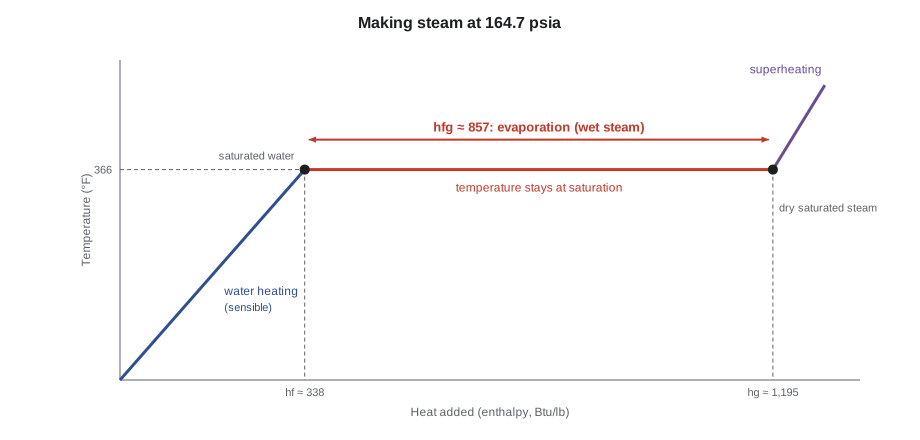
Imagine one pound of water in a cylinder under a piston that keeps the pressure constant at 164.7 psia, Cantwell's drum pressure. Heat is added steadily. Three stages follow, and they happen in every boiler.
- Sensible heating of the water. The water warms until it reaches the saturation temperature for that pressure, about 366 °F. No steam forms yet. Water at its saturation temperature is called saturated water.
- Evaporation. Further heat does not raise the temperature. Instead the water turns into steam, bubble by bubble, at a constant temperature. The heat absorbed is latent heat. While both water and steam are present, the mixture is wet steam. When the last drop has evaporated, the steam is dry saturated steam.
- Superheating. If heat is still added once there is no water left, the temperature of the steam rises above the saturation temperature. Steam above its saturation temperature is superheated steam.
The saturation temperature depends on the pressure. Raise the pressure and water must get hotter before it boils; lower the pressure and it boils at a lower temperature. Every saturation pressure has exactly one saturation temperature, which is why a saturated steam boiler's pressure gauge also tells the operator the temperature of the steam and the water in the drum.
Enthalpy
Steam tables do not list "heat" as such. They list enthalpy, given the symbol h: the energy a fluid carries per unit mass, counting both its internal energy and the work done in pushing it into and out of the space it occupies. In a boiler, where water flows in and steam flows out at steady pressure, the heat added to each unit of mass is simply the enthalpy out minus the enthalpy in. That one idea makes the tables very easy to use.
Enthalpy is given in Btu/lb. The tables measure it from a reference state of liquid water at 32 °F. Only differences in enthalpy matter in calculations, so the choice of starting point never affects an answer.
Three enthalpies are listed for each saturation pressure:
- hf, the enthalpy of saturated water: the sensible heat needed to bring water from the reference state up to the saturation temperature.
- hfg, the enthalpy of evaporation, or latent heat: the heat needed to turn saturated water into dry saturated steam at that pressure.
- hg, the enthalpy of dry saturated steam: the total of the two.
As the pressure rises, hf grows (the water is hotter) and hfg shrinks (less heat is needed to separate the molecules). The total, hg, changes only a little across the whole range of plant pressures. At a pressure of about 3,200 psia, the critical point, hfg falls to zero and water and steam become indistinguishable; that is far above anything at Cantwell.
How the tables are laid out
Steam tables come in a few standard parts. The saturation tables are arranged either by pressure or by temperature: one column gives the pressure or temperature, the next its partner, and then come specific volume, enthalpy and entropy for saturated water and steam. The superheat tables give properties at combinations of pressure and temperature above saturation. Entropy, the last column, is used in turbine and cycle work at higher certificate levels.
Modern tables are based on the IAPWS Industrial Formulation 1997, an internationally agreed set of equations for water and steam. Different publishers round and present the values slightly differently, so two printed tables may disagree in the last digit. Always use the tables your examination or employer provides. The values below are rounded typical values taken from standard saturated steam tables, with pressure in psia.
| Pressure (psia) | Saturation temperature (°F) | hf (Btu/lb) | hfg (Btu/lb) | hg (Btu/lb) |
|---|---|---|---|---|
| 14.7 | 212.0 | 180.2 | 970.1 | 1,150.3 |
| 100 | 327.8 | 298.5 | 889.0 | 1,187.5 |
| 150 | 358.4 | 330.5 | 863.4 | 1,193.9 |
| 200 | 381.8 | 355.5 | 842.8 | 1,198.3 |
Look at the pattern down the columns: as pressure rises, the saturation temperature and hf rise, hfg falls, and hg rises only slightly. Note also that the specific volume of steam, which the full tables list, falls sharply with pressure. At Cantwell's drum pressure, dry steam takes up about 150 times the volume of the water it came from, and at atmospheric pressure about 1,600 times. That is why steam lines are so much larger than feedwater lines for the same mass flow.
Interpolation
The tables list only certain pressures. For a pressure between two rows, the value is found by linear interpolation: assuming the property changes in a straight line between the two rows, and taking the same fraction of the way along. The fraction is how far the wanted pressure lies between the two listed pressures.
Worked problem
Interpolating a saturation temperature
Find the saturation temperature at 125 psia from the rows for 100 and 150 psia.
Show solution
- Fraction of the way from 100 to 150:
- \[\frac{125 - 100}{150 - 100} = 0.5\]
- Saturation temperature:
- \[T = 327.8 + 0.5 \times (358.4 - 327.8) = 343.1 \text{ °F}\]
Answer: About 343.1 °F. The exact value from the IAPWS equations is about 344.3 °F, so straight-line interpolation is within about 1.2 °F here. The closer together the table rows, the smaller the error, which is why full tables list many more pressures than this summary.
Interpolating to Cantwell's drum pressure of 164.7 psia, which is about 0.29 of the way from 150 to 200, gives hf of about 338 Btu/lb, hfg of about 857 Btu/lb and hg of about 1,195 Btu/lb, with a saturation temperature of about 366 °F from the exact equations. Those are the numbers Tamar used for the rest of the morning.
Heat needed to make steam
With the tables, the heat added in a boiler is the enthalpy of the steam leaving minus the enthalpy of the water entering. The feedwater at Cantwell arrives from the deaerator, already hot, so its own enthalpy must be subtracted.
Worked problem
Heat per unit of steam
Feedwater enters boiler 2 at 221 °F, where hf is about 189 Btu/lb. The boiler makes dry saturated steam at 164.7 psia. How much heat does the boiler add to each pound?
Show solution
- Heat added:
- \[q = h_g - h_{\text{feed}} = 1{,}195 - 189 = 1{,}006 \text{ Btu/lb}\]
Answer: About 1,006 Btu for every pound. Of that, only about 149 Btu (338 − 189) finishes heating the water; the rest, about 857 Btu, is latent heat. This is the answer to Grazyna's question, and lesson 12 uses it to find how much fuel a pound of steam costs.
A handy check: for water below its boiling point at atmospheric pressure, hf is close to the temperature in °F minus 32. Any figure far from that rule of thumb points to a misread table.
Wet steam and dryness fraction
Steam leaving a boiler drum is rarely perfectly dry. Small droplets carried over from the water surface make it slightly wet. The dryness fraction, or quality, x, is the mass of dry steam in each unit mass of the mixture. Steam with x = 0.98 is 98 parts dry steam and 2 parts water by mass. Only the steam part has received its latent heat, so the enthalpy of wet steam is:
Worked problem
Enthalpy of wet steam
If boiler 2's steam has a dryness fraction of 0.98 at 164.7 psia, what is its enthalpy, and how much heat was added per pound from feedwater at 189 Btu/lb?
Show solution
- Enthalpy:
- \[h = 338 + 0.98 \times 857 \approx 1{,}178 \text{ Btu/lb}\]
- Heat added:
- \[1{,}178 - 189 = 989 \text{ Btu/lb}\]
Answer: About 1,178 Btu/lb, 17 Btu/lb less than dry steam. Wet steam carries less useful heat, wears turbine blades and valve seats, and brings boiler water solids into the steam lines.
Dryness can be measured. A separating calorimeter catches the water from a sample and weighs it against the condensed steam; a throttling calorimeter expands a sample to low pressure, where any superheat that appears reveals how dry the sample was. If a separator removes 30 parts of water from every 1,000 parts of mixture, the dryness fraction is (1,000 − 30) ÷ 1,000 = 0.97. In practice, plants rely on good drum internals, steady water levels and controlled boiler water chemistry to keep carryover low.
Superheated steam
Superheated steam has been heated beyond its saturation temperature. The amount by which it exceeds that temperature is the degree of superheat. Superheat lets steam travel through turbines and long lines without condensing, and it carries more energy per unit mass. Its enthalpy is read from the superheat tables, which need both pressure and temperature because, unlike saturated steam, superheated steam can exist at many temperatures for the same pressure.
Worked problem
Degree of superheat
Steam at 150 psia and 500 °F. From the saturation table, the saturation temperature is 358.4 °F, and from the superheat table its enthalpy is about 1,274 Btu/lb. What is the degree of superheat, and how much more energy does it carry than dry saturated steam at the same pressure?
Show solution
- Degree of superheat:
- \[500 - 358.4 = 141.6 \text{ °F}\]
- Extra enthalpy:
- \[1{,}274 - 1{,}194 = 80 \text{ Btu/lb}\]
Answer: About 142 °F of superheat, carrying about 80 Btu/lb more than saturated steam. Cantwell's boilers make saturated steam for heating, so superheat matters most at the steam turbine on the backup feed pump and in larger power plants.
Flash steam
When saturated water at high pressure is released to a lower pressure, it is suddenly hotter than the new saturation temperature. Part of it boils instantly, using its own extra sensible heat as the latent heat for that part. This is flash steam, the white cloud seen at a steam trap discharge or a blowdown tank vent. The fraction that flashes is the extra enthalpy divided by the latent heat at the low pressure.
For water from Cantwell's drum, at 338 Btu/lb, released to atmospheric pressure, where hf is 180 and hfg is 970: (338 − 180) ÷ 970 ≈ 0.163. About one sixth of the blowdown water flashes to steam the moment it leaves the valve. Flash tanks and heat recovery units capture that steam for the deaerator rather than venting it.
Tamar's answer
By noon, Tamar had a page of numbers for Grazyna: 1,195 Btu in every pound of dry steam leaving the drum, 189 Btu of it already in the feedwater, 1,006 Btu added by the boiler. Grazyna checked one number with her own calculator, nodded, and turned the tables to the superheat pages. "Next time," she said, "we do the same for the turbine on the backup feed pump."
Using the tables on rounds
The saturation tables are as useful on a round as at a desk. Because pressure and temperature are locked together for saturated steam, each one checks the other:
- Drum pressure against steam temperature. If a thermometer on a saturated steam line reads well above the saturation temperature for the line's absolute pressure, either the steam is superheated, which a plain saturated boiler cannot do, or the thermometer or the gauge is wrong.
- Deaerator pressure against water temperature. The water in a working deaerator should be at the saturation temperature for its pressure. Water noticeably cooler than that means the deaerator is not heating fully, and oxygen may be getting through to the boilers.
- Condensate temperature against receiver pressure. Condensate arriving well above the saturation temperature for a vented receiver will flash, and the plume from the vent shows it.
The tables arranged by temperature are handy for these checks: enter with the measured temperature and read the saturation pressure directly, then convert it to gauge pressure by subtracting atmospheric pressure to compare with the gauge. Specific volume, the other main column, explains why a little water carried into a steam line becomes a slug that can hammer: the same mass of water occupies only a small fraction of the space of the steam it displaces, and it travels with the steam at high velocity until it hits a bend or a closed valve. Lesson 12 uses the enthalpy columns again for the deaerator.
Common mistakes
MistakeLooking up a gauge pressure in the steam tables.
InsteadConvert to absolute pressure first.
MistakeAdding hf and hfg for wet steam.
InsteadMultiply hfg by the dryness fraction: h = hf + x hfg.
MistakeForgetting to subtract the feedwater enthalpy.
InsteadHeat added in the boiler is steam enthalpy minus feedwater enthalpy.
MistakeReading superheated steam from the saturation table.
InsteadSuperheated steam needs both pressure and temperature, from the superheat table.
MistakeInterpolating across a wide gap without checking.
InsteadCloser table rows give smaller errors; check the answer looks reasonable.
Summary and key terms
- Water heated at constant pressure warms to saturation, evaporates at constant temperature, then superheats.
- Saturation temperature depends only on pressure; the tables use absolute pressure.
- hf is the enthalpy of saturated water, hfg the latent heat, hg = hf + hfg the enthalpy of dry saturated steam.
- Heat added in a boiler = steam enthalpy − feedwater enthalpy.
- Wet steam: h = hf + x hfg; superheated steam is read from the superheat tables using pressure and temperature.
- Linear interpolation finds values between table rows; flash fraction = (hf high − hf low) ÷ hfg low.
- Saturation temperature
- The boiling temperature of water at a given pressure.
- Enthalpy
- The energy a flowing fluid carries per unit mass, listed in the steam tables.
- Dryness fraction
- The mass fraction of dry steam in a steam-water mixture, also called quality.
- Dry saturated steam
- Steam at its saturation temperature containing no liquid water.
- Superheated steam
- Steam heated above its saturation temperature.
- Degree of superheat
- How far superheated steam is above its saturation temperature.
- Flash steam
- Steam formed when hot water is released to a lower pressure.
- Interpolation
- Estimating a value between two table rows by assuming a straight-line change.
Practice problems
Work each problem on paper first, then reveal the answer to check.
Using the table above, what is hg at 150 psia?
Show answer
About 1,194 Btu/lb.
What is the enthalpy of steam at 150 psia with x = 0.95?
Show answer
About 1,151 Btu/lb (330.5 + 0.95 × 863.4).
Interpolate the saturation temperature at 175 psia between 150 and 200 psia.
Show answer
About 370.1 °F.
Steam at 200 psia is at 450 °F. What is its degree of superheat?
Show answer
About 68 °F.
How much heat does the boiler add per pound to make dry steam at 150 psia from feedwater at 189 Btu/lb?
Show answer
About 1,005 Btu/lb.
Lesson quiz · 5 questions
Score 60% or more to complete this lesson.
Create a free account to save your progress, take quizzes and earn a certificate.