
PWR-210 · Lesson 5 of 12 · 24 min
Heat and temperature
▶ Video coming soon A video version of this lesson is on the way.
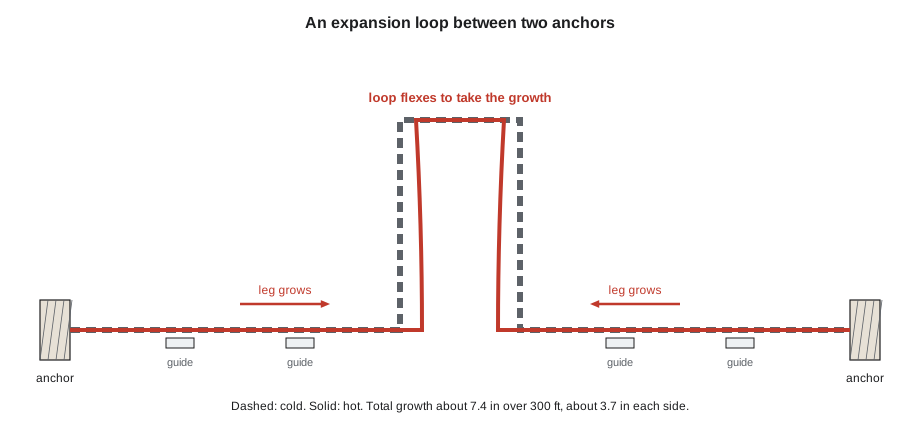
On Friday, October 9, 2026, Fenella Thorncroft took Tamar Ellingsen into the steam tunnel under Broad Street to look at an expansion loop. The main steam line ran straight for a long stretch, then bent up into a wide U and came back down, like a goalpost lying on its side. A painted mark on the pipe sat a hand's width from a mark on the guide beneath it. "In August, with the line cold for maintenance, those marks lined up," Fenella said. "Now it's hot. The pipe grew, and the loop took it. If that loop weren't there, the pipe would have pushed something over."
This lesson covers temperature and how it is measured, the temperature scales and absolute temperature, heat and specific heat in more depth than PWR-120, mixing streams at different temperatures, the heat needed to warm a boiler from cold, and thermal expansion of pipes and metals, with the expansion loops and joints that absorb it.
Temperature and its scales
Temperature measures how hot or cold something is, which at the level of molecules means how fast they are moving. Two bodies at the same temperature, touching each other, exchange no heat; that observation, sometimes called the zeroth law of thermodynamics, is what makes a thermometer work, because a thermometer reaches the temperature of whatever it touches and then reports its own.
Four scales are in common use. The Celsius scale puts the freezing point of water at 0 °C and its boiling point at atmospheric pressure at 100 °C. The Fahrenheit scale puts them at 32 °F and 212 °F, so its degrees are smaller: 180 °F span the same range as 100 °C. The kelvin scale has degrees the same size as Celsius but starts at absolute zero, the lowest possible temperature, at −273.15 °C. The Rankine scale does the same for Fahrenheit, starting at −459.67 °F.
| Point | °C | K | °F | °R |
|---|---|---|---|---|
| Absolute zero | −273.15 | 0 | −459.67 | 0 |
| Water freezes | 0 | 273.15 | 32 | 491.67 |
| Water boils (1 atm) | 100 | 373.15 | 212 | 671.67 |
| Cantwell header steam (saturated) | 185 | 458 | 365 | 825 |
Lesson 1 gave the conversions. The point to remember is that ordinary temperatures, in °C or °F, are fine for sensible heat calculations, because those use temperature differences. Absolute temperatures are needed whenever a formula multiplies or divides by a temperature itself, as the gas laws and the radiation law do.
Measuring temperature in a plant
A plant measures temperature in many ways, each suited to a range and a job:
- Liquid-in-glass and bimetal dial thermometers read locally on pipes and tanks. A bimetal thermometer uses a coiled strip of two metals that expand at different rates, so the coil winds or unwinds as it heats.
- Thermocouples join two different metals; the junction produces a small voltage that rises with temperature. They are rugged and cover high ranges, which suits flue gas and furnace measurements.
- Resistance temperature detectors (RTDs) use a fine platinum wire whose resistance rises steadily with temperature. They are accurate and stable, which suits feedwater, steam and hot water measurements.
- Thermistors are small semiconductor sensors whose resistance changes sharply with temperature, common in equipment controls.
- Infrared thermometers and thermal cameras read the radiation from a surface without touching it. They are quick for finding hot bearings and missing insulation, but their reading depends on the surface's emissivity (lesson 8), so shiny metal can fool them.
Most fixed sensors sit in a thermowell, a closed tube welded or screwed into the pipe so the sensor can be removed without opening the line. A thermowell slows the response a little and must be deep enough to reach the moving fluid. A sensor that reads low on a hot line has often slipped partly out of its well.
Heat, specific heat and sensible heat
PWR-120 introduced sensible heat, latent heat and the formula for heat that changes temperature. This lesson uses it more widely. The heat that a mass m of a substance gains or loses when its temperature changes by ΔT is its mass times its specific heat capacity times the temperature change.
Specific heat (c) is the heat needed to raise one pound of a substance by 1 °F, in Btu/(lb·°F). Water's specific heat is 1.0 by definition of the Btu, rising a little as water gets very hot; steel's is about 0.12; air's is about 0.24 at constant pressure. Water's high value is why a small flow of water carries a lot of heat, and why water heats up and cools down slowly.
Worked problem
Heat to warm a boiler from cold
After its internal inspection, boiler 3 must be warmed from 59 °F to its operating saturation temperature of about 366 °F. The steel of the boiler weighs about 70,500 lb. Using c = 0.12 Btu/(lb·°F), how much heat goes into the steel alone?
Show solution
- Temperature rise:
- \[366 - 59 = 307 \text{ °F}\]
- Heat into the steel:
- \[Q = 70{,}500 \times 0.12 \times 307 \approx 2{,}597{,}000 \text{ Btu}\]
Answer: About 2.6 million Btu, before counting the water, the refractory and the losses. Delivered slowly over a warm-up of several hours, as PWR-120 described, that heat lets the thick drum and the thin tubes rise in temperature together instead of straining against each other.
Mixing streams at different temperatures
When two streams of the same liquid mix and no heat is lost, the heat lost by the hotter one equals the heat gained by the colder one. If both have the same specific heat, the final temperature is the mass-weighted average of the two temperatures. This happens all the time in a plant: condensate mixing with cold make-up water in the condensate tank, hot and cold water mixing at a three-way valve, return water mixing with supply in a bypass.
Worked problem
Condensate and make-up water
In one minute, 130 lb of condensate at 176 °F and 90 lb of cold make-up water at 50 °F flow into the condensate tank. If they mix with no heat loss, what is the temperature of the mixture?
Show solution
- Weighted average:
- \[T = \frac{130 \times 176 + 90 \times 50}{130 + 90} = \frac{22{,}880 + 4{,}500}{220} \approx 124 \text{ °F}\]
Answer: About 124 °F. Every pound of condensate lost in the buildings is replaced by cold water that drags the tank temperature down, so the deaerator then has to use more steam to heat the feedwater. Lesson 12 puts a number on that steam.
The same idea works with different substances, as long as each one's specific heat is used. A hot steel part dropped into a bucket of water ends up at a temperature where the heat the steel lost equals the heat the water gained. That is how some laboratory methods measure a specific heat, and it explains why cooling water poured on hot metal can cool it far faster than air, at the cost of large thermal stresses.
Thermal expansion
Almost every material grows when it is heated and shrinks when it cools. For a long, thin object such as a pipe, the change in length is proportional to the original length and to the temperature change. The constant of proportionality is the coefficient of linear expansion, α, the fraction by which the material grows for each degree of temperature rise.
| Material | Coefficient of linear expansion (typical) |
|---|---|
| Carbon steel | about 6.5 × 10⁻⁶ per °F |
| Stainless steel | about 9.6 × 10⁻⁶ per °F |
| Copper | about 9.4 × 10⁻⁶ per °F |
| Aluminum | about 12.8 × 10⁻⁶ per °F |
| Concrete | about 5.5 × 10⁻⁶ per °F |
Worked problem
How much the tunnel main grows
A straight run of carbon steel steam main in the tunnel is 300 ft long between anchors. It was installed at 50 °F and runs at about 366 °F. Using α = 6.5 × 10⁻⁶ per °F, how much does it grow?
Show solution
- Temperature rise:
- \[366 - 50 = 316 \text{ °F}\]
- Growth:
- \[\Delta L = 6.5 \times 10^{-6} \times 300 \times 316 \approx 0.616 \text{ ft} \approx 7.4 \text{ in}\]
Answer: About 7.4 in, roughly the hand's width Fenella pointed to. That movement has to go somewhere every time the line heats and cools.
What happens if expansion is blocked
If a pipe is held so tightly at both ends that it cannot grow, the expansion turns into stress. The pipe is effectively compressed by the amount it wanted to grow, and the stress that results is Young's modulus times the strain it was prevented from taking.
For carbon steel heated by 316 °F, that is 29,000,000 psi × 6.5 × 10⁻⁶ × 316 ≈ 59,600 psi, well above the yield strength of ordinary pipe steel. The pipe would buckle, or push its anchors out of the wall, or crack a branch connection. Note that the stress does not depend on the length: a short pipe locked between two anchors is stressed just as much as a long one.
Piping designers therefore never fight expansion; they guide it. Anchors fix the pipe at chosen points. Guides let it slide along its length but not sideways. Between anchors, the growth is taken up by:
- Expansion loops and offsets, which bend slightly as the pipe grows. They need no maintenance but take up space.
- Expansion joints of the bellows type, which flex like a concertina. They are compact but can fail if they are overstretched, twisted or not guided properly.
- Slip joints, in which one pipe slides inside another through packing. They need repacking and can leak.
Expansion also explains several operating rules. Lines must be warmed slowly so that they can move freely and so that drains can clear the condensate. Guides and hangers must be free, not seized. A pipe that has slipped off a guide or a hanger rod that is bent at a steep angle is a sign that the line is not moving the way it was designed to, and it should be reported.
Expansion in boilers and equipment
Inside a boiler, parts at different temperatures expand by different amounts. The furnace and tubes nearest the flame run hotter than the outer shell, and thin tubes heat faster than thick drums. Firetube boilers use flexible tube sheets and corrugated furnaces; watertube boilers hang their drums and tubes so that they can grow downward freely. Rapid temperature changes, whether from a fast warm-up, a sudden load swing or cold feedwater striking hot metal, cause large differences in expansion and large thermal stresses. Repeated many times, those stresses crack tube ends and ligaments by fatigue, as lesson 4 described.
The same physics appears in smaller ways all through the plant. A bolted flange that is heated faster than its bolts can leak until the bolts catch up. A pump casing that is warmed unevenly can rub its rotor. A thermowell on a cold line can loosen as it cycles. Each of these is easier to understand once an operator thinks of every piece of metal as quietly growing and shrinking with every change in temperature.
Volume expansion and water
Liquids expand by volume as they heat. Water is unusual: it shrinks as it is heated from 0 °C to 4 °C, then expands, slowly at first and faster as it gets hotter. Between room temperature and 203 °F, water expands by about 4 parts in 100. A closed hot water system must therefore have an expansion tank to take the extra volume, as PWR-120 described; without one, the pressure would rise until the relief valve opened. A boiler or pipe that is completely filled with cold water and then isolated and heated is in serious danger: liquid water is almost incompressible, so even a small temperature rise can push the pressure far above the design pressure. Isolating a full, cold, liquid-filled section that may be heated, by the sun, by tracing or by a leaking valve, is a classic way to burst a pipe or a heat exchanger.
Fenella's marks
Before they left the tunnel, Fenella had Tamar check the next two guides and the loop's hanger rods. The rods hung straight down when the line was hot, which meant whoever had set them had offset them correctly when it was cold. "In spring we'll shut this line down, it'll shrink back, and the marks will line up again," Fenella said. "If they ever don't, something's binding." Tamar wrote the distance between the marks in her notebook, 7½ in, next to her calculation of 189.
Common mistakes
MistakeUsing absolute temperatures where only a difference is needed, or the reverse.
InsteadSensible heat and expansion use ΔT; gas and radiation laws use absolute temperature.
MistakeForgetting that a locked pipe's thermal stress does not depend on its length.
Insteadσ = EαΔT for any length held at both ends.
MistakeIsolating a liquid-full section that can be heated.
InsteadProvide relief or leave a vent path; trapped liquid can burst equipment.
MistakeWarming a cold steam line quickly with the drains closed.
InsteadWarm slowly with drains open so the pipe can grow freely and condensate clears.
MistakeAssuming an infrared thermometer reads shiny metal accurately.
InsteadLow emissivity surfaces read low; use a contact probe or a painted spot.
Summary and key terms
- Temperature measures hotness; the Celsius and Fahrenheit scales have kelvin and Rankine absolute counterparts.
- Plant temperatures are measured by bimetal dials, thermocouples, RTDs, thermistors and infrared devices.
- Sensible heat Q = m c ΔT; water's specific heat is 1 Btu/(lb·°F), steel's about 0.12.
- Mixing streams of the same liquid gives a mass-weighted average temperature.
- Thermal expansion ΔL = αLΔT; blocked expansion creates stress EαΔT, independent of length.
- Anchors, guides, loops and expansion joints control pipe growth; closed liquid systems need expansion space.
- Absolute zero
- The lowest possible temperature: 0 K or −273.15 °C.
- Thermocouple
- A temperature sensor made of two different metals that produces a voltage at their junction.
- RTD
- A resistance temperature detector, usually platinum, whose resistance rises with temperature.
- Specific heat capacity
- The heat needed to raise a unit mass of a substance by one degree.
- Coefficient of linear expansion
- The fraction by which a material's length grows per degree of temperature rise.
- Expansion loop
- A bend in a pipe that flexes to absorb thermal growth between anchors.
Practice problems
Work each problem on paper first, then reveal the answer to check.
Convert 104 °F to degrees Rankine.
Show answer
About 564 °R.
How much heat raises 1,000 lb of water by 36 °F?
Show answer
36,000 Btu.
Mix 66 lb of water at 194 °F with 154 lb at 68 °F. What is the final temperature?
Show answer
About 106 °F.
A 150 ft steel pipe is heated by 270 °F. How much does it grow?
Show answer
About 3.2 in (6.5 × 10⁻⁶ × 150 × 270 × 12).
What does a pipe guide allow?
Show answer
Movement along the pipe's length but not sideways.
Lesson quiz · 5 questions
Score 60% or more to complete this lesson.
Create a free account to save your progress, take quizzes and earn a certificate.