
PWR-210 · Lesson 12 of 12 · 27 min
Plant energy balance problems
▶ Video coming soon A video version of this lesson is on the way.
On Wednesday, November 11, 2026, Grazyna Wolanski gave Tamar Ellingsen a task that pulled the whole course together. "Take boiler 2 for one steady hour this afternoon," she said. "Gas in, steam out, feedwater, condensate, make-up, losses. Make every number balance. When you can do that for one boiler, you can do it for the plant, and you can do it on the license exam." Boiler 2 was still running with the higher stack temperature Tamar had spotted the week before, 417 °F against 385 °F earlier in the month, with a fire-side inspection booked for later in November.
This lesson brings together the steam tables, combustion, heat transfer and flow from earlier lessons into energy balance problems. It covers the principle of an energy balance, a boiler balance by the input-output and heat loss methods, steam produced per unit of fuel, the deaerator heat balance and the value of returned condensate, the cost of fouling, and how to set out a balance problem on an examination.
The principle of an energy balance
Energy cannot be created or destroyed, only changed from one form to another. For any piece of equipment running steadily, the energy flowing in must equal the energy flowing out. That is an energy balance, and it is the most useful tool a power engineer has for checking meters, finding losses and judging performance.
The method is always the same. Draw a boundary around the equipment, such as a boiler, a deaerator or the whole plant. List every stream crossing the boundary: fuel, air, water, steam, electricity, flue gas, blowdown. Find the energy carried by each one, using mass flow times enthalpy for water and steam (lesson 7), fuel flow times heating value for fuel (lesson 9), and power times time for electricity (lesson 11). Then add up the ins and the outs. A balance that does not close tells you a meter is wrong or a stream has been missed.
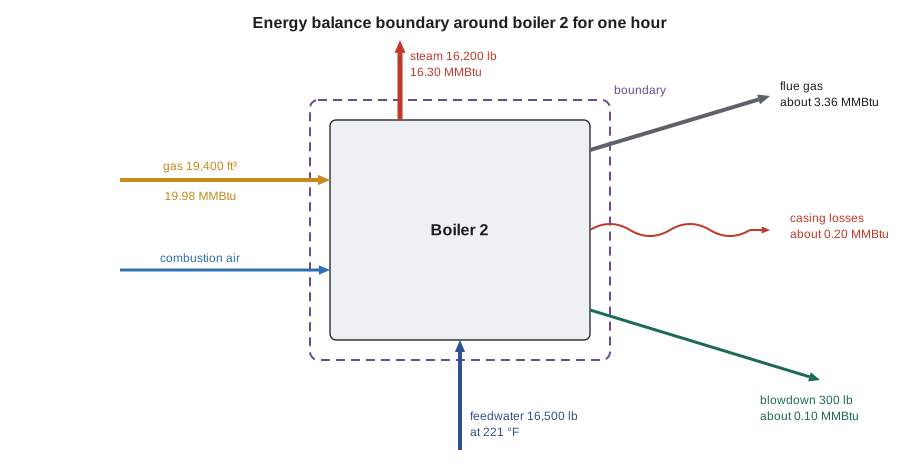
A boiler balance: input and output
Worked problem
Boiler 2 for one steady hour
During the hour, boiler 2 burned 19,400 ft³ of gas with an HHV of 1,030 Btu/ft³ and delivered 16,200 lb of dry saturated steam at 164.7 psia, with feedwater at 221 °F. Using lesson 7, the heat added per pound is 1,006 Btu. Find the heat input, the heat output and the efficiency.
Show solution
- Heat input:
- \[19{,}400 \times 1{,}030 = 19{,}982{,}000 \text{ Btu}\]
- Heat output:
- \[16{,}200 \times 1{,}006 = 16{,}297{,}200 \text{ Btu}\]
- Efficiency:
- \[\eta = \frac{16{,}297{,}200}{19{,}982{,}000} \approx 0.816\]
Answer: About 81.6 in 100, a little below what boiler 2 managed earlier in the month, which fits the higher stack temperature.
A boiler balance: the losses
The difference between input and output is the total loss, about 18 in 100 of the input. The heat loss method breaks it down. A combustion analyzer, using the stack temperature, the oxygen reading and the gas composition, estimates the flue gas losses; radiation and convection from the casing are usually taken from the maker's data; blowdown loss comes from the blowdown flow and the enthalpy of boiler water.
| Item | Fraction of input (typical estimates) | Energy per hour (Btu) |
|---|---|---|
| Heat into steam (output) | 0.817 | 16,297,000 |
| Dry flue gas loss | 0.068 | 1,359,000 |
| Moisture loss (water from burning hydrogen) | 0.100 | 1,998,000 |
| Radiation and convection from the casing | 0.010 | 200,000 |
| Blowdown | 0.005 | 100,000 |
| Total accounted for | 1.000 | 19,954,000 |
| Measured input | 19,982,000 |
The balance closes to within about 28,000 Btu in nearly 20 million, far better than the meters can actually measure. In practice a balance that closes within one or two parts in 100 is excellent. Note that the moisture loss is the largest single loss: the water vapor formed from the hydrogen in natural gas leaves the stack carrying its latent heat. Only a condensing boiler or a condensing economizer can recover it.
Steam from fuel
A useful plant figure is how much steam each unit of fuel produces. It combines the heating value, the boiler efficiency and the heat needed per unit of steam into one number that operators can check against the meters every shift.
Worked problem
Steam per unit of gas
For boiler 2 this afternoon, how many pounds of steam does each cubic foot of gas make, and how much gas does 1,000 lb of steam need?
Show solution
- Steam per cubic foot:
- \[\frac{1{,}030 \times 0.816}{1{,}006} \approx 0.835 \text{ lb}\]
- Gas per 1,000 lb of steam:
- \[\frac{1{,}000}{0.835} \approx 1{,}198 \text{ ft}^3\]
Answer: About 0.84 lb of steam per cubic foot of gas, or about 1,200 ft³ of gas for each 1,000 lb of steam. A sudden change in this ratio at the same load is a sign that something has changed: a meter, the gas quality, the boiler's cleanliness or a steam leak upstream of the flow meter.
Steam produced per unit of fuel is sometimes called the evaporation ratio. Older texts also use equivalent evaporation, the amount of water that the same heat would evaporate from and at 212 °F, which allows boilers working at different pressures and feed temperatures to be compared fairly. It equals the actual steam flow times the heat added per unit, divided by the latent heat at atmospheric pressure.
The deaerator heat balance
The deaerator heats feedwater by mixing it directly with steam, as PWR-120 described. Because the steam condenses into the water, the deaerator is a mixing problem like the ones in lesson 5, but with latent heat as well. The heat given up by the steam as it condenses and cools must equal the heat gained by the water.
Here m_s is the steam flow, m_w the water flow entering, and h_s, h_w and h_out the enthalpies of the steam, the incoming water and the feedwater leaving. The steam and water together make the feedwater, so m_s + m_w equals the feedwater flow. A neat point about the steam: when high-pressure steam is reduced in pressure through a valve, its enthalpy stays the same, so steam taken from the main header and reduced for the deaerator still carries the header's hg.
Worked problem
Steam for the deaerator
Boiler 2 needs 16,500 lb/h of feedwater at 221 °F (hf 189 Btu/lb), including its blowdown. Water arrives from the condensate tank at about 124.5 °F (hf about 92.5 Btu/lb), the mixture from lesson 5. Heating steam comes from the header at 1,195 Btu/lb. How much steam does the deaerator use?
Show solution
- Write the water flow as 16,500 − m_s and balance the heat:
- \[m_s \, (1{,}195 - 189) = (16{,}500 - m_s)(189 - 92.5)\]
- Rearranged, the steam flow is the feedwater flow times the temperature-rise enthalpy over the steam-to-water enthalpy:
- \[m_s = \frac{16{,}500 \times (189 - 92.5)}{1{,}195 - 92.5} \approx 1{,}444 \text{ lb/h}\]
Answer: About 1,444 lb/h of steam, close to nine in 100 of the boiler's output, goes straight back into heating its own feedwater. It is not lost, because its heat returns to the boiler in the feedwater, but it is steam that cannot be sold.
The value of returned condensate
Every unit of condensate that customers return hot is water already treated, already warm and, in effect, already partly paid for. Every unit lost must be replaced by cold make-up water that needs treatment and much more heat.
Worked problem
If all the condensate came back
Suppose all of boiler 2's feedwater came from condensate returned at 176 °F (hf about 144 Btu/lb) with no cold make-up. How much deaerator steam would be needed, and how much gas would that save each hour at 0.835 lb of steam per cubic foot?
Show solution
- Steam needed:
- \[m_s = \frac{16{,}500 \times (189 - 144)}{1{,}195 - 144} \approx 706 \text{ lb/h}\]
- Steam saved:
- \[1{,}444 - 706 = 738 \text{ lb/h}\]
- Gas saved:
- \[\frac{738}{0.835} \approx 884 \text{ ft}^3\text{/h}\]
Answer: About 884 ft³ of gas an hour on this boiler alone, or roughly 7 million cubic feet over an 8,000-hour year, before counting the water and treatment chemicals saved. Lost condensate is one of the largest avoidable costs in a district steam system, which is why Cantwell's customers are asked to repair failed traps and leaking returns promptly.
The cost of fouling
Boiler 2's stack temperature had risen by 32 °F at the same firing rate and oxygen. Using the rule of thumb from lesson 9, about one point of efficiency for every 40 °F, that is about 0.8 of a point. At an efficiency of about 81.6 in 100 and a gas flow of 19,400 ft³/h, the extra gas is roughly 19,400 × 0.8 ÷ 81.6 ≈ 190 ft³ every hour, around 4,600 ft³ a day. The rise in stack temperature is a cost that grows every day the fouling stays, and the energy balance turns it into a number that justifies taking the boiler off line for cleaning.
The whole plant
The same method scales up. Around the whole plant, the inputs are gas or oil, electricity for motors and lighting, and make-up water; the outputs are steam and hot water sent to customers, condensate and water returned counted as a credit, and the losses from the stacks, the casings, the blowdown, the piping and any steam vented. Monthly totals from the gas, steam, electricity and water meters, set out in a balance, give the plant's overall efficiency and show where the largest losses lie. Comparing one month with the same month a year earlier, adjusted for weather, shows whether the plant is improving.
Electricity appears in the balance too. Lesson 11's condensate transfer pump uses about 60,000 kWh a year, which is about 205 million Btu. Added up across all the fans and pumps, auxiliary power is a noticeable cost, and variable speed drives (lesson 10) are one of the best ways to reduce it.
Setting out a balance problem
Examination questions on energy balances reward clear, ordered working. A reliable approach:
- Sketch the equipment and draw the boundary. Mark every stream in and out.
- Write down the known flows, pressures and temperatures, and convert gauge pressures to absolute.
- Look up each enthalpy in the steam tables, interpolating where needed, and write it on the sketch.
- Write the balance as an equation, energy in equals energy out, and solve for the unknown.
- Check the units, then check the answer against common sense: an efficiency above 1, a negative flow or a feedwater temperature above the steam temperature means an error.
Many marks are lost not on difficult physics but on gauge pressure used in the tables, a missed stream, or a unit left unconverted. The same habits that make a clean examination answer make a trustworthy plant report.
Tamar's balance
By the end of the shift, Tamar had a single page for Grazyna: the boiler balance closed to within a fraction of a part in 100, the deaerator used about 1,444 lb of steam an hour, the fouling was costing about 190 ft³ of gas an hour, and a full condensate return would save about 884. Grazyna read it twice. "That," she said, "is what a high pressure boiler operator who understands the plant does." Tamar's plan was to sit the state high pressure boiler operator examination in the spring of 2027, after finishing her coursework and her qualifying hours, and Grazyna told her the page would go on the operations meeting agenda alongside the deaerator alarm question from lesson 10.
A monthly check across the plant
Grazyna asked Tamar to extend the method to the whole plant at the end of each month, using only the totals the meters already record:
- Gas used against steam sent out. Divide the month's steam by the month's gas to get the plant's average steam per unit of fuel, and compare it with last month and the same month last year.
- Make-up water against steam sent out. The fraction of steam not returned as condensate shows how much the customers are losing, and each part of it costs deaerator steam and fuel, as this lesson showed.
- Blowdown and water treatment. Blowdown flow follows make-up, because every unit of untreated water brings dissolved solids that must be blown down again.
- Electricity per unit of steam. Auxiliary power divided by steam sent out shows whether fans and pumps are using more energy than they should.
None of these figures needs a new instrument, and together they make a short, honest picture of how the plant ran. A change in any one of them is a question to answer, not just a number to record. Tamar set up the first sheet with the October totals, ready for Grazyna's review at the start of December.
Common mistakes
MistakeLeaving a stream out of the balance.
InsteadList every flow crossing the boundary before calculating.
MistakeUsing gauge pressure to look up enthalpy.
InsteadConvert to absolute pressure first.
MistakeTreating deaerator steam as a loss.
InsteadIts heat returns to the boiler in the feedwater, though the steam cannot be sold.
MistakeExpecting a balance to close exactly.
InsteadMeter errors mean one or two parts in 100 is a good result.
MistakeIgnoring a gradual rise in stack temperature.
InsteadPut a number on it with the balance; fouling costs fuel every day.
Summary and key terms
- An energy balance says energy in equals useful energy out plus losses, for steady operation.
- Boiler efficiency can be found by input-output or by the heat loss method; the largest gas-fired loss is moisture, then dry flue gas.
- Steam per unit of fuel = HHV × efficiency ÷ heat added per unit of steam.
- The deaerator balance equates the heat given up by steam to the heat gained by water.
- Returned condensate saves deaerator steam, fuel, water and treatment.
- Set out balance problems with a sketch, a boundary, absolute pressures, table enthalpies and a sense check.
- Energy balance
- An accounting of all energy entering and leaving a boundary, which must agree in steady operation.
- Boundary
- The imaginary line drawn around equipment for an energy balance.
- Evaporation ratio
- The mass of steam produced per unit of fuel burned.
- Equivalent evaporation
- The water that the same heat would evaporate from and at the atmospheric boiling point.
- Moisture loss
- Heat carried up the stack by the water vapor formed from hydrogen in the fuel.
- Deaerator heat balance
- The balance between heat given up by heating steam and heat gained by feedwater.
Practice problems
Work each problem on paper first, then reveal the answer to check.
A boiler burns 15,000 ft³/h of gas at 1,030 Btu/ft³ and makes 12,300 lb/h of steam with 1,006 Btu/lb added. What is its efficiency?
Show answer
About 0.80 (12,373,800 ÷ 15,450,000).
At an HHV of 1,020 Btu/ft³, efficiency 0.82 and 1,000 Btu/lb added, how much steam does 1 ft³ of gas make?
Show answer
About 0.84 lb.
A deaerator delivers 11,000 lb/h at hf 189 Btu/lb from water at hf 108 Btu/lb, using steam at 1,195 Btu/lb. How much steam is needed?
Show answer
About 820 lb/h.
What is the largest single loss in a gas-fired boiler without a condensing economizer?
Show answer
The moisture loss from water vapor formed in combustion.
Why should enthalpies always be read at absolute pressure?
Show answer
The steam tables are written in absolute pressure.
Lesson quiz · 5 questions
Score 60% or more to complete this lesson.
Create a free account to save your progress, take quizzes and earn a certificate.