
PWR-210 · Lesson 6 of 12 · 30 min
Pressure and fluids
▶ Video coming soon A video version of this lesson is on the way.
On Tuesday, October 13, 2026, Lorne Fitzwilliam set a deadweight tester on the workbench in the shop and lined up four pressure gauges that had come off the plant during the month. "Every number you write in the log starts with one of these," he told Tamar Ellingsen. "If the gauge lies, the log lies, and you'll make good decisions on bad information." Before they tested the first gauge, he asked her a question she had not expected: "When the steam gauge on boiler 2 says 150 psi, what is the actual pressure in the drum?"
This lesson answers that question and the ones that follow from it. It covers what pressure is, gauge and absolute pressure, atmospheric pressure and vacuum, pressure in liquids and hydrostatic head, manometers and draft gauges, the force pressure exerts on a surface, how fluids flow through pipes, and a first look at Bernoulli's principle.
What pressure is
Pressure is force spread over an area: the force pressing on a surface divided by the area of the surface. A fluid pushes on every surface it touches, and at any point in a still fluid the pressure acts equally in all directions. That is why a gauge reads the same whether it is mounted on the top or the side of a drum at the same level.
In US customary units, pressure is given in pounds per square inch (psi). Low pressures, such as draft, are given in inches of water column (inWC), and vacuums in inches of mercury (inHg). In SI the unit is the pascal, one newton per square meter.
Atmospheric, gauge and absolute pressure
The air above us has weight, and at sea level it presses on everything with an average atmospheric pressure of about 14.7 psi, or 29.92 inHg. It changes a little with the weather and falls with altitude. We do not feel it because it pushes on us equally from all sides and from inside.
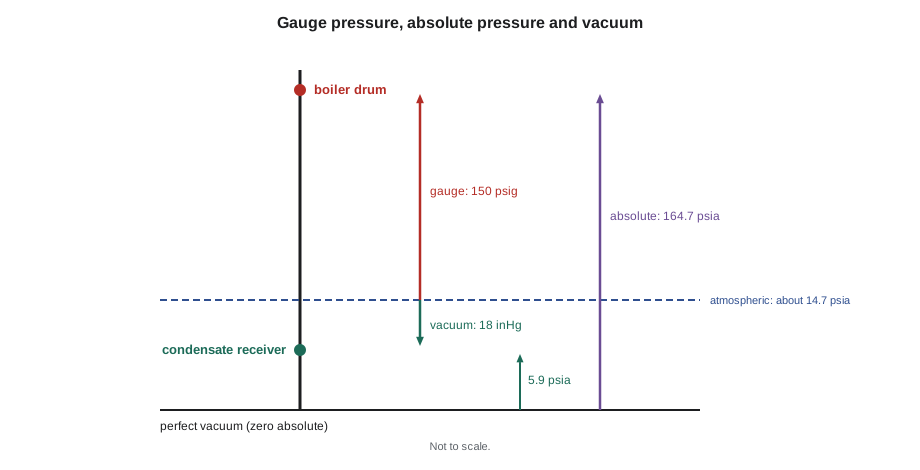
Most plant gauges are built to read zero when they are open to the atmosphere. They measure gauge pressure: how far the pressure is above atmospheric. The true pressure measured from a perfect vacuum is absolute pressure. The two are linked by a simple sum.
So the answer to Lorne's question is about 150 + 14.7 = 164.7 psia. The difference matters most in the steam tables (lesson 7), which are always written in absolute pressure. Using a gauge reading in the tables gives the wrong saturation temperature. In writing, engineers add a letter to make the kind of pressure clear: psig for gauge and psia for absolute.
A pressure below atmospheric is a vacuum. A vacuum gauge reads how far below atmospheric the pressure is, so a perfect vacuum would read the full atmospheric pressure. Vacuums appear in a plant at condensers, at vacuum condensate return systems in customer buildings, at the suction of pumps lifting from a sump, and in the furnace of a balanced-draft boiler.
Worked problem
A vacuum gauge reading
The vacuum gauge on a condensate receiver at one of Cantwell's customer buildings reads 18 inHg of vacuum. Taking atmospheric pressure as 29.92 inHg, what is the absolute pressure in the receiver, in inHg and in psia?
Show solution
- Absolute pressure in inHg:
- \[p_{\text{abs}} = 29.92 - 18 = 11.92 \text{ inHg abs}\]
- In psia (1 inHg ≈ 0.491 psi):
- \[11.92 \times 0.491 \approx 5.86 \text{ psia}\]
Answer: About 5.9 psia. Water boils at about 170 °F at that pressure, which is why hot condensate flashes to steam when it reaches the receiver.
Pressure in liquids and hydrostatic head
A liquid at rest presses harder the deeper you go, because each layer carries the weight of all the liquid above it. The pressure at a depth depends only on the depth, the density of the liquid and gravity; it does not depend on the shape or width of the tank. A tall thin pipe full of water gives the same pressure at the bottom as a wide tank of the same height.
A handy figure for cold water is that each foot of depth adds about 0.433 psi, and each psi is about 2.31 ft of water. The height of liquid is called its head, and pump and piping engineers often state pressures as feet of head.
Worked problem
Head on the feed pump suction
The water level in Cantwell's deaerator storage tank is 30 ft above the center line of the feed pump suction. The water is hot, with a specific gravity of about 0.96. What pressure does the column add at the pump suction?
Show solution
- Hydrostatic pressure:
- \[p = 0.433 \times 0.96 \times 30 \approx 12.5 \text{ psi}\]
Answer: About 12.5 psi above whatever pressure sits on the water surface in the deaerator. The deaerator is set up high for exactly this reason: the hot water needs that extra pressure at the pump to stay liquid as it enters the impeller. Lesson 10 explains why.
Head explains several things operators see every day. A gauge mounted well below a drum reads a little high, because of the water in the gauge line. A level transmitter measures the pressure at the bottom of a tank and converts it into a level. A water column on a boiler shows the same level as the drum because the water in it balances the water in the drum. And a hot water system in a tall building has a higher pressure at the bottom floors than at the top.
Manometers and draft gauges
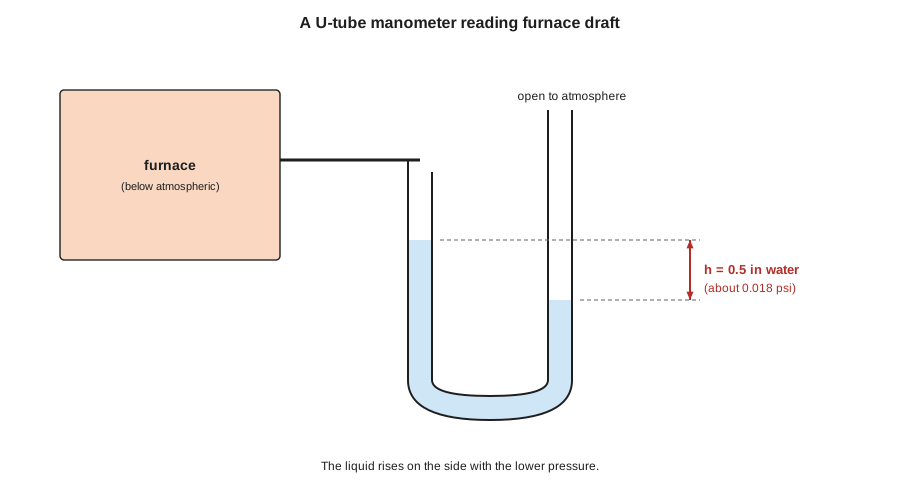
A manometer measures pressure by balancing it against a column of liquid. The simplest is a U-tube partly filled with water or a special gauge oil. With one leg open to the atmosphere and the other connected to the point being measured, the difference in the liquid levels shows the gauge pressure, or the vacuum if the connected side is lower than atmospheric.
Manometers are ideal for small pressures. Boiler draft, the slight pressure difference that moves air and flue gas through a furnace, is measured this way. An inclined manometer lays the tube at a shallow angle so that a small change in pressure moves the liquid a long way along the tube, which makes small readings easier to see. Electronic draft gauges do the same job with a pressure sensor, but they are still calibrated in units of water column.
Worked problem
Reading a draft gauge
The draft gauge on boiler 2 shows a difference of 0.5 inWC. What is the pressure difference in psi?
Show solution
- One inch of water is about 0.0361 psi:
- \[p = 0.5 \times 0.0361 \approx 0.018 \text{ psi}\]
Answer: About 0.018 psi. A Bourdon tube steam gauge could not even begin to show it, which is why draft needs its own instrument.
Pressure gauges and their care
Most plant pressure gauges use a Bourdon tube, a curved, flattened metal tube closed at one end. Pressure inside tries to straighten it, and a linkage turns the small movement of the tip into the sweep of the pointer. Other designs use a diaphragm or bellows for low pressures, and electronic transmitters use a strain gauge or capacitance sensor.
Steam gauges are protected by a siphon, a loop or coil of pipe below the gauge that fills with condensate so that live steam never reaches the delicate tube. A gauge on a pulsating line, such as a reciprocating pump discharge, is fitted with a snubber to damp the movement. Each gauge has its own isolating valve or cock so that it can be removed and tested.
Lorne's deadweight tester checks a gauge by loading a small piston with accurately known weights. The weight divided by the piston's area produces an exact pressure, and the gauge under test should read it. A gauge that reads wrong by more than its stated accuracy is adjusted or replaced. A boiler's steam gauge should normally have a range of about one and a half to twice the safety valve setting, so that the working pressure sits near the middle of the dial where the gauge is most accurate.
The force of pressure on a surface
Because pressure is force per unit area, the total force on a surface is the pressure times the area. Over a large area, even a moderate pressure produces a very large force. This is the reason manway covers are designed to sit inside the drum, so that the pressure pushes them against their seats.
Worked problem
Force on a manway cover
Boiler 3's elliptical manway opening measures 12 in by 16 in. What total force does a gauge pressure of 150 psi exert on the cover? The area of an ellipse is π/4 times the two axes multiplied together.
Show solution
- Area:
- \[A = \frac{\pi}{4} \times 12 \times 16 \approx 150.8 \text{ in}^2\]
- Force:
- \[F = 150 \times 150.8 \approx 22{,}600 \text{ lb}\]
Answer: About 22,600 lb, more than eleven tons. Gauge pressure is used here because atmospheric pressure acts on the outside of the cover too and cancels out. It is also why a manway must never be loosened while there is any pressure on the boiler: even a small pressure over that area is a dangerous force.
The same reasoning lies behind hydraulic jacks and the hydrostatic test pumps used on boilers. Pascal's principle says that pressure applied to a confined liquid is passed on equally throughout it. A small force on a small piston produces a pressure that, acting on a large piston, gives a large force. A hand pump can therefore raise a boiler to test pressure with modest effort, though it takes many strokes.
Fluids in motion: flow and velocity
When a fluid flows, the volume passing a point each second is the volume flow rate. For a liquid, which does not compress, the same volume must pass every section of a pipe each second. Where the pipe narrows, the liquid must speed up; where it widens, it slows down. This is the continuity principle.
In US customary units, a handy form for water in a pipe is v ≈ 0.408 × Q ÷ d², with v in ft/s, Q in gpm and d the inside diameter in inches. It comes from Q = A × v with the unit conversions folded in.
Worked problem
Velocity in a pipe
Make-up water flows at 55 gpm through a 2 in Schedule 40 pipe with an inside diameter of 2.067 in. What is its average velocity?
Show solution
- Velocity:
- \[v = \frac{0.408 \times 55}{2.067^2} \approx 5.25 \text{ ft/s}\]
Answer: About 5.3 ft/s, a normal velocity for water in a pipe of that size. Much faster water erodes elbows and causes noisy, wasteful pressure drop; much slower water means the pipe is larger and costlier than it needs to be.
Moving fluids lose pressure to friction against the pipe walls and in turbulence at fittings, valves and bends. The loss grows roughly with the square of the velocity, so doubling the flow through the same pipe increases the pressure drop about four times. That is why a throttled valve gets noisy and why a dirty strainer shows up as a widening pressure difference across it.
Bernoulli's principle
Bernoulli's principle is a statement of energy conservation for a flowing fluid. Along a streamline, a fluid carries energy in three forms: its pressure, its velocity and its height. If no energy is added by a pump and none is lost to friction, the total stays the same, so when one form goes up another must come down. In particular, where a fluid speeds up, its pressure falls.
Each term is a head: pressure head, velocity head and elevation head. In feet, with g = 32.2 ft/s², the make-up water above has a velocity head of 5.25² ÷ (2 × 32.2) ≈ 0.43 ft, small next to the pressure head, which is typical of liquid in pipes. In a nozzle or an orifice the velocity can become large, and then the drop in pressure is large too.
Many plant devices use this idea. An orifice plate or venturi in a pipe speeds the flow up through a narrow section; the drop in pressure across it is measured and converted into a flow rate. A steam injector uses a fast jet of steam to create low pressure that draws in water. An ejector removes air from a condenser the same way. And the low pressure where water speeds up at a pump impeller's eye is one cause of cavitation, which lesson 10 covers. Real flows lose some energy to friction, so the full Bernoulli equation used by engineers includes a loss term, and a pump term where energy is added.
The gauges on the bench
Of Lorne's four gauges, three read within their stated accuracy across the range. The fourth, from the condensate tank, read low by a steady amount at every test point. "Zero shift," Lorne said. "Someone's knocked it, or the pointer's slipped." They reset the pointer, retested, and tagged it good. Then Tamar answered his first question in her notebook in both forms: 150 psig is about 164.7 psia, and underlined the second number for the steam tables lesson that Grazyna had promised for Thursday.
Common mistakes
MistakeUsing a gauge pressure in the steam tables.
InsteadAdd atmospheric pressure first; steam tables use absolute pressure.
MistakeThinking the shape of a tank changes the pressure at the bottom.
InsteadOnly depth, density and gravity matter.
MistakeLoosening a manway or flange with pressure still on.
InsteadEven a small pressure over a large area gives a dangerous force.
MistakeReading a vacuum gauge as an absolute pressure.
InsteadVacuum is measured down from atmospheric; subtract it from atmospheric to get absolute.
MistakeLetting live steam reach a gauge tube.
InsteadKeep the siphon full of condensate so the gauge only sees water.
Summary and key terms
- Pressure is force per unit area and acts equally in all directions at a point in a still fluid.
- Absolute pressure = gauge + atmospheric (about 14.7 psi); vacuum is measured in inHg down from atmospheric.
- Hydrostatic pressure is about 0.433 psi per foot of cold water; 1 psi ≈ 2.31 ft.
- Manometers balance pressure against a liquid column and suit small pressures such as draft.
- The force on a surface is pressure times area, so large surfaces carry large forces.
- Continuity Q = Av links flow, area and velocity; Bernoulli says pressure falls where velocity rises.
- Gauge pressure
- Pressure measured above atmospheric pressure.
- Absolute pressure
- Pressure measured from a perfect vacuum.
- Vacuum
- A pressure below atmospheric, measured down from atmospheric.
- Hydrostatic head
- The height of a liquid column, and the pressure it produces at its base.
- Manometer
- An instrument that measures pressure by the difference in height of a liquid column.
- Bourdon tube
- A curved metal tube that straightens under pressure and drives a gauge pointer.
- Continuity
- The principle that the same volume of liquid passes every section of a pipe each second.
Practice problems
Work each problem on paper first, then reveal the answer to check.
A gauge reads 100 psig. What is the absolute pressure?
Show answer
About 114.7 psia.
What pressure does a 40 ft column of cold water produce?
Show answer
About 17.3 psi.
A vacuum gauge reads 24 inHg. What is the absolute pressure in inHg?
Show answer
About 5.9 inHg abs.
What force does 75 psi exert on a round cover 8 in in diameter?
Show answer
About 3,770 lb.
Water flows at 30 gpm through a pipe of 1.61 in inside diameter. What is its velocity?
Show answer
About 4.7 ft/s.
Lesson quiz · 5 questions
Score 60% or more to complete this lesson.
Create a free account to save your progress, take quizzes and earn a certificate.