
PWR-210 · Lesson 2 of 12 · 27 min
Forces, moments and equilibrium
▶ Video coming soon A video version of this lesson is on the way.
On Thursday, September 24, 2026, Lorne took Tamar up the ladder beside boiler 1 to look at the old lever safety valve that the plant kept on the boiler room wall as a teaching piece. It came off a 1950s boiler that once stood where boiler 3 is now: a heavy iron weight hung on a long arm, pressing the valve disc down onto its seat. "Nobody builds these any more," Lorne said. "Spring valves replaced them because people kept sliding the weight out to stop the valve lifting. But this one teaches more mechanics in five minutes than a chapter of the textbook."
This lesson covers the mechanics of forces: what a force is and how it is measured, mass and weight, resolving and combining forces, moments and levers, the conditions for equilibrium, beam reactions, and the simple machines a plant uses to lift and move heavy equipment.
What a force is
A force is a push or a pull. It has a size (its magnitude), a direction and a point where it acts. Quantities with both size and direction, such as force, velocity and acceleration, are called vectors; quantities with size only, such as mass, temperature and energy, are called scalars. A force is drawn as an arrow whose length shows its size and whose direction shows the way it acts.
In US customary units the unit of force is the pound force (lbf, usually written lb). One pound force is the weight of a one-pound mass under standard gravity. In SI the unit is the newton (N), and 1 lbf is about 4.448 N.
Weight is the force of gravity on a mass. Because a one-pound mass weighs one pound force, US plant work often uses pounds for both, and a 550 lb pump motor is said to weigh 550 lb. In SI terms, gravity accelerates falling objects at about 32.2 ft/s² (9.81 m/s²). The distinction matters mainly when mass and force appear in the same formula, as in some engineering equations, and when equipment is rated in SI.
Combining and resolving forces
When several forces act on one point, their combined effect is a single force called the resultant. Forces acting along the same line simply add or subtract. Forces at an angle to each other are combined by drawing them head to tail (the triangle or parallelogram of forces) or by splitting each one into parts along two directions at right angles and adding the parts. That splitting is called resolving a force, and it uses basic trigonometry.
Here θ is the angle between the force and the horizontal, F_x is its horizontal part and F_y its vertical part. Resolving forces matters every time a plant lifts a load with a sling or a chain block. The legs of a two-leg sling do not just hold up the load: because they lean inward, each leg also pulls sideways on the load, and the flatter the angle, the larger the force in each leg for the same load.
Worked problem
Sling leg tension
Fenella Thorncroft's crew is lifting a feed pump weighing 2,200 lb with a two-leg sling. Each leg makes an angle of 60° with the horizontal. What is the tension in each leg? What would it be at 30°?
Show solution
- Each leg carries half the weight vertically:
- \[2{,}200 \div 2 = 1{,}100 \text{ lb}\]
- The vertical part of each leg tension is T sin θ, so:
- \[T = \frac{1{,}100}{\sin 60°} = \frac{1{,}100}{0.866} \approx 1{,}270 \text{ lb}\]
- At 30°:
- \[T = \frac{1{,}100}{\sin 30°} = \frac{1{,}100}{0.5} = 2{,}200 \text{ lb}\]
Answer: About 1,270 lb per leg at 60°, but 2,200 lb per leg at 30°: each leg then carries the whole weight of the pump. That is why riggers avoid flat sling angles and why a sling's rated capacity drops as the angle flattens.
Moments and levers
A force can turn something as well as push it. The turning effect of a force about a point is its moment (or torque), equal to the force times the perpendicular distance from the point to the force's line of action. The point is called the fulcrum or pivot, and the distance is the moment arm. A long wrench turns a stiff valve more easily than a short one because the same hand force acts at a longer arm.
Moments are measured in foot-pounds (ft·lb) or inch-pounds (in·lb), and torque wrenches are calibrated in the same units. A moment is called clockwise or counterclockwise depending on which way it would turn the object. A body that is not rotating has its clockwise and counterclockwise moments about any point in balance; this is the principle of moments.
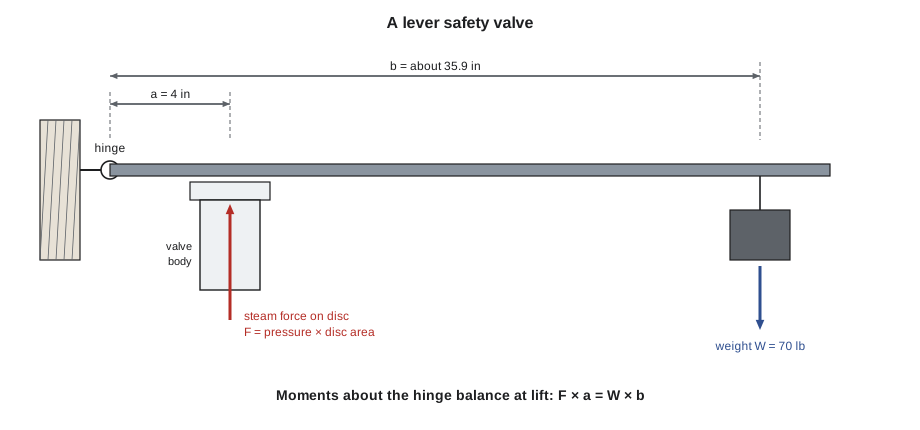
The old safety valve on the wall is a lever. The steam pushes up on the valve disc with a force equal to the pressure times the disc area. The weight on the arm pushes down. The arm is hinged at one end, so the valve disc sits close to the hinge and the weight hangs far out. A small weight at a long arm balances a large steam force at a short arm, and sliding the weight farther out raises the pressure at which the valve lifts.
Worked problem
Setting a lever safety valve
The wall valve has a disc 2 in in diameter, centered 4 in from the hinge. To lift at 200 psi, how far from the hinge must a weight of 70 lb hang? Ignore the weight of the arm and the valve itself.
Show solution
- Disc area:
- \[A = \frac{\pi}{4} d^2 = 0.7854 \times 2^2 \approx 3.142 \text{ in}^2\]
- Steam force at lift:
- \[F = 200 \times 3.142 \approx 628 \text{ lb}\]
- Moments about the hinge:
- \[70 \times d = 628 \times 4\]
- Distance:
- \[d = 2{,}513 \div 70 \approx 35.9 \text{ in}\]
Answer: About 36 in from the hinge. If someone slid the weight out to 48 in, the valve would not lift until the pressure reached about 200 × 48 ÷ 35.9 ≈ 267 psi, far above the boiler's design. That is exactly how lever valves caused explosions, and why the code now requires spring valves sealed by the maker.
Modern safety valves use a compressed spring instead of a weight, but the mechanics are the same: the spring force must balance the steam force on the disc at the set pressure. Lesson 4 returns to the spring, which is a stressed piece of steel, and PWR-120 covered how safety valves are set, sealed and tested.
Equilibrium
A body is in equilibrium when it is at rest, or moving steadily, because the forces on it balance. For equilibrium in a flat (two-dimensional) problem, three conditions must all hold at once:
- The forces to the right equal the forces to the left (the horizontal forces add to zero).
- The forces up equal the forces down (the vertical forces add to zero).
- The clockwise moments about any point equal the counterclockwise moments about that point (the moments add to zero).
These three conditions solve most of the statics problems an engineer meets: the reactions at the ends of a beam, the force in a pipe hanger, the load on a bracket bolt, the pull on a chain block anchor. The method is always the same: draw a free-body diagram of the object alone, mark every force on it with its direction and point of action, then write the three conditions and solve.
Beams and support reactions
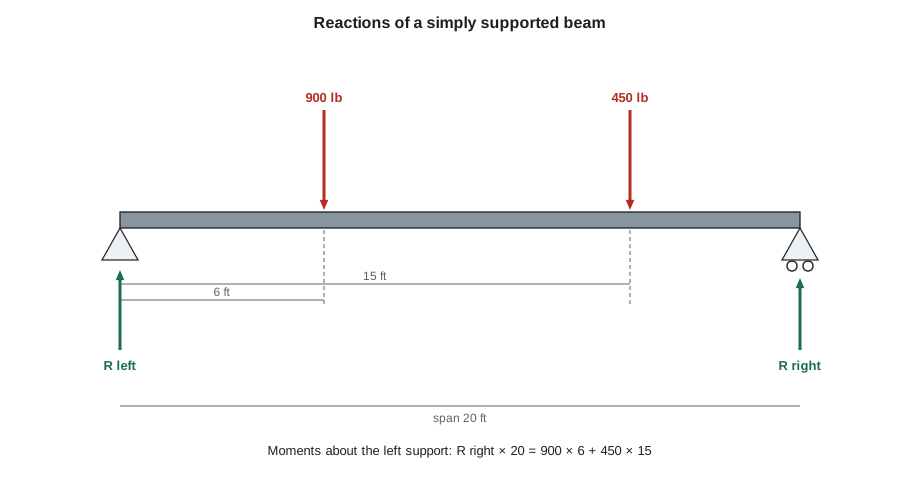
A beam is a structural member that carries loads across a span between supports. A simply supported beam rests on two supports, one at each end, and the upward forces those supports provide are called reactions. To find them, take moments about one support: the unknown reaction at that support has no moment about it, so the equation gives the other reaction directly. The vertical force balance then gives the first.
Worked problem
A pipe rack beam in the tunnel
A steel beam spans 20 ft between two supports in the steam tunnel under Broad Street. It carries a valve and fitting load of 900 lb at 6 ft from the left support and a pipe support load of 450 lb at 15 ft from the left support. Ignoring the beam's own weight, what are the reactions at the two supports?
Show solution
- Take moments about the left support (clockwise = counterclockwise):
- \[R_R \times 20 = 900 \times 6 + 450 \times 15 = 5{,}400 + 6{,}750 = 12{,}150 \text{ ft·lb}\]
- Right reaction:
- \[R_R = 12{,}150 \div 20 = 607.5 \text{ lb}\]
- Vertical forces balance:
- \[R_L = (900 + 450) - 607.5 = 742.5 \text{ lb}\]
Answer: About 743 lb at the left support and 608 lb at the right. The left support carries more because the heavier load is nearer to it. A check: the two reactions add to 1,350 lb, the total load.
In real tunnels the beam's own weight, the weight of the pipe and its insulation and water, and the forces from thermal expansion (lesson 5) all add to these loads. A pipe full of water during a hydrostatic test weighs far more than the same pipe full of steam, which is why supports are designed for the test condition.
Simple machines
A machine lets a small effort move a large load. The plant uses several: levers, pulleys and chain blocks for lifting, screw jacks for leveling, valve handwheels and gear operators for turning stiff valves. Three numbers describe a machine.
- Mechanical advantage (MA) is the load divided by the effort. A chain block that lifts 2,000 lb with an effort of 90 lb has an MA of about 22.2.
- Velocity ratio (VR) is the distance the effort moves divided by the distance the load moves. If the hand chain must be pulled 30 m to raise the hook 1 m, the VR is 30. The VR depends only on the machine's geometry.
- Efficiency is the MA divided by the VR. It is less than 1 because some effort is lost to friction. Work out equals work in only for a perfect machine.
Worked problem
A chain block
A chain block with a velocity ratio of 30 lifts a load of 2,000 lb with a hand effort of 90 lb. What are its mechanical advantage and efficiency?
Show solution
- Mechanical advantage:
- \[\text{MA} = 2{,}000 \div 90 \approx 22.2\]
- Efficiency:
- \[\eta = 22.2 \div 30 \approx 0.74\]
Answer: An MA of about 22.2 and an efficiency of about 0.74, or 74 in 100. About a quarter of the work put into the chain is lost to friction in the gears and sheaves, which is what holds the load when the operator lets go: most chain blocks are designed to be self-locking for exactly that reason.
Friction
Friction is the force that resists one surface sliding over another. It acts along the surfaces, against the direction of motion, and its size depends on how hard the surfaces are pressed together and on what they are made of. The ratio of the friction force to the force pressing the surfaces together is the coefficient of friction, μ. Friction is a nuisance in bearings and valve stems, where it wastes energy and causes wear, and a help in belt drives, brakes, clamps and bolted joints, where it is what does the work.
Here N is the normal force, the force pressing the surfaces together at right angles. Static friction (before sliding starts) is higher than kinetic friction (once sliding), which is why a stuck valve suddenly gives and then turns more easily. Lubrication, covered in PWR-230, cuts friction by separating the surfaces with a film of oil or grease.
Back to the wall valve
Lorne had Tamar draw the free-body diagram of the valve arm before they climbed down: the steam force up at the disc, the weight down at the end, the hinge reaction at the pivot, and the arm's own weight at its middle. "Now you see why the arm's weight matters," he said. "Ours is about 20 lb at the middle of the arm. It adds its own moment, so the real valve lifts higher than the simple calculation says. The textbook ignores it to keep the numbers clean. The steam doesn't." Taking moments with the arm included, Tamar found the lift pressure would be several psi higher. She wrote it in the margin under the example.
Common mistakes
MistakeUsing the slant distance to a force instead of the perpendicular distance when taking moments.
InsteadThe moment arm is the perpendicular distance from the pivot to the force's line of action.
MistakeForgetting that a flatter sling angle increases the leg tension.
InsteadLeg tension equals the vertical share divided by the sine of the angle; it rises steeply below about 45°.
MistakeMixing pressure in kPa with area in m² and expecting newtons.
InsteadConvert kPa to Pa (multiply by 1,000) before multiplying by area in m².
MistakeExpecting a machine's mechanical advantage to equal its velocity ratio.
InsteadFriction makes MA smaller than VR; their ratio is the efficiency.
MistakeIgnoring the weight of a beam, arm or pipe in a statics problem.
InsteadInclude it at its center of gravity unless the problem says to ignore it.
Summary and key terms
- A force has size, direction and point of action; force is a vector, mass is a scalar.
- Weight is the force of gravity; a one-pound mass weighs one pound force.
- Forces at an angle are combined or resolved into horizontal and vertical parts using sine and cosine.
- A moment is a force times its perpendicular distance from the pivot; in equilibrium the moments balance.
- Beam reactions are found by taking moments about one support and then balancing vertical forces.
- Machines are described by mechanical advantage, velocity ratio and efficiency (MA ÷ VR).
- Vector
- A quantity with both size and direction, such as force.
- Resultant
- The single force with the same effect as several forces together.
- Moment
- The turning effect of a force about a point: force times perpendicular distance.
- Equilibrium
- The state of a body whose forces and moments balance.
- Reaction
- The force a support provides to hold up a beam or structure.
- Mechanical advantage
- The ratio of load to effort for a machine.
Practice problems
Work each problem on paper first, then reveal the answer to check.
A 6 ft bar is pushed with 35 lb at its end. What is the moment about the other end?
Show answer
210 ft·lb.
A motor has a mass of 1,100 lb. What does it weigh?
Show answer
About 1,100 lb force.
A beam 12 ft long carries 1,200 lb at its middle. What are the reactions?
Show answer
600 lb at each end.
A machine has an MA of 12 and a VR of 16. What is its efficiency?
Show answer
0.75, or 75 in 100.
Two sling legs at 45° lift a 1,600 lb load. What is the tension in each leg?
Show answer
About 1,131 lb (800 ÷ 0.707).
Lesson quiz · 5 questions
Score 60% or more to complete this lesson.
Create a free account to save your progress, take quizzes and earn a certificate.