
PWR-120 · Lesson 9 of 12 · 23 min
Boiler water treatment basics
▶ Video coming soon A video version of this lesson is on the way.
On Monday, October 19, 2026, Keziah Ostby from Beaumont Water Services, Cantwell's water treatment supplier, made her monthly visit. She and Tamar ran the plant's water tests side by side at the lab bench in the water treatment room: hardness on the softener outlet, conductivity and pH on each boiler, sulphite residual, and pH on a condensate sample from the return. Keziah's numbers matched the shift log's within a few points, which pleased Lorne. Then she walked to boiler 2's continuous blowdown valve, looked at its setting and the conductivity trend, and said, "You're blowing down a little more than you need to. That's money going down the drain. Let's work out where it should be."
This lesson explains why boiler water needs treatment, the impurities in raw water and what each does to a boiler, external treatment by filtering, softening and demineralizing, internal treatment with chemicals, the tests operators run, and how blowdown controls the concentration of solids. PWR-220 takes water chemistry further for higher pressure boilers.
Why water needs treatment
Pure water does not exist in nature. City water, well water and river water all carry dissolved minerals, dissolved gases and, sometimes, suspended dirt and organic matter. When a boiler turns water to steam, the steam leaves almost pure and the impurities stay behind in the boiler. Over time, without treatment and blowdown, they concentrate and cause three kinds of damage: scale, corrosion and carryover. Each one costs money, and scale and corrosion can cause tube failures that put the boiler out of service or injure someone.
| Impurity | Where it comes from | What it does |
|---|---|---|
| Hardness (calcium and magnesium) | Dissolved minerals in raw water | Forms hard scale on heating surfaces |
| Silica | Dissolved from rock and sand | Forms very hard, glassy scale; carries over into steam at higher pressures |
| Dissolved oxygen | Air dissolved in water | Pitting corrosion of steel |
| Carbon dioxide | Air, and breakdown of bicarbonate alkalinity in the boiler | Forms carbonic acid in condensate; corrodes return lines |
| Total dissolved solids (TDS) | All dissolved salts | Foaming and carryover at high concentrations |
| Suspended solids | Dirt, rust, sludge | Deposits, sludge, plugged gauge connections |
| Oil and organics | Contaminated condensate or process leaks | Foaming, carryover, insulating deposits |
Scale
When hardness minerals are heated, they become less soluble and come out of solution as a hard, rock-like layer on the hottest surfaces, which is scale. Scale is a poor conductor of heat: a thin layer acts like insulation between the flame and the water. That causes two problems. First, less heat reaches the water, so the boiler burns more fuel and its stack temperature rises (lesson 5). Second, and more dangerous, the metal under the scale runs hotter because the water can no longer cool it properly. Even a layer about the thickness of a credit card can raise the tube metal temperature by a large amount on a highly heated surface, enough over time to cause overheating, bulging and tube failure (typical).
Sludge is softer deposit, loose material that settles in low places such as the mud drum or the bottom of a firetube shell. It is removed by bottom blowdown. Treatment programs aim to keep hardness out of the boiler completely, and to condition any that gets in into loose sludge rather than hard scale.
Corrosion
Dissolved oxygen attacks steel and forms deep, localized pits that can perforate a tube or drum even where the general metal loss is small. Oxygen is most aggressive where water is hot, which is why it is removed before the feedwater reaches the boiler, in the deaerator (lesson 4) and with a chemical oxygen scavenger. Low pH (acidic water) corrodes steel generally, so boiler water is kept alkaline. Carbon dioxide from the breakdown of bicarbonate in the boiler leaves with the steam and dissolves in condensate as carbonic acid, which grooves and thins condensate return lines, especially at the bottom of pipes. Cantwell's return lines run under downtown streets, so condensate corrosion is a serious concern.
Other forms the operator should know of are caustic embrittlement, cracking of stressed steel by highly concentrated caustic in crevices such as leaking tube ends, and corrosion during idle periods, when air reaches a damp boiler (lesson 7's lay-up).
External treatment
External treatment removes impurities from the make-up water before it enters the boiler system. Cantwell's water treatment room uses three steps, typical for a low and medium pressure plant:
- Filtration. Strainers and cartridge or media filters remove suspended solids.
- Softening. A sodium zeolite softener passes water through a bed of ion exchange resin that swaps the calcium and magnesium in the water for sodium, which does not form scale. When the resin is exhausted, it is regenerated with strong salt brine, which drives off the hardness and reloads it with sodium. Cantwell has two softeners, so one can regenerate while the other is in service.
- Dealkalization or reverse osmosis (RO). Softening leaves the alkalinity (bicarbonate) in the water. Some plants add a dealkalizer or an RO unit to reduce it, because bicarbonate breaks down in the boiler to carbon dioxide. RO pushes water through a fine membrane that rejects most dissolved solids, producing very low TDS make-up.
Higher pressure plants use demineralizers, which remove almost all dissolved solids with cation and anion resins. Operators check the softener outlet for zero hardness on every shift; any hardness breakthrough means the softener is exhausted or faulty and must be regenerated or switched.
Worked problem
How long will a softener last?
A softener's resin can remove 600,000 grains of hardness between regenerations. The raw water has a hardness of 7 grains per gallon, and the plant uses 770 US gallons of make-up an hour. How many hours will the softener run before it needs regeneration?
Show solution
- Hardness removed per hour:
- \[7 \times 770 = 5{,}390 \text{ grains/h}\]
- Hours of service:
- \[600{,}000 \div 5{,}390 \approx 111 \text{ h}\]
Answer: About 111 hours, or about four and a half days. Cantwell's softeners regenerate on a metered volume, set a little below that, so they never run to exhaustion, and the shift tests the outlet for hardness every shift in case one does.
Internal treatment
Internal treatment is the chemicals fed into the boiler system to deal with what external treatment leaves behind. The supplier designs the program for each plant; the operator's job is to feed the chemicals as set, test the water and adjust within the program's limits. Cantwell's program uses the chemicals that arrived on October 22 (PWR-110 lesson 8):
- An oxygen scavenger, here catalyzed sodium sulphite, fed to the deaerator storage section, which reacts with the last traces of dissolved oxygen. The operator tests for a sulphite residual in the boiler water; a residual shows that enough scavenger is present.
- An alkalinity builder (caustic soda based) that keeps the boiler water pH high enough to protect the steel.
- A polymer dispersant or a phosphate program that keeps any small amounts of hardness in suspension as conditioned sludge rather than scale, so blowdown can remove it.
- A neutralizing amine fed to the steam, which travels with it and raises the pH of the condensate in the return lines to fight carbonic acid. Some plants also use filming amines, which coat the pipe walls.
Chemical feed is usually by small metering pumps from day tanks, paced to the feedwater or make-up flow. Operators check the day tank levels on rounds and log chemical use. Chemicals are handled with the PPE and procedures from their safety data sheets, as PWR-110 lesson 8 covered.
Testing boiler and feed water
Water tests are part of every shift. Simple bench tests use reagents and color changes or drop counts; many plants also have online analyzers for conductivity and pH. The common tests and typical control ranges for a low pressure watertube plant like Cantwell's are listed below; each plant's actual limits are set by its treatment supplier and the boiler manufacturer.
| Test | Where | Typical control range | Why |
|---|---|---|---|
| Hardness | Softener outlet, feedwater | Zero or near zero | Proves the softeners are working |
| pH | Boiler water | About 10.5 to 11.5 | Alkaline water protects steel |
| Conductivity or TDS | Boiler water | Below the program limit, e.g. 3,000 µS/cm | Controls blowdown and prevents foaming |
| Sulphite residual | Boiler water | About 20 to 40 mg/L | Shows enough oxygen scavenger |
| Condensate pH | Return condensate | About 8.3 to 9.0 | Shows amine is protecting return lines |
| Condensate conductivity or hardness | Return condensate | Low and steady | Detects contamination from customers |
A test result is only useful if the sample is good. Samples are taken from proper sample points, through a sample cooler that brings hot boiler water down to a safe temperature, after the line has been flushed. Hot boiler water must never be sampled directly into a bottle: it flashes, scalds and gives a false result. Results go in the water treatment log, and anything outside its range is acted on and reported.
Tamar learned to read the trend, not just the number. A slow rise in boiler conductivity means blowdown is too low or the make-up has more solids than usual; a sudden rise in condensate conductivity means something has leaked into the return, perhaps from a customer's heat exchanger; and a sulphite residual that falls to zero means the scavenger feed has stopped or oxygen is getting in somewhere.
Blowdown and cycles of concentration
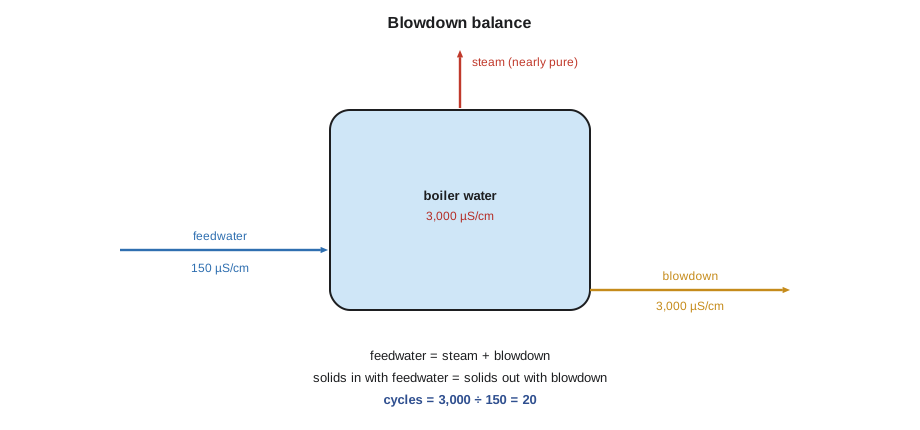
As the boiler makes steam, the dissolved solids from the feedwater stay behind. The ratio of the solids concentration in the boiler water to the concentration in the feedwater is called the cycles of concentration. A boiler running at 20 cycles holds water 20 times as concentrated as its feed. Blowdown removes concentrated boiler water and replaces it with feedwater, keeping the cycles at the level the program sets. Too little blowdown and the solids rise until they cause foaming, carryover and deposits; too much and the plant throws away hot, treated water, which wastes fuel, water and chemicals.
Continuous (surface) blowdown controls dissolved solids; its valve is set, or controlled automatically by a conductivity controller, to hold the boiler water within its range. Bottom blowdown removes sludge from the mud drum or shell bottom and is done in short bursts on a schedule (lesson 3). The basic blowdown balance is:
Worked problem
Setting the blowdown rate
Boiler 2's feedwater conductivity is 150 µS/cm and the program limit for boiler water is 3,000 µS/cm. The boiler makes 13,200 lb/h of steam. What are the target cycles, the feedwater flow and the blowdown flow? The continuous blowdown was actually running at 1,320 lb/h. How much water was being wasted?
Show solution
- Cycles:
- \[3{,}000 \div 150 = 20\]
- Feed = steam + blowdown, and blowdown = feed ÷ 20, so feed = steam × 20 ÷ 19:
- \[13{,}200 \times 20 \div 19 \approx 13{,}895 \text{ lb/h}\]
- Blowdown:
- \[13{,}895 \div 20 \approx 695 \text{ lb/h}\]
- Excess blowdown:
- \[1{,}320 - 695 = 625 \text{ lb/h}\]
Answer: Target 20 cycles, about 13,900 lb/h of feed and about 695 lb/h of blowdown. The valve was blowing about 625 lb/h too much, or about 15,000 lb a day of hot, treated water. Keziah and Lorne adjusted the continuous blowdown controller's set point to the program limit, and Tamar logged the change.
Hot water and closed systems
Closed hot water loops, like Cantwell's district hot water system, lose very little water, so they need far less make-up and almost no blowdown. They are treated once with a corrosion inhibitor, such as a nitrite, molybdate or polymer based product, kept at a set concentration, and tested regularly. A closed loop that needs a lot of make-up has a leak, and every liter of fresh make-up brings in oxygen and hardness, so loop make-up is metered and watched. Glycol loops, covered in lesson 10, need inhibited glycol, not plain antifreeze.
Taking a good water sample
A water test is only as good as the sample. Keziah showed Tamar the habits that make the plant's numbers trustworthy:
- Use the sample cooler. Boiler water is drawn through a cooling coil so that it comes out cool and does not flash to steam, which would concentrate the sample and make the conductivity read high. The cooling water is turned on before the sample valve is opened.
- Flush the line first. Let the sample run for a minute or so to clear stagnant water from the line before filling the bottle.
- Rinse the bottle with the sample water two or three times, then fill it.
- Test promptly. Sulfite in particular reacts with air, so a sample left standing reads low.
- Use fresh reagents and keep the test kit clean; record the reagent lot if the program asks for it.
- Compare with the last result. A sudden jump is more often a sampling or testing error than a real change in the boiler, so retest before making a large chemical adjustment.
Keziah also asked that each test be logged with the time and the operator's initials, beside the blowdown and chemical feed settings in force at the time. With that record, she could see from the trends whether a change in blowdown or chemical feed was having the effect she expected, instead of guessing from one month's visit to the next.
Common mistakes
MistakeSampling boiler water straight into a bottle.
InsteadUse the sample cooler and flush the line first.
MistakeIgnoring a small hardness reading at the softener outlet.
InsteadAny hardness breakthrough means regenerate or switch softeners now.
MistakeBlowing down extra to be safe.
InsteadBlow down to the program limit; excess blowdown wastes heat, water and chemicals.
MistakeClosing the continuous blowdown to save water when conductivity is high.
InsteadHigh conductivity needs more blowdown, not less.
MistakeMixing up units in water calculations.
InsteadCheck mg against g and grains against pounds; an answer that looks wrong usually is.
Summary and key terms
- Raw water contains hardness, silica, gases, dissolved and suspended solids and sometimes oil.
- Scale insulates heating surfaces, wastes fuel and lets the metal overheat; oxygen and low pH cause corrosion.
- External treatment filters, softens or demineralizes make-up water; softeners are regenerated with brine.
- Internal treatment adds oxygen scavenger, alkalinity, dispersant and condensate amine as the program sets.
- Shifts test hardness, pH, conductivity, scavenger residual and condensate, using sample coolers.
- Cycles of concentration set the blowdown; blowdown = feed ÷ cycles.
- Hardness
- Dissolved calcium and magnesium, which form scale.
- Ion exchange softener
- A resin bed that swaps hardness for sodium and is regenerated with brine.
- Oxygen scavenger
- A chemical that removes the last traces of dissolved oxygen.
- Cycles of concentration
- The ratio of boiler water solids to feedwater solids.
- Continuous blowdown
- A steady bleed of concentrated water from near the drum surface.
- Neutralizing amine
- A chemical carried with steam that raises condensate pH.
Practice problems
Work each problem on paper first, then reveal the answer to check.
What does scale do to the tube metal temperature?
Show answer
Raises it, because the scale insulates the metal from the water.
How is a sodium zeolite softener regenerated?
Show answer
With strong salt brine.
Boiler water is 2,400 µS/cm and feedwater is 120. What are the cycles?
Show answer
20.
Why is a sample cooler used?
Show answer
Hot boiler water would flash and scald, and give a false result.
What does a falling sulphite residual suggest?
Show answer
The scavenger feed has stopped or oxygen is getting in.
Lesson quiz · 5 questions
Score 60% or more to complete this lesson.
Create a free account to save your progress, take quizzes and earn a certificate.