
PWR-120 · Lesson 7 of 12 · 24 min
Starting up and shutting down a boiler
▶ Video coming soon A video version of this lesson is on the way.
On Saturday, September 19, 2026, three days after its inspection, boiler 3 was ready to come back. The water side had been cleaned, new gaskets were in the manways, and the inspector's tag was off. Lorne put Tamar on the start-up checklist and stood behind her for each line. It took most of the day shift to bring the boiler from cold to 150 psi and cut it in on the header, and that was deliberate. "Steel doesn't like surprises," Lorne said. "A cold boiler fired hard cracks, leaks at the tube ends or bangs its drum. We bring it up the way the manufacturer says, and we take our time."
This lesson follows a steam boiler from cold through filling, light-off, warm-up and cutting in on a common header, then through a normal shutdown and an emergency shutdown. It also covers water hammer, which causes many of the worst accidents in steam plants, and a brief look at laying up an idle boiler. Every plant writes its own procedure from the manufacturer's instructions, and an operator always follows the plant's procedure; this lesson explains why each step is there.
Before filling
A boiler coming back from an inspection or repair is checked before any water goes in:
- All work permits and lockouts are cleared, every person is out of the drums and furnace, and the manways and handholes are closed with new gaskets, tightened as the manufacturer specifies.
- Tools, rags and debris are removed from the furnace and gas passages; one forgotten rag can block a tube.
- The safety valves are free and their discharge pipes clear; any test gags used during a hydrostatic test are removed.
- The gauge glass, water column, try cocks and low water cutoffs are connected and their valves open.
- The blowdown valves are closed; the drum vent (air vent) is open; the main steam stop valve and the non-return valve are closed; the drains between the stop valves and on the steam line are open.
- The burner has been checked, the fuel supply is available, and the flame safeguard is reset and ready.
Filling
The boiler is filled with treated, deaerated feedwater through the normal feed line, slowly, with the drum vent open so the air inside can escape. Feedwater from the deaerator is hot, around 227 to 239 °F, and a cold boiler must not be shocked with it all at once; filling slowly lets the metal warm evenly. The boiler is filled to the start-up level the manufacturer gives, usually a little below normal operating level, because the water will swell as it heats and expands. Lorne filled boiler 3 to about a third of the gauge glass.
While filling, the operator watches the gauge glass to see the water rise, checks the manways and handholes for leaks, and confirms the low water cutoffs make (close) as the water passes them. A low water cutoff that doesn't respond while the boiler is being filled will not respond when it matters either.
Light-off and warm-up
With the boiler at its start-up level and the drum vent still open, the burner is started on low fire through the normal flame safeguard sequence (lesson 6). The heat goes first into raising the water and steel temperature; no pressure builds while the vent is open and the water is below 212 °F. The burner is kept at low fire, and on many boilers fired intermittently, so the temperature rises at the rate the manufacturer allows.
The warm-up rate matters because the boiler's parts heat at different speeds. Thin tubes in the hot gases warm quickly; the thick steam drum and its tube ends warm slowly. If the temperature rises too fast, the difference between them sets up thermal stresses that can loosen expanded tube joints, crack ligaments between tube holes, or damage refractory. Manufacturers often limit the rise in water temperature to about 100 °F per hour (typical) for drum boilers; the actual figure is in the manual.
Because the water and steam are saturated, the operator can watch the temperature rise through the pressure: a pressure gauge reading converted to saturation temperature (lesson 1) gives the water temperature. That makes the steam table a warm-up tool.
Worked problem
How long to warm up?
Boiler 3 starts at 68 °F and must reach its operating pressure of 150 psig, a saturation temperature of about 366 °F. The manufacturer limits the rise to 100 °F per hour. What is the shortest warm-up time?
Show solution
- Temperature rise:
- \[366 - 68 = 298 \text{ °F}\]
- Time:
- \[298 \div 100 \approx 3.0 \text{ h}\]
Answer: At least 3 hours of firing at a controlled rate, plus the time to fill and to cut in. Boiler 3 took about four and a half hours from light-off to cut-in, with the burner cycled at low fire for the first hour.
| Elapsed time | Drum pressure (gauge) | Water temperature (saturation) | Step |
|---|---|---|---|
| 0:00 | 0 psig (vent open) | 68 °F | Light-off at low fire |
| 1:30 | 0 psig (vent open) | 212 °F | Steam blowing steadily from the vent |
| 1:45 | 25 psig | about 267 °F | Drum vent closed |
| 2:30 | 70 psig | about 316 °F | Gauge glass and column blown down; joints checked |
| 3:15 | 145 psig | about 363 °F | Approaching header pressure |
| 4:30 | 152 psig | about 367 °F | Cut in on the header |
When steam blows steadily from the drum vent, the air has been driven out, and the vent is closed. A typical point is when the drum pressure reaches about 25 psi (typical; the manual governs). Air left in a boiler causes corrosion and, because it does not condense, it blankets heat transfer surfaces in customer equipment. As the pressure rises, the operator:
- blows down the gauge glass and water column to make sure they are working;
- checks manways, handholes, gauge glass fittings and flanges for leaks, and has them tightened if the procedure allows (gaskets are often re-tightened at a low pressure, never at full pressure);
- watches the water level, adding feed as needed once the swell has passed and steaming starts to lower the level;
- keeps the superheater drains open, on boilers that have superheaters, so steam flows through and cools the superheater tubes.
Testing the safety valves
A boiler returning from inspection often has its safety valves tested. Some jurisdictions and insurers require a lifting lever test at set intervals, and the code and manufacturers recommend that the lever only be used when the boiler pressure is at least about 75 in 100 of the valve's set pressure, so that the valve lifts cleanly and reseats tightly instead of letting dirt wire-draw its seat. The operator lifts the lever to open the valve fully, lets it blow briefly to clear the seat, and releases it so it snaps closed. A valve that doesn't open, chatters or keeps leaking after it closes is reported, and the boiler may not be run until it is repaired.
Pop testing a safety valve, raising the boiler pressure until the valve opens by itself to check its set pressure, is done only when the inspector or an authorized organization requires it, under a written procedure, with a National Board VR-certified repairer or the inspector present. Cantwell does not pop test in the plant; its valves are sent out for bench testing by a VR-certified repair shop on a set schedule.
Worked problem
When may the lever be used?
Boiler 3's safety valves are set at 200 psi. Using the 75 in 100 guide, what is the lowest boiler pressure at which the lever test should be done?
Show solution
- \[200 \times 0.75 = 150 \text{ psi}\]
Answer: 150 psi, which is Cantwell's normal operating pressure, so the test is done once the boiler is fully up to pressure.
Cutting in on the header
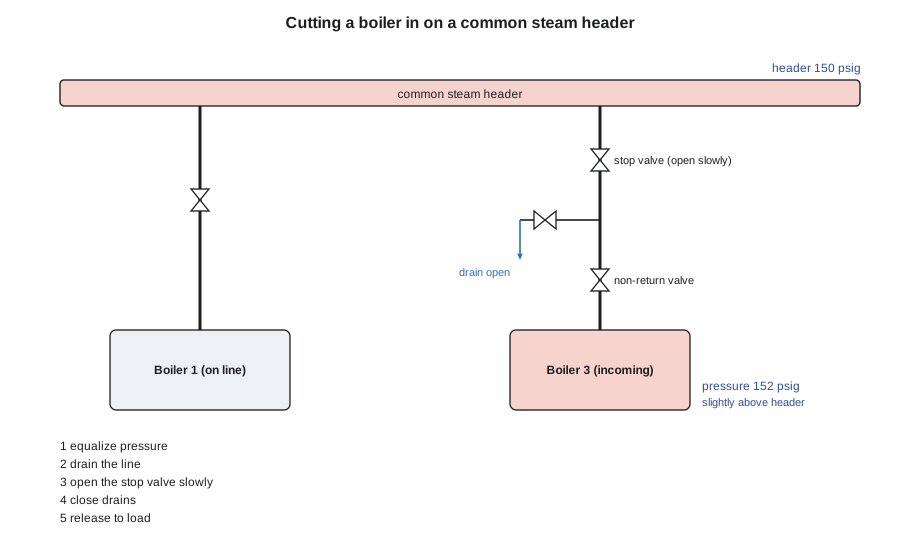
Cantwell's three steam boilers feed a common steam header. Bringing a boiler onto a live header is called cutting in, and it is one of the most hazardous routine jobs in a plant, because a mistake can send water or a pressure surge into the header. The sequence Lorne taught follows the plant's procedure:
- Bring the incoming boiler's pressure up to just above the header pressure, so steam will flow out of it, not into it.
- Make sure the steam line between the boiler and the header is warmed and drained: the drains between the stop valves are open and blowing dry steam, not water.
- Open the header stop valve slowly, if the line has one, then crack open the boiler stop valve or bypass and let the line pressure equalize.
- With a non-return valve, open the stop valve; the non-return valve will open by itself once the boiler's pressure exceeds the header's. Watch the boiler's level and pressure.
- Close the drains once the line is hot and carrying steam, then release the burner to take its share of the load gradually.
If the incoming boiler's pressure is below the header's when its stop valve is opened, header steam rushes back into it. If the line is full of condensate, the steam drives slugs of water down the pipe. Either way, the result can be a violent pressure surge or water hammer.
Water hammer
Water hammer is the shock that happens when moving water is stopped suddenly, or when steam meets a pocket of cold condensate. It comes in two common forms in steam systems. In the first, steam flowing fast pushes a slug of condensate along a pipe like a bullet; when the slug hits an elbow or a closed valve, it strikes with enormous force. In the second, condensation-induced water hammer, steam meets cold water in a pipe, condenses suddenly, and leaves a vacuum into which water rushes and collides. Both can crack valve bodies, burst fittings, split pipes and kill people nearby; steam line failures caused by water hammer are a leading cause of fatal steam accidents.
The causes are almost always the same: steam lines not properly warmed and drained before being put into service, valves opened too quickly, failed traps that let condensate collect in low points, or lines laid without enough slope to drain. The cures are the same too:
- Warm steam lines slowly with drains open, using small bypass valves where they are fitted.
- Keep drip legs and traps working; a cold trap station on a live line means a blocked or failed trap.
- Open steam valves slowly, a little at a time, and stop if you hear banging.
- Never open a steam valve into a line that may be full of condensate.
- Stand to the side of valves you are opening, not in line with the pipe, and never stand under or in front of flanges on a line being warmed.
PWR-110 lesson 5 described the same rules for returning an isolated line to service after a lockout. They apply every time steam is let into a pipe.
Normal shutdown
A boiler is taken off line when the load drops, for maintenance or for inspection. A normal shutdown runs roughly in reverse:
- Transfer the load to the other boilers gradually and reduce the firing rate of the boiler coming off.
- Stop the burner through its normal control, so the safeguard runs its post-purge. Never shut a burner off at its main power switch while it is firing, except in an emergency.
- Close the boiler stop valve once the boiler is no longer feeding the header, and open the drains between the stop valves.
- Keep the water level normal as the boiler cools; it will shrink as it cools, so add feed as needed.
- As the pressure falls close to atmospheric, open the drum vent. A cooling boiler with the vent closed will pull a vacuum as the steam condenses, which can draw air and water in through any leak, and can even damage some vessels.
- Let the boiler cool at a controlled rate. Never cool a boiler quickly by blowing it down hot or by filling it with cold water.
- Drain the boiler only when the water has cooled to the temperature the procedure allows, typically below about 120 to 140 °F (typical), and with the vent open.
A boiler that will be idle for a while is laid up. In wet lay-up, it is filled completely with treated water containing extra oxygen scavenger and kept full, ready to return to service quickly. In dry lay-up, it is drained, dried and kept dry with desiccant trays or dry air, for long outages. The water treatment supplier and the manufacturer specify the method. A boiler left half-full and open to the air corrodes fast.
Emergency shutdown
An emergency shutdown is for conditions where waiting would be dangerous: low water that can't be restored, a tube failure, a fire, a gas leak, a safety valve that won't close, or anything that puts people at risk. The operator:
- Stops the fuel first, using the burner's emergency stop or the fuel shutoff valve. Shutting off the fuel removes the heat.
- Keeps the combustion air fan running if it is safe, to purge the furnace, unless the fan is part of the problem.
- Does what the plant's emergency procedure says about the feedwater. For a boiler where the water has dropped out of sight in the glass, the rule is never to add water until the boiler has cooled (lesson 8).
- Closes the steam stop valve to protect the header and the other boilers if the problem is on this boiler.
- Calls the shift engineer and the chief, clears the area if needed, and follows the plant's emergency plan.
A clean start
By 16:30 boiler 3 was on line and carrying about a third of the plant load. Tamar walked the boiler once more, checking every manway and gauge glass fitting with a flashlight, and logged the start-up in the plant log: times, pressures, the vent closing, the safety valve lever test and the cut-in. Lorne initialed it. "Next time," he said, "you'll do it and I'll watch from the door."
Common mistakes
MistakeFiring a cold boiler hard to save time.
InsteadWarm up at the manufacturer's rate; thermal stress loosens tubes and cracks drums.
MistakeClosing the drum vent before steam blows freely.
InsteadLeave it open until the air is driven out.
MistakeOpening the stop valve when the boiler's pressure is below the header's.
InsteadBring the boiler just above header pressure first.
MistakeOpening a steam valve fast into an undrained line.
InsteadWarm and drain the line; open slowly; listen for banging.
MistakeLeaving the drum vent closed while a boiler cools.
InsteadOpen it near atmospheric pressure to prevent a vacuum.
Summary and key terms
- Before filling, permits are cleared, the boiler is closed up, fittings are checked and the vent is open.
- Fill slowly with treated feedwater to the start-up level, checking that low water cutoffs respond.
- Warm up at the manufacturer's rate; the saturation temperature from the pressure shows the water temperature.
- Close the vent when steam blows freely; lever-test safety valves only at about 75 in 100 of set pressure or more.
- Cut in by bringing the boiler just above header pressure, with the line warmed and drained, valves opened slowly.
- Water hammer is prevented by warming, draining and opening slowly; shutdowns open the vent near atmospheric pressure.
- Cutting in
- Bringing a boiler onto a live common steam header.
- Drum vent
- A valve at the top of the boiler that lets air out during filling and warm-up.
- Thermal stress
- Stress caused by parts of a structure heating or cooling at different rates.
- Water hammer
- A violent shock from moving water stopped suddenly or steam meeting cold condensate.
- Wet lay-up
- Storing an idle boiler completely full of treated water.
- Dry lay-up
- Storing an idle boiler drained and kept dry.
Practice problems
Work each problem on paper first, then reveal the answer to check.
Why is a boiler filled only to the start-up level?
Show answer
The water swells as it heats.
At about what pressure is the drum vent typically closed?
Show answer
When steam blows freely, about 25 psi (typical).
A manufacturer allows 100 °F per hour. How long to warm from 68 °F to 366 °F?
Show answer
About 3 hours.
What must be true before the stop valve of an incoming boiler is opened?
Show answer
Its pressure is just above the header's and the line is warmed and drained.
What is the first action in an emergency shutdown?
Show answer
Stop the fuel.
Lesson quiz · 5 questions
Score 60% or more to complete this lesson.
Create a free account to save your progress, take quizzes and earn a certificate.