
PWR-120 · Lesson 5 of 12 · 24 min
Fuels and combustion
▶ Video coming soon A video version of this lesson is on the way.
On Friday, October 2, 2026, the gas utility asked Cantwell to switch boiler 1 to fuel oil for four hours while it worked on a regulator station upstream. Lorne used it as a lesson. He and Tamar checked the oil tank level, started the oil pump set, watched the burner management system purge the furnace and relight on oil, and then stood at the combustion analyzer as the flue gas oxygen settled. "Two fuels, one boiler," Lorne said. "Everything the burner does is about getting the right amount of air to the fuel. Too little and you make carbon monoxide and soot. Too much and you heat the sky."
This lesson describes the fuels used in boiler plants, what happens chemically when they burn, why boilers need a little more air than the chemistry says, how operators read combustion from flue gas, and how fuel is handled safely in the plant. Lesson 6 covers the burners and flame safeguards that do the burning; GAS-230 and GAS-310 in the gasfitter program cover combustion analysis and burner tuning in more depth.
Boiler fuels
Most heating and district energy boilers in Canada and the United States burn natural gas, which is mostly methane (CH₄) with small amounts of ethane, propane, nitrogen and carbon dioxide. It burns cleanly, needs no storage on site and leaves almost no ash. Many plants keep fuel oil as a backup, so that they can keep running if the gas supply is interrupted or the utility asks large customers to switch, as Cantwell's contract allows. Light fuel oil (No. 2, similar to diesel) is the usual backup; heavier oils, which must be heated to flow and atomize, are now rare in heating plants.
Other fuels include propane, often in plants without a gas main; biomass such as wood chips and pellets, burned on grates or in fluidized beds; coal, now uncommon outside large industry; and waste heat, recovered by HRSGs. Electric boilers burn nothing at all. Each fuel needs its own handling, its own burner and its own safety rules, but the chemistry of burning is the same.
| Fuel | Typical heating value | Notes |
|---|---|---|
| Natural gas | about 1,030 Btu/ft³ | Mostly methane; delivered by pipeline; metered by volume |
| Propane | about 2,500 Btu/ft³ as gas | Heavier than air; stored as a liquid under pressure |
| Light fuel oil (No. 2) | about 138,500 Btu/US gal | Stored in tanks; atomized by the burner |
| Wood pellets | about 7,300 Btu/lb | Bulk storage and conveyors; produces ash |
The heating value of a fuel is the heat it releases when burned completely. The higher heating value (HHV) includes the latent heat recovered if the water vapor in the flue gas is condensed; the lower heating value (LHV) does not. Non-condensing boilers lose that latent heat up the stack, so they can never reach the HHV figure. North American gas bills and efficiency ratings are usually on the HHV basis.
The chemistry of burning
Combustion is the rapid chemical reaction of a fuel with oxygen, releasing heat and light. It needs three things, the combustion triangle: fuel, oxygen (from air) and enough heat to reach the fuel's ignition temperature. Remove any one and the fire goes out, which is how a flame safeguard shuts down a burner (it closes the fuel valves) and how firefighters put fires out.
The useful elements in most fuels are carbon and hydrogen. When they burn completely, carbon becomes carbon dioxide (CO₂) and hydrogen becomes water vapor (H₂O). For methane the overall reaction is:
Each volume of methane needs two volumes of oxygen. Air is only about 21 parts oxygen in 100 by volume, the rest being mostly nitrogen, which passes through the flame without taking part (though a little forms nitrogen oxides, NOx). So each volume of methane needs about 2 ÷ 0.21, or about 9.5 volumes of air. For real natural gas, with its other components, the figure is close to 9.6 (typical), as the gasfitter program's GAS-310 notes. That exact amount is the stoichiometric or theoretical air.
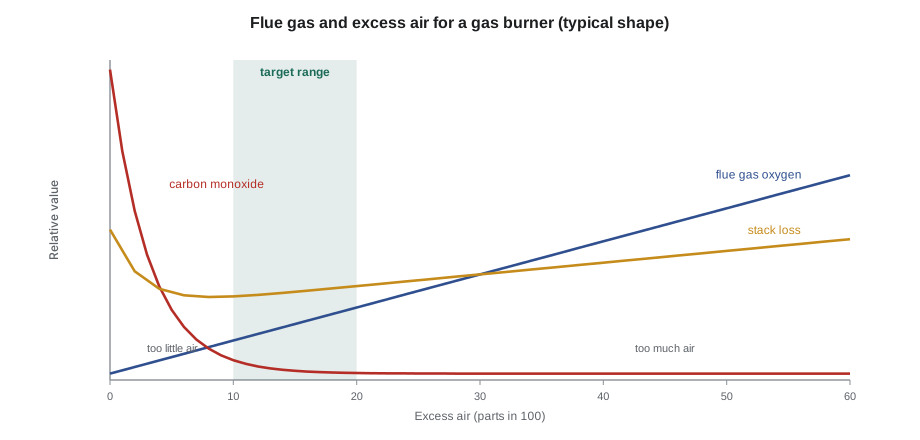
If there is not enough oxygen, some carbon burns only to carbon monoxide (CO), a poisonous gas that is also unburned fuel. Some hydrogen and carbon may not burn at all and leave as soot. Incomplete combustion wastes fuel, fouls heating surfaces and can leave unburned fuel in the furnace that may explode when air reaches it. That is why burners are always run with a little more air than theoretical.
Excess air
In a real burner, fuel and air never mix perfectly, so a burner is set to supply some excess air above the theoretical amount to make sure every molecule of fuel finds its oxygen. Typical targets are about 10 to 20 in 100 excess air for gas burners and 15 to 25 for oil (typical; the burner manufacturer's setup governs). Too little excess air risks CO and soot; too much wastes fuel, because every extra kilogram of air must be heated from room temperature to stack temperature and then thrown away.
Operators measure excess air indirectly, by measuring the oxygen left in the flue gas. With no excess air, there is almost no oxygen in the flue gas; the more excess air, the more oxygen remains. A handy approximation, good enough for checks, is:
where O₂ is the measured oxygen in the dry flue gas, in parts per 100 by volume, and the answer is excess air in parts per 100 of theoretical air.
Worked problem
Excess air from oxygen
On gas, boiler 1's analyzer read 3.0 parts oxygen in 100. On oil, after the switch, it read 4.0. What were the excess air levels?
Show solution
- On gas:
- \[3.0 \div (20.9 - 3.0) \times 100 = 3.0 \div 17.9 \times 100 \approx 17\]
- On oil:
- \[4.0 \div (20.9 - 4.0) \times 100 = 4.0 \div 16.9 \times 100 \approx 24\]
Answer: About 17 in 100 on gas and about 24 in 100 on oil, both within typical ranges for their fuels. The oil burner runs with more excess air because liquid fuel takes longer to mix and burn.
Reading the flue gas
A combustion analyzer samples the flue gas through a probe in the breeching and measures oxygen, carbon monoxide and the flue gas temperature, and calculates CO₂, excess air and combustion efficiency. Cantwell's boilers have permanent oxygen analyzers that trim the air damper continuously (oxygen trim), and the operators check them against a portable analyzer on a set schedule.
| Reading | What it tells the operator |
|---|---|
| Oxygen (O₂) | How much excess air the burner is getting |
| Carbon monoxide (CO) | Whether combustion is complete; rising CO means too little air, poor mixing or a burner problem |
| Carbon dioxide (CO₂) | Falls as excess air rises; useful for checking an analyzer |
| Stack temperature | How much heat is leaving; a rising stack temperature at the same load suggests fouled heating surfaces |
| Combustion efficiency | An estimate of the heat not lost up the stack |
A rising stack temperature at the same load and the same excess air is an early warning. It usually means soot on the gas side or scale on the water side is stopping heat from reaching the water, so more of it is going up the stack. On a watertube boiler, a sudden rise in CO with steady oxygen can mean a burner problem, while a slow rise in both CO and oxygen may mean air leaking into the furnace or the analyzer probe failing.
Worked problem
Gas use at full load
Boiler 3 delivers 27,300,000 Btu/h at full load with an efficiency of 0.82 on gas with a heating value of 1,030 Btu/ft³. How much gas does it burn per hour?
Show solution
- Fuel input:
- \[27{,}300{,}000 \div 0.82 \approx 33{,}292{,}700 \text{ Btu/h}\]
- Gas volume:
- \[33{,}292{,}700 \div 1{,}030 \approx 32{,}323 \text{ ft}^3\text{/h}\]
Answer: About 32,300 cubic feet of gas an hour. Each point of efficiency gained saves about 400 cubic feet an hour at full load, which is why operators care about excess air and clean heating surfaces.
Fuel oil handling
Fuel oil is stored in tanks, above or below ground, with secondary containment to hold spills, level gauges, vents with flame arresters, and fill connections that a delivery driver can reach safely. Oil passes through strainers and filters to the oil pump set, which delivers it to the burner at the pressure the burner needs. Light oil needs no heating except in very cold weather; heavy oils need tank heaters and line heaters to keep them fluid.
At the burner, oil must be broken into a fine mist before it can burn, a process called atomization. Pressure atomizing burners force oil through a small nozzle at high pressure; air or steam atomizing burners use a jet of compressed air or steam to shatter the oil stream. Poor atomization gives a long, smoky flame, soot and oil dripping into the furnace. Operators check oil pressure and temperature at the burner, watch for leaks and drips, and keep the oil gun clean.
In Ohio, fuel oil tanks are covered by the fire code and, for underground tanks, by the state's underground storage tank rules; oil burner installations follow NFPA 31. Spills must be contained and reported under environmental law.
Natural gas safety
Natural gas is lighter than air and rises; propane is heavier and collects in low places. Both are odorized with a sulfur compound so leaks can be smelled, but an operator never relies on smell alone, because people get used to an odor and odorant can fade. A boiler room has a main gas shutoff valve outside or near the exit, gas detectors in many plants, and ventilation. If gas is smelled, the operator does not operate switches, shuts off the gas at a safe valve if trained to, ventilates, leaves the area and calls the utility and the chief. PWR-110 lesson 7 covers the plant's emergency response.
On the burner side, the gas train between the main shutoff and the burner contains a manual shutoff, a pressure regulator, high and low gas pressure switches, two automatic safety shutoff valves in series and, on larger burners, a vent or a valve proving system. Lesson 6 explains how these work with the flame safeguard.
Combustion air and draft
A burner needs a steady supply of air. Boiler rooms have combustion air openings or ducts sized for the burners, and those openings must never be blocked; a closed louver or a pile of supplies in front of an air intake starves the burners and can cause CO and flame instability. The flue gases leave through the breeching and stack. In a natural draft system, the stack's hot column of gas creates the draft; in a forced draft system, a fan pushes air into the burner and through the boiler; in an induced draft system, a fan pulls gas out; a balanced draft system has both. Cantwell's packaged boilers use forced draft fans built into the burners, with a barometric damper on the hot water boilers' breeching.
Back to the oil test
At 14:00 the utility called to say its work was done. Lorne switched boiler 1 back to gas, the burner management system purged and relit on gas, and the oxygen settled back at 3.0. Tamar logged the oil used: the tank level had dropped by about 590 US gallons over the four hours, which she checked against the burner's firing rate. "Write the oil delivery reorder level in your notes," Lorne said. "The day the gas goes out for real, that tank is the plant."
Worked problem
Checking the oil used
Boiler 1 ran on oil for 4 hours at an average output of 17,000,000 Btu/h and an efficiency of 0.80. Light oil has a heating value of 138,500 Btu per US gallon. How many gallons should it have burned?
Show solution
- Fuel input:
- \[17{,}000{,}000 \div 0.80 = 21{,}250{,}000 \text{ Btu/h}\]
- Energy over 4 hours:
- \[21{,}250{,}000 \times 4 = 85{,}000{,}000 \text{ Btu}\]
- Oil:
- \[85{,}000{,}000 \div 138{,}500 \approx 614 \text{ US gal}\]
Answer: About 614 gallons. The tank gauge showed about 590, close enough given the gauge's resolution and the averaged load. A big gap would mean a gauge fault, a leak or a burner running richer than it should.
Common mistakes
MistakeRunning a burner with no excess air to save fuel.
InsteadToo little air makes CO and soot; set excess air to the manufacturer's range.
MistakeRunning with lots of excess air to be safe.
InsteadExtra air carries heat up the stack and wastes fuel.
MistakeRelying on smell alone to find a gas leak.
InsteadUse a detector; odorant can fade and people get used to the smell.
MistakeBlocking a combustion air opening in cold weather.
InsteadBurners need their air; a blocked opening causes CO and unstable flames.
MistakeIgnoring a slowly rising stack temperature.
InsteadIt usually means fouled heating surfaces; investigate before efficiency falls further.
Summary and key terms
- Boiler plants mostly burn natural gas, with fuel oil as a backup; each fuel needs its own handling and burner.
- Combustion needs fuel, oxygen and ignition heat; carbon burns to CO₂ and hydrogen to water vapor.
- Natural gas needs about 9.6 volumes of air per volume; burners add excess air to burn completely.
- Flue gas oxygen shows excess air; CO shows incomplete combustion; stack temperature shows fouling.
- Oil is filtered, pumped and atomized; gas trains have regulators, pressure switches and two safety shutoff valves.
- Combustion air openings must stay clear; draft is natural, forced, induced or balanced.
- Stoichiometric air
- The exact amount of air needed to burn a fuel completely.
- Excess air
- Air supplied above the stoichiometric amount, to ensure complete combustion.
- Higher heating value
- Heat released by a fuel including the latent heat of its water vapor.
- Atomization
- Breaking fuel oil into a fine mist so it can burn.
- Oxygen trim
- A control that adjusts the air damper from a flue gas oxygen measurement.
- Combustion triangle
- Fuel, oxygen and ignition heat, all needed for combustion.
Practice problems
Work each problem on paper first, then reveal the answer to check.
What are the products of complete combustion of methane?
Show answer
Carbon dioxide and water vapor.
About how many volumes of air does a volume of natural gas need?
Show answer
About 9.6.
Flue gas oxygen reads 2.0. About what is the excess air?
Show answer
About 2 ÷ 18.9 × 100, or about 11 in 100.
What does a rising stack temperature at steady load suggest?
Show answer
Fouled heating surfaces.
Why is fuel oil atomized?
Show answer
So it breaks into a fine mist that mixes with air and burns completely.
Lesson quiz · 5 questions
Score 60% or more to complete this lesson.
Create a free account to save your progress, take quizzes and earn a certificate.